Youth Development
Mastering the Game: A Coach's Guide to Age-Appropriate Training Progressions in Basketball and Netball
Unlock your players' full potential with this comprehensive guide to age-appropriate training. Discover how to build skills progressively from age 6 to 17+ and avoid common coaching pitfalls.
Building Champions for Life: The Philosophy of Age-Appropriate Training
As coaches, our passion is to unlock the potential in our athletes. We dream of seeing them execute a flawless play, sink a game-winning shot, or work together as a seamless unit. However, the path from a child first picking up a ball to a skilled, confident competitor is a long one, and it's paved with patience, not pressure. The most effective coaches understand that true development isn't about winning at all costs in junior leagues; it's about building a solid foundation of skills and a lifelong love for the game. This approach, often referred to as Long-Term Athlete Development (LTAD), prioritizes skill mastery over complex tactics, especially in the formative years [1].
Both USA Basketball and Netball Australia have developed comprehensive frameworks that guide coaches on what to teach and when. A core principle is the idea of a shifting training-to-competition ratio. In the early stages, the vast majority of time should be spent on training and skill development, with very little emphasis on formal competition. As athletes mature, this ratio gradually shifts towards more competition, but always built upon a bedrock of mastered fundamentals.
According to Breakthrough Basketball, a leading resource for coaches, "For youth players, we want to focus on the long-term development, not how many games they win when they're 11 years old. If you try to progress them too quickly, it will hurt them in the long-run. You want to have a solid foundation first" [2].
This philosophy requires a paradigm shift for many coaches. It means celebrating a perfectly executed pivot as much as a made basket and focusing on the process of learning rather than just the outcome of a game. It's about coaching the child, not just the sport.
The Developmental Roadmap: From First Steps to Elite Performance
To effectively structure training, it helps to visualize the athlete's journey as a series of stages. While every child develops at a different pace, these stages provide a valuable roadmap for coaches. The USA Basketball Player Development Curriculum outlines a clear, seven-stage progression that is highly relevant to both basketball and netball coaches [1].
| Stage | Approximate Age | Primary Focus | Training-to-Competition Ratio |
|---|---|---|---|
| 1. Active Start | 0-6 years | Fundamental movement skills through play. | N/A |
| 2. FUNdamentals | 6-9 years | Learning overall motor skills with a focus on fun. | 90:10 |
| 3. Learning to Train | 8-12 years | Building a base of sport-specific skills. | 70:30 |
| 4. Training to Train | 12-15 years | Building the aerobic "engine" and consolidating skills. | 60:40 |
| 5. Training to Compete | 14-17 years | Optimizing fitness and position-specific skills. | 50:50 |
| 6. Training to Win | 17+ years | Maximizing all aspects of performance for high-level competition. | 25:75 |
| 7. Basketball/Netball for Life | All Ages | Encouraging lifelong participation as players, coaches, or officials. | N/A |
Foundational Stage (Ages 6-9): Fun, Fundamentals, and Physical Literacy
This is the golden age for building a love of the game. Practices should be filled with energy, laughter, and game-based activities. The focus is not on winning, but on developing fundamental movement skills—the ABCs (Agility, Balance, Coordination) of athleticism. At this stage, players should be encouraged to play multiple sports to develop a broad range of motor skills.
Basketball Focus: The primary goal is to get comfortable with the ball. This includes learning to dribble with both the left and right hands, understanding the basic footwork for a lay-up (e.g., jumping off the left foot for a right-handed lay-up), and mastering the triple threat position and pivoting without traveling [2].
Netball Focus: The emphasis is on movement and ball handling. Players should learn to balance, run, jump, and land safely. Basic catching with two hands and executing simple chest and bounce passes are key skills. The Netball Skills Development Framework emphasizes building these foundational movement and ball skills before progressing [3].
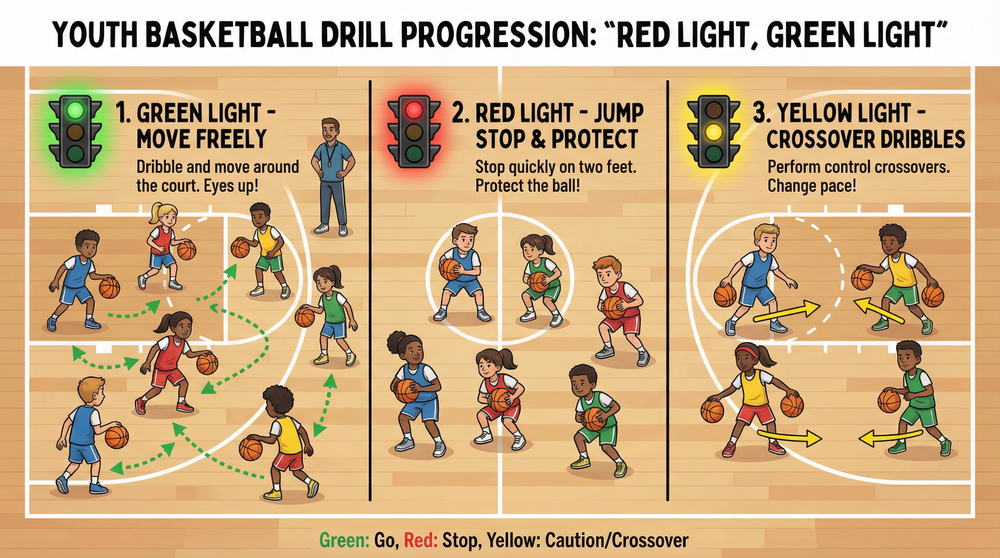
Practical Drill 1: "Red Light, Green Light" Dribbling (Basketball)
This classic childhood game is perfect for developing ball control and body awareness.
- Setup: Players spread out in a defined area, each with a basketball.
- Execution: The coach calls out commands. "Green light" means dribble and move around the space. "Red light" means come to a controlled stop (a "jump stop"), protecting the ball. "Yellow light" means dribble slowly and with control.
- Progression: Add complexity by calling out "Use your right hand only," "Use your left hand only," or "Crossover on yellow light." This keeps the drill engaging while reinforcing specific skills.

Development Stage (Ages 10-14): Learning to Train and Building the Engine
During this period, athletes are ready for more structured training and can begin to understand more complex concepts. Their capacity for learning sport-specific skills increases significantly. While fun is still crucial, practices can become more focused on technical refinement and the introduction of basic tactical elements. This is the "Training to Train" phase, where we build the aerobic engine and consolidate skills [1].
Basketball Focus: Players can now learn basic screens, more complex cuts (like the curl and back cut), and individual offensive moves like the jab step. Defensively, they can move beyond basic on-ball defense to understand team concepts like help-side defense. Introducing basic post moves like the drop step is also appropriate [2].
Netball Focus: This is the time to introduce more specific footwork for attacking and defending. Players can learn the three phases of defense (first-ball pressure, denying space, and contesting the rebound) and begin to refine their shooting technique. Simple attacking strategies, like the "give and go," can be introduced to teach the importance of movement off the ball [3].
Practical Drill 2: "Cut, Fill, and Finish" (Basketball)
This drill teaches essential offensive movement, spacing, and decision-making.
- Setup: Three players and one ball, starting at the top of the key and the two wings.
- Execution: Player 1 (top) passes to Player 2 (wing) and makes a hard basket cut. As Player 1 cuts, Player 3 "fills" the now-empty spot at the top of the key. Player 2 has the option to pass to the cutting Player 1 for a layup or pass to the filling Player 3 for a jump shot.
- Progression: Add a passive defender to put pressure on the passer and force a better decision. This drill simulates game-like movement and teaches players to read the defense.
Advanced Stage (Ages 14+): Training to Compete and Win
As athletes enter their mid-to-late teens, they become physically and mentally capable of handling higher training loads and more complex tactical instruction. The focus shifts towards optimizing performance and preparing for competition. Training becomes more position-specific, and the training-to-competition ratio begins to even out and eventually favor competition [1].
Basketball & Netball Focus: At this level, training should be high-intensity and simulate the demands of a real game. Drills should involve contested shots, decision-making under pressure, and advanced team strategies. Strength and conditioning become a critical component to prevent injury and enhance performance. Coaches should focus on refining individual skills to a high level of mastery while integrating them into sophisticated team offensive and defensive systems.
Practical Drill 3: "Advantage" 3-on-3 (Basketball & Netball)
This drill is excellent for teaching players to recognize and exploit defensive mismatches under pressure.
- Setup: A 3-on-3 game in a half-court setting.
- Execution: The game starts with the coach passing the ball to one offensive player, but as they do, one defensive player must touch the baseline before they can join the play. This creates a temporary 3-on-2 advantage for the offense.
- Objective: The offense must read the situation and score quickly before the third defender can recover. This teaches rapid decision-making, communication, and aggressive play. The defense learns to scramble, communicate, and rotate to cover the most immediate threats.

7 Common Coaching Mistakes to Avoid
Even with the best intentions, coaches can fall into traps that hinder long-term development. Based on insights from sports performance experts, here are seven common mistakes and how to fix them [4]:
- Mistake: Constantly introducing new drills. Fix: Master the fundamentals. Stick with 4-5 core exercises for several weeks to allow players to feel competent and see real progress.
- Mistake: Rushing to heavy weights too quickly. Fix: Master bodyweight first. An athlete should be able to perform 10-15 perfect bodyweight squats before adding any external load.
- Mistake: Celebrating weight lifted over proper technique. Fix: Become a technique coach. Praise perfect form and smooth movement, making it clear that mastery of movement is the real goal.
- Mistake: Skipping warm-ups and cool-downs. Fix: Make them non-negotiable. A 10-minute dynamic warm-up and a 5-10 minute cool-down are essential for injury prevention and recovery.
- Mistake: Letting athletes stand around in lines. Fix: Plan for small groups and multiple stations. Keep every player active and engaged to maximize precious practice time.
- Mistake: Talking when you should be showing. Fix: Demonstrate, demonstrate, demonstrate. Young athletes are visual learners. Use your own body or a player who is executing well to show what correct looks like.
- Mistake: Focusing only on performance gains. Fix: Make injury prevention an equal priority. Include exercises for stabilizing muscles, build in rest days, and never push an athlete who is showing signs of fatigue or pain.
Conclusion: Coaching for the Long Game
Age-appropriate training progressions are not just about teaching skills in the right order; they're about respecting the developmental journey of each athlete. By understanding the stages of development, implementing appropriate training-to-competition ratios, and avoiding common coaching pitfalls, you can create an environment where young athletes thrive. Remember, the goal is not to create champions at age 12, but to develop skilled, confident, and passionate players who will love basketball or netball for a lifetime. When you coach with patience, purpose, and a focus on the fundamentals, you're not just building better players—you're building better people.
References
[1] USA Basketball. (n.d.). USA Basketball Player Development Curriculum. Retrieved from https://www.usab.com/play/the-usa-basketball-coaching-guide-for-all-levels/usa-basketball-player-development-curriculum-introduction
[2] Haefner, J. (n.d.). Coaching Youth Basketball - What Should You Teach?. Breakthrough Basketball. Retrieved from https://www.breakthroughbasketball.com/coaching/teach-youth.html
[3] Netball Australia. (2018). Netball Skills Development Framework. Retrieved from https://netball.com.au/sites/default/files/2019-06/NetballSkillsDevelopmentFramework_UpdatedFINAL_Sept2018.pdf
[4] Athletic Republic Knoxville. (2025, September 4). 7 Mistakes You're Making With Youth Sports Training (and How To Fix Them). Retrieved from https://knoxville.athleticrepublic.com/blog/7-mistakes-youre-making-with-youth-sports-training-and-how-to-fix-them/
Tags