Basketball Skills
Defensive Footwork Drills for Beginners: The Complete Guide for Basketball and Netball Coaches
Master the building blocks of great team defence with these five practical, game-realistic footwork drills designed specifically for beginner basketball and netball players — plus expert coaching tips you can implement at your very next training session.
Defensive Footwork Drills for Beginners: The Complete Guide for Basketball and Netball Coaches
As a youth basketball or netball coach, you know that offense sells tickets, but defense wins games. However, teaching defense to beginners can often feel like an uphill battle. Young players are naturally drawn to shooting and scoring, while the gritty, fundamental work of defensive positioning is frequently overlooked. The foundation of any great defender is their footwork — and getting it right from day one sets the tone for every season that follows.
In this comprehensive guide, we explore the critical defensive footwork drills that every beginner needs to master. Whether you are coaching on the hardwood or the netball court, these practical, game-like drills will help your players stay in front of their opponents, contest shots without fouling, and ultimately build a formidable team defense.
Why Defensive Footwork Is the Foundation of Great Defence
Before diving into the drills, it is essential to understand why footwork is the bedrock of defense. In both basketball and netball, a defender's primary goal is to dictate the offensive player's movement, contest passes or shots, and secure rebounds or interceptions. None of this is possible if the defender is off-balance or out of position.
Many coaches fall into the trap of teaching what some experts call "fake fundamentals" — drills that look productive in practice but fail to transfer to game situations. The traditional zig-zag drill is a classic example: it teaches players to move to a predetermined point, which creates artificial anticipation that simply does not exist in a real game. By contrast, game-realistic footwork drills force players to read, react, and respond to live stimuli, building the instincts they will actually need on game day.
Research and coaching experience consistently show that defenders who develop strong footwork habits early are far more effective at containing dribble penetration, closing out on shooters, and contesting passes in the netball circle. The investment in footwork fundamentals during the beginner stage pays dividends for years to come.
Essential Defensive Footwork Concepts Every Beginner Must Know
Before running specific drills, ensure your players understand and can demonstrate these three core concepts. Return to them regularly — beginners will need reminders, especially when fatigue sets in.
The Universal Defensive Stance
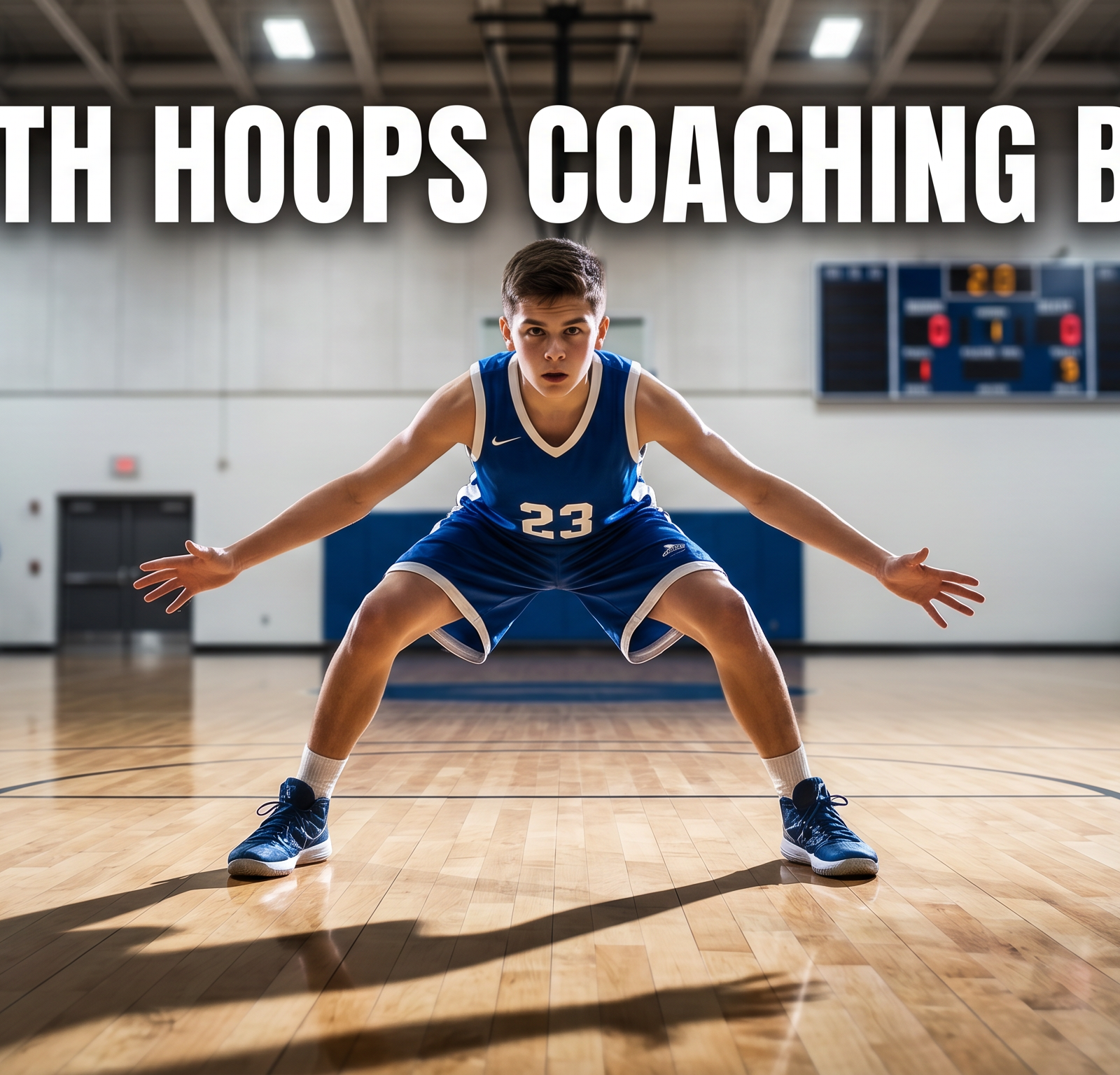
The foundation of all defensive movement is the universal stance, sometimes called the "U-Stance." A proper stance ensures a player is balanced, loaded, and ready to move in any direction at any moment.
| Key Element | What It Looks Like |
|---|---|
| Wide Base | Feet slightly wider than shoulder-width apart |
| Weight Distribution | On the balls of the feet, heels slightly raised |
| Hips | Dropped low, as if sitting into a chair |
| Chest | Leaning slightly forward, chin above the knees |
| Hands | Up and active, wider than the knees, palms facing the ball |
Coaches often use the cue "living low" to remind players to maintain this position throughout a defensive possession, not just at the start.
The Defensive Slide vs. The Crossover Step
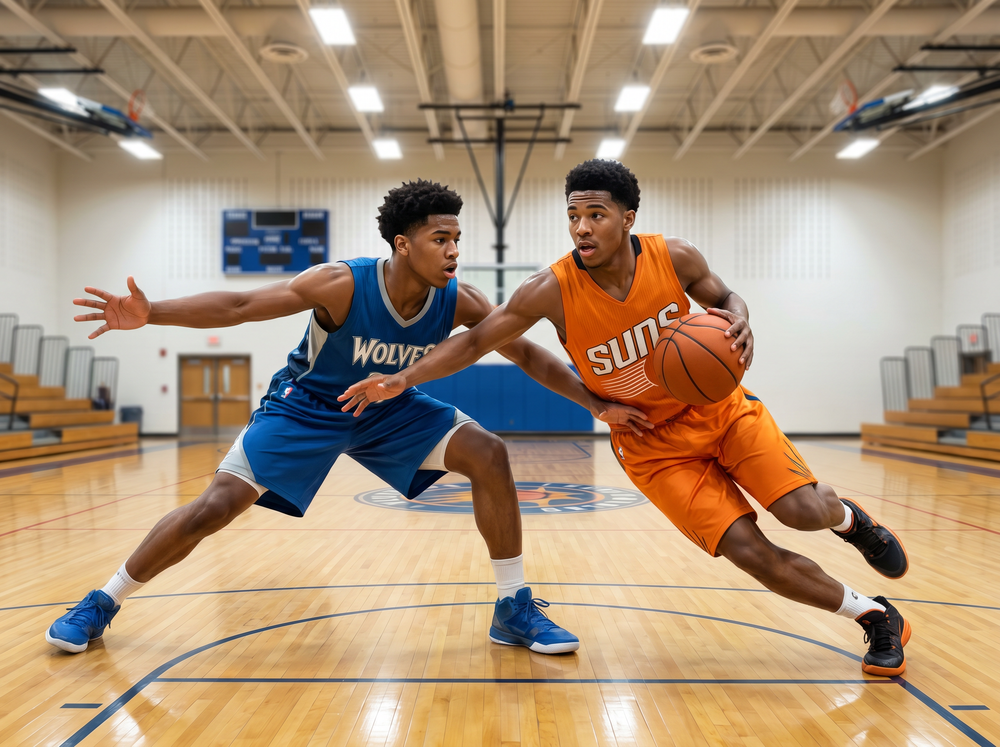
While the defensive slide (step-slide) is a fundamental movement, it is only effective when the defender is squared up to the offensive player and moving laterally at a manageable pace. If the offensive player gets an angle and accelerates, the defender must transition to a crossover step — taking a big step with the trail foot and crossing in front of the lead foot — to cover ground quickly and recover position. Teaching beginners when to use each movement is just as important as teaching the mechanics of both.
Hip Turns for Direction Changes
When an offensive player changes direction rapidly, a slow drop-step is often too sluggish and places unnecessary rotational stress on the knee joint. Instead, teach players to use a quick hip turn: a small hop that allows them to rotate their hips in the air and land in a powerful, balanced position to push off in the new direction. Watch any elite-level defender closely and you will see this movement used constantly.
Top 5 Defensive Footwork Drills for Beginners
Here are five practical, high-effort drills that will improve your team's defensive footwork, anticipation, and reaction times. Each drill is designed to be immediately usable in your next training session, requiring minimal equipment.
Drill 1: The Mirror Defense Drill
The Mirror Defense Drill is a superior alternative to the traditional zig-zag drill because it removes artificial anticipation and forces the defender to react to a live offensive player.
Setup: Pair players up. One player is the offensive leader; the other is the defender. Define a working space of roughly three to four metres wide.
How It Works: The offensive player moves laterally within the designated space, changing speed and direction unpredictably. The defender must stay in a proper defensive stance and mirror the offensive player's movements exactly, maintaining a gap of approximately one arm's length.
Coaching Tips: Emphasise keeping the chest squared to the offensive player at all times. Watch for players who begin to anticipate rather than react — if the defender is consistently getting ahead of the offensive player, instruct the offensive player to vary their movements more aggressively. Progress to allowing the offensive player to make small forward drives to force the defender to use crossover steps.
Drill 2: The 1-on-1 Closeout Drill
A poor closeout gives the offense an immediate advantage. This drill focuses on sprinting to the ball and chopping the feet to establish a balanced, controlled defensive position.
Setup: The defender starts under the basket holding a ball. The offensive player starts on the wing.
How It Works: The defender passes the ball to the offensive player and immediately sprints out to close the distance. As the defender approaches, they must chop their feet (short, rapid steps) to break their momentum, drop their hips into a defensive stance, and get at least one hand up to contest the shot. Initially, have the offense hold the ball so the defender can focus purely on the closeout mechanics. Progress to live 1-on-1 play on the catch.
Coaching Tips: Teach players to arrive with "high hands and low hips." They should close out under control, balanced enough to defend the drive in either direction. Avoid defenders who sprint all the way to the offensive player and fly past them — a poor closeout is worse than no closeout.
Drill 3: The "No Paint" Drill
This drill develops the mentality of protecting the most critical area of the court and forces defenders to use proper footwork to stop dribble penetration, rather than relying on reaching fouls.
Setup: Set up a 4-on-4 half-court scenario. Mark the paint (the key) clearly with tape if needed.
How It Works: The offense's only goal is to penetrate the paint via a dribble drive or a pass. The defense must use proper slides, crossover steps, and help-defense positioning to keep the ball out of the paint. The offense scores a point every time the ball enters the paint. Play games to three or five points, then rotate.
Coaching Tips: If you notice excessive reaching or hand-checking, penalise the defense with a point. Players must learn to stop the ball with their feet and body positioning, not their hands. This drill also naturally teaches help-defense principles, as defenders quickly learn they cannot guard the ball alone.
Drill 4: The Four-Cone Reaction Drill (Netball Focus)
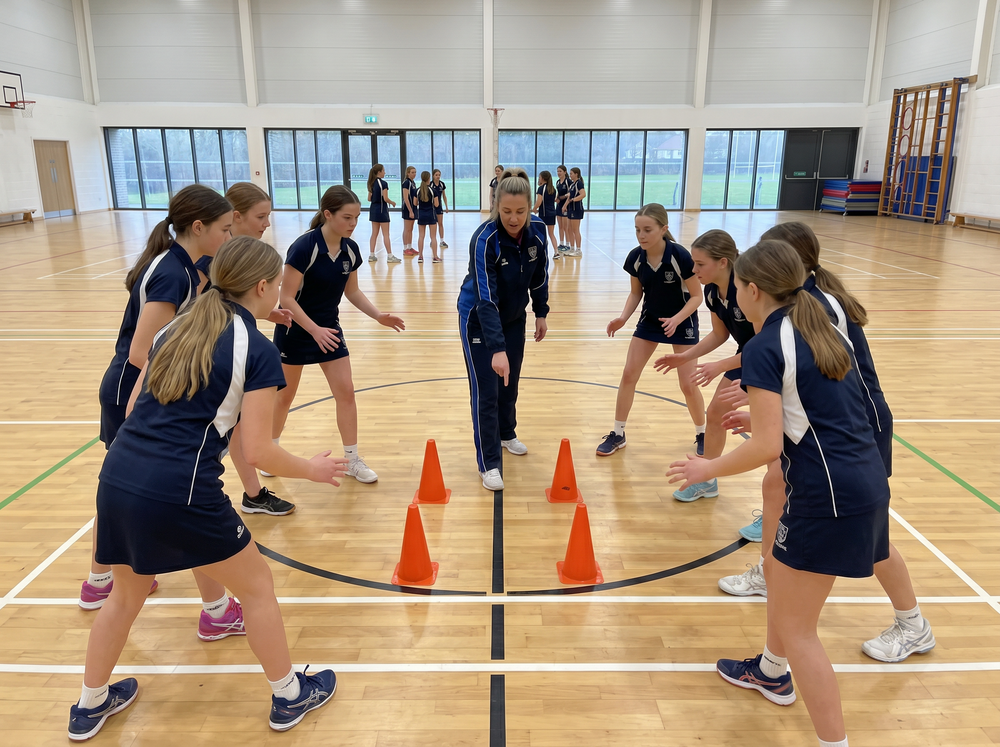
In netball, defenders must constantly adjust to rapid changes of direction within confined spaces. This drill develops quick feet, short reactionary steps, and the explosive lateral movement that is the hallmark of a great netball defender.
Setup: Set up four cones in a small square, approximately two to three metres apart. The defender starts in the centre of the square.
How It Works: The coach points to or calls out a specific cone. The defender must use quick, small steps to move to the cone, touch it, and immediately recover to the centre in a ready defensive stance. Vary the sequence and speed of the calls to keep the defender reacting rather than anticipating.
Coaching Tips: Ensure players are pushing off their outside foot when changing direction and keeping their eyes up to see the "play" rather than looking down at the cones. As players improve, reduce the recovery time between calls to increase the intensity. This drill is also excellent for building the leg strength and stamina required to maintain a low defensive stance throughout a full netball match.
Drill 5: The Defensive Movement Sequence
This drill combines multiple footwork patterns into one continuous sequence, building both technique and defensive stamina simultaneously. It is an excellent way to close out a training session.
Setup: Players start on the baseline. No equipment is required, though cones can be used as markers.
How It Works: Players complete the following sequence continuously:
- Sprint forward to the free-throw line (simulating a closeout).
- Defensive slide laterally to the sideline.
- Backpedal diagonally to the opposite block.
- Crossover step sprint back to the starting position.
Coaching Tips: Watch carefully for fatigue. When players tire, they invariably stand up out of their stance and begin to shuffle rather than slide. Demand that players "stay low" throughout the entire sequence. Use this drill as a fitness benchmark — time players and track improvement over the season to give them a tangible measure of their defensive development.
Common Mistakes to Avoid When Teaching Defensive Footwork
Even experienced coaches can inadvertently reinforce poor habits. Here are the most common pitfalls to watch for:
Crossing the feet unnecessarily is often cited as a cardinal sin in beginner coaching, but the reality is more nuanced. Crossing the feet is appropriate when the offensive player has gained an angle and is accelerating — the key is teaching players to recognise when to cross over versus when to slide.
Neglecting the stance between movements is another frequent issue. Beginners often stand upright between defensive actions, losing the athletic position they need to react quickly. Reinforce the habit of returning to the universal stance after every movement.
Over-relying on static drills limits development. While some static repetition is useful for initial learning, the majority of defensive footwork training should involve live or semi-live opponents to develop the anticipation and reaction skills that matter in games.
Managing Your Training Programme Like a Pro
Implementing these drills effectively requires organisation, session planning, and clear communication with your players and their families. Managing a youth sports team can often feel like a full-time job, taking time away from what you really want to do: coach.
This is where having the right tools makes all the difference. Vanta Sports is the premier, purpose-built ecosystem for youth basketball and netball, offering a complete suite of apps designed specifically for the needs of coaches, clubs, parents, and players.
The Vanta Coach App is completely free for volunteer coaches and allows you to plan your sessions in detail — scheduling drills like those above, tracking attendance, and communicating with your team all in one place. The Vanta Club platform handles registrations, payments (integrated with Stripe), and compliance effortlessly, so club administrators can focus on the sport rather than the spreadsheets. For families, the Vanta Guardian App keeps parents informed about schedules and payments, while the Vanta Player App lets players track their goals, achievements, and team events, building engagement and accountability from the ground up.
With built-in safeguarding and compliance tools, Vanta Sports ensures a secure and professional environment for all participants — something every youth sports organisation needs to prioritise. By streamlining the administrative side of coaching, Vanta Sports gives you back the time you need to focus on developing your players' skills on the court.
Key Takeaways for Coaches
Defensive footwork is not glamorous, but it is the single most important physical skill a beginner defender can develop. By prioritising game-realistic drills, reinforcing the universal defensive stance, and teaching players when to slide versus when to crossover, you will build a defensive culture that elevates your entire team's performance.
Start with the Mirror Defense Drill and the Closeout Drill to establish the fundamentals, then progress to the No Paint Drill and the Defensive Movement Sequence as your players grow in confidence and conditioning. For your netball players, the Four-Cone Reaction Drill is an indispensable tool for building the quick feet and reactive movement that elite defenders rely on.
Remember: great defenders are made in training, one drill at a time.
Ready to Take Your Training to the Next Level?
Discover how Vanta Sports helps coaches run better practices. Learn more about Vanta Sports
Tags