Coaching Tools
Beyond the Scoreboard: A Volunteer Coach's Guide to Tracking Player Development
Discover simple, low-cost strategies for volunteer basketball and netball coaches to track player progress, boost morale, and make data-driven decisions without needing a degree in analytics.

Beyond the Scoreboard: A Volunteer Coach's Guide to Tracking Player Development
As a volunteer coach, you're the heart and soul of youth basketball and netball. You dedicate your time, energy, and passion to helping young athletes fall in love with the game. But beyond teaching the fundamentals and managing the controlled chaos of a Saturday morning game, how do you really know if your players are improving? How do you provide meaningful feedback that goes beyond a simple "good job"?
Tracking player development is often seen as a complex, data-heavy task reserved for professional teams with a full staff of analysts. The reality is, with the right approach, any volunteer coach can implement a simple, effective system to monitor progress, motivate players, and make smarter coaching decisions. This guide will provide you with practical, low-cost strategies and drills to track player development and elevate your coaching impact.
Why Tracking Player Development is a Game-Changer
Moving beyond wins and losses to focus on individual growth offers profound benefits for both you and your team. When you systematically track progress, you unlock a new level of coaching effectiveness.
Boosts Player Morale and Motivation
Young athletes thrive on seeing progress. When a player can see tangible evidence that their hard work is paying off—that their shooting percentage has increased by 10% or they've shaved a second off their agility drill time—it's a powerful motivator. Tracking provides this concrete proof, turning abstract effort into visible achievement and fueling their desire to keep improving [1].
Enhances On-Court Performance
Vague feedback leads to vague results. Telling a player to "work on your passing" is far less effective than showing them data that their pass completion rate in drills has improved from 60% to 85% over the last month. Tracking allows you to pinpoint specific areas of weakness and provide targeted, evidence-based feedback that athletes can understand and act upon, leading to noticeable improvements in performance [2].
Builds Confidence and Eliminates Self-Doubt
Many young players struggle with self-doubt, especially when they aren't getting consistent playing time or feel they aren't a "star" player. Objective tracking can be a powerful antidote. By showing a player their individual progress—how their defensive footwork has become quicker or their ball-handling more secure—you provide them with personal wins that build confidence, regardless of their role on the team [1].
Informs Your Coaching Strategy
Data, even simple data, empowers you to be a more strategic coach. Is your team struggling with turnovers? Tracking the types of errors can reveal if the issue is poor passing, insecure dribbling, or a lack of awareness. Are your offensive sets ineffective? Player tracking might show that players aren't getting to their spots quickly enough. This information allows you to move beyond guesswork and tailor your practice plans to address the team's actual needs.
A Simple Framework: The Rule of Three
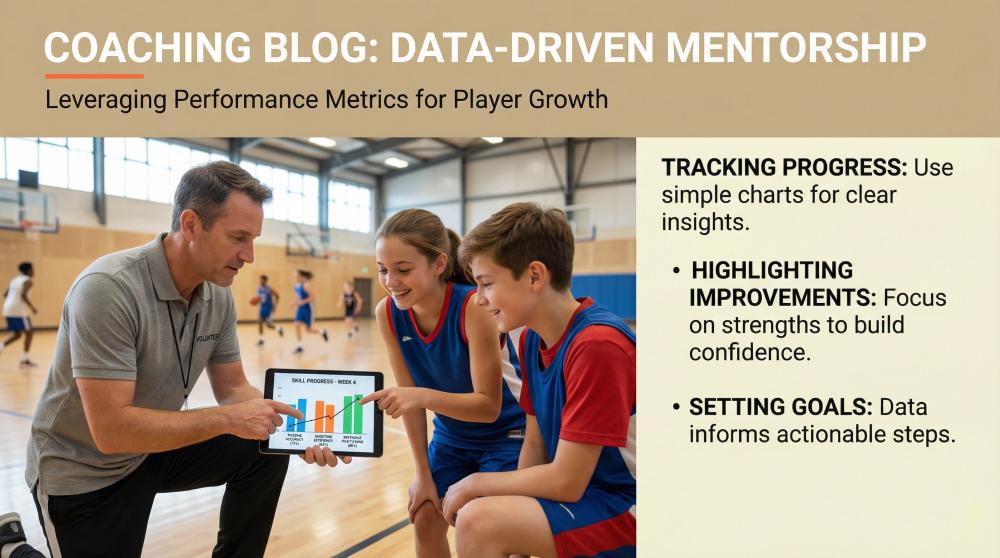
To avoid getting overwhelmed, it's helpful to break down player development into three core areas. This "Rule of Three" provides a holistic view of your athletes without requiring a mountain of paperwork [3]. For each area, aim to track just one or two key metrics to keep it manageable.
1. Technical Skill Development
This is the most obvious area of tracking and relates to the fundamental skills of the sport. These are the tangible, teachable actions that players perform during a game.
- For Basketball: Shooting percentage (from different spots), free-throw accuracy, dribbling speed and control (e.g., time to complete a cone-weaving drill), pass completion rate.
- For Netball: Goal shooting accuracy, pass completion under pressure, footwork violations (stepping, contact), number of successful intercepts.
2. Physical Performance Metrics
This category focuses on the athletic base that supports technical skills. Improvements here often lead to significant gains in on-court effectiveness.
- Metrics: Speed (e.g., timed court sprints), agility (e.g., lane agility drill time), vertical jump, and endurance. These can be measured with a simple stopwatch and measuring tape.
3. Off-Court Habits and Soft Skills
Often overlooked, these intangible qualities are crucial for long-term success and team chemistry. While harder to quantify, they can be tracked through observation and simple rating scales.
- Metrics: Coachability (do they listen and apply feedback?), teamwork (do they encourage others?), resilience (how do they react to mistakes?), and focus during practice. You can rate these on a simple 1-5 scale each month to note trends.
Practical, Low-Cost Tracking Methods
You don't need expensive software to start tracking player development. The most effective tools are often the simplest.
The Humble Clipboard: Skills Checklists and Rating Scales
A clipboard and a pen are your best friends. Create a simple spreadsheet with player names down one side and the skills you want to track across the top. During practice or small-sided games, you can make notes or use a simple rating system (e.g., 1-5) to assess each player. Do this once at the start of the season to set a baseline, and then again every 4-6 weeks to measure progress.
| Player | Shooting Form (1-5) | Defensive Stance (1-5) | Passing Accuracy (1-5) | Notes |
|---|---|---|---|---|
| Ava | 3 | 2 | 4 | Great court vision, needs to stay lower on defense. |
| Milla | 4 | 4 | 3 | Excellent on-ball defender, needs to be more decisive with passes. |
The Power of Video: Using Your Smartphone
Your smartphone is a powerful coaching tool. Record players executing a drill at the beginning of the season and again a few months later. Showing them the side-by-side comparison can be incredibly illuminating. They can visually see the improvement in their shooting form, the quickness of their first step, or their defensive positioning. This visual feedback is often more impactful than verbal coaching alone.
Timed Drills and Objective Measures
Remove subjectivity by timing drills. How long does it take a player to dribble the length of the court and make a layup? How many shots can they make from a specific spot in 60 seconds? These objective numbers are easy to track and provide clear, unbiased evidence of improvement.
3 Drills to Immediately Track Player Development
Here are three drills you can incorporate into your practices this week. They are designed to be simple, require minimal equipment, and provide clear data for tracking.
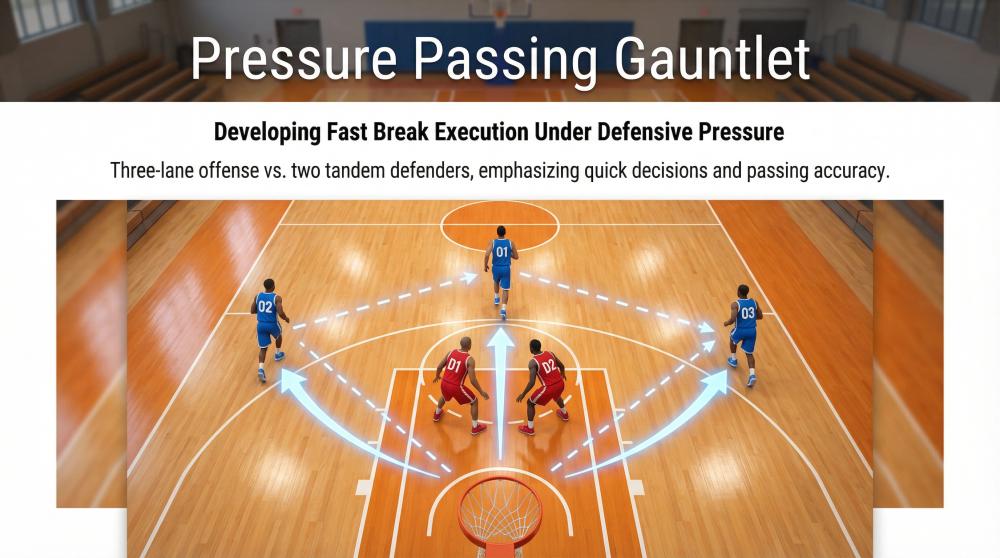
Drill 1: The "Pressure Passing" Gauntlet (Netball & Basketball)
This drill assesses decision-making, passing accuracy, and execution under pressure.
- Setup: Three offensive players line up on the baseline. Two defenders stand near the elbows of the free-throw line. The coach stands at half-court with the balls.
- Execution: The coach passes to one of the offensive players. The three attackers run a 3-on-2 fast break against the two defenders. The key rule: no dribbling allowed (for basketball) or players must pass within 3 seconds (for netball). The goal is to score without losing possession.
- Tracking: For every 10 attempts per trio, track the following:
- Number of successful scores.
- Number of turnovers (and the type: bad pass, dropped catch, offensive foul).
- Time from receiving the ball to the shot attempt.
- Coaching Points: Look for players who communicate, use sharp pivots and fakes, and make smart passing decisions.
Drill 2: "Finishing School" Shooting Series
This drill measures a player's ability to shoot accurately from various positions while fatigued.
- Setup: Players start under the hoop. Cones are placed at five spots around the key (e.g., short corner, wing, top of the key, opposite wing, opposite short corner).
- Execution: The player takes two shots from each of the five spots, for a total of 10 shots. They must rebound their own shot and run to the next spot. Time the entire sequence.
- Tracking:
- Total shots made (out of 10).
- Total time to complete the circuit.
- Calculate a "Performance Score": (Shots Made x 10) - (Total Time in Seconds). A higher score is better.
- Coaching Points: Emphasize consistent form even when tired. Track scores over the season to see improvements in both accuracy and conditioning.
Drill 3: "Defensive Footwork Frenzy" (Agility & Defense)
This drill measures agility, defensive posture, and endurance.
- Setup: Use the basketball key or a similar-sized area for netball. Players start in the middle of the key in a defensive stance.
- Execution: The coach points to one of the four corners of the key. The player must defensively slide to that corner, touch it with their hand, and slide back to the middle. The coach immediately points to another corner. Continue this for 30 seconds.
- Tracking:
- Count the number of corners the player successfully touches in 30 seconds.
- Use a 1-3 rating scale to assess their defensive form (staying low, not crossing feet).
- Coaching Points: This is a great way to quantify defensive work rate and footwork quality. Challenge players to beat their previous score.
Bringing It All Together
Tracking development doesn't have to be complicated. Start small. Pick one technical skill, one physical metric, and one soft skill to focus on for the first month. Use a simple clipboard checklist and a few timed drills. The key is consistency. Regular check-ins and feedback sessions where you share the data with your players will create a culture of development and accountability.
Most importantly, celebrate the progress. When a player sees their hard work reflected in the numbers, it builds a foundation of confidence and a love for the game that will last a lifetime.
Ready to Take Your Coaching to the Next Level?
Try the Vanta Coach App - Free for youth coaches. Learn more about Vanta Sports
References
[1] SkillShark. (n.d.). How to Measure Athlete Progress in Youth Sports. Retrieved from https://skillshark.com/blog/measure-success-in-youth-sports/
[2] Breakthrough Basketball. (2016, September 23). 15 Basketball Tryout Drills for Efficiently Evaluating Players. Retrieved from https://www.breakthroughbasketball.com/haefner/15-basketball-tryout-drills-for-efficiently-evaluating-players
[3] Sportsmith. (n.d.). Player development: Monitoring what really matters. Retrieved from https://www.sportsmith.co/articles/player-development-monitoring-what-really-matters/
Tags