The 1-4 Flat Press Break: Beating Full Court Pressure
Equip your team with a reliable, structured press break that uses spacing, misdirection, and decisive passing to dismantle aggressive full-court defense.
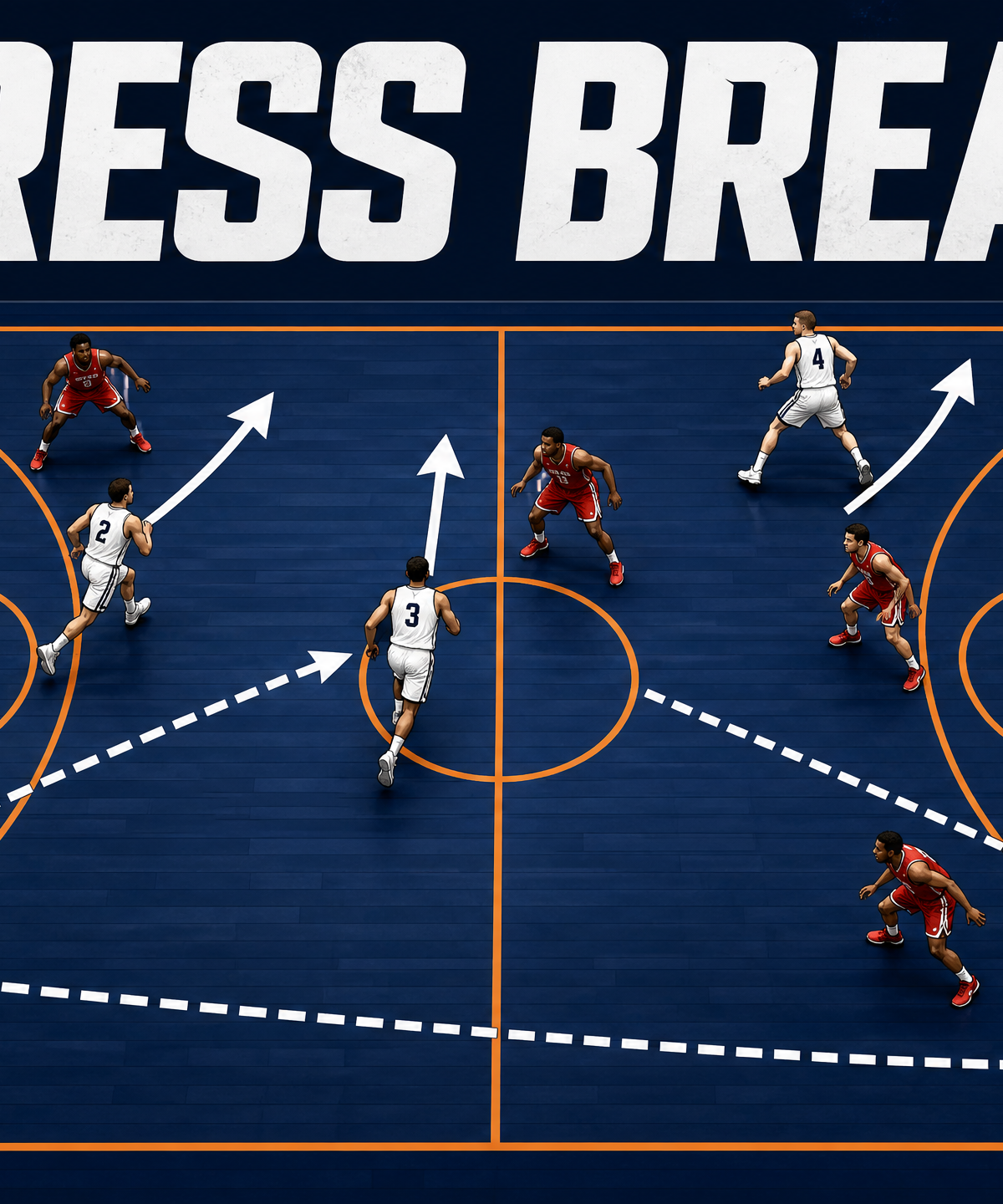
Equipment Needed
1. Overview
Full-court pressure can disrupt your team's rhythm, force turnovers, and swing the momentum of a game in seconds. The 1-4 Flat Press Break is designed to counter aggressive man-to-man or zone presses by maximizing spacing and providing multiple safe passing outlets. By aligning four players across the free-throw line extended, this set play forces the defense to spread out, opening up passing lanes and isolation opportunities.
Use this play when the opposing team is denying the inbound pass or trapping the first receiver. It is highly effective in late-game situations when securing possession is paramount.
2. Setup
- Equipment: 1 Basketball, FIBA regulation court (28m x 15m).
- Positions:
- Player 1 (Point Guard): Inbounder, starting out of bounds on the baseline.
- Player 2 (Shooting Guard): Positioned on the right sideline, free-throw line extended.
- Player 3 (Small Forward): Positioned on the left sideline, free-throw line extended.
- Player 4 (Power Forward): Positioned near the right elbow/mid-court area.
- Player 5 (Center): Positioned near the left elbow/mid-court area.
3. Step-by-Step Instructions
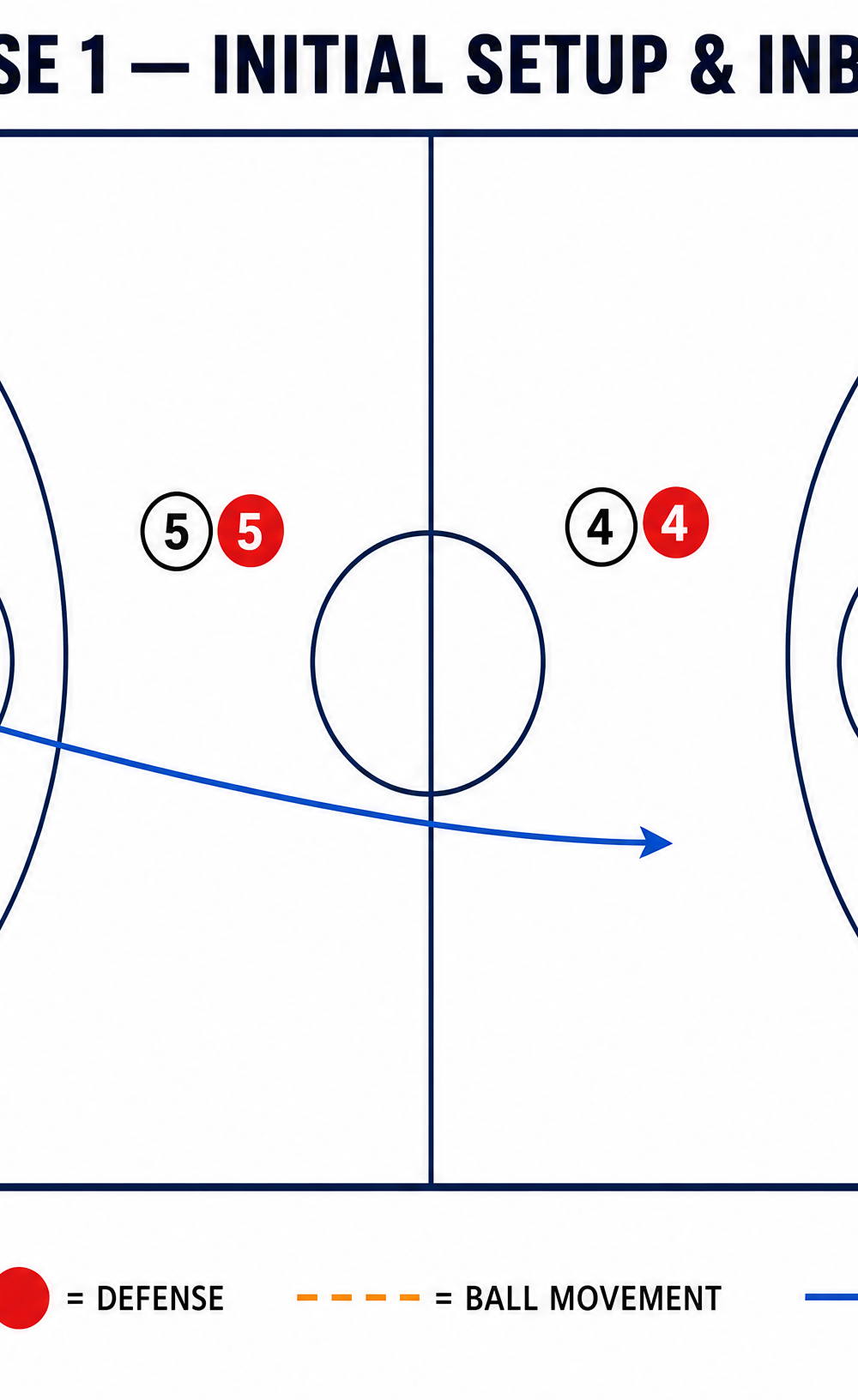
Phase 1: Initial Setup & Inbound
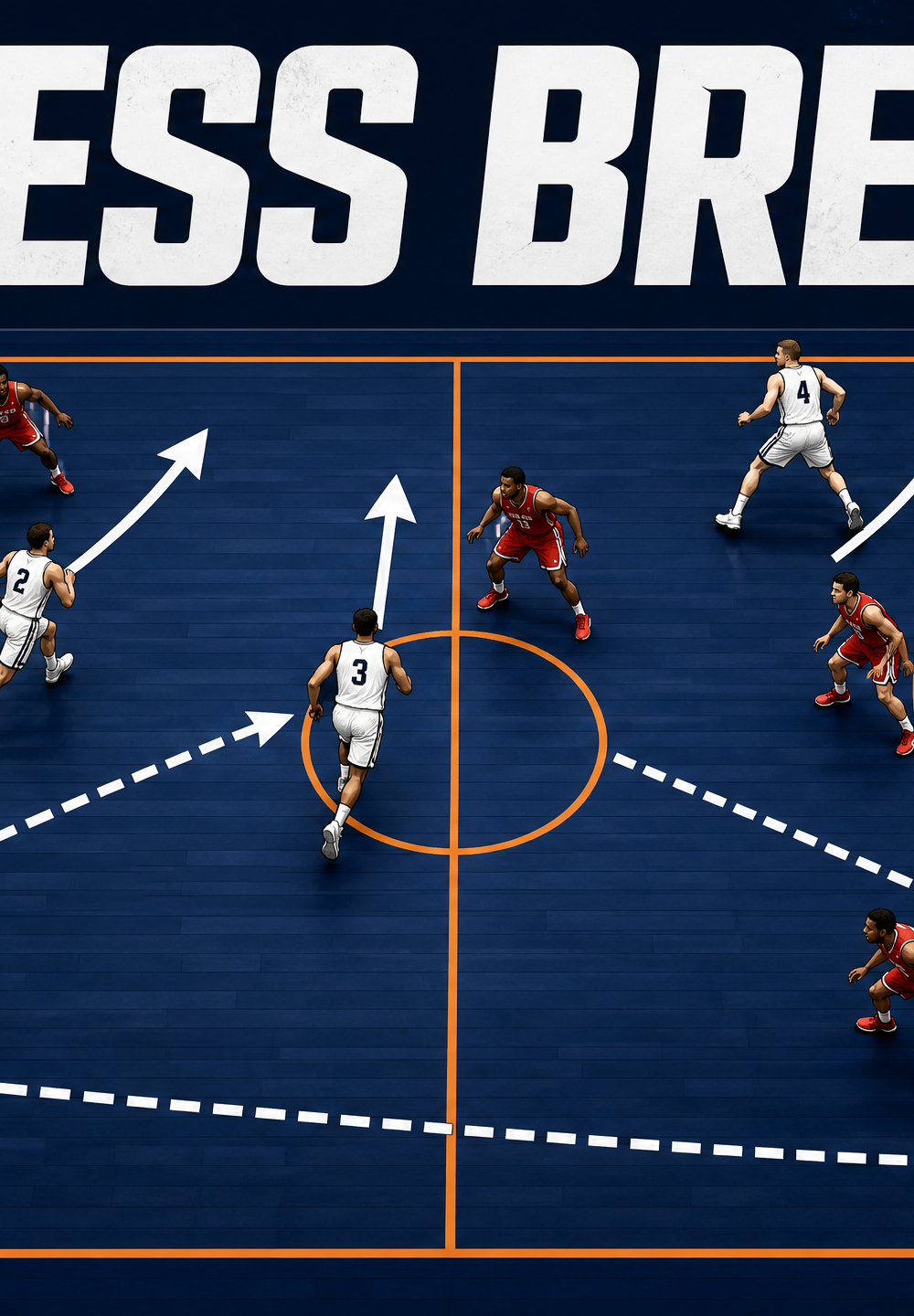
- Alignment: Players 2, 3, 4, and 5 align in a flat line across the free-throw line extended, stretching the defense.
- The V-Cut: Player 2 executes a hard V-cut, taking their defender toward the basket before popping out to the right wing to receive the inbound pass from Player 1.
- Decoy Action: Simultaneously, Player 3 cuts diagonally toward the middle to draw defensive attention away from the primary target.
- The Inbound: Player 1 makes a crisp, two-handed chest pass to Player 2.
Phase 2: Mid-Court Split & Advance
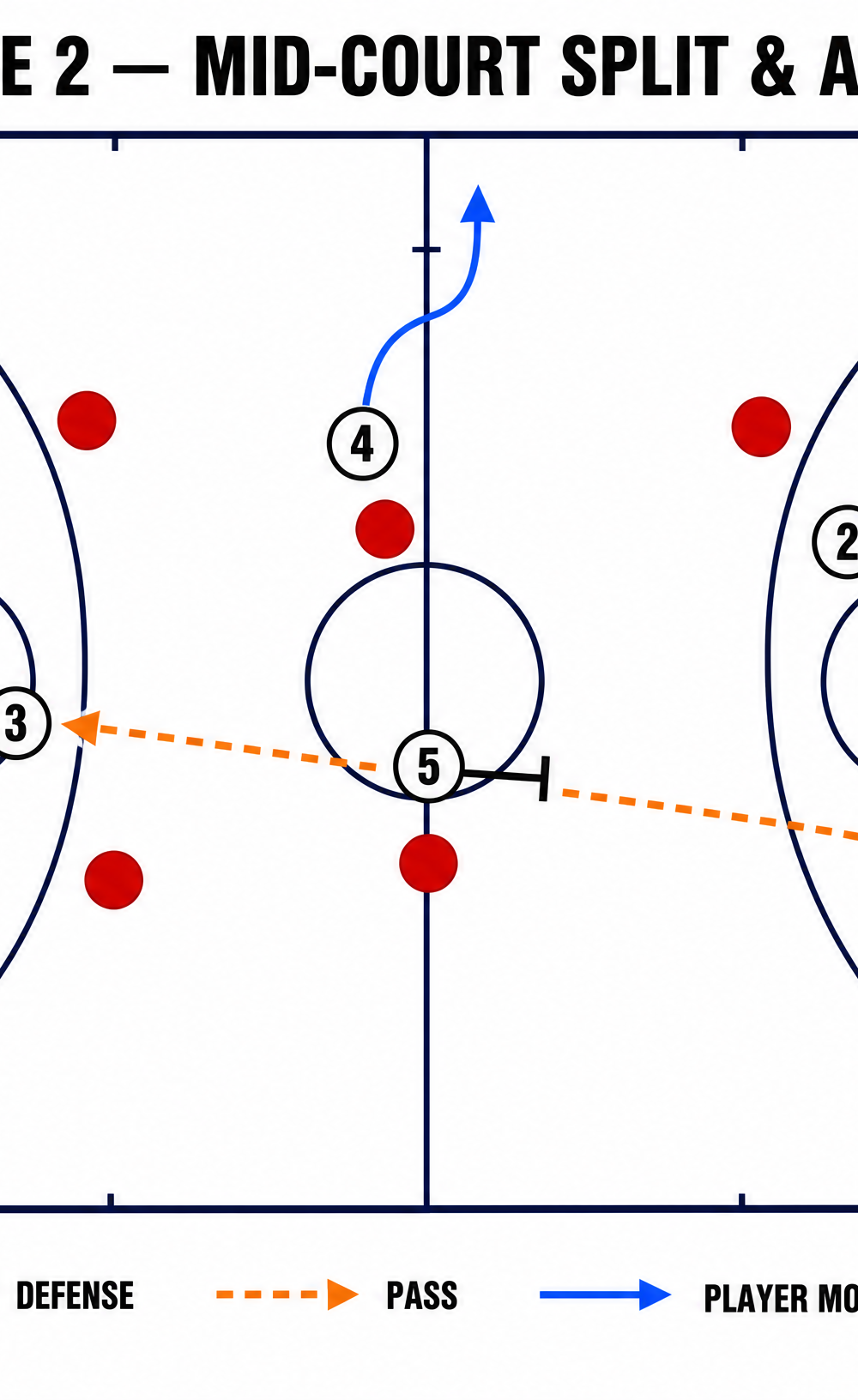
- Inbounder Entry: As soon as Player 2 secures the ball, Player 1 steps inbounds and sprints up the right sideline to provide an immediate outlet.
- Middle Flash: Player 3 continues their cut through the center circle, flashing to the middle of the court.
- The Screen: Player 5 sets a solid screen near the mid-court line to disrupt trailing defenders.
- Advancement: Player 2 passes to Player 1, who advances the ball past half-court, or to Player 3 if the middle is open.
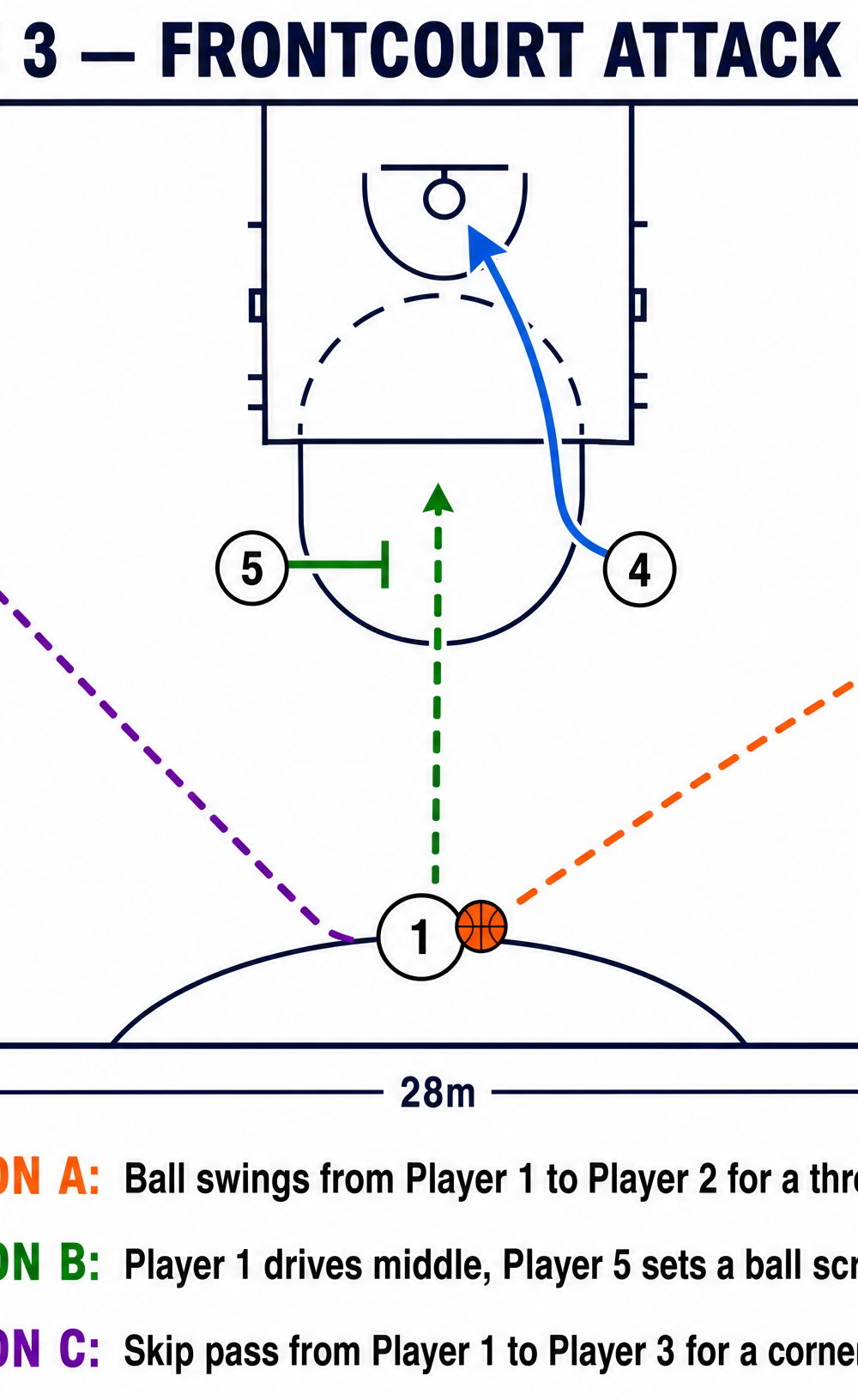
Phase 3: Frontcourt Attack Options
- Transition to Offense: Once the ball crosses half-court, the team transitions seamlessly into their half-court offense.
- Option A (Swing): Player 1 swings the ball to Player 2 on the right wing for an open three-point shot.
- Option B (Pick and Roll): Player 1 drives the middle off a ball screen set by Player 5, while Player 4 cuts to the basket.
- Option C (Skip Pass): Player 1 throws a skip pass to Player 3 in the left corner for an open shot.
4. Key Coaching Points
- Meet the Pass: Receivers must aggressively step toward the ball to prevent defenders from jumping the passing lane.
- Use Fakes: The inbounder (Player 1) must use pass fakes to shift the defense and open up the primary target.
- Stay Poised: Emphasize composure. Players should pivot, face up the court, and read the defense before dribbling.
- Spacing is Critical: Maintain the 1-4 flat alignment to stretch the defense. If players bunch up, the press becomes more effective.
5. Common Mistakes
- Panicking Under Pressure: Rushing the inbound pass or putting the ball on the floor immediately after receiving it.
- Weak Cuts: Jogging through cuts instead of sprinting, allowing defenders to easily deny the pass.
- Turning the Back: Receivers catching the ball and keeping their back to the frontcourt, limiting their vision of open teammates.
6. Variations & Progressions
- The Deep Threat: If the defense plays tight on the 1-4 line, have Player 4 or 5 sprint deep toward the opposite basket for a baseball pass.
- Dribble Entry: If the initial pass is denied, allow Player 1 to run the baseline (after a made basket) to find a better angle.
7. Age Adaptations
- Under 10/12: Focus heavily on the fundamentals of pivoting, strong passes, and meeting the ball. Simplify the mid-court actions.
- Under 14/16: Introduce the reads and secondary options (Phase 3). Emphasize the importance of the weak-side flash.
- Open/Advanced: Run the play at game speed with aggressive, trapping defense in practice to simulate late-game scenarios.