4-Out 1-In Motion Offense Continuity Play
Master a versatile 4-Out 1-In motion offense continuity that creates constant movement, spacing, and scoring opportunities through backdoor cuts and ball screens.
Equipment Needed
Overview
The 4-Out 1-In Motion Offense Continuity Play is a fundamental tactical framework designed to keep the defense constantly shifting. By utilizing four perimeter players and one post player, this offense maximizes spacing on a standard 28m x 15m FIBA court. It relies on a continuous flow of passes, cuts, and screens, ensuring that if the primary scoring option is denied, the offense seamlessly transitions into the next action without resetting. This continuity is highly effective against man-to-man defenses, forcing defenders to make split-second decisions and punishing over-aggressiveness with backdoor cuts and high-percentage shots.
Setup
Court Dimensions: Standard FIBA Court (28m x 15m)
Equipment Needed: 1 Basketball, 5 Players (game scenario), or cones to mark starting positions during walk-throughs.
Initial Player Positions:
- Player 1 (Point Guard): Top of the key, slightly offset to the side of the initial action.
- Player 2 (Shooting Guard): Right wing, extended from the free-throw line, near the three-point arc.
- Player 3 (Small Forward): Left wing, extended from the free-throw line, near the three-point arc.
- Player 4 (Power Forward): Right elbow / high post area.
- Player 5 (Center): Left elbow / high post area.
Step-by-Step Instructions
Phase 1: The Initial Entry and Backdoor Action
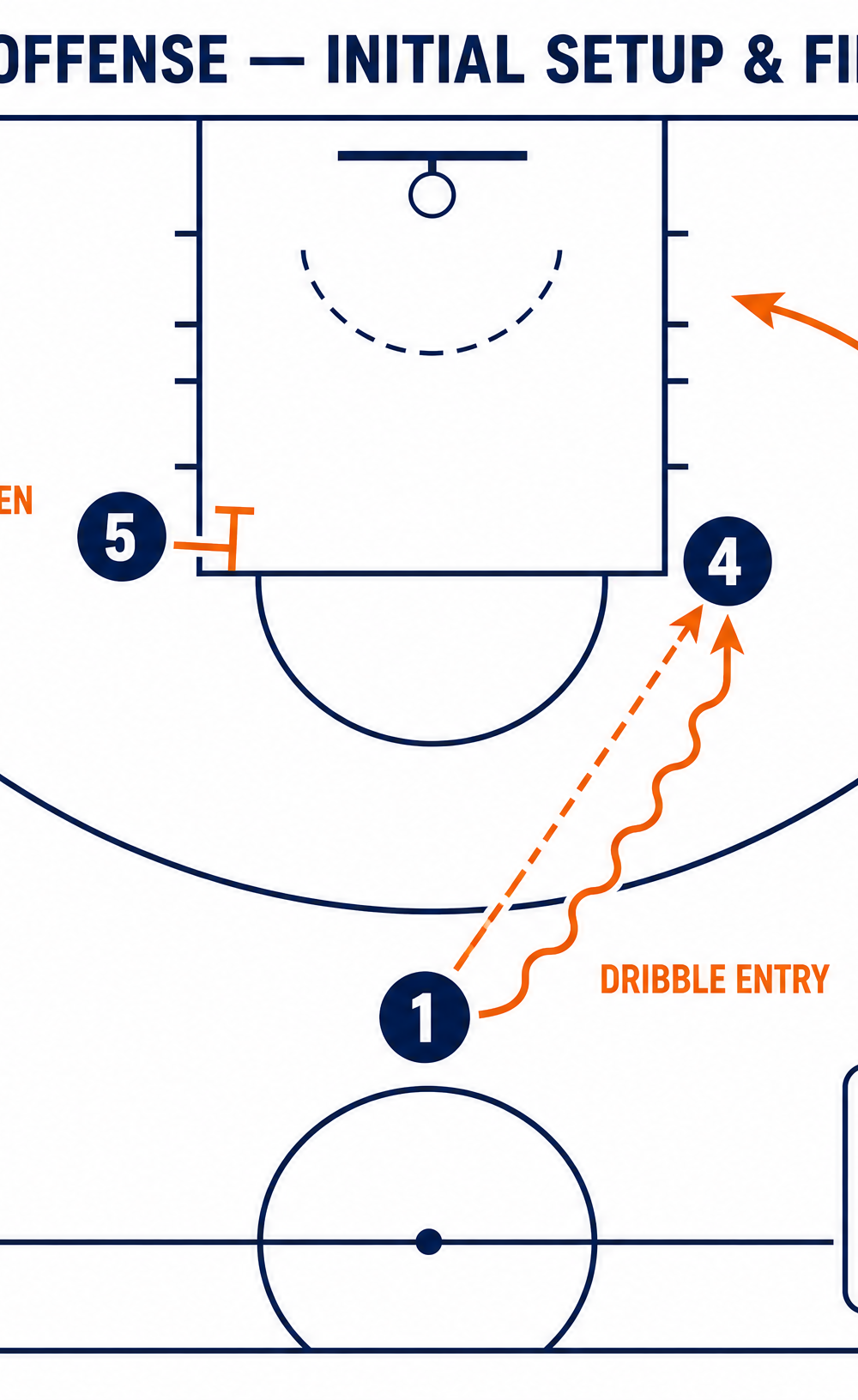
- Dribble Entry: Player 1 initiates the offense by taking a purposeful dribble toward the right side of the court, aiming at the gap between the top of the key and the wing.
- The Read: As Player 1 dribbles right, Player 2 reads their defender. If the defender is overplaying the passing lane, Player 2 immediately plants their outside foot and executes a hard backdoor cut toward the rim.
- Post Action: Simultaneously, Player 4 flashes from the right elbow toward the ball to offer a passing angle if the backdoor cut is covered.
- Weak Side Movement: Player 3 slides up from the left wing toward the top of the key to maintain spacing and prepare for a potential reversal.
- Screening: Player 5 sets a down screen or flare screen for Player 3, depending on the defensive alignment.
Phase 2: Continuity Sequence and Reset
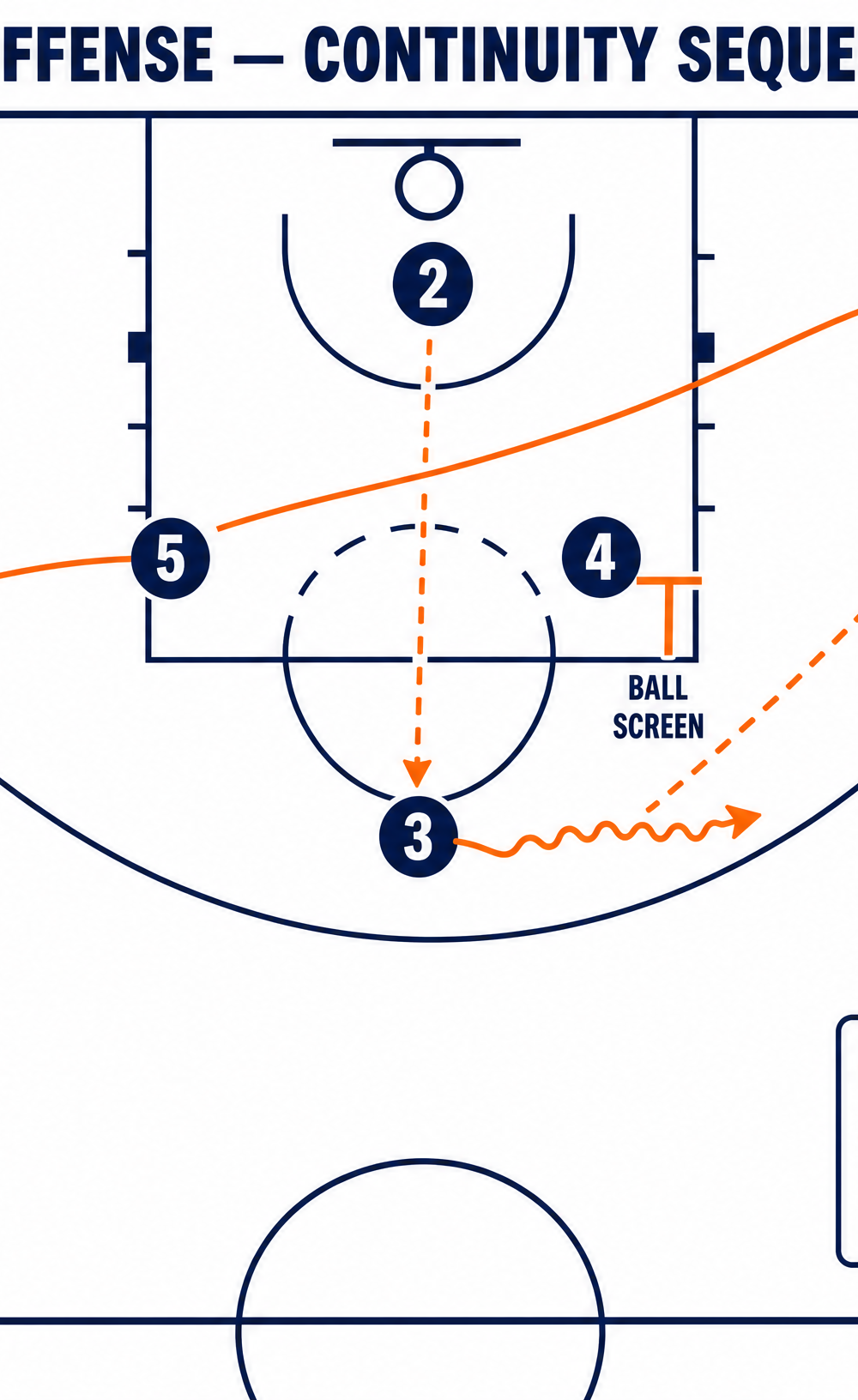
- The Reversal: If Player 2 does not receive the pass on the backdoor cut, they clear out to the weak side block or corner. Player 1 passes the ball to Player 4 at the high post, who then immediately looks to reverse the ball to Player 3 at the top of the key.
- Ball Screen Action: Once Player 3 receives the ball, Player 4 follows the pass and sets a solid ball screen for Player 3 at the top of the arc.
- Corner Fill: Player 1, after making the initial pass, cuts through the lane and fills the right corner to stretch the defense.
- Spacing and Reads: Player 5 pops out to the left wing. Player 3 now has multiple options: attack the rim off the screen, hit Player 4 rolling to the basket, or make a skip pass to Player 1 in the corner or Player 5 on the wing.
- Reset: If no immediate advantage is gained, the players are now in a new 4-Out 1-In alignment, and the continuity begins again on the opposite side.
Key Coaching Points
- Read the Defense: Players must not pre-determine their cuts. The backdoor cut by Player 2 only happens if the defender is aggressively denying the pass.
- Patience and Spacing: Emphasize the importance of maintaining 4-5 meters of spacing between perimeter players. Poor spacing clogs the driving lanes.
- Quality of Screens: Screeners (Player 4 and 5) must set wide, stationary bases. The cutter must wait for the screen to be set and rub shoulders with the screener to prevent the defender from slipping through.
- Pass Fake: Encourage the ball handler (Player 1) to use pass fakes to shift the defense before delivering the entry pass or hitting the cutter.
- Vocal Communication: Players must call out screens and cuts to ensure timing is synchronized.
Common Mistakes
- Rushing the Action: Players often move before the ball handler is ready to make the pass, ruining the timing of the backdoor cut.
- Curving Cuts: Cutters must make sharp, angular cuts (V-cuts or L-cuts). Curving the cut allows the defender to easily recover and stay between the offensive player and the basket.
- Staring Down the Target: The point guard telegraphing the pass allows weak-side defenders to anticipate and intercept the ball.
- Slipping Screens Early: The screener moving before the cutter uses the screen results in an illegal screen foul or an ineffective action.
Variations & Progressions
- Dribble Handoff (DHO) Entry: Instead of a pass, Player 1 dribbles directly at Player 2 for a dribble handoff. If the defense switches, Player 2 attacks the mismatch.
- Post Entry Variation: If Player 4 receives the ball at the elbow, Player 1 can immediately cut off Player 4 for a quick give-and-go before initiating the continuity.
- Adding a Flare Screen: On the weak side, instead of Player 3 simply sliding up, Player 5 can set a flare screen to create an open jump shot opportunity on the ball reversal.
Age Adaptations
- Under 10s / Under 12s: Focus heavily on the basic V-cut and passing fundamentals. Remove the complex weak-side screening and simply have players fill the open spots. Emphasize spacing and the concept of moving when the ball moves.
- Under 14s / Under 16s: Introduce the ball screen continuity and the reads required for the backdoor cut. Teach the post players how to read the defense when setting screens (roll vs. pop).
- Open / Advanced: Implement all reads, including flare screens, skip passes, and secondary actions off the ball screen. Focus on the speed of execution and exploiting mismatches created by defensive switches.