Death Overs Mastery: The Ultimate Bowling & Field Placement Plan
Equip your fast bowlers with a comprehensive tactical blueprint to restrict scoring, execute variations under pressure, and close out the innings effectively during the critical death overs.

Equipment Needed
1. Overview
The final overs of a limited-overs cricket match—commonly referred to as the "death overs"—are the most high-pressure moments for any bowler. Batters are looking to clear the boundary rope, and margins for error are microscopic. This set play provides a structured bowling plan and corresponding field placements designed to restrict scoring, build pressure, and induce wickets when the opposition is attacking.
This resource focuses on executing the primary weapon (the yorker) while intelligently integrating variations (slow balls and bouncers) to disrupt the batter's rhythm and timing. By setting a field that protects the boundaries while allowing the bowler to execute their specific skills, coaches can give their players the confidence to close out an innings successfully.
2. Setup
Equipment Needed
- Standard cricket balls (match quality)
- Target cones or markers (bright colours like orange or yellow)
- Stumps (full set with bails)
- Measuring tape (to mark specific lengths if required)
Pitch & Field Setup
- Use a standard 22-yard cricket pitch.
- Mark a boundary rope at approximately 65 metres radius from the centre of the pitch.
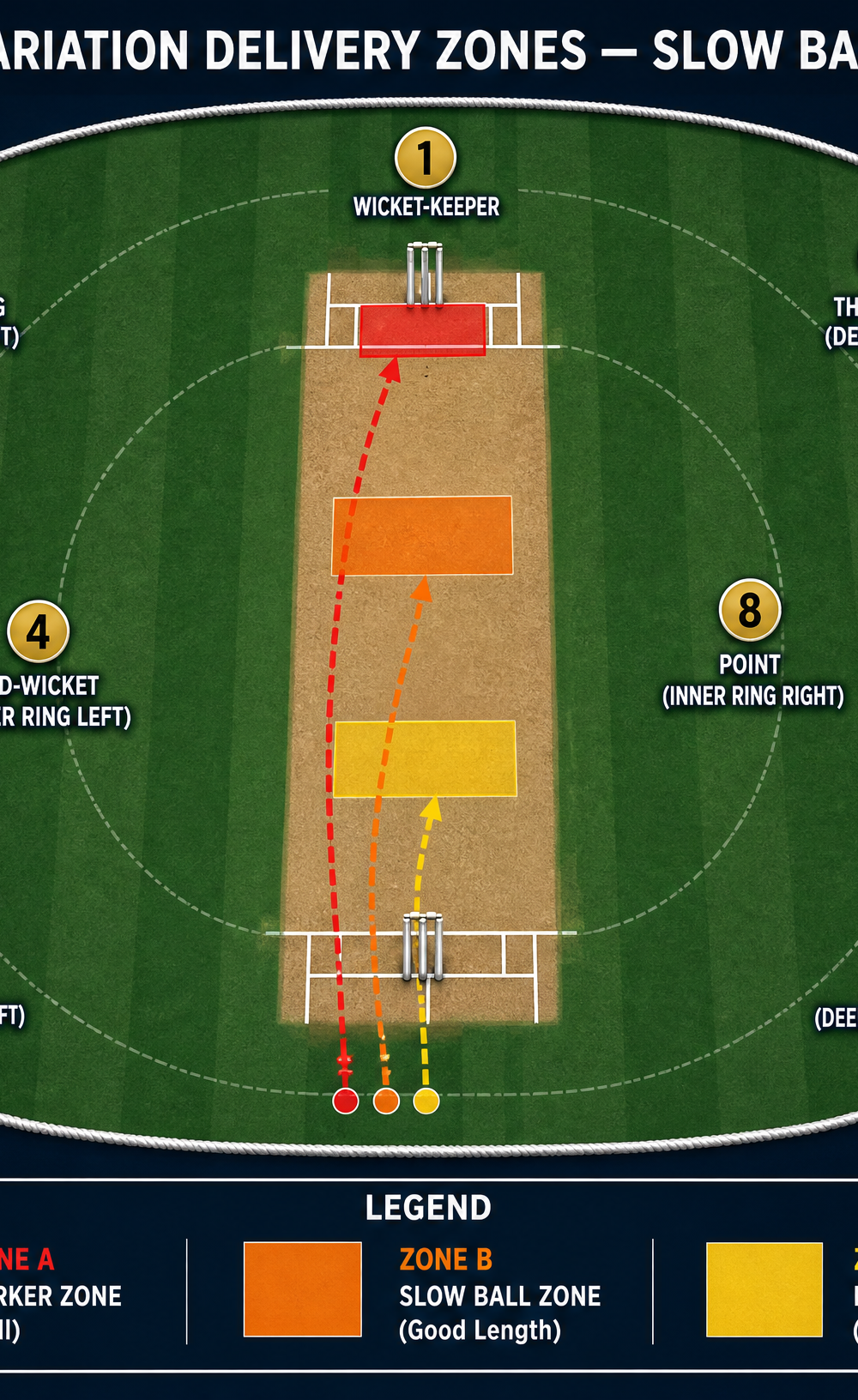
- Place two target cones at the base of the stumps at the batting end to mark the "Yorker Zone".
- Place two target cones on a good length (approx. 6-8 metres from the batter) to mark the "Slow Ball Zone".
- Place two target cones short of a length (approx. 10-12 metres from the batter) to mark the "Bouncer Zone".
Player Positions
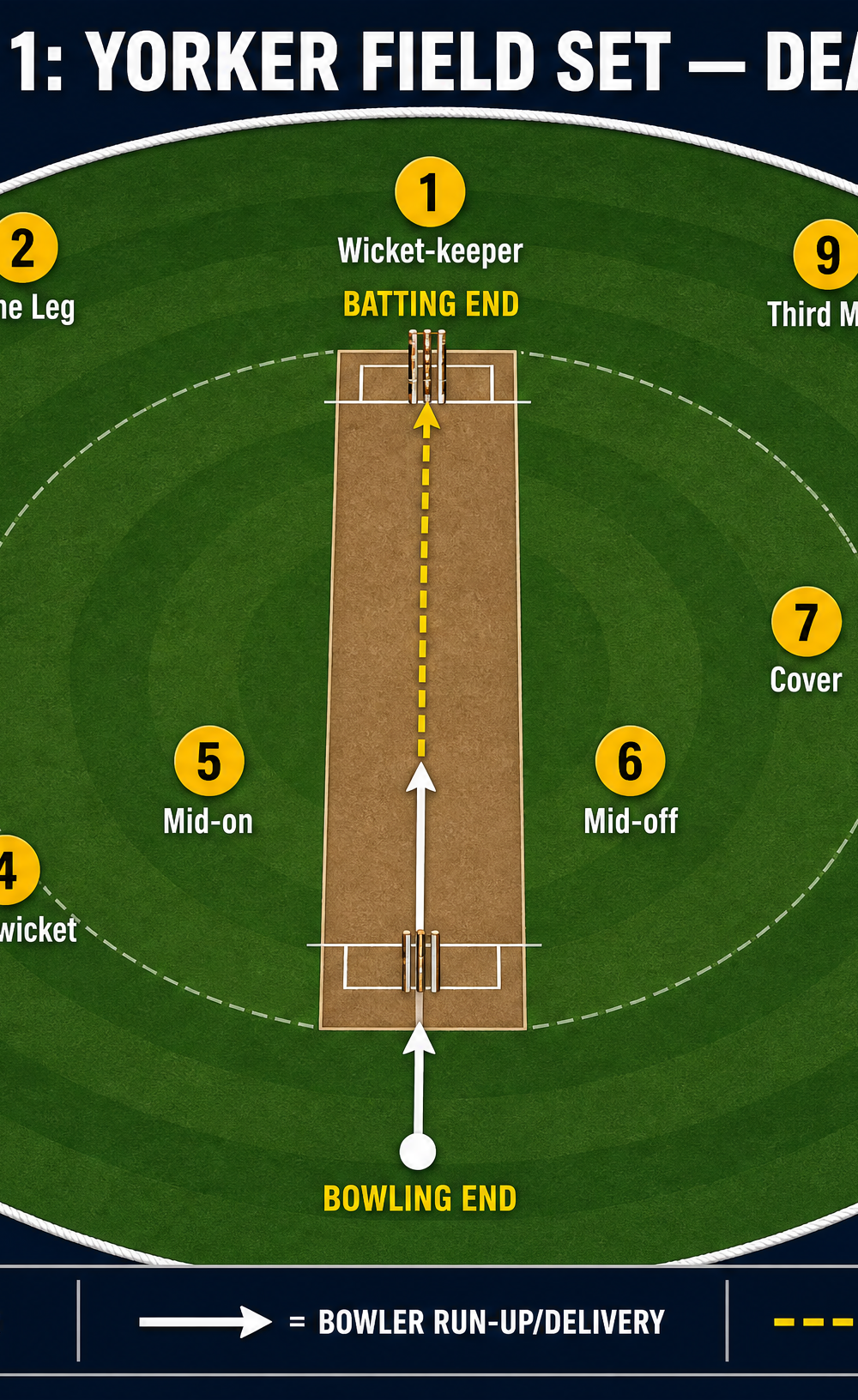
This plan utilises a standard death overs field with five fielders permitted outside the inner 30-yard circle (assuming standard T20/ODI fielding restrictions for the final overs). The core positions are:
- Wicket-keeper: Standing back for pace, ready to collect wide yorkers or bouncers.
- Fine Leg: Deep on the boundary, protecting against scoops and inside edges.
- Deep Square Leg / Mid-wicket: Deep on the boundary, protecting the leg-side slog.
- Long-on: Deep straight boundary, protecting the straight drive.
- Long-off: Deep straight boundary, protecting the off-side drive.
- Deep Cover / Point: Deep on the boundary, protecting the square off-side shot.
Note: The exact placement of the deep fielders depends on the specific batter's strengths and the bowler's intended line, but the focus is always on protecting the boundaries.
3. Step-by-Step Instructions
Step 1: Establish the Primary Weapon (The Yorker)
The foundation of death bowling is the ability to consistently bowl a yorker. The bowler must aim for the base of the stumps or slightly wide outside off-stump.

- Action: The bowler approaches the crease with a full run-up and delivers the ball aiming directly at the base of the stumps (the "Yorker Zone").
- Focus: Accuracy is paramount. The bowler must watch the target (the base of the stumps) throughout the delivery stride.
- Fielding: The field is set to protect the straight boundaries (Long-on, Long-off) and the square boundaries (Deep Square Leg, Deep Cover) in case the bowler misses their length and bowls a full toss or half-volley.
Step 2: Introduce the Variation (The Slow Ball)
Once the batter expects the yorker, the bowler must introduce a variation to disrupt their timing. The slow ball (off-cutter or back-of-the-hand) is highly effective when bowled on a good length.
- Action: The bowler uses the same arm speed and run-up as the yorker but changes the grip or release to bowl a slower delivery, aiming for the "Slow Ball Zone" (good length).
- Focus: Disguise is critical. The batter must believe a fast ball is coming until the moment of release.
- Fielding: The field remains largely the same, but fielders inside the circle (e.g., Mid-wicket, Point) must be alert for mistimed shots or leading edges.
Step 3: Apply the Pressure Ball (The Bouncer)
The bouncer is used as a shock tactic to force the batter onto the back foot and prevent them from constantly lunging forward for the yorker.
- Action: The bowler delivers a fast, short-pitched delivery aimed at the batter's chest or head height (the "Bouncer Zone").
- Focus: The bouncer must be fast and well-directed. A slow or poorly directed bouncer is easily dispatched.
- Fielding: The Wicket-keeper must be ready to jump and collect high balls. Fine Leg and Deep Square Leg are crucial for catching top edges.
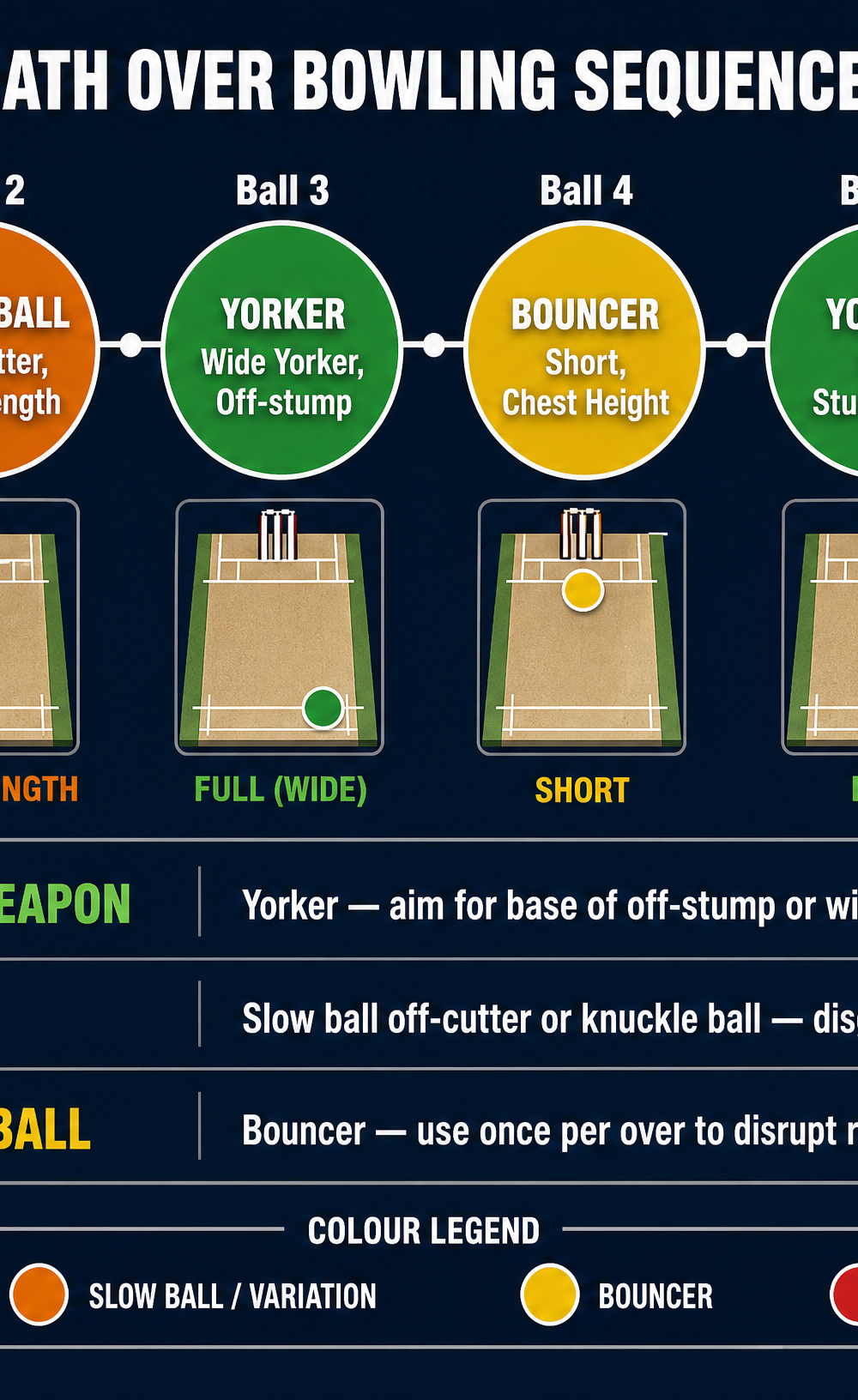
Step 4: Execute the Over Plan
A successful death over is about stringing these deliveries together unpredictably. The bowler should never bowl the same ball twice in a row unless they have completely deceived the batter.
- Action: The bowler executes a planned sequence of deliveries (e.g., Yorker, Slow Ball, Wide Yorker, Bouncer, Yorker, Variation). This sequence should be discussed with the captain and wicket-keeper beforehand.
- Focus: The bowler must commit 100% to each delivery. Hesitation leads to poor execution.
4. Key Coaching Points
- Commitment to the Plan: The bowler must fully commit to the chosen delivery. If they decide to bowl a yorker, they must bowl it with maximum effort and focus. Half-hearted deliveries are heavily punished in the death overs.
- Visualise the Target: Encourage bowlers to pick a specific spot on the pitch or the base of the stumps and focus intently on it during their run-up.
- Disguise the Variations: The effectiveness of a slow ball relies entirely on the batter not expecting it. Bowlers must maintain their standard arm speed and run-up intensity.
- Field Placement Alignment: The field must match the bowling plan. If the bowler is aiming for wide yorkers outside off-stump, the field must be heavily stacked on the off-side to protect the boundary.
- Maintain Composure: Death bowling is mentally taxing. Teach bowlers to take a deep breath, reset their focus, and not panic if they are hit for a boundary.
5. Common Mistakes
- Missing the Length (The "Slot"): The most common and costly mistake is aiming for a yorker but bowling a half-volley (in the "slot"), which is easily hit for six. Bowlers must err on the side of bowling a full toss rather than a half-volley.
- Telegraphing the Slow Ball: Slowing down the run-up or arm action before delivering a slow ball immediately alerts the batter.
- Predictability: Bowling three yorkers in a row allows the batter to anticipate the length and adjust their stance (e.g., moving deep in the crease).
- Ignoring the Field: Bowling down the leg side when the field is set for off-side wide yorkers is a tactical error that often results in easy runs.
6. Variations & Progressions
- Progression 1: Target Practice Under Fatigue: Have bowlers run a quick 20-metre sprint before bowling each delivery to simulate the physical fatigue experienced at the end of an innings.
- Progression 2: Batter Match-Ups: Introduce a live batter into the drill. The bowler must adjust their plan based on the batter's movements (e.g., if the batter steps away to the leg side, the bowler must follow them with a wide yorker).
- Variation 1: The Wide Yorker Focus: Adjust the target cones to focus entirely on bowling wide yorkers outside the off-stump line, teaching bowlers to use the width of the crease.
- Variation 2: Slower Ball Bouncer: Introduce the slower ball bouncer as an advanced variation, combining the disguise of a slow ball with the surprise of a short length.
7. Age Adaptations
- Under 10 / Under 12: Focus entirely on bowling straight and hitting a good length. Do not introduce complex variations or bouncers. The goal is consistency and basic accuracy.
- Under 14: Introduce the concept of the yorker and basic field placements. Begin practicing one simple variation (e.g., an off-cutter).
- Under 16: Full implementation of the death overs plan. Bowlers should be practicing yorkers, slow balls, and bouncers regularly, and understanding how to set their own fields.
- Open / Senior: Focus on executing under extreme pressure, advanced variations (knuckleballs, wide yorkers), and sophisticated field adjustments based on the batter's stance and movement.