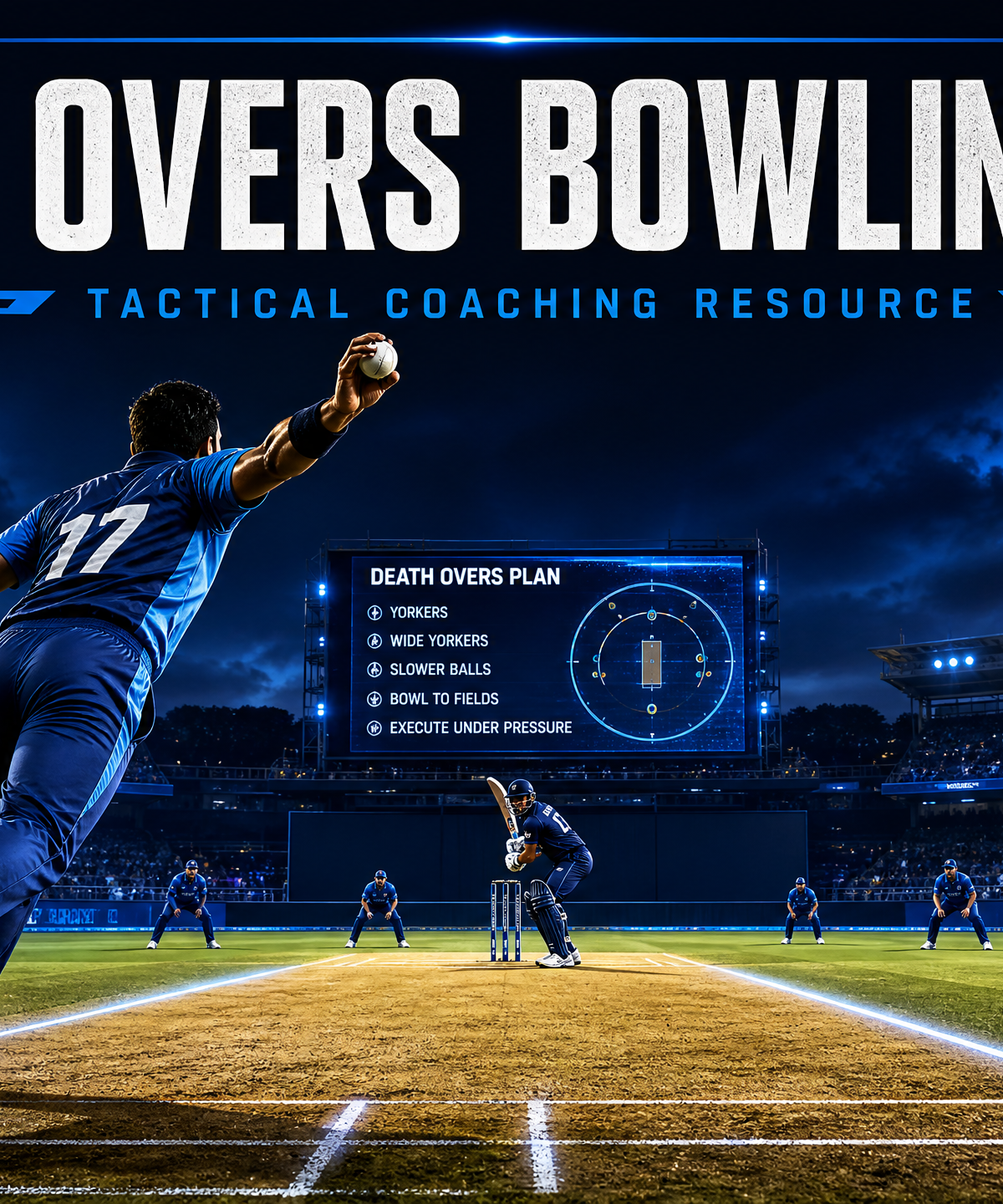
Mastering the Death Overs: The Yorker & Slower Ball Blueprint
Equip your bowlers with a tactical framework to execute yorkers and deceptive slower balls under extreme pressure in the final overs.
Equipment Needed
1. Overview
The 'death overs' (typically the final 4-5 overs of a T20 or ODI innings) are where matches are won and lost. Batsmen are looking to clear the boundary off every delivery, making predictability a bowler's worst enemy. This set play provides a structured blueprint for bowlers to restrict scoring, build pressure, and take crucial wickets by mastering two non-negotiable deliveries: the yorker and the deceptive slower ball. By combining pinpoint execution with strategic field placements, coaches can give their bowlers a distinct psychological and tactical advantage when the game is on the line.
2. Setup
Equipment Needed:
- 1x standard cricket ball (match condition, preferably slightly older to simulate death overs).
- 6x marker cones (to define target zones on the pitch).
- 1x set of stumps at both ends.
Pitch & Field Setup:
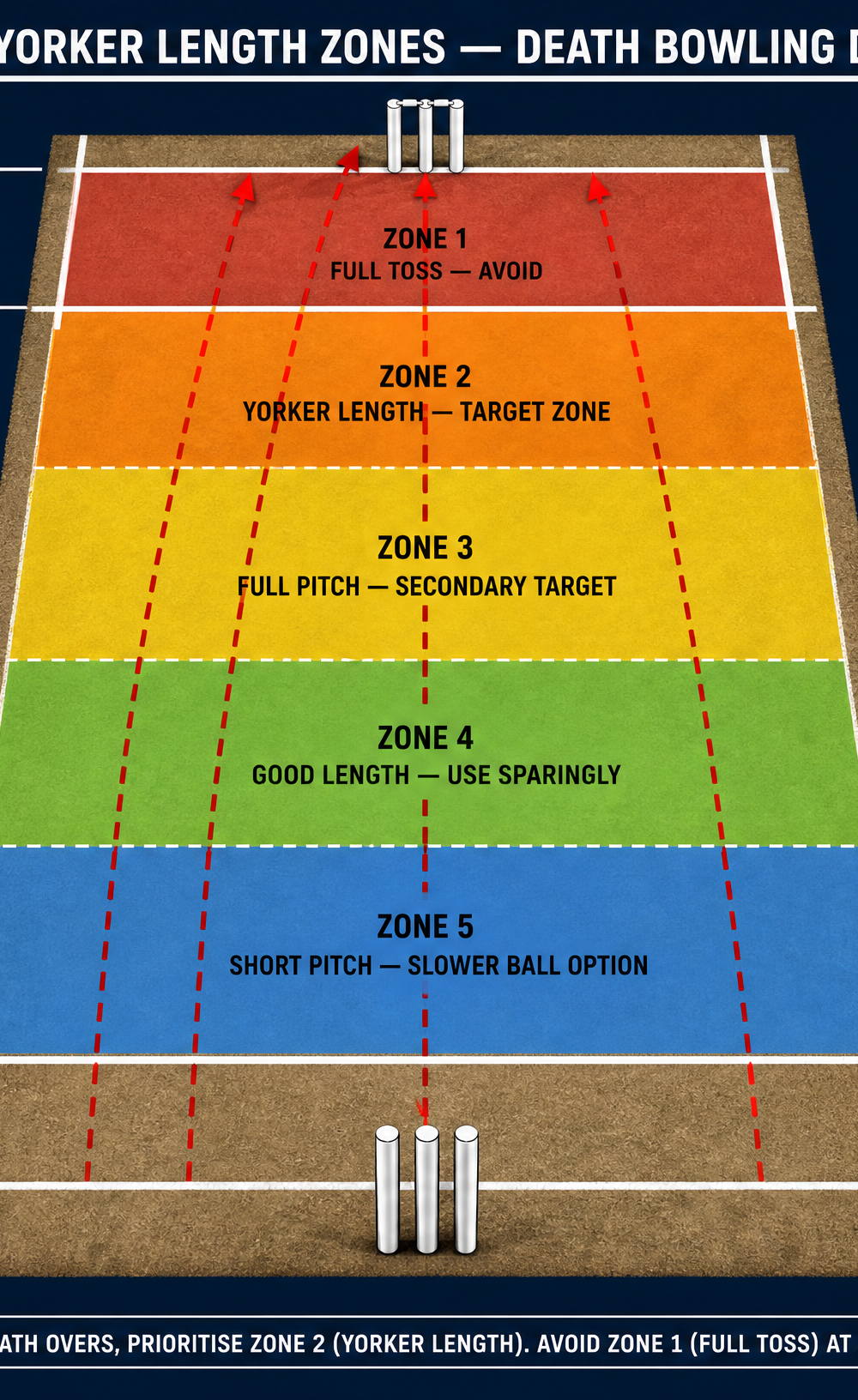
Set up a standard 22-yard pitch. Place marker cones to highlight the 'Yorker Zone' (Zone 2 in the diagram below) – specifically the area right at the popping crease.
Player Positions:
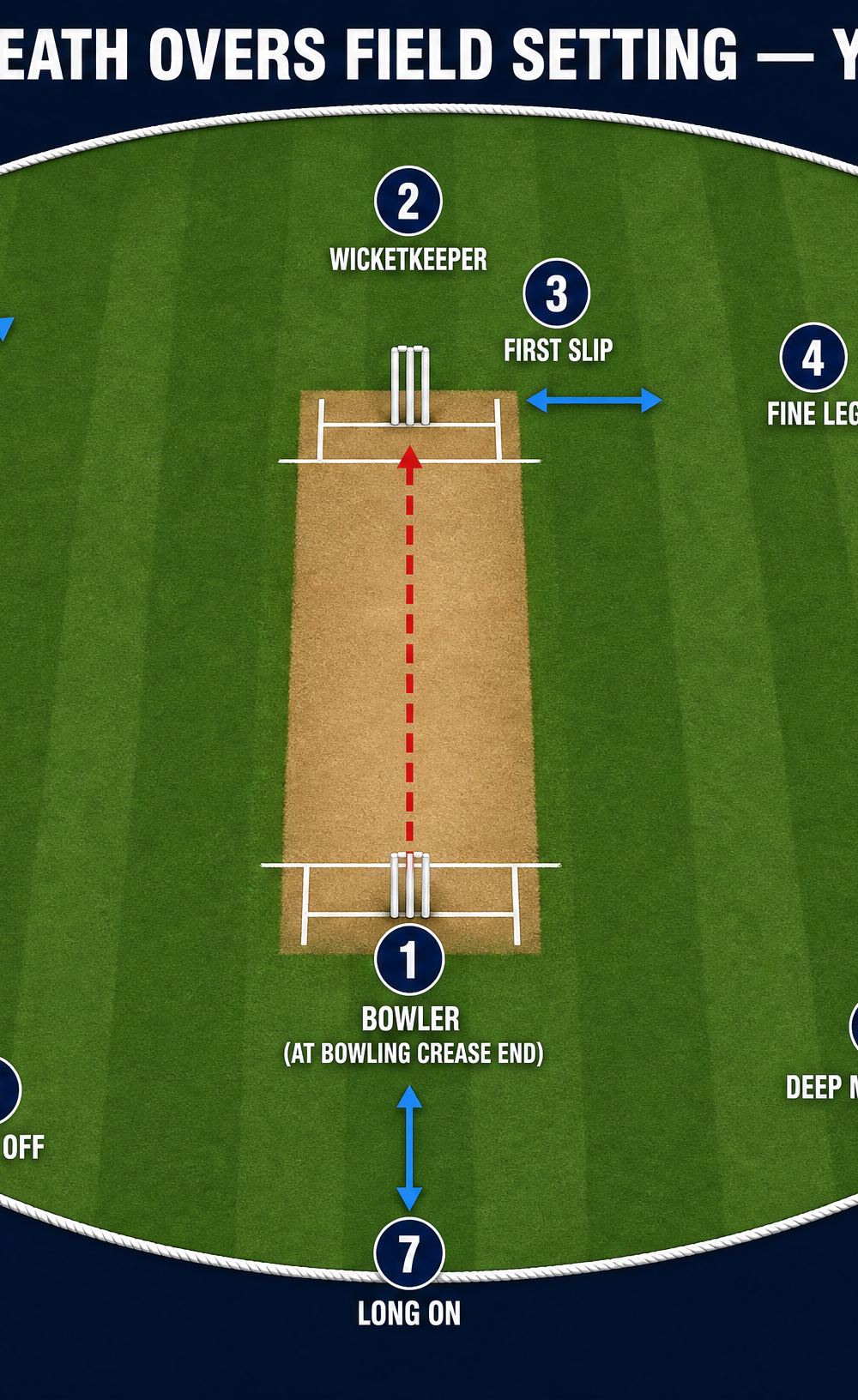
Ensure you have a full complement of fielders (or cones representing them) to simulate match conditions. The core field setting requires:
- 1 Bowler
- 2 Wicketkeeper
- 3 First Slip (optional, often removed in death overs for an extra boundary rider)
- 4 Fine Leg (Deep)
- 5 Deep Square Leg
- 6 Deep Mid-Wicket
- 7 Long On
- 8 Long Off
- 9 Deep Cover
- 10 Third Man

3. Step-by-Step Instructions
Step 1: Establish the Yorker Base
The foundation of death bowling is the ability to hit the yorker length consistently. Bowlers must aim for the batsman's toes or the base of the stumps. The primary target is 'Zone 2'.
Step 2: Set the Field to the Bowling Plan
If the plan is to bowl straight yorkers, protect the straight boundaries (Long On, Long Off) and the leg side (Deep Mid-Wicket, Deep Square Leg). If bowling wide yorkers, shift protection to Deep Cover and Sweeper Cover.
Step 3: Introduce the Slower Ball Variation
Once the batsman expects the yorker and begins to sit deep in the crease, introduce the slower ball. This should be bowled back of a length (Zone 5) to force the batsman to generate their own power.
Step 4: Execute the Sequence
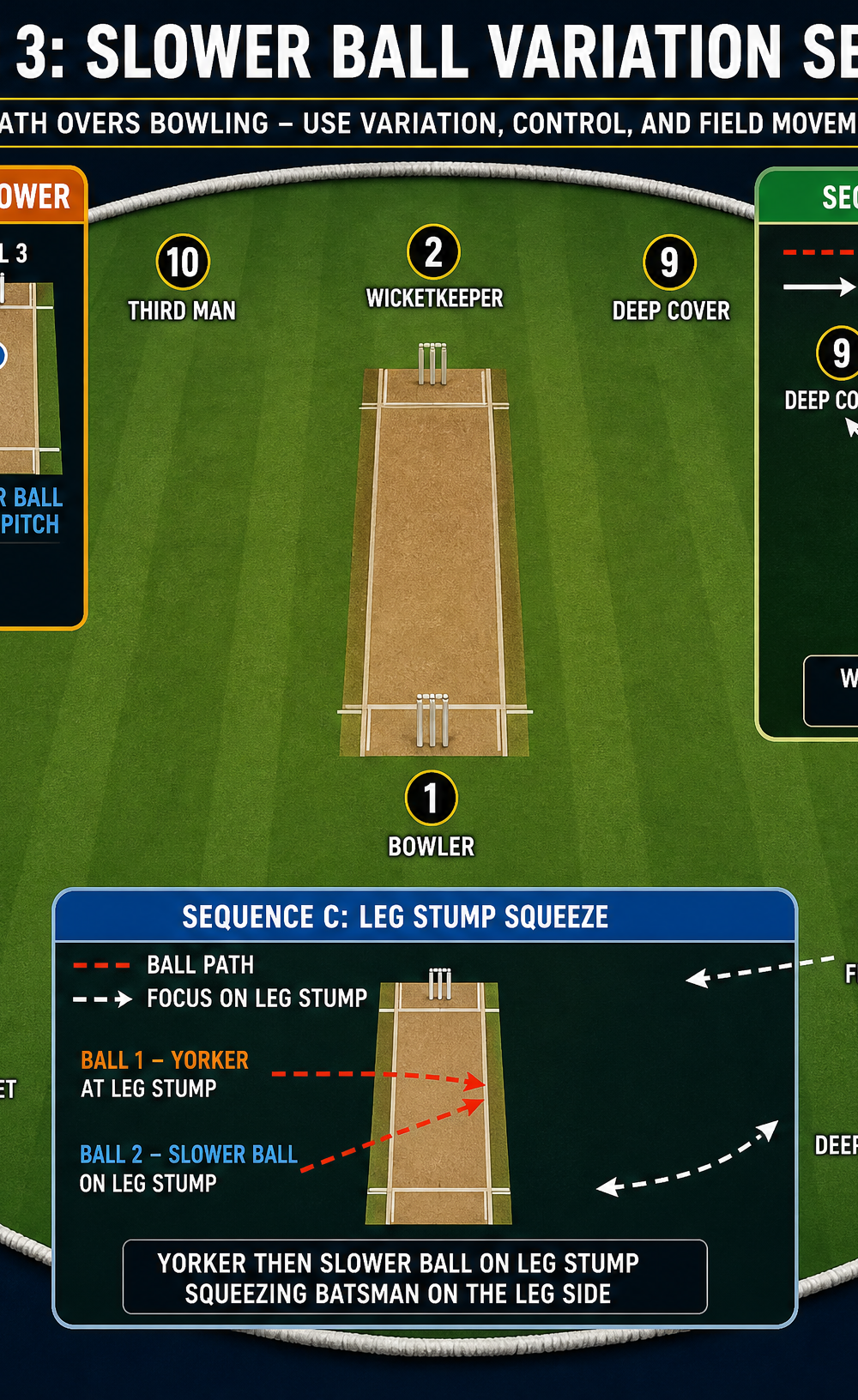
Do not bowl variations randomly. Use structured sequences to outthink the batsman. For example, Sequence A: Yorker, Yorker, Slower Ball. This builds expectation and then shatters it.
Step 5: Review and Adjust
After every over, the bowler and captain must assess the batsman's movements. If the batsman is moving across the stumps, switch to the wide yorker trap.
4. Key Coaching Points
- Visual Focus: Bowlers must lock their eyes on the target area (the base of the stumps or the batsman's toes) during the run-up and delivery stride.
- Arm Speed: When bowling the slower ball, the arm speed must remain identical to a fast delivery to deceive the batsman.
- Field Awareness: Bowlers must know exactly where their boundary riders are and bowl strictly to that field. A wide yorker with no deep cover is a tactical error.
- Commitment: Indecision leads to execution failure. Once a delivery is chosen at the top of the mark, the bowler must commit 100% to executing it.
- Breathing and Composure: Teach bowlers to take a deep breath at the top of their mark to lower their heart rate and maintain focus under pressure.
5. Common Mistakes
- Missing Length (The Full Toss): Aiming for the yorker and missing full (Zone 1) results in a high full toss, which is easily hit for six.
- Telegraphing the Slower Ball: Changing the run-up speed or dropping the arm early alerts the batsman to the slower variation.
- Bowling to the Wrong Field: Executing a perfect leg-stump yorker when the field is set for outside off-stump.
- Overusing Variations: Bowling too many slower balls allows the batsman to adjust. The yorker must remain the primary weapon.
6. Variations & Progressions
- Progression 1: Target Practice: Place a single shoe or a brightly colored cone on the popping crease. Award points for hitting the target.
- Progression 2: Pressure Scenarios: Create match simulations (e.g., "You need to defend 10 runs off the last over").
- Variation 1: The Wide Yorker: Shift the target line outside the off-stump to keep the ball away from the batsman's hitting arc.
- Variation 2: The Bouncer: Occasionally use a sharp bouncer to push the batsman back, making the subsequent yorker even more effective.
7. Age Adaptations
- Under 10/12: Focus purely on accuracy and hitting the stumps. Introduce the concept of a slower ball using a simple grip change, but prioritize basic line and length.
- Under 14/16: Introduce target zones and basic field placements. Begin teaching specific slower ball techniques (e.g., off-cutter, back-of-the-hand).
- Open/Senior: Full implementation of tactical sequences, field manipulation, and high-pressure scenario training.