Middle Overs Masterclass: Executing the Seam-to-Spin Bowling Change
Learn how to seamlessly transition from pace to spin in the middle overs to build pressure, dry up boundaries, and force crucial breakthroughs.

Equipment Needed
1. Overview
The middle overs (typically overs 11-40 in ODIs, or 7-15 in T20s) are the engine room of a cricket innings. During this phase, the batting team looks to consolidate and rotate strike, while the fielding captain aims to break partnerships and control the run rate.
This set play details the strategic transition from opening seam bowlers to spin bowlers. A well-executed bowling change can immediately disrupt the batters' rhythm. By altering the pace of the ball, changing the field placements, and attacking different lengths, coaches can teach their captains how to manufacture wickets through sustained pressure rather than relying solely on raw pace or magic deliveries.
2. Setup
Equipment Needed:
- 1 Match ball (slightly worn, typically 10-15 overs old)
- Stumps and bails
- Marker cones (for training drills to indicate target lengths)
Pitch & Field Setup:
- Standard 22-yard pitch on an oval ground.
- Initial State: Standard seam field (e.g., 2 slips, gully, standard outfield).
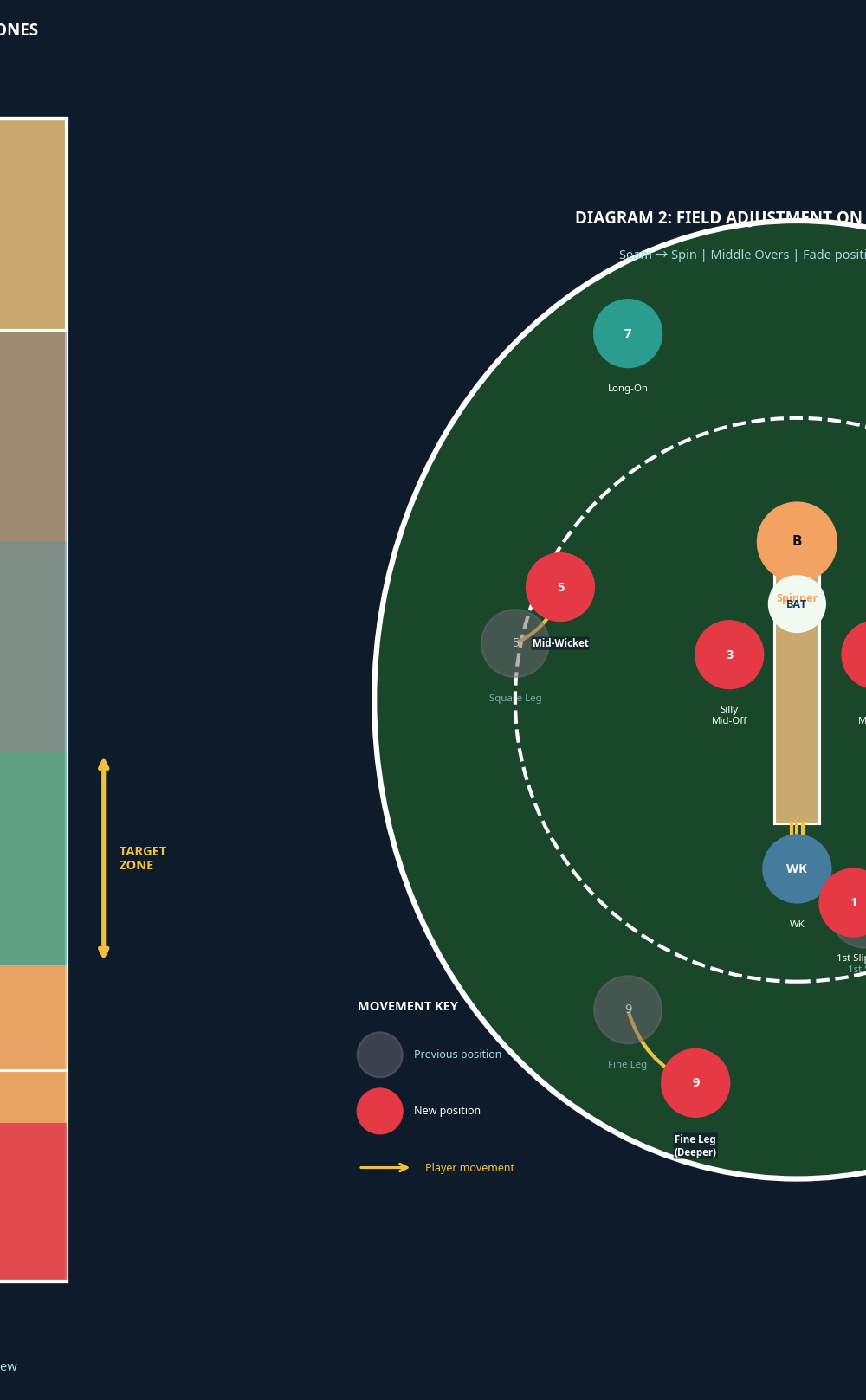
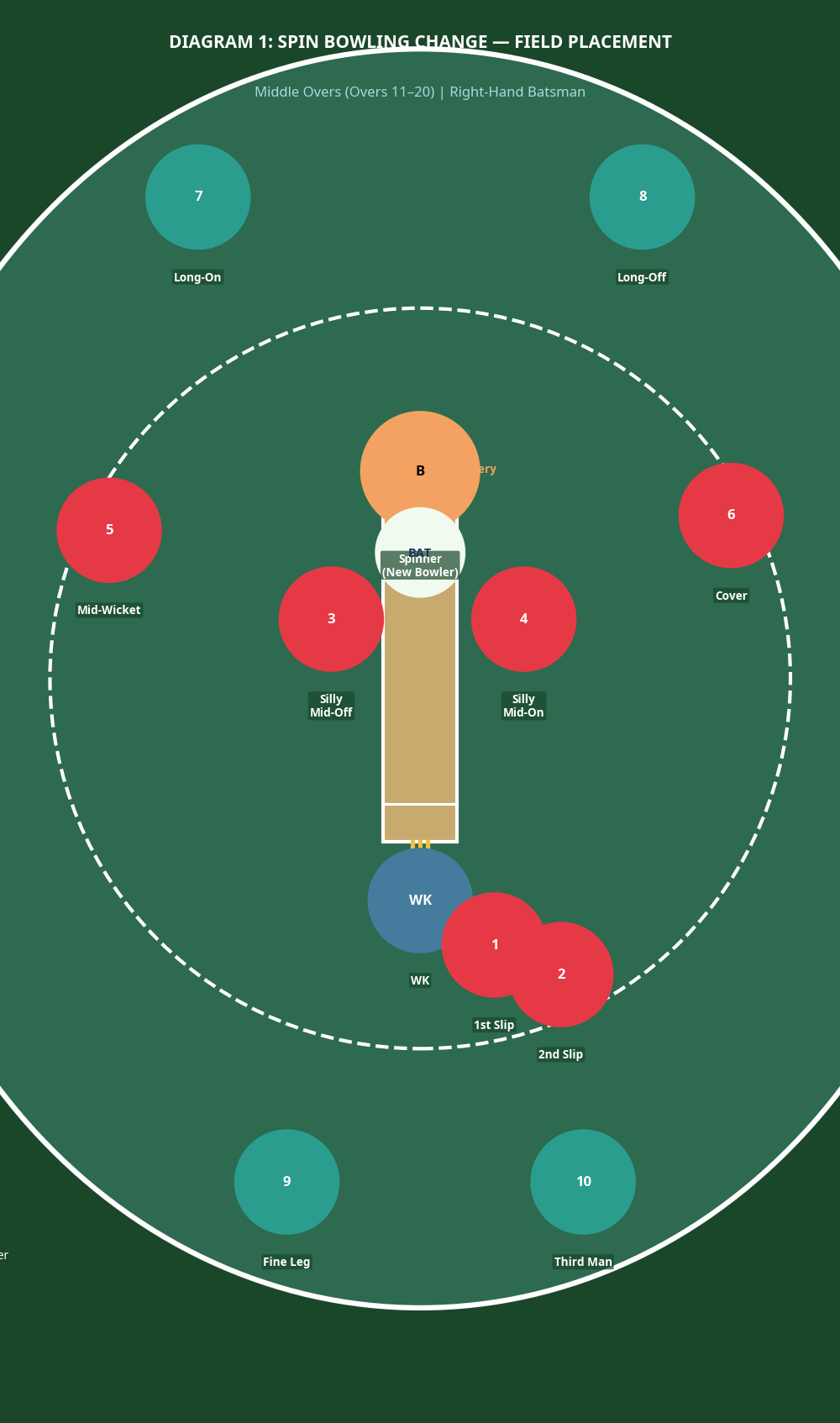
- Target State (Spin): As shown in the diagrams below, the field must contract to cut off the singles, with close-in catchers (slips, silly point/mid-off) brought in to capitalize on the new bowler's variations.

3. Step-by-Step Instructions
Step 1: The Communication Phase (End of the Previous Over)
- The captain approaches the incoming spinner before the end of the preceding over.
- Discuss the specific batter on strike: Are they strong square of the wicket? Do they use their feet?
- Agree on the target line and length for the first three deliveries (usually aiming for the top of off-stump on a good length).
Step 2: Field Re-alignment
- Withdraw the Pace Field: Move the third man and fine leg deeper or square them up, depending on the spinner's line.
- Set the Spin Trap: Bring in a slip and position a silly mid-off or short cover to create immediate psychological pressure on the new batter.
- Protect the Boundaries: Ensure long-on and long-off are correctly positioned to allow the spinner to flight the ball without fear of being hit straight for easy boundaries.
Step 3: The First Over Execution
- Delivery 1 & 2: The bowler bowls a tight, good-length delivery (6-10m from the batter's stumps) to establish a baseline rhythm.
- Delivery 3 & 4: Introduce slight flight variation. The wicketkeeper must stand up to the stumps, communicating the pace of the pitch to the bowler.
- Delivery 5 & 6: If the batter is defensive, the bowler can push the ball slightly fuller (3-6m) to invite the drive, relying on the newly placed close catchers.
4. Key Coaching Points
- Seamless Transition: The field must be set before the bowler reaches their mark. Delays release the pressure on the batting side.
- Wicketkeeper Positioning: The keeper must immediately come up to the stumps. This prevents the batter from leaving their crease and brings stumpings into play.
- Targeting the 'Good Length': Spinners must consistently hit the 6-10m zone. Bowling too short (14-18m) allows easy singles off the back foot.
- Body Language: Close-in fielders (slips, silly mid-off) must adopt an aggressive, crouched posture, walking in with the bowler to crowd the batter's peripheral vision.
5. Common Mistakes
- Bowling Too Fast, Too Early: Spinners often rush their first over, bowling flat and fast instead of finding their optimal loop and dip.
- Lazy Field Changes: Leaving a deep third man in place for a spinner when that fielder could be better utilized at square leg or deep mid-wicket.
- Ignoring the Match Situation: Setting an attacking field when the batters are already set and scoring freely, instead of adopting a defensive, boundary-riding setup to build dot-ball pressure.
6. Variations & Progressions
- Progression 1 (The Double Change): Bring on spin from both ends simultaneously to completely remove pace from the ball, forcing the batters to generate all the power.
- Progression 2 (The Left-Arm/Right-Arm Combo): Pair an off-spinner with a left-arm orthodox bowler to ensure the ball is spinning in different directions, making it harder for the batters to settle into a single sweep or drive pattern.
- Variation (Attacking the Pads): If the pitch is turning sharply, adjust the field to include a leg slip and short leg, instructing the bowler to aim at the middle-and-leg stump line.
7. Age Adaptations
- Under 10 / Under 12: Focus purely on the bowler hitting the pitch. Keep field changes simple (e.g., bringing in one slip and pushing mid-on back). Don't crowd the bat with dangerous silly positions.
- Under 14 / Under 16: Introduce the concept of bowling to a field. Teach captains how to move fielders based on where the batter is hitting the ball.
- Open / Senior: Full tactical implementation. Captains should be fluid, changing the field every ball if necessary to play mind games with the opposition.