Football
Drill
intermediate
under 14
Defensive Heading and Box Clearing Drill
Master the art of defensive heading and penalty box clearances to neutralise aerial threats and relieve defensive pressure.
Jul 8, 20264 min read20 min drill8 players

Equipment Needed
1 full-size goal
10-15 footballs
Cones or markers
Bibs
1. Overview
Defending the penalty area against aerial deliveries is a fundamental requirement for any successful football team. This drill focuses on the mechanics of defensive heading, the timing of the jump, and the tactical awareness required to clear the ball effectively from the danger zone. By simulating match-realistic crosses and long balls, coaches can train their defenders to attack the ball with aggression and purpose, ensuring clearances are directed high, wide, and far away from the goal.
This session is ideal for preparing a backline for opponents who rely on direct play, set pieces, or frequent wide deliveries.
2. Setup
- Pitch Area: Use the penalty area and extend the playing space to approximately 35 metres from the goal line. Standard pitch width.
- Players: 4 Defenders (Back four: LB, LCB, RCB, RB), 2 Attackers, 2-3 Servers.
- Equipment: 1 full-size goal, 10-15 footballs, cones/markers to define the target clearance zones, and bibs for the attackers.
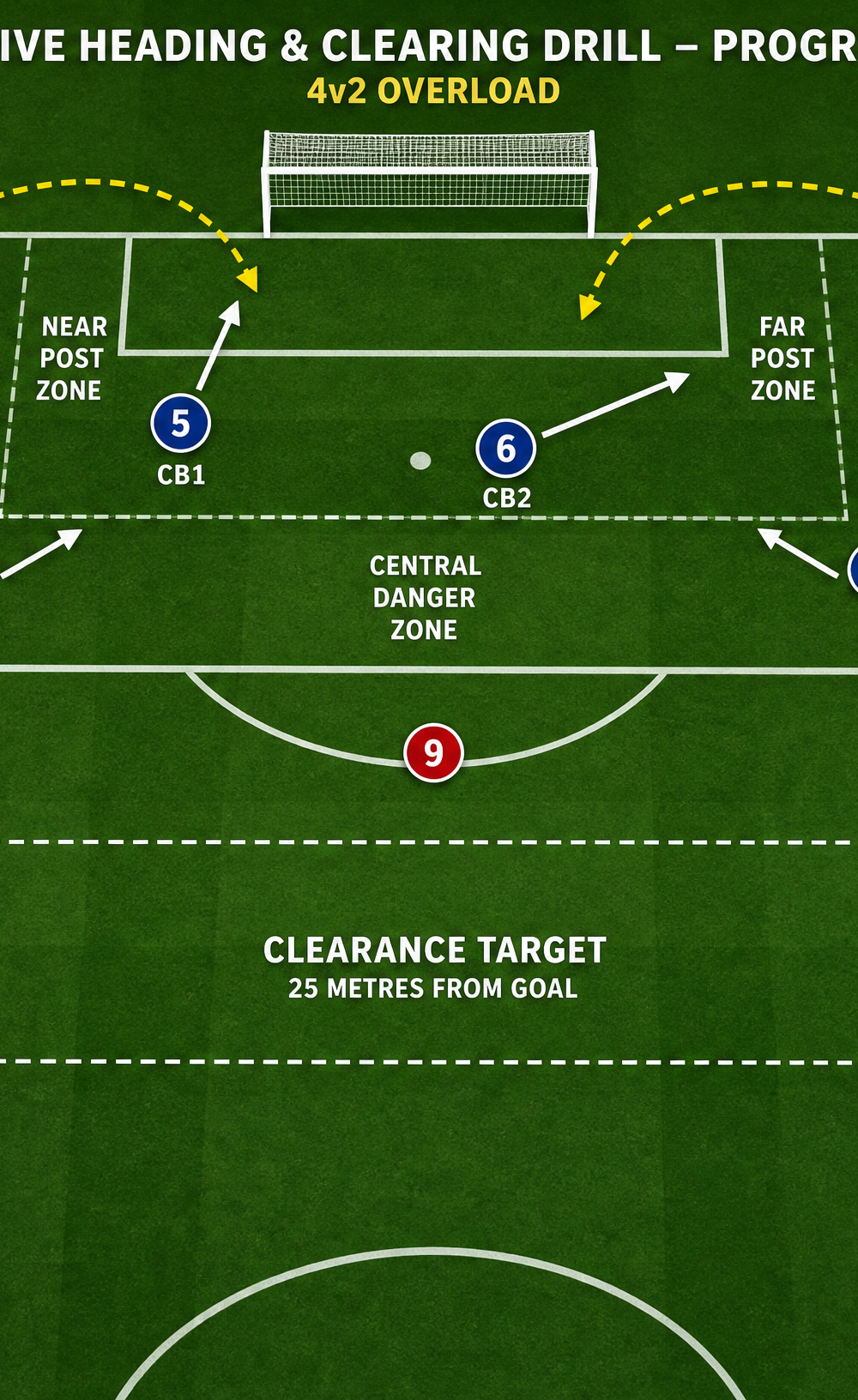
- Target Zones: Set up a marked 'Clearance Target Zone' approximately 25 metres from the goal, spanning the width of the pitch.
3. Step-by-Step Instructions
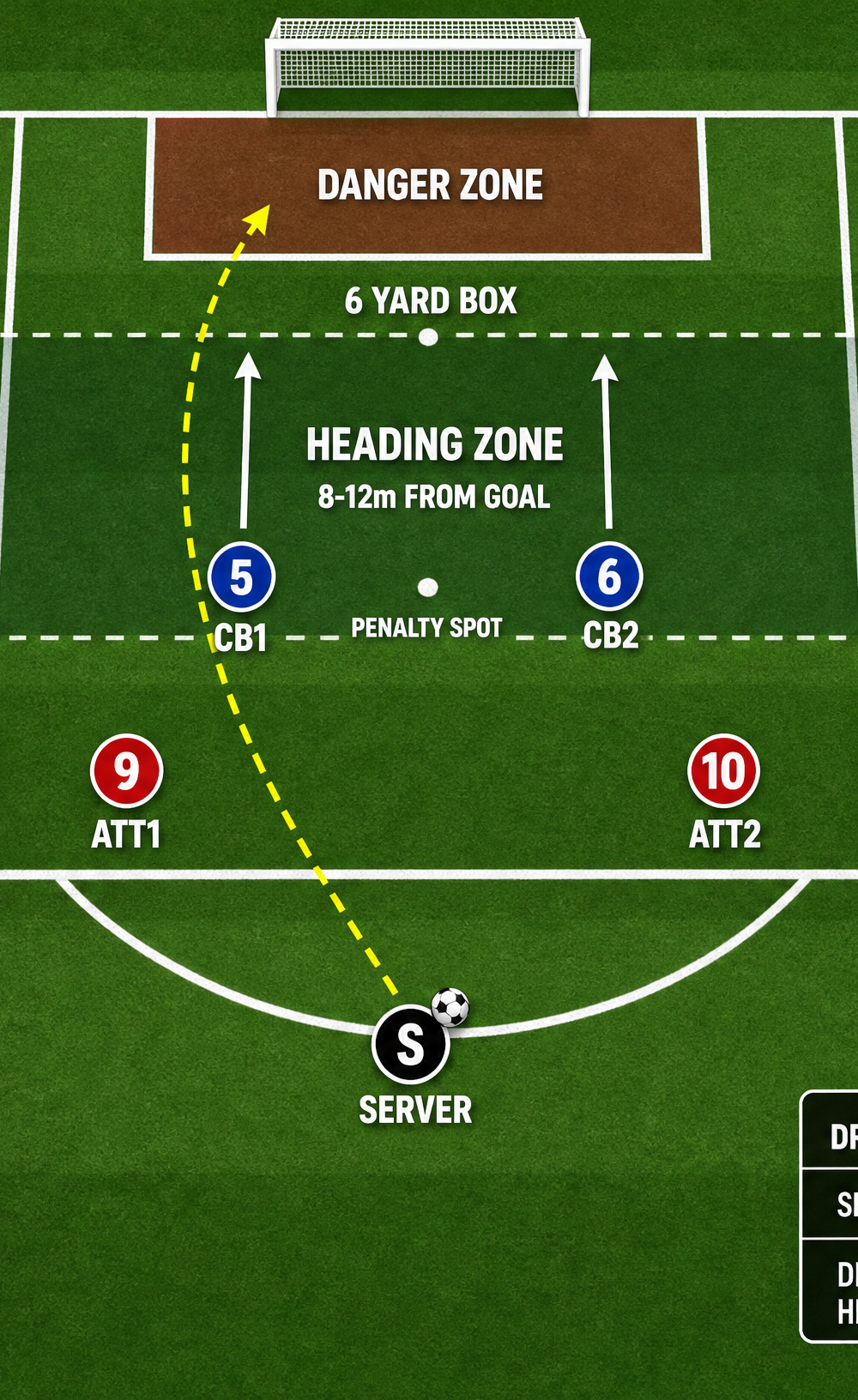
- Initial Positioning: Position the four defenders in their standard defensive shape inside the penalty area, approximately 8-12 metres from the goal line. The two attackers position themselves around the penalty spot.
- Service Delivery: A server (S), positioned centrally outside the penalty area, delivers a lofted ball into the 'Danger Zone' (between the penalty spot and the six-yard box).
- Attacking the Ball: The designated centre-back (CB1 or CB2) must read the flight of the ball, communicate early (e.g., "Keeper's" or "Away!"), step forward, and attack the ball at its highest point.
- The Clearance: The defender must head the ball with power and direction, aiming to land the ball inside the marked 'Clearance Target Zone' outside the penalty area.
- Cover and Balance: As the primary defender attacks the ball, the remaining defenders must drop slightly and tuck in to provide cover and maintain a compact defensive block.
- Reset: Once the ball is cleared, the defensive line pushes up quickly to the edge of the penalty area to reset for the next delivery.
4. Key Coaching Points
- Attack the Ball: Never wait for the ball to drop. Defenders must step forward, time their jump, and meet the ball at its highest possible point.
- Use the Forehead: Strike the ball with the flat, hard surface of the forehead. Keep eyes open and mouth closed upon impact.
- Direction and Distance: Clearances must go high, far, and ideally wide. Avoid heading the ball straight back down the centre of the pitch where opponents can easily volley it back.
- Communication: Loud, early, and clear communication is vital. The player committing to the header must call it early to avoid collisions and confusion.
- Defensive Shape: The players not challenging for the ball must immediately adopt covering positions, ready to react to knock-downs or second balls.
5. Common Mistakes
- Closing the Eyes: Players often close their eyes just before impact, leading to poor contact and unpredictable clearances.
- Heading Under the Ball: Making contact too low on the ball results in a weak, looping header rather than a powerful, driven clearance.
- Lack of Communication: Two defenders challenging for the same ball, resulting in a collision or a missed clearance.
- Standing Still: Waiting for the ball to arrive rather than attacking it, allowing the attacker to step in front and win the header.
6. Variations & Progressions
- Wide Service (Crosses): Move the servers to the flanks to deliver crosses instead of central lofted balls. This forces defenders to adjust their body shape and clear the ball facing away from goal.
- Add Pressure: Introduce active attackers who challenge the defenders for the header, simulating match conditions and testing the defenders' aggression and bravery.
- Second Ball Transition: After a successful clearance, the coach plays a second ball into the midfield area, requiring the defenders to push up and transition into a pressing shape.
7. Age Adaptations
- Under 8 - Under 10: Focus on the basic mechanics of heading using softer, lighter balls (e.g., sponge balls or slightly deflated size 3 balls). Emphasise keeping eyes open and using the forehead without jumping.
- Under 12 - Under 14: Introduce jumping and attacking the ball. Use size 4 balls and begin incorporating basic defensive shape and communication.
- Under 16 - Open: Full match-realistic intensity. Use size 5 balls, active attackers, and focus on tactical elements such as the defensive line dropping and pushing up as a unit.