Fast Bowler's Run-Up Alignment Channel Drill
A fundamental coaching drill to correct fast bowler run-up deviation, improve momentum transfer, and ensure consistent legal foot placement at the crease.
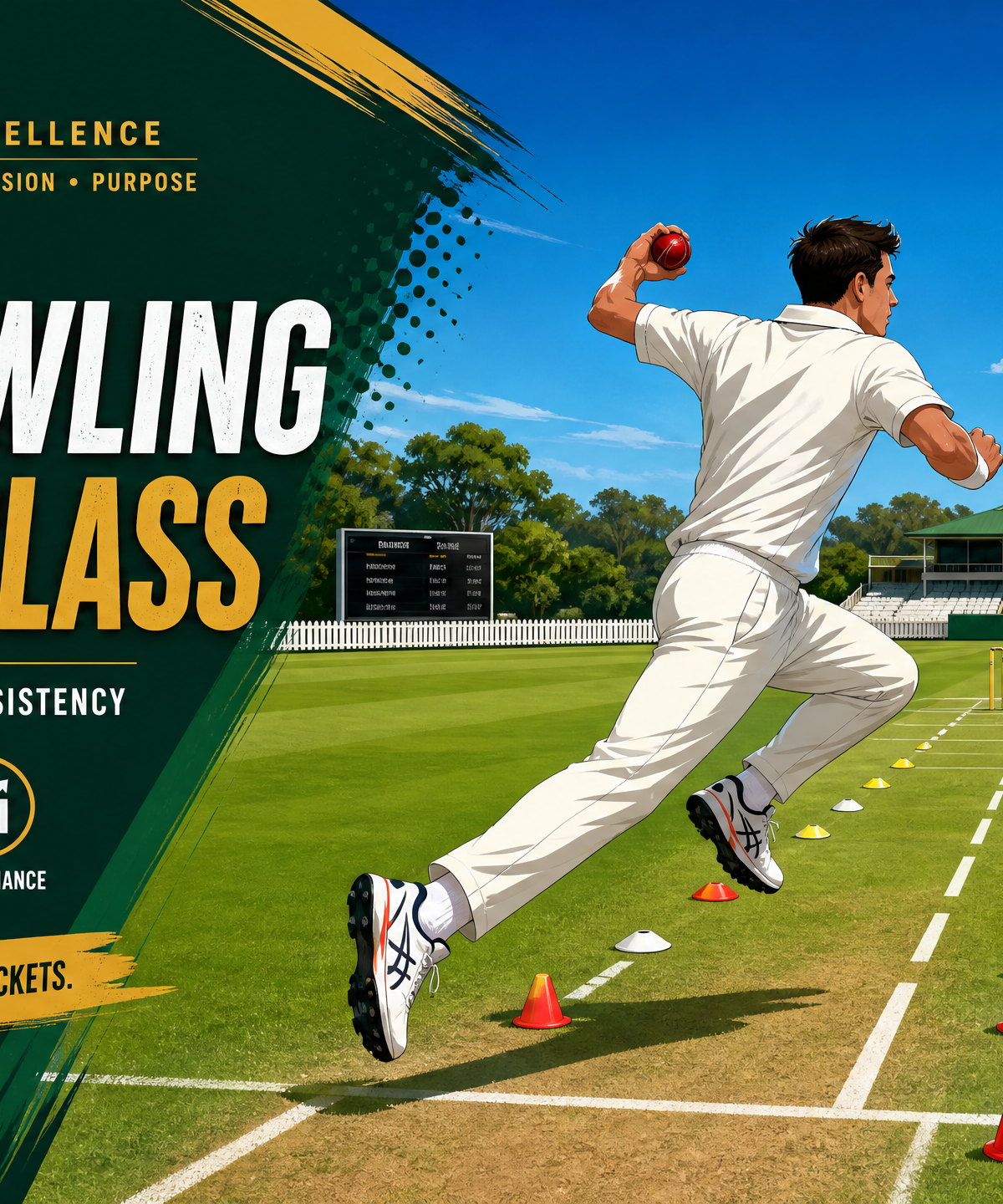
Equipment Needed
1. Overview
The Run-Up Alignment Channel Drill is a critical diagnostic and corrective exercise designed for fast bowlers. A straight, consistent run-up is the foundation of pace and accuracy. When a bowler weaves, drifts, or runs in on an angle, they bleed momentum and compromise their delivery alignment.
This drill provides immediate visual feedback to the bowler regarding their approach path, ensuring that their energy is directed straight toward the target (the batter or the off-stump). It is particularly effective for identifying and correcting 'running out' or 'running in' habits that lead to no-balls, wide deliveries, or loss of pace. Use this drill during the pre-season to establish muscle memory, or during regular net sessions to recalibrate a bowler whose radar is off.
2. Setup
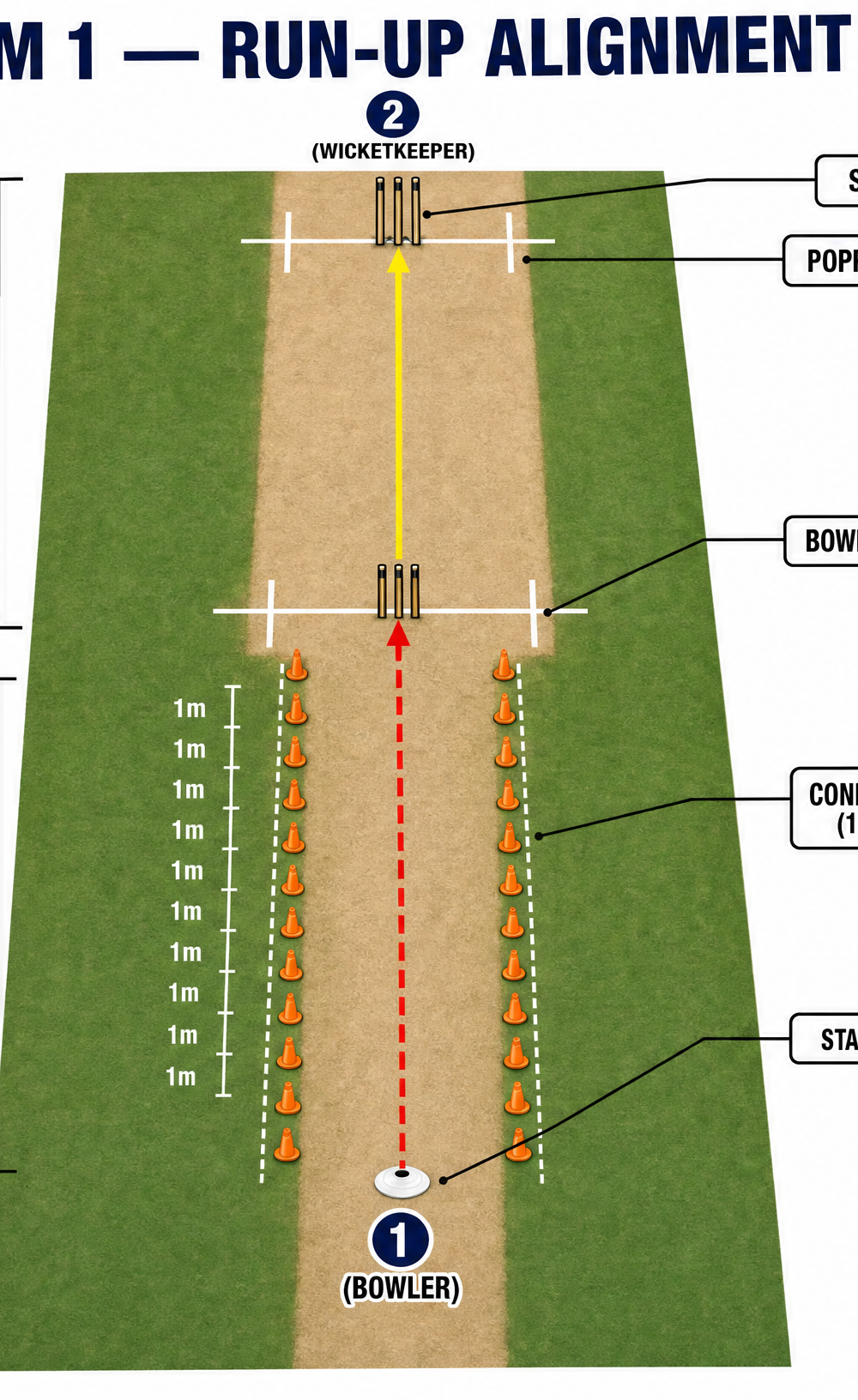
To execute this drill effectively, you need a standard 22-yard cricket pitch and basic training equipment. The focus is on creating a visual corridor that the bowler must stay within.
Equipment Required:
- 10 to 14 flat marker cones (preferably two different high-visibility colors, e.g., orange and yellow)
- 1 measuring tape (optional, but recommended for precision)
- Cricket balls (1 per bowler, or a bucket for rapid repetition)
- Stumps (at both ends of the pitch)
Pitch and Field Setup:
- Mark the Start: Place a single flat marker cone at the bowler's established start mark (15 to 20 metres behind the bowling crease, depending on the bowler's age and pace).
- Create the Channel: Starting from the bowling crease, lay out two parallel lines of cones extending back toward the start mark.
- Channel Width: The channel should be exactly 1 metre wide. For advanced bowlers, you can narrow this to 0.75 metres to increase the difficulty.
- Cone Spacing: Place a cone every 1 to 1.5 metres along both sides of the channel.
- Positioning: Ensure the channel is perfectly aligned with the target stump (usually off-stump or middle-and-off) at the batter's end.
3. Step-by-Step Instructions
Run the drill systematically to ensure the bowler focuses on alignment rather than just bowling the ball.
Step 1: The Dry Run (Without Ball)
- Have the bowler (Player 1) start at their mark.
- Instruct them to run through the channel at 70% pace without a ball, focusing purely on staying between the cones and maintaining a straight line.
- The coach (Player 3) should stand behind the stumps at the bowler's end to observe any lateral deviation.
Step 2: The Approach and Jump (Without Ball)
- The bowler repeats the run-up, this time incorporating their bound/jump and landing in the delivery stride at the crease.
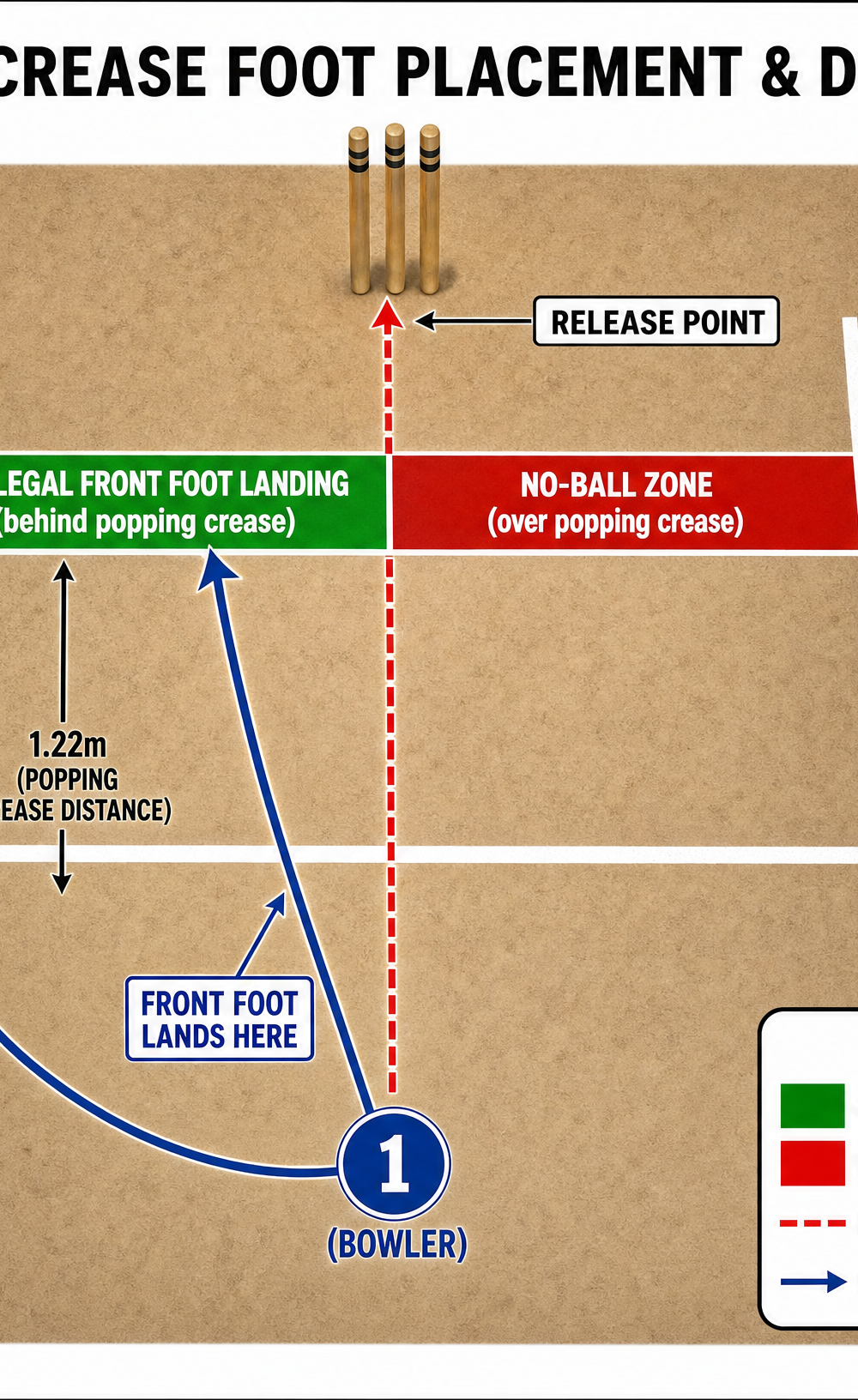
- The coach observes where the front foot lands relative to the popping crease and the return crease.
Step 3: Full Delivery (With Ball)
- The bowler now takes a ball and executes their full run-up and delivery at 85-90% match intensity.
- The goal is to run straight down the channel, land the front foot legally behind the popping crease, and deliver the ball to the target area.
Step 4: Review and Adjust
- After each delivery, check if any cones were kicked or disturbed. A disturbed cone indicates a deviation in the run-up path.
- Check the foot marks at the crease to ensure the bowler is not drifting too wide or cutting in too close to the danger area.
4. Key Coaching Points
When observing the bowler, focus on these critical technical elements:
- Head Position: The head must remain still and level throughout the approach. A bobbing or tilting head will cause the body to drift off the straight line.
- Arm Drive: The arms should pump straight forward and backward, like a sprinter. Arms crossing the midline of the body will induce a rotational force, causing the bowler to run diagonally.
- Target Fixation: The bowler's eyes should be locked onto the target (e.g., the top of off-stump) from the very first step. Looking down at the cones or the crease disrupts alignment.
- Momentum Transfer: The run-up should build smooth, progressive speed. Stuttering or decelerating before the jump kills momentum and often leads to a collapsed front leg or a wide delivery.
- Foot Alignment at Crease: Ensure the back foot lands parallel to the return crease and the front foot lands pointing down the pitch, not excessively closed off or open.
5. Common Mistakes
Watch out for these frequent errors and correct them immediately:
- 'Banana' Run-Up: The bowler starts wide and curves in toward the stumps, or starts straight and flares out. This is usually caused by poor initial alignment or crossing the arms during the run.
- Looking at the Crease: Bowlers who have a history of no-balls often look down at the popping crease as they approach. This drops the head, rounds the shoulders, and destroys posture.
- Over-striding: Trying to run too fast often leads to over-striding, which reduces control and makes it difficult to stay within the 1-metre channel.
- Jumping Out: The bowler runs straight but jumps laterally (away from the stumps) during the delivery stride, losing all forward momentum.
6. Variations & Progressions
Once the bowler masters the basic drill, introduce these variations to challenge them:
- The Narrowing Funnel (Progression): Instead of parallel lines, set the cones up like a funnel. Start 1.5 metres wide at the start mark and narrow it down to 0.5 metres at the bowling crease. This demands extreme precision in the final strides.
- Blind Start (Variation): Have the bowler start facing away from the pitch. On the coach's call, they must turn, sight the target, and immediately begin their run-up through the channel. This tests their ability to find alignment under pressure.
- Target Bowling (Progression): Place a target cone or a fielding stump on a good length at the batter's end. The bowler must stay in the channel and hit the target. This links alignment directly to accuracy.
7. Age Adaptations
Tailor the drill to the age and skill level of your players:
- Under 10s / Under 12s: Make the channel wider (1.5 metres) and focus primarily on running in a straight line without worrying too much about the exact foot placement at the crease. Use softer balls if necessary.
- Under 14s / Under 16s: Enforce the 1-metre channel strictly. Begin focusing heavily on the bound/jump phase and ensuring the momentum is carried directly toward the target.
- Open / Seniors: Narrow the channel to 0.75 metres. Introduce the 'Narrowing Funnel' progression and demand 100% match intensity. Focus on the micro-mechanics of arm drive and head position.