Defensive Heading & Penalty Box Clearance Mastery
A high-intensity, game-realistic drill designed to teach defenders how to attack the ball aggressively, dominate the penalty area, and execute powerful, directional headers to clear danger zones.

Equipment Needed
1. Overview
Dominating the airspace in your own penalty box is a non-negotiable trait for any successful defensive unit. Whether dealing with inswinging corners, deep free-kicks, or open-play crosses, defenders must possess the timing, bravery, and technique to clear the ball effectively.
This drill, Defensive Heading & Penalty Box Clearance Mastery, isolates the critical moments of defensive heading under pressure. It shifts the focus from merely 'getting a head on it' to making purposeful, directional clearances that relieve pressure and initiate counter-attacks. Coaches should use this drill to instil an aggressive mindset in their centre-backs and defensive midfielders, ensuring they meet the ball at its highest point while maintaining defensive shape.
2. Setup
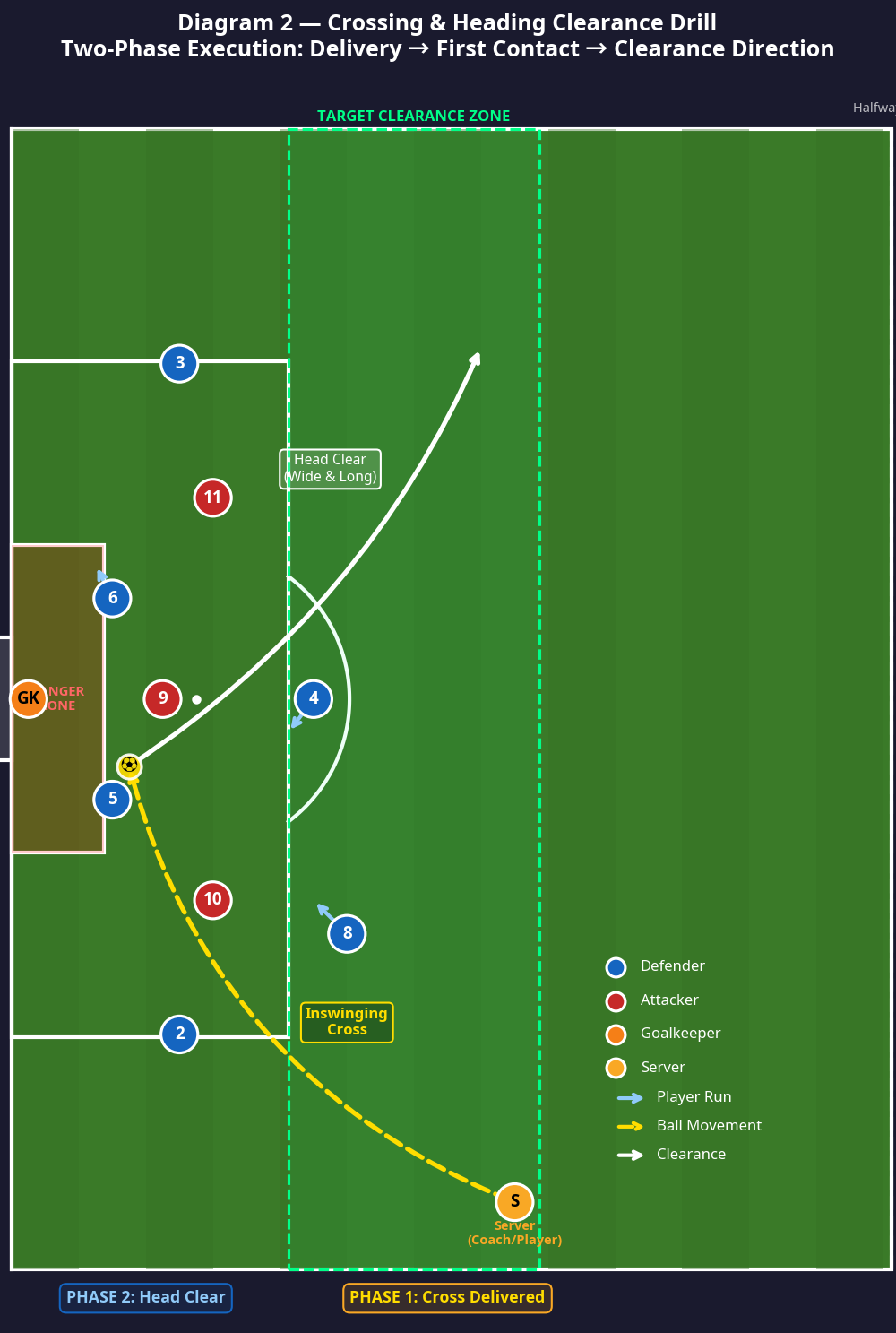
To replicate match conditions, this drill utilises the defensive third of a standard football pitch (105m x 68m).
- Pitch Area: The defensive third (from the goal line to roughly 35-40m out).
- Players: 1 Goalkeeper, 4-5 Defenders (Blue), 3-4 Attackers (Red), and 2 Servers/Crossers (Yellow/Coach).
- Equipment: Full-size goal, 10-15 footballs, cones to mark clearance zones, and bibs (Blue, Red, Yellow).
- Clearance Zones: Set up two 10m x 10m target grids on the flanks, positioned 25-35m away from the goal. These represent the 'safe zones' for clearances.

3. Step-by-Step Instructions
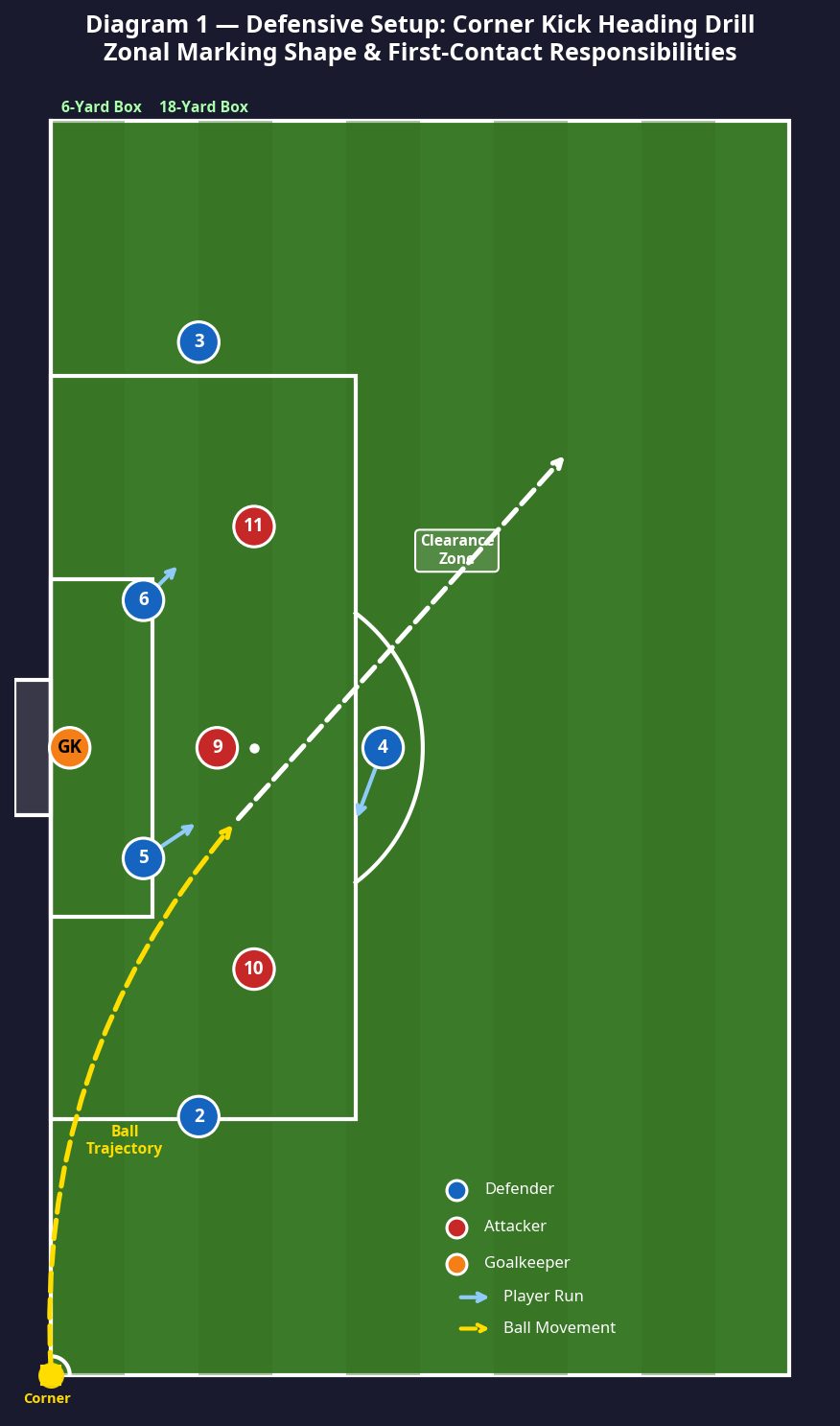
- Starting Positions: The defensive unit (back four and a holding midfielder) sets up in a realistic zonal or mixed marking system inside the penalty area. The goalkeeper takes their starting position. Attackers position themselves dynamically to challenge for the ball.
- The Delivery: A server (Coach or wide player) positioned on the flank or at the corner flag delivers a high-quality cross or set-piece into the 'Danger Zone' (between the 6-yard box and the penalty spot).
- Attacking the Ball: As the ball is in flight, the designated defender (e.g., the near-post centre-back) must read the trajectory, attack the ball aggressively, and jump off one foot to generate maximum elevation.
- The Clearance: The defender must execute a powerful defensive header. The objective is not just to head it away, but to direct the ball high, wide, and long into one of the designated target 'Clearance Zones'.
- Second Balls & Reset: The rest of the defensive unit must react instantly to the clearance. If the ball drops short, the defensive midfielder must win the second ball. Once the phase is complete, the defensive line pushes up quickly to the edge of the box to reset for the next delivery.
4. Key Coaching Points
- Attack the Ball: Never wait for the ball to come to you. Step forward, attack the flight path, and meet the ball at its highest possible point.
- Eyes Open, Mouth Closed: Keep eyes firmly fixed on the ball through the point of contact. Keep the mouth closed to prevent injury if a collision occurs.
- Contact Point: Strike the ball with the forehead (just above the eyebrows). Use the neck muscles and core to generate power, snapping the head forward upon contact.
- Height and Distance: A successful defensive header must go high and wide. Aiming for the flanks reduces the risk of the ball dropping to an attacker in a central, dangerous shooting position.
- Communication: Clear, decisive calls (e.g., "Keeper's!" or "Away!") are vital to avoid collisions between defenders or with the goalkeeper.
5. Common Mistakes
- Heading with the Top of the Head: This results in a lack of power and direction, often causing the ball to drop dangerously inside the penalty area. Always use the forehead.
- Closing the Eyes: A natural flinch reaction, but it leads to mistimed jumps and poor contact. Coaches must encourage bravery.
- Flat-Footed Defending: Waiting for the ball while flat-footed allows attackers to gain momentum and win the aerial duel. Defenders must stay on their toes and adjust their feet quickly.
- Clearing Centrally: Heading the ball straight back down the middle of the pitch often gifts possession to the opposition's central midfielders in prime shooting locations.
6. Variations & Progressions
- Progression 1: Active Attackers: Introduce fully active attackers who genuinely compete for the header. This increases the physical demand and forces defenders to win contested aerial duels.
- Progression 2: Transition to Attack: Once the ball is headed into the clearance zone, a waiting midfielder receives it and immediately launches a 3v2 counter-attack against the servers, transitioning from defense to offense.
- Variation: Unopposed Technique: For younger or less experienced players, remove the attackers initially. Allow the defenders to focus purely on the timing of their jump and the technique of the header without physical pressure.
7. Age Adaptations
- Under 8 - Under 10: Focus on the fundamental technique of heading using lighter, softer footballs (size 3 or 4). Keep the ball on the ground or use gentle underarm throws. Emphasise using the forehead and keeping eyes open. No contested headers.
- Under 12 - Under 14: Introduce gentle, uncontested crosses. Focus on footwork, tracking the flight of the ball, and directing the header back to the server. Begin teaching the concept of clearing high and wide.
- Under 16 - Open (Adult): Full match realism. Implement heavy physical pressure, fast-paced crosses (inswinging and outswinging), and demand explosive jumps and powerful, tactical clearances into specific zones.