High-Intensity 5-Station Ball Handling Circuit
A fast-paced, 5-station dribbling circuit designed to maximize touches, improve weak-hand confidence, and build elite ball control under fatigue.
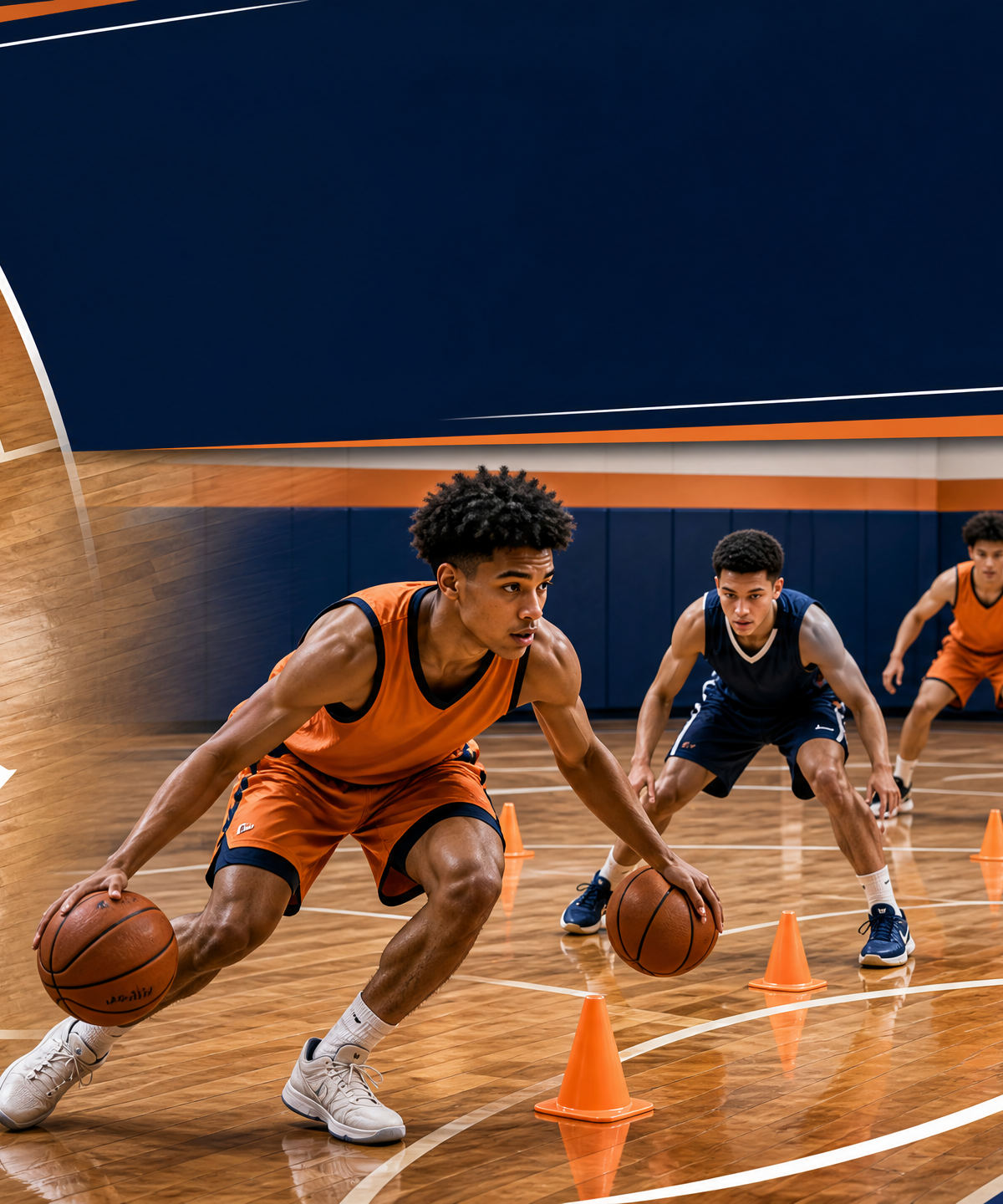
Equipment Needed
1. Overview
The High-Intensity 5-Station Ball Handling Circuit is a fundamental yet demanding drill designed to maximize the number of touches players get in a short period. Rather than having players stand in lines waiting for their turn, this circuit keeps every player actively engaged, dribbling, and working on their mechanics simultaneously. It is an excellent conditioning tool that builds muscle memory, improves weak-hand confidence, and develops elite ball control under the stress of fatigue.
Use this circuit early in practice as a high-energy warm-up, or place it at the end of a session to challenge players to maintain their form when their legs and arms are heavy.
2. Setup
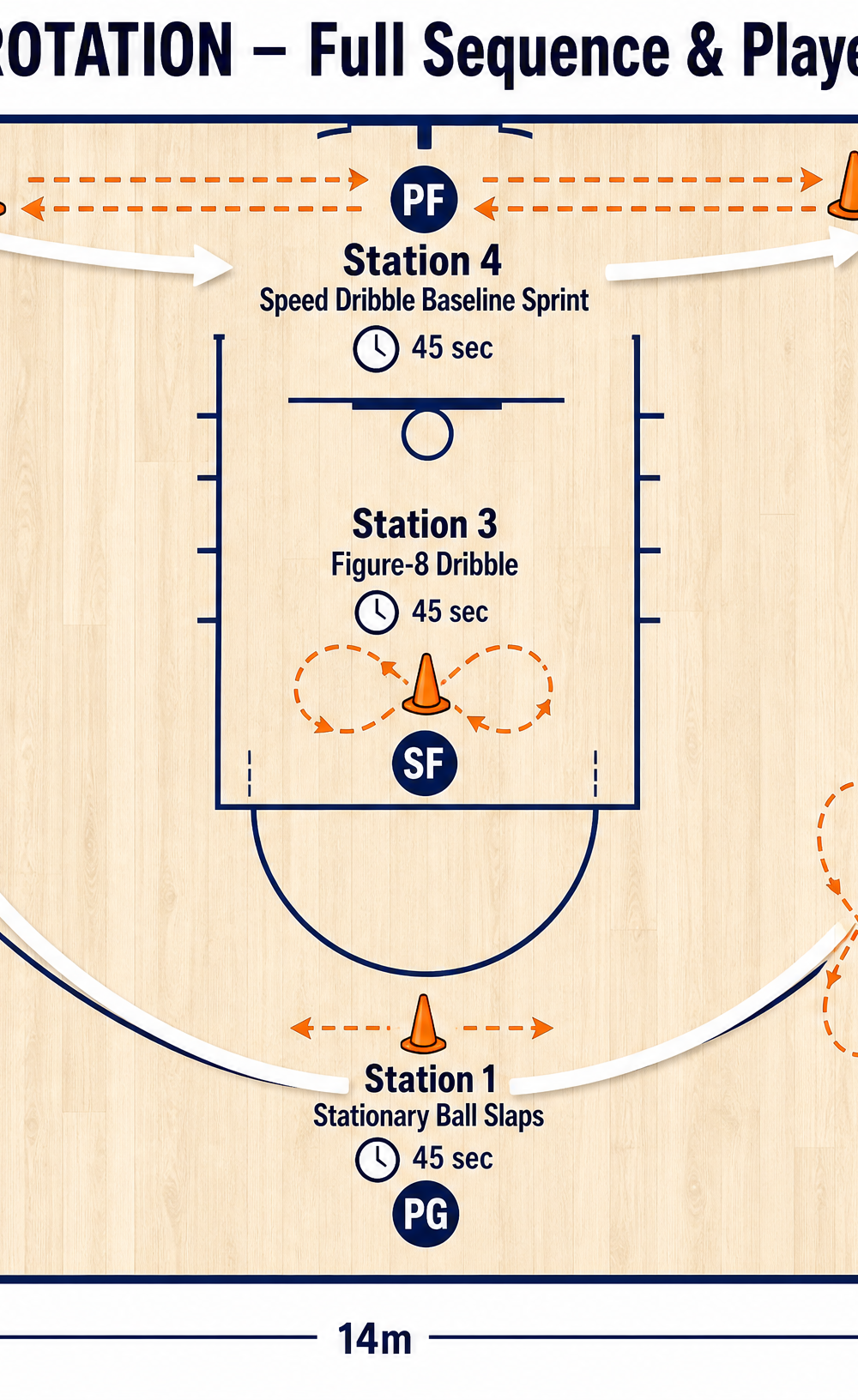
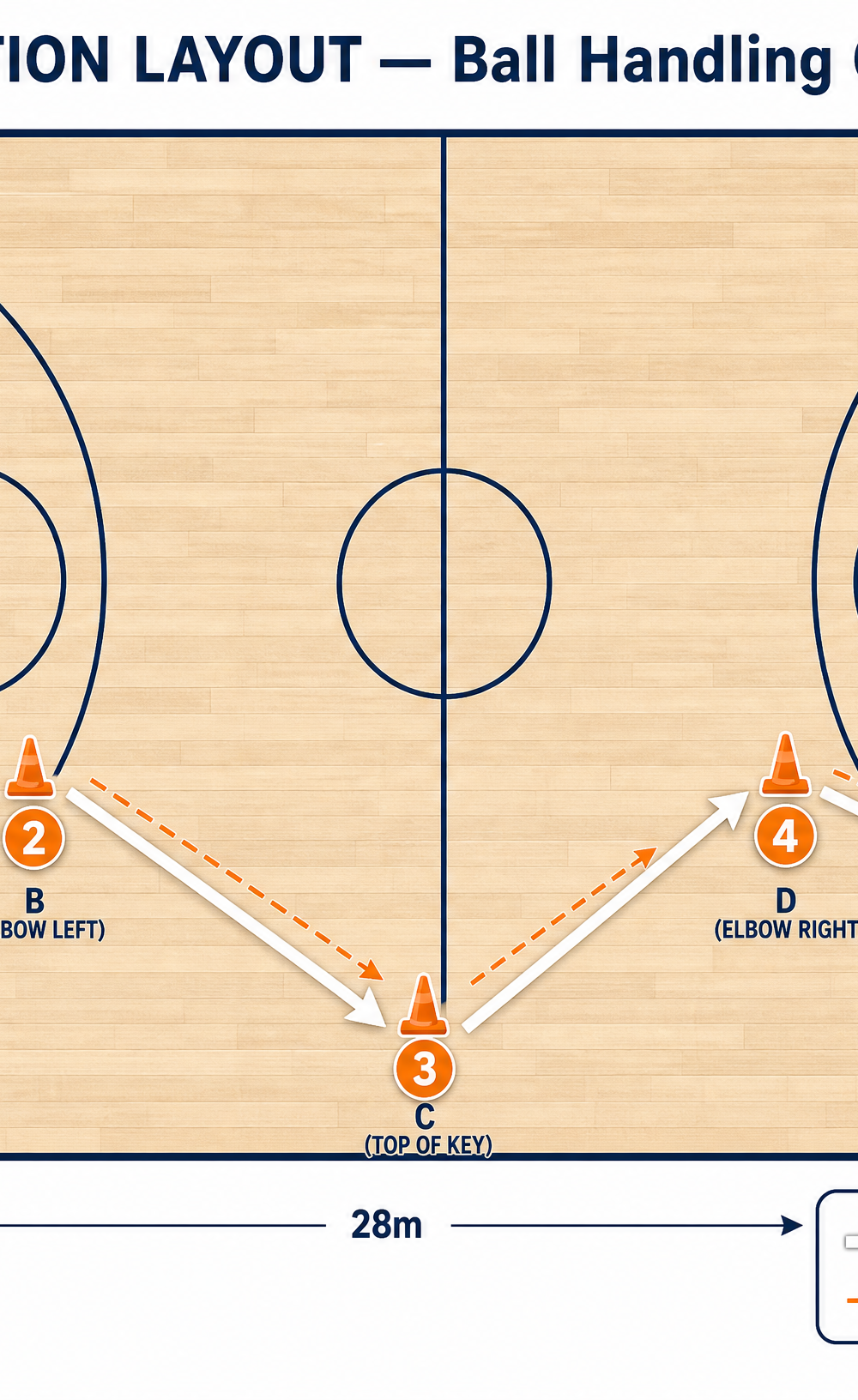
This drill utilizes a standard FIBA half-court (14m x 15m). You will need 5 basketballs (one for each station) and 10-12 traffic cones to mark the stations and pathways.
Divide your team into groups of 2-3 players per station. If you have a smaller team, assign one player per station.
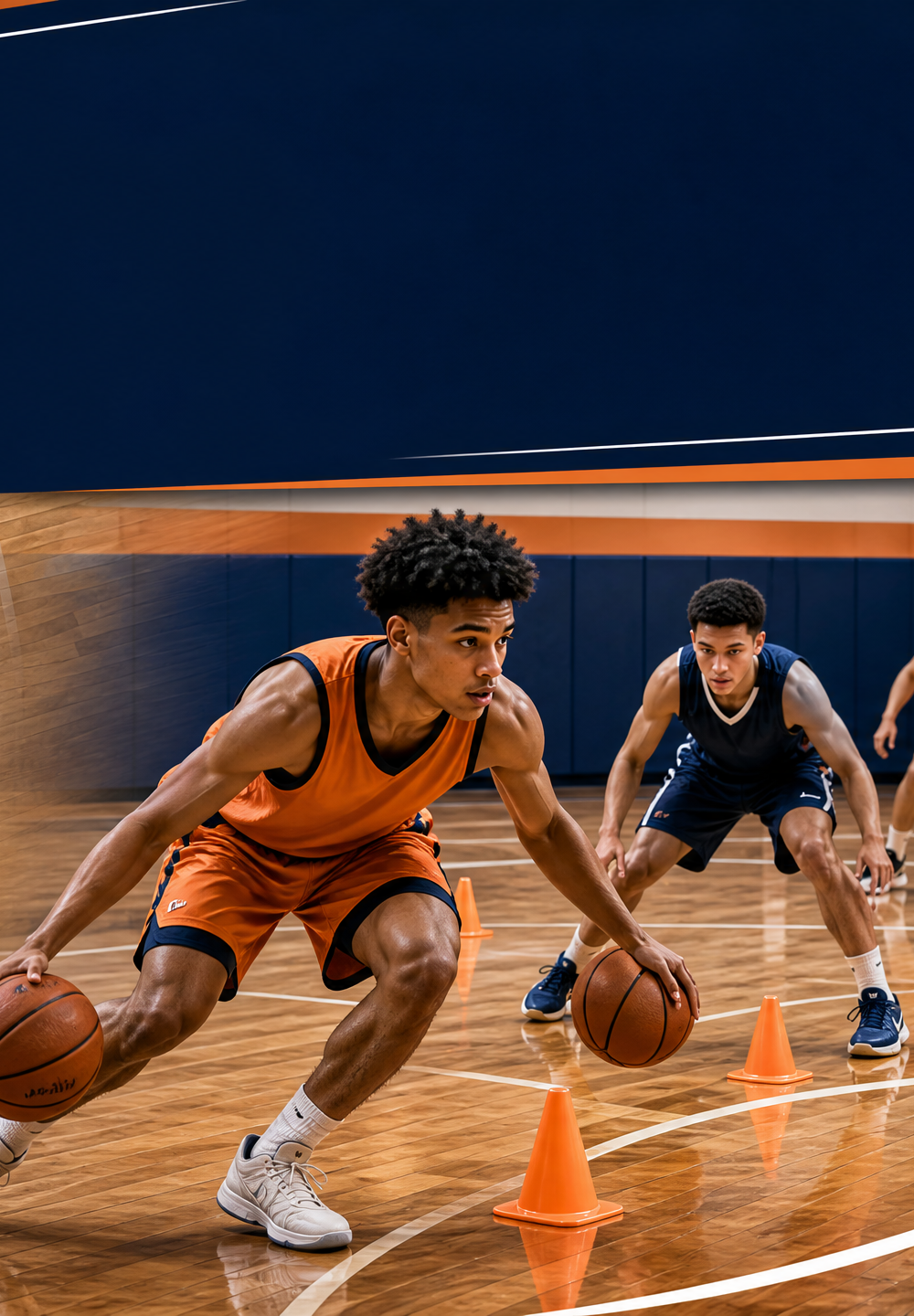
Station Locations:
- Station 1 (Top of Key): Stationary Ball Slaps & Wraps
- Station 2 (Left Sideline): Cone Slalom Crossover
- Station 3 (Paint/Key Area): Figure-8 Dribble
- Station 4 (Baseline): Speed Dribble Baseline Sprint
- Station 5 (Right Wing): Behind-the-Back & Between-Legs
3. Step-by-Step Instructions
Run the circuit on a strictly timed rotation. Set the clock for 45 seconds of intense work, followed by a 15-second rotation period to move to the next station.
Step 1: Station 1 — Stationary Ball Slaps & Wraps
Players start in an athletic stance at the top of the key. For the first 20 seconds, they aggressively slap the ball from hand to hand to build grip strength. For the remaining 25 seconds, they perform rapid ball wraps around their head, waist, and ankles (both directions).
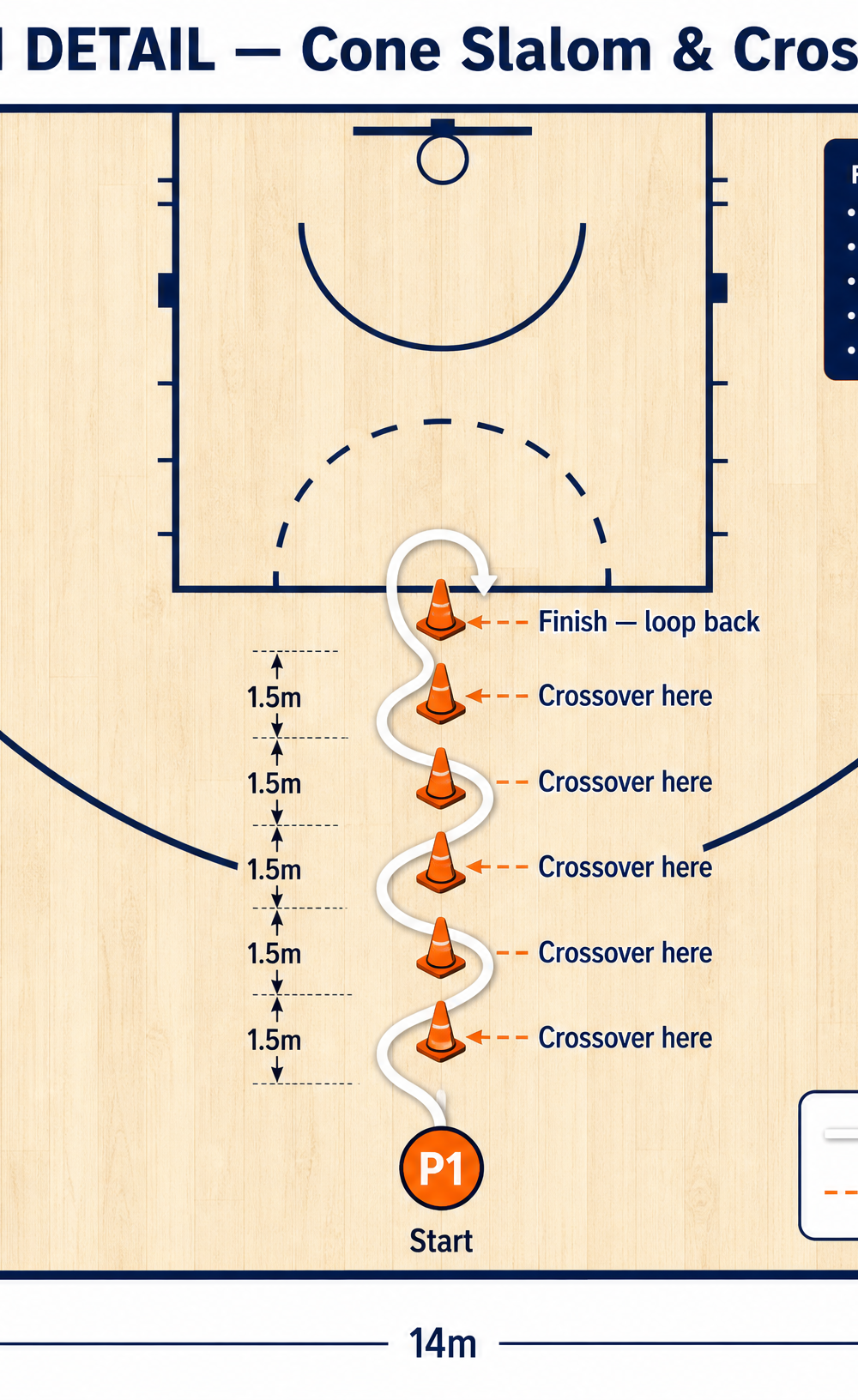
Step 2: Station 2 — Cone Slalom Crossover
Set up 5-6 cones in a straight line along the left sideline, spaced 1.5m apart. Players start at the baseline, dribbling through the cones in a tight weave. At each cone, they must execute a sharp, low crossover dribble. Once they reach the top cone, they speed dribble back to the start and repeat.
Step 3: Station 3 — Figure-8 Dribble
Located in the paint, players set up two cones shoulder-width apart. In a low, wide stance, players continuously dribble the ball in a figure-8 pattern around and through their legs. They must keep their eyes up and the ball low to the ground.
Step 4: Station 4 — Speed Dribble Baseline Sprint
Place one cone at the left baseline corner and another at the right baseline corner. Players speed dribble (pushing the ball out in front) from corner to corner. They must touch the cone, pivot, switch hands, and speed dribble back.
Step 5: Station 5 — Behind-the-Back & Between-Legs
At the right wing, players practice stationary combination moves. They perform a continuous rhythm of one between-the-legs dribble followed immediately by a behind-the-back dribble, alternating their lead leg.
Step 6: Rotation
On the coach's whistle, players have 15 seconds to rotate clockwise to the next station. The drill is complete when every player has completed all 5 stations.
4. Key Coaching Points
- Pound the Ball: Encourage players to dribble the ball as hard as they can. A harder dribble returns to the hand faster, giving the defender less time to steal it.
- Eyes Up to See the Floor: Players must fight the urge to look down at the basketball. Have coaches or resting players hold up numbers with their fingers that the dribblers must call out.
- Stay Low and Athletic: Maintain a wide base with knees bent and chest up. Dropping the hips provides better balance and explosiveness.
- Embrace Mistakes: If players aren't losing the ball occasionally, they aren't pushing themselves hard enough. Encourage them to go outside their comfort zone.
- Weak Hand Focus: Remind players to give equal, if not more, attention to their non-dominant hand during the circuit.
5. Common Mistakes
- Standing Straight Up: Players often lose their athletic stance as they get tired, making them slower and easier to defend.
- Pounding from the Shoulder: The dribble should originate from the elbow and wrist, not by moving the entire arm from the shoulder joint.
- Looking at the Ball: Staring at the floor prevents players from seeing open teammates or reading the defense.
- Slowing Down: Treating the drill as a casual shoot-around rather than a game-speed conditioning exercise.
6. Variations & Progressions
- Two-Ball Circuit (Advanced): Require players to use two basketballs at Stations 1, 2, and 4 to significantly increase the difficulty and coordination required.
- Tennis Ball Toss (Intermediate): Have players toss and catch a tennis ball with their off-hand while executing the dribbling moves at the stationary stations.
- Defensive Pressure (Advanced): Add a passive or active defender at the Cone Slalom and Speed Dribble stations to force players to protect the ball.
7. Age Adaptations
- Under 8 / Under 10: Simplify the stations. Replace the behind-the-back station with simple right-hand/left-hand stationary pounding. Reduce the work time to 30 seconds per station.
- Under 12 / Under 14: Run the standard circuit but focus heavily on correct mechanics over raw speed. Ensure the crossover is low and wide.
- Under 16 / Open: Implement the Two-Ball Circuit variation and demand absolute game-speed intensity. Decrease the rotation rest time to 5-10 seconds to increase the cardiovascular load.