Mastering the Middle Overs: The 'Strike & Rotate' Run Chase Strategy
Equip your batters with the tactical framework to dominate the middle overs (overs 15-40) through intelligent strike rotation, exploiting field gaps, and minimizing dot balls without taking undue risks.

Equipment Needed
1. Overview
The middle overs (typically overs 15-40 in a 50-over match, or 7-15 in a T20) are the engine room of a successful run chase. Too often, teams lose momentum here by either bogging down against spin or taking reckless risks to break a string of dot balls. The 'Strike & Rotate' set play provides batters with a clear, repeatable framework to manipulate the field, find the gaps, and maintain a healthy run rate of 5-6 runs per over with minimal risk.
This strategy shifts the mindset from 'hitting boundaries' to 'finding the single.' By constantly rotating the strike, you force the captain to change the field and disrupt the bowler's rhythm. Use this strategy when the fielding restrictions have eased, the field is spread (typically 4 or 5 men on the boundary), and you need to build a platform for the death overs.
2. Setup
To run this scenario in practice, you need to simulate match conditions as closely as possible.
- Equipment: Standard cricket gear, 10-15 cones (to mark fielders if you don't have enough players), a whiteboard for tactical briefing.
- Pitch Setup: A standard 22-yard pitch. Use a full oval if possible, or mark a 30-meter circle and boundary on a smaller ground.
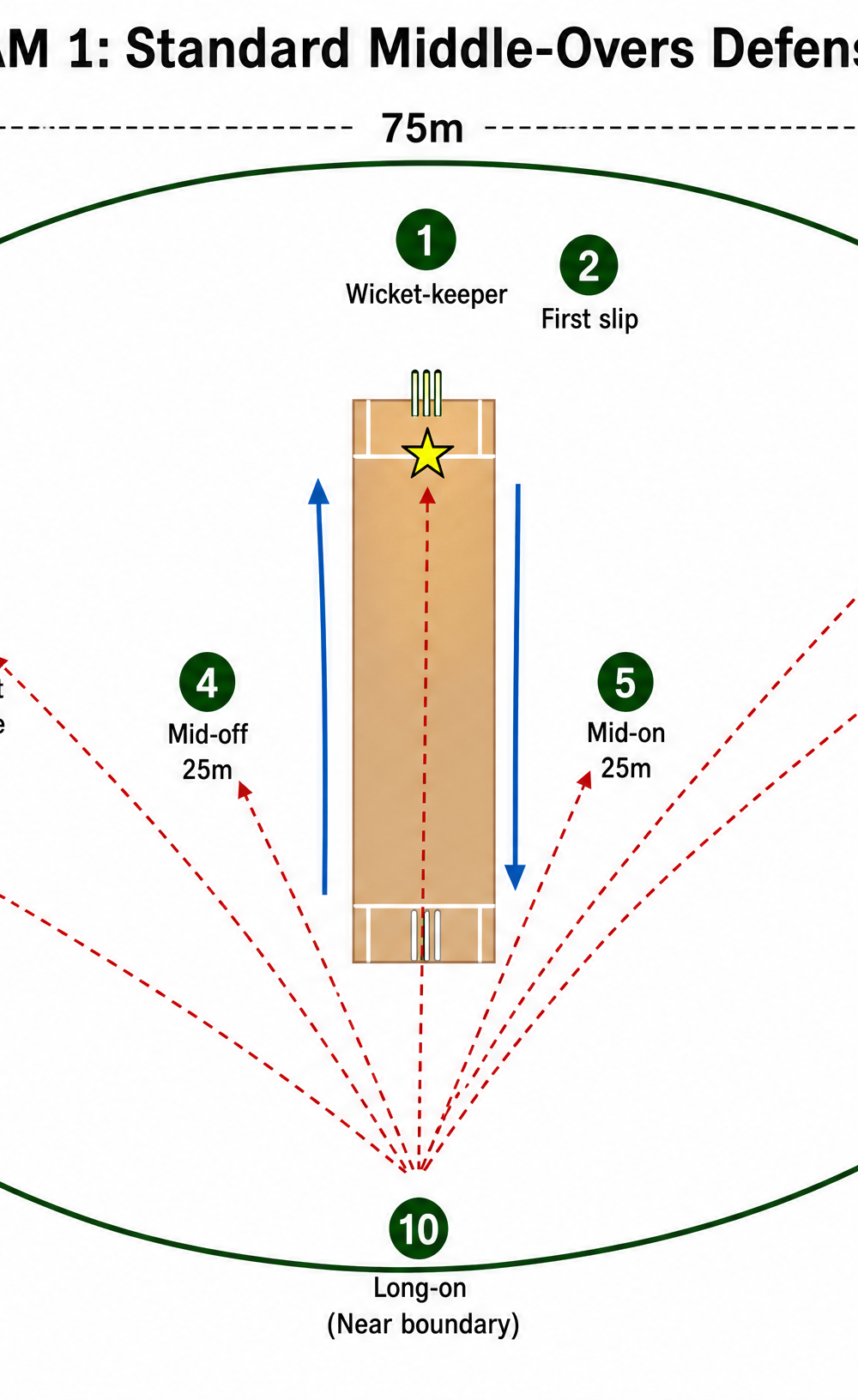
- Player Positions: Set a standard middle-overs defensive field (as shown in Diagram 1). You will need:
- Bowler and Wicket-keeper
- 4 inner-ring fielders (e.g., Point, Cover, Mid-wicket, Square Leg)
- 5 boundary riders (e.g., Long-off, Long-on, Deep Mid-wicket, Deep Square Leg, Third Man)
- Two batters fully padded up.

3. Step-by-Step Instructions
Run this as an active scenario session. Set a target (e.g., 60 runs off 10 overs) and have the batters execute the strategy.
Step 1: Analyze the Field (The Pre-Delivery Routine)
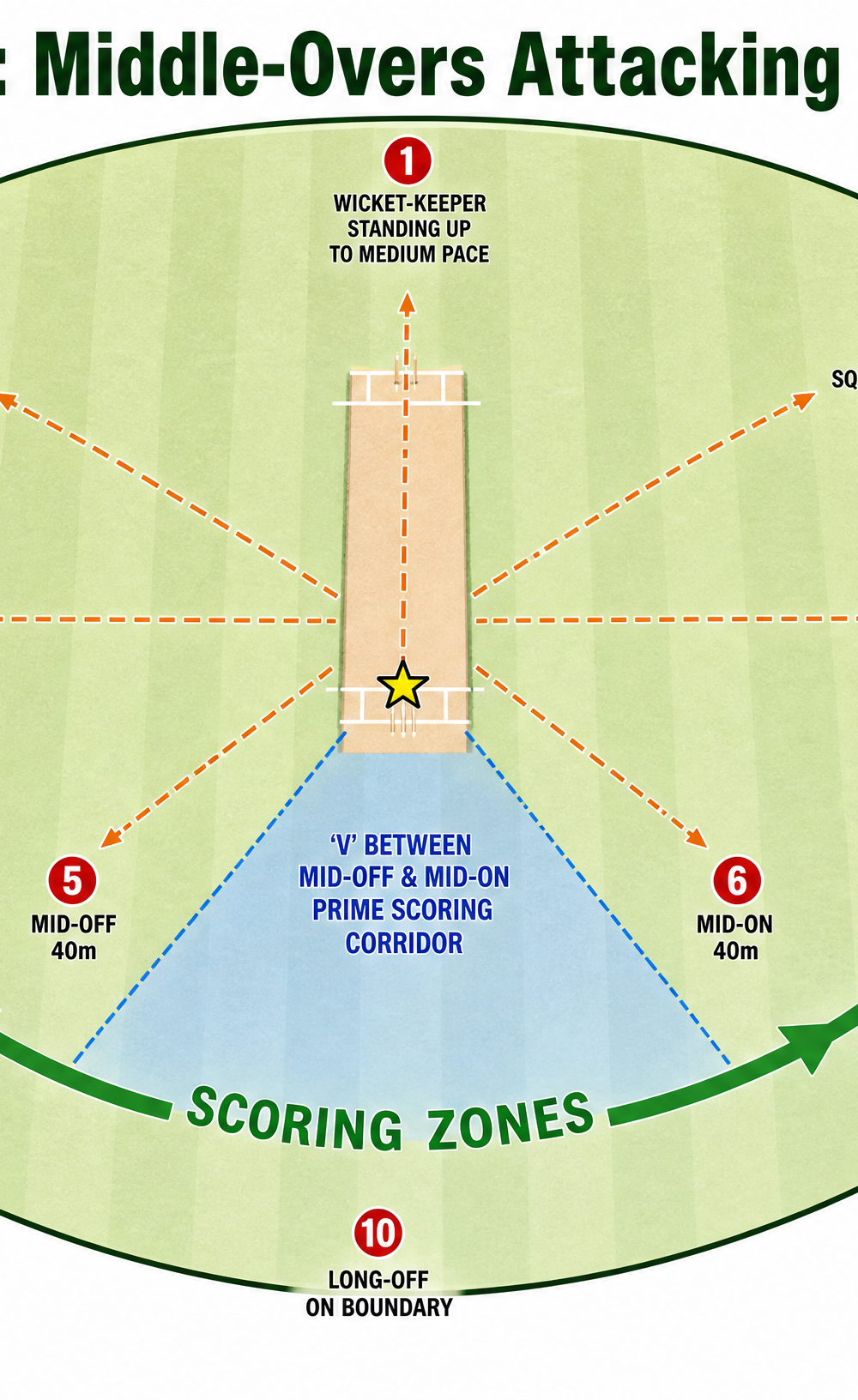
Before every ball, the striker and non-striker must scan the field. Identify the 'sweepers' (boundary riders) and the 'ring' fielders. The striker should mentally map the gaps where a soft push or drop-and-run will yield a safe single.
Step 2: The Non-Striker's Role (Backing Up)
The non-striker must back up aggressively. As the bowler enters their delivery stride, the non-striker should be walking in, ready to explode if the ball is hit into a gap. They should be 2-3 meters down the pitch as the ball is released, watching the striker's bat.
Step 3: Exploiting the 'V' and the Gaps
The striker's primary goal is to play the ball with soft hands into the gaps.
- Against pace: Look to drop the ball square on the off-side or tap it into the leg-side for a quick single.
- Against spin: Use the depth of the crease to work the ball square, or step out to drive down the ground to long-off/long-on for a comfortable single.
Step 4: The Call and the Sprint
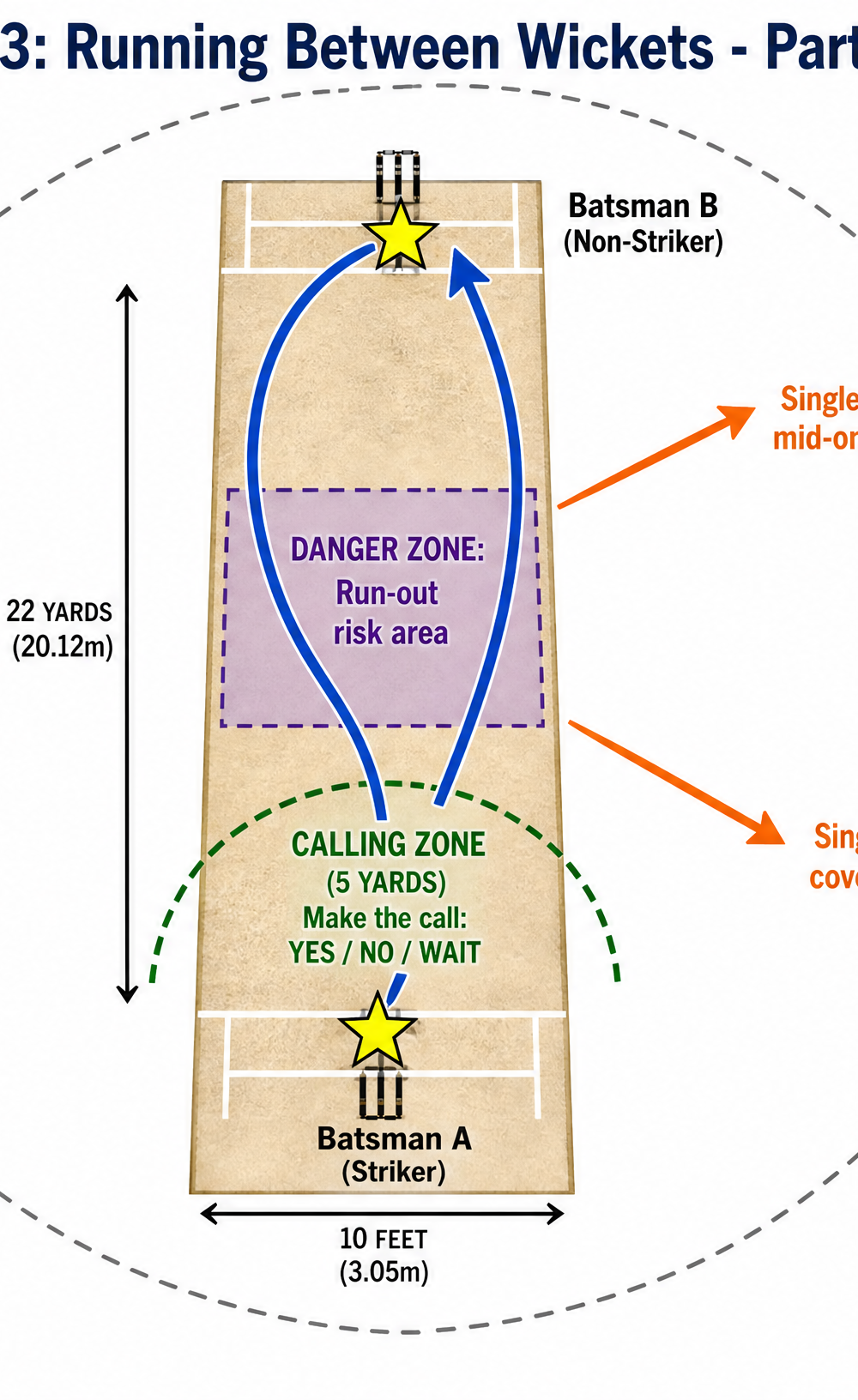
Communication must be loud, clear, and early. The golden rule: The batter hitting the ball in front of square makes the call. The non-striker calls for balls hit behind square. Use only three calls: "YES", "NO", or "WAIT". Once "YES" is called, both batters must sprint the first run hard, turning blind to the ball if necessary, to put pressure on the fielders.
Step 5: The Turn and Look (Pushing for Two)
Never settle for a single. As the batters complete the first run, they must turn aggressively, ground their bat, and immediately look at the fielder. If the fielder fumbles or is slow to the ball, the call for "TWO" should be immediate. This aggressive running forces fielding errors.
4. Key Coaching Points
- Soft Hands: Emphasize gripping the bat slightly looser to absorb the pace of the ball, allowing it to drop near the batter rather than pinging straight to a fielder.
- Proactive Footwork: Batters cannot be static. They must use the crease—going deep to play late, or coming down the track to smother spin—to manipulate where they hit the ball.
- Aggressive Running: The first 10 meters of the run are crucial. Batters must explode out of the crease and slide their bat in early to avoid run-outs.
- Target the Weak Arm: Train batters to identify fielders with weaker throwing arms or those who are slow to get down to the ball, and target their zones for quick singles.
5. Common Mistakes
- Pre-meditating Big Shots: Batters getting frustrated by dot balls and attempting a high-risk slog instead of working a single.
- Poor Backing Up: The non-striker being caught ball-watching or stationary at the non-striker's end, missing out on easy runs.
- Hesitant Calling: Indecision or late calling ("Yes... No... Wait") leading to run-outs or missed opportunities.
- Hitting the Fielders: Striking the ball too hard directly at the ring fielders instead of finding the gaps.
6. Variations & Progressions
- Progression 1: The 'No Boundaries' Rule: To force strike rotation, play a scenario where boundaries count for zero runs. The only way to score is through running.
- Progression 2: The Squeeze: Bring the field in (e.g., 6 fielders in the ring). The batters must now find ways to hit over the infield or use precise placement to score.
- Variation: The Spin Choke: Bowl exclusively spin for 10 overs with a spread field to challenge the batters' ability to sweep, reverse sweep, and use their feet.
7. Age Adaptations
- Under 10s/12s: Focus purely on loud, clear calling ("YES", "NO") and running hard between the wickets. Don't worry too much about field manipulation yet.
- Under 14s/16s: Introduce the concept of soft hands and dropping the ball for quick singles. Start teaching them to analyze the field before each ball.
- Open/Senior: Full implementation of the strategy, including targeting specific fielders, aggressive turning for the second run, and advanced crease use against spin.