Cricket
Set Play
intermediate
Mastering the Slip Cordon: A Comprehensive Catching Field Setup
Learn how to build a dominant slip cordon and catching field to create and convert wicket-taking opportunities with pace bowling.
Jul 12, 20265 min read20 min drill11 players

Equipment Needed
Cricket ball (new/semi-new)
Stumps and bails
Wicket-keeping gear
Slip cradle (for practice)
1. Overview
The slip cordon is the engine room of a pace bowler's attacking arsenal. Setting an effective catching field—specifically the slips and gully—is crucial for capitalizing on the movement and bounce generated by fast bowlers. This set play focuses on establishing a traditional attacking field designed to take wickets with the new ball or when conditions favour seam and swing. By positioning fielders in optimal catching zones, coaches can maximize the chances of dismissing top-order batsmen through outside edges.
2. Setup
Equipment Needed:
- 1 cricket ball (preferably a new or semi-new ball)
- Stumps and bails
- Wicket-keeping gloves and pads
- Protective equipment for close-in fielders (optional but recommended for short leg/silly point if used)
Field Setup:
- Use a standard 22-yard pitch on an oval ground.
- Position the Wicket-Keeper at a comfortable distance back from the stumps to catch the ball at waist height.
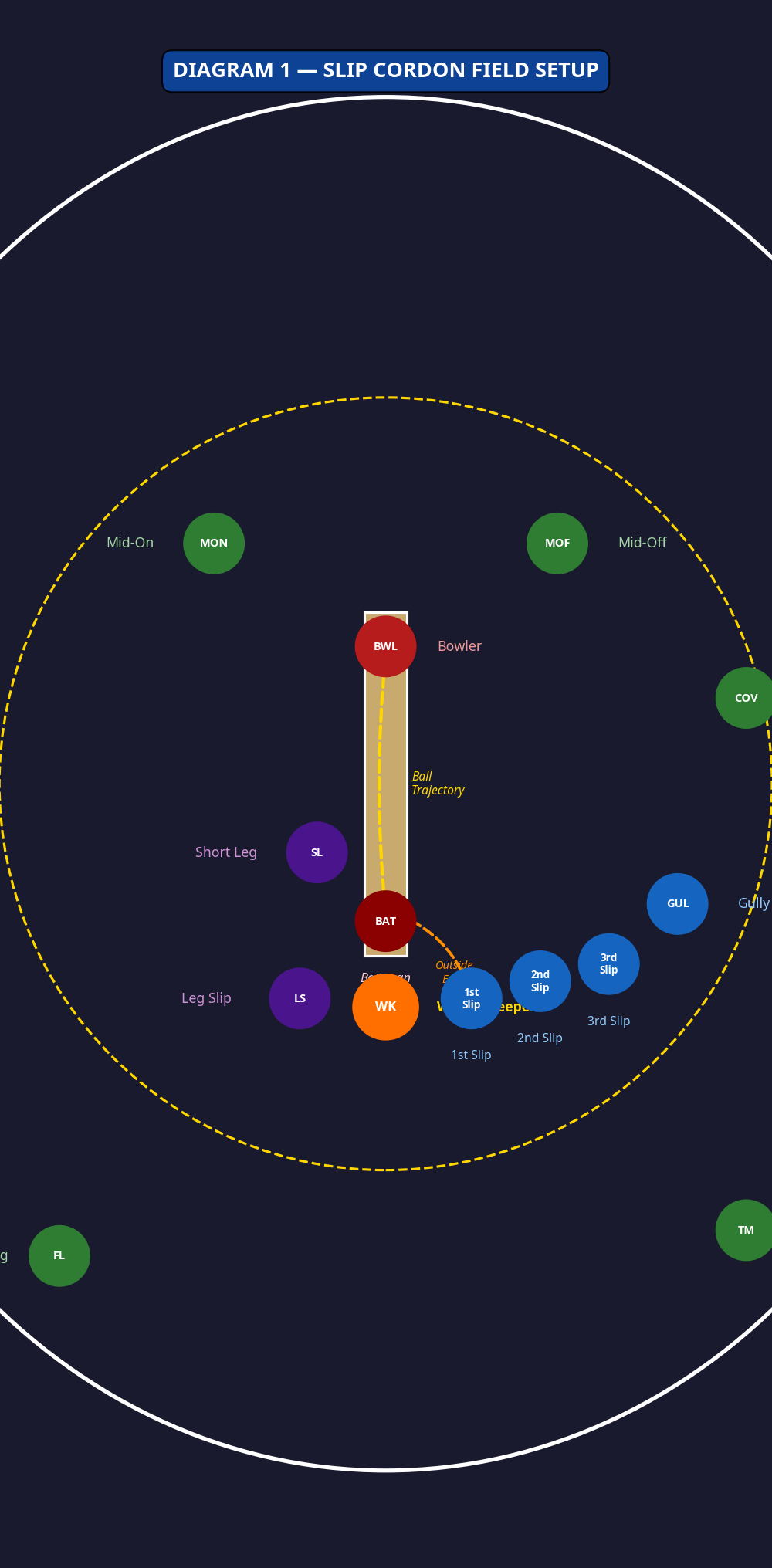
- Deploy three slips and a gully on the off side.
- Add supporting catchers (e.g., leg slip or short leg) depending on the bowler's line and the pitch conditions.
3. Step-by-Step Instructions
- Establish the Wicket-Keeper's Position: The keeper sets the depth for the entire cordon. They must stand far enough back so that a standard edge carries to them comfortably at waist height. This distance varies based on the bowler's pace.
- Position First Slip: First slip stands adjacent to the keeper, slightly deeper (about half a pace back) and wide enough to cover the edge that goes just past the keeper's right glove (for a right-handed batsman). The gap should be roughly an arm's length plus a dive.
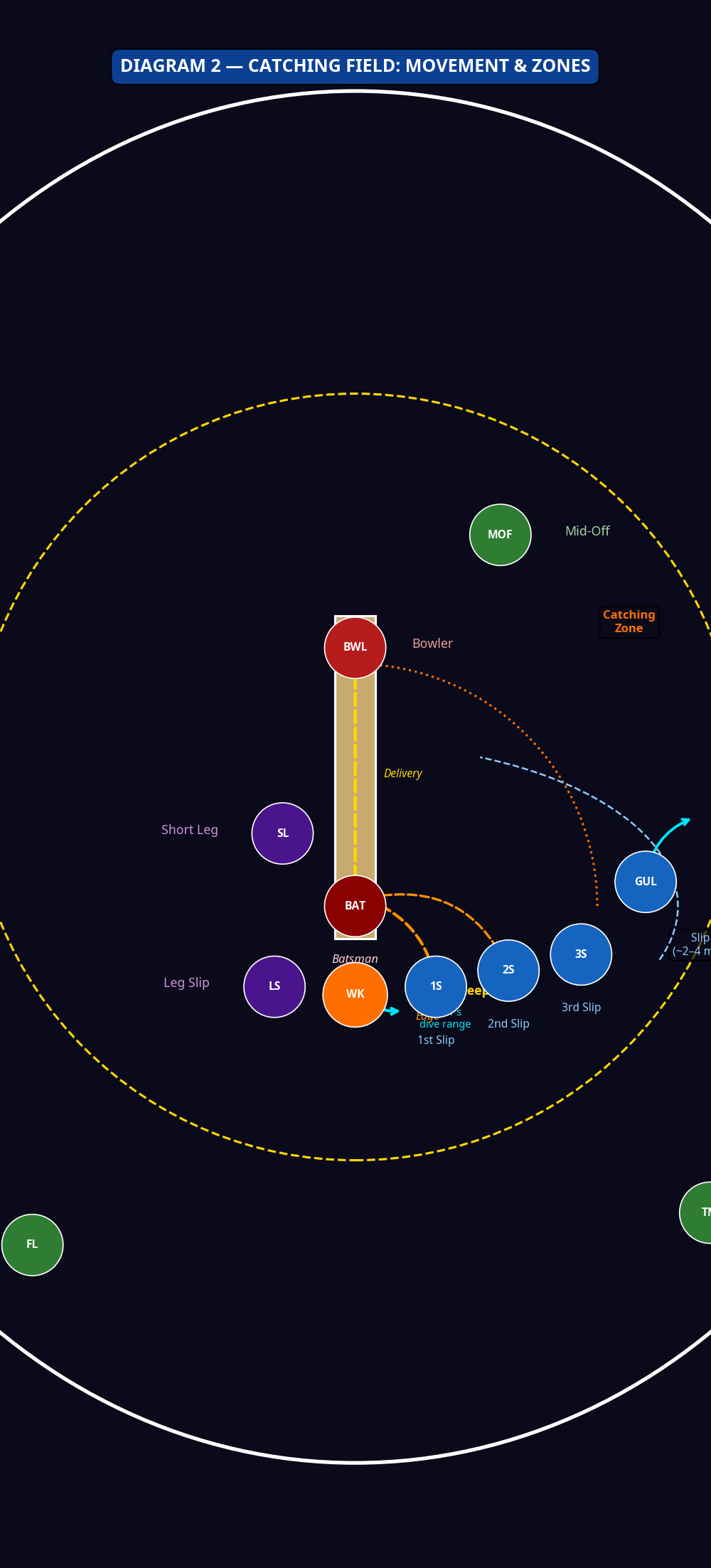
- Set the Arc (Second and Third Slips): Second slip stands slightly deeper than first slip, maintaining the same lateral gap. Third slip continues this staggered, diagonal arc. The stagger ensures fielders do not obstruct each other's vision or diving paths.
- Position the Gully: The gully fielder stands square of the wicket on the off side, typically in line with the batsman's popping crease but significantly wider than the slips. Their role is to catch thicker edges or square cuts played in the air.
- Coordinate Movement: As the bowler delivers the ball, all slip fielders must crouch in a balanced, ready position, rising slightly as the ball is released, with eyes intensely focused on the outside edge of the bat.
4. Key Coaching Points
- Staggered Alignment: Ensure the slip cordon forms a distinct diagonal arc. If fielders stand in a straight line, they risk colliding or blocking each other's line of sight.
- Soft Hands: Teach fielders to catch with "soft hands"—letting the ball "give" into the palms rather than snatching at it, which often causes the ball to pop out.
- Low Center of Gravity: Fielders must stay low. It is much easier to push up for a high catch than to dive down for a low one. Weight should be on the balls of the feet.
- Watch the Ball, Not the Bowler: Slip fielders must focus entirely on the release point and then the bat's edge. Anticipation is key.
- Communication: The wicket-keeper is the captain of the cordon. They must dictate the spacing and ensure no gaps are left unexploited.
5. Common Mistakes
- Standing Too Close: Fielders standing too close to the bat will see edges fly past them before they can react. It is better to stand a half-pace too deep and dive forward than to be beaten for pace.
- Uneven Spacing: Irregular gaps between slips lead to confusion over whose catch it is, resulting in dropped chances between fielders.
- Rising Too Early: Fielders who stand up before the ball reaches the batsman lose their explosive diving power and often drop low catches.
- Hard Hands: Snatching at the ball creates a rigid surface, causing the ball to bounce out of the hands.
6. Variations & Progressions
- The Spinner's Cordon: For spin bowling, move the keeper up to the stumps and bring the slip fielder(s) much closer, typically just a single slip and perhaps a leg slip or silly point.
- The Squeeze: Remove third slip and add a short extra cover or short mid-wicket to apply pressure on a batsman who is defending solidly but struggling to score.
- Catching Practice Progression: Start with stationary edge practice using a slip cradle or catching ramp, then progress to live bowling in the nets to simulate match reactions.
7. Age Adaptations
- Under 10s / Under 12s: Use softer balls (Incrediballs) for catching practice to build confidence without fear of injury. Limit the cordon to one or two slips.
- Under 14s: Introduce the full slip cordon structure. Emphasize the staggered arc and the importance of staying low.
- Under 16s & Open: Focus on advanced reaction drills, diving catches, and adjusting depth dynamically based on the bowler's exact pace and the pitch's bounce.