Mastering the Slip Cordon: Positioning, Stance, and Catching Field Setup
A comprehensive guide to setting up an effective slip cordon, focusing on correct spacing, depth, body mechanics, and synchronized movement to maximize catching opportunities behind the wicket.
Equipment Needed
1. Overview
The slip cordon is arguably the most critical catching zone in cricket, especially in the longer formats (Test and First-Class cricket) and during the opening powerplays of limited-overs matches. A well-organized slip cordon applies immense psychological pressure on the batsman and capitalizes on the slightest error in judgment against pace and swing bowling. This set play resource provides coaches with the exact mechanics for setting up the cordon, ensuring optimal spacing, correct depth, and synchronized movement to turn half-chances into match-winning wickets.
Use this setup when the ball is new, swinging, or seaming, or when a new batsman arrives at the crease and is vulnerable outside the off-stump.
2. Setup
Equipment Needed
- 1x Cricket ball (new or well-maintained match ball)
- Stumps (at both ends)
- Bat (for the coach/feeder if running a drill)
- Slip catching cradle or Katchet board (optional for drills)
- Measuring tape or cones (for initial spacing alignment)
Pitch & Field Setup
Set up on a standard 22-yard cricket pitch. The primary focus is the area directly behind the stumps at the striker's end.
Player Positions (Seam Bowling)
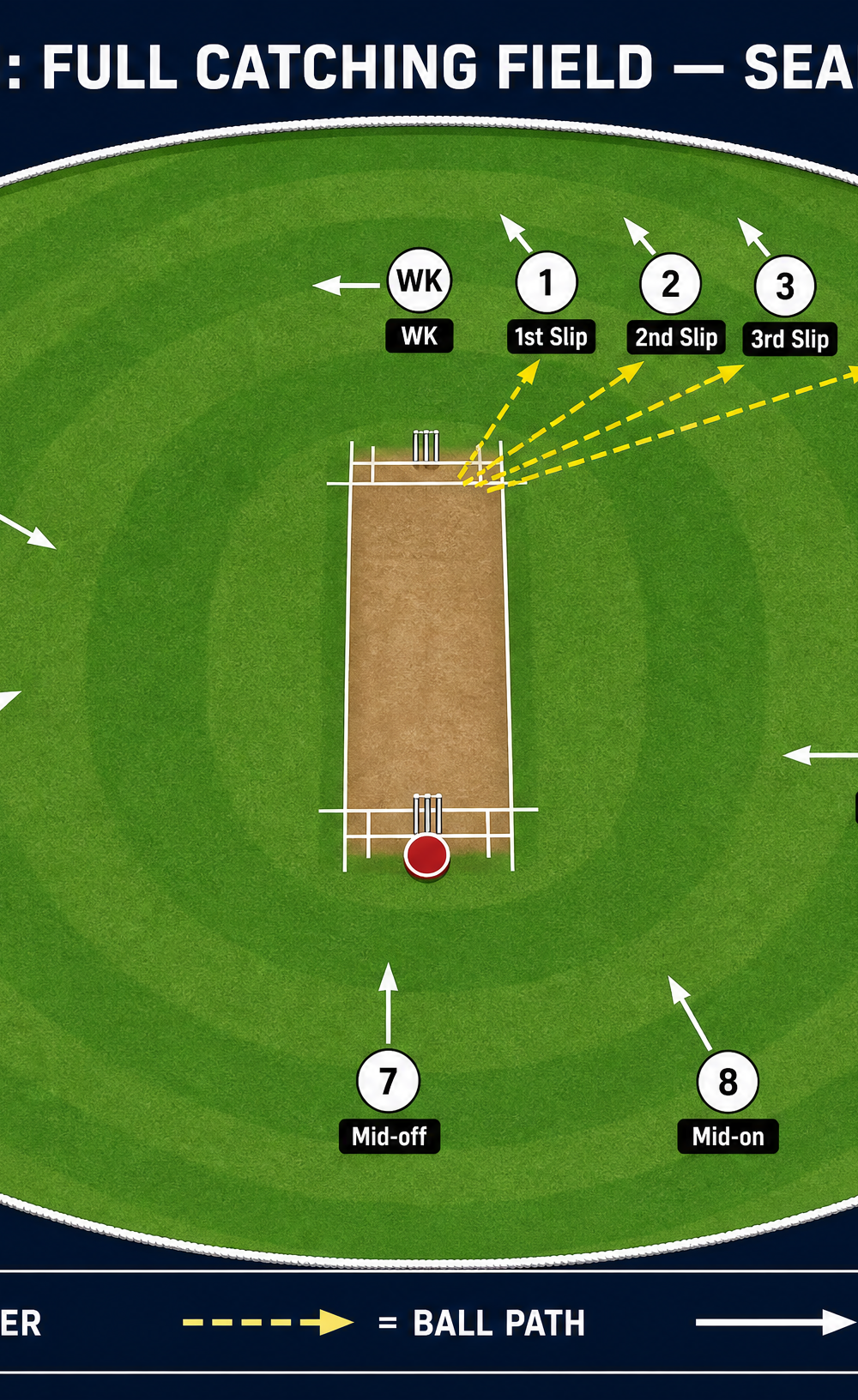
- Wicketkeeper (WK): Standing back. Distance depends on the bowler's pace, typically 15-20 metres behind the stumps, ensuring the ball is taken at waist height.
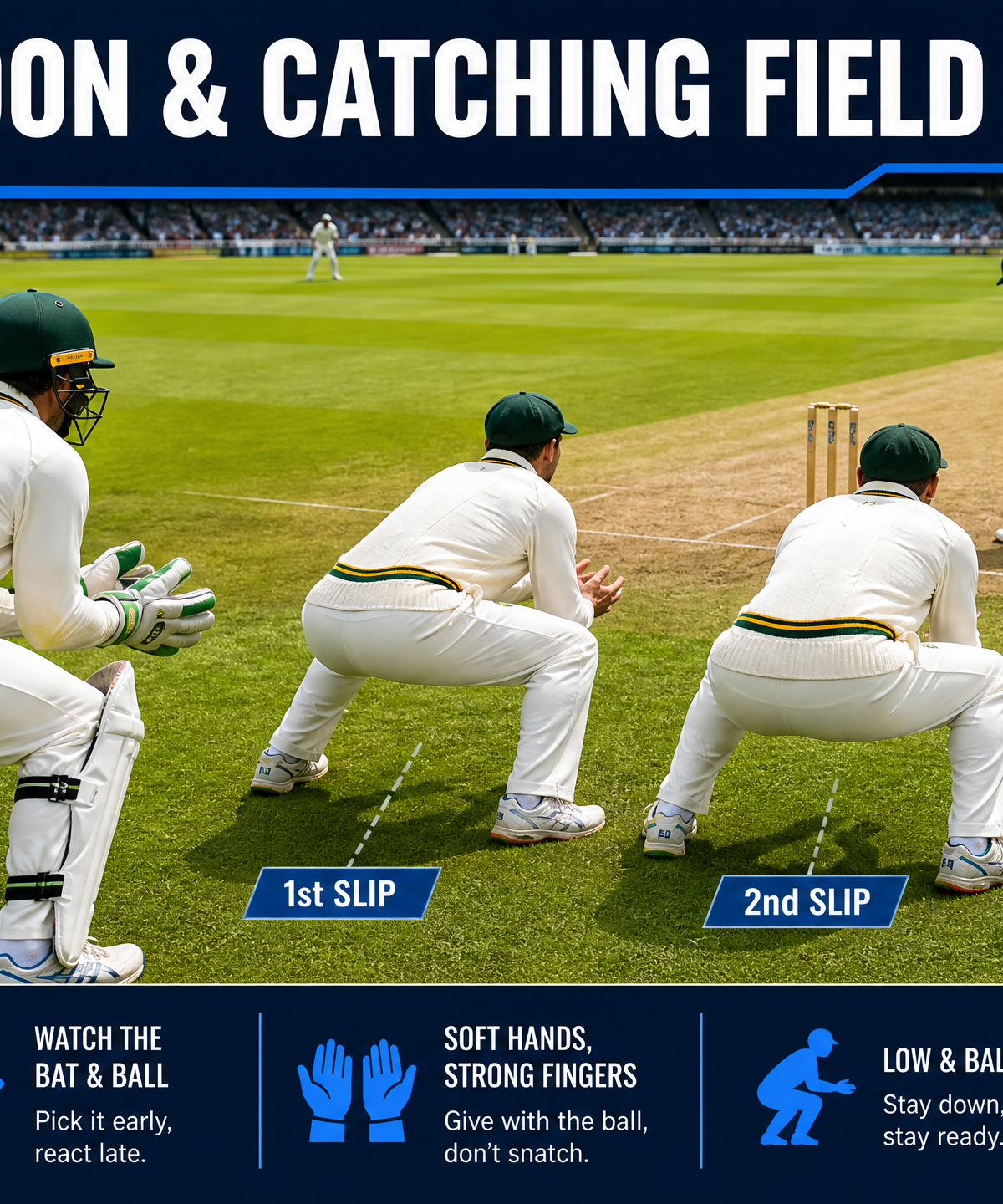
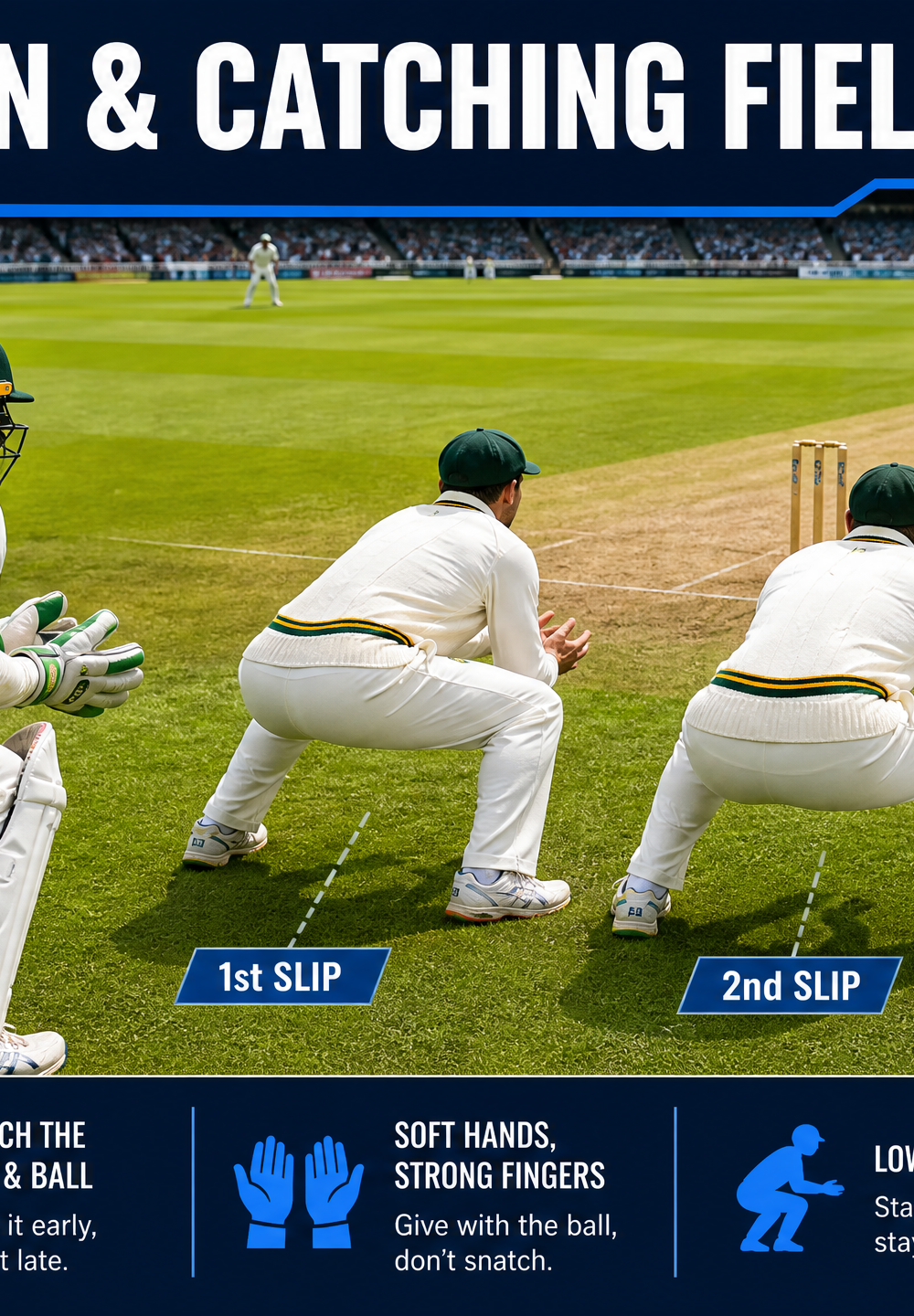
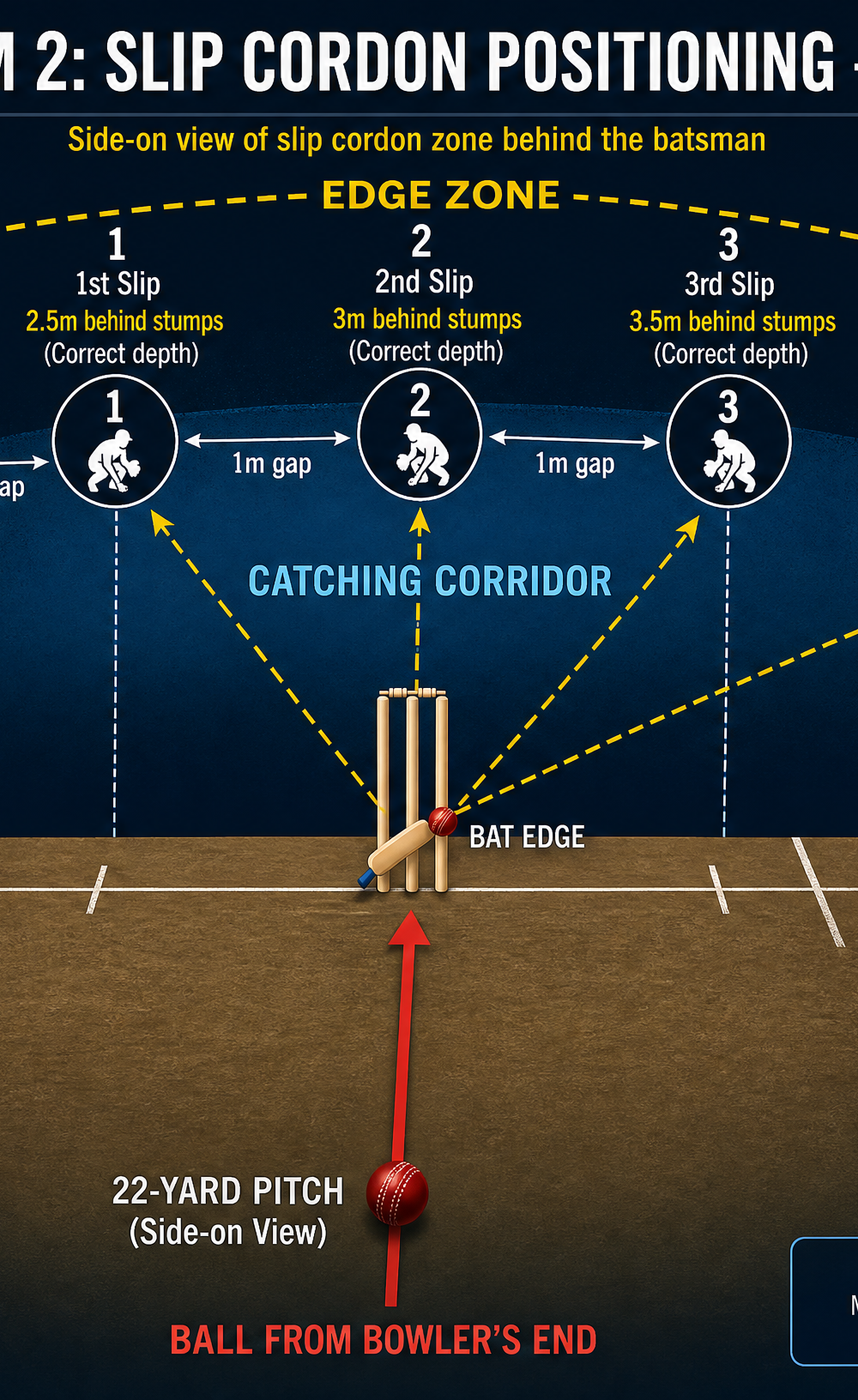
- 1st Slip: Positioned slightly deeper than the wicketkeeper. The lateral gap between the WK and 1st slip should be roughly an arm's length plus a bat width (approx. 1 to 1.5 metres).
- 2nd Slip: Positioned slightly deeper than 1st slip, maintaining the same 1 to 1.5-metre lateral gap.
- 3rd Slip: Positioned slightly deeper than 2nd slip, maintaining the lateral gap.
- Gully: Positioned squarer than the slips, often slightly forward of the 3rd slip's depth, anticipating the harder, sliced edge.
3. Step-by-Step Instructions
- Establish the Base (The Wicketkeeper): The WK sets the depth based on the bowler's pace. All slip fielders take their depth cues from the WK.
- Set the Stagger (The Diagonal Line): 1st slip stands approximately half a step deeper than the WK. 2nd slip stands half a step deeper than 1st slip. 3rd slip stands half a step deeper than 2nd slip. This diagonal formation prevents fielders from colliding when diving for the same ball.
- Set the Spacing (The Lateral Gap): The gap between each slip fielder must be precisely judged. It should be wide enough to cover maximum ground, but narrow enough that a ball cannot pass cleanly between them without at least one fielder being able to get two hands to it (typically 1 to 1.5 metres).
- Assume the Stance: As the bowler begins their run-up, fielders adopt a relaxed, upright position.
- The 'Crouch' and Synchronization: As the bowler enters their delivery stride, the entire cordon must crouch together. This synchronized movement ensures everyone is balanced and ready at the exact moment the ball is released.
- Track the Ball: Eyes must be fixed on the ball from the bowler's hand, tracking it onto the pitch and then to the bat. Do not just watch the bat edge.
- React and Move: If an edge is induced, the fielder pushes off the balls of their feet, moving low and decisively toward the ball, keeping hands soft to absorb the impact.
4. Key Coaching Points
- Synchronized Movement: The cordon must move as one breathing organism. If one fielder crouches early or late, it disrupts the peripheral vision and rhythm of the entire group.
- Low and Balanced Stance: Weight should be on the balls of the feet, knees bent, back straight, and hands resting lightly on the knees or hanging loose. The head must remain still and level.
- Watch the Ball, Not the Edge: Fielders must track the ball out of the bowler's hand. Relying solely on seeing the ball leave the bat edge severely reduces reaction time.
- Soft Hands: When catching, fielders must 'give' with the ball, bringing it into their body to cushion the impact, rather than snatching at it with hard hands.
- Clear Calling (Leave/Mine): For edges that go exactly between two fielders, the fielder moving to their right (for right-handed fielders) usually has the natural advantage, but clear, loud calling is essential to prevent collisions.
5. Common Mistakes
- Standing Too Close Together: This leads to hesitation, collisions, and dropped catches as two fielders go for the same ball.
- Standing Too Flat (No Stagger): If slips stand in a straight horizontal line, the fielder diving across will obscure the vision or physically block the adjacent fielder.
- Rising Up Too Early: Fielders often anticipate a leave or a play-and-miss and stand up before the ball has passed the bat. They must stay low until the ball is dead or past the stumps.
- Snatching at the Ball: Pushing hands out rigidly toward the ball causes it to bounce out. Hands must be soft and yielding.
6. Variations & Progressions
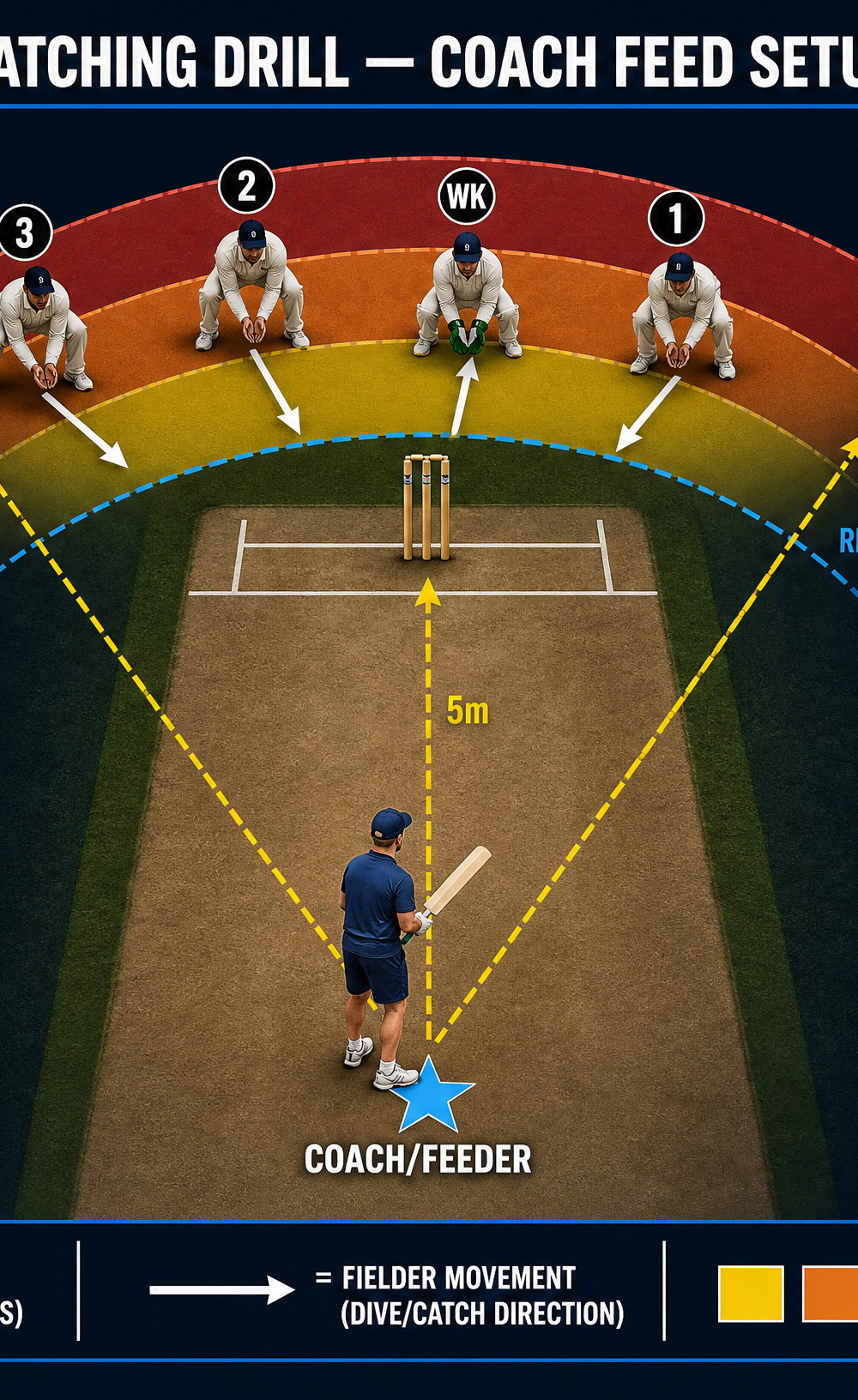
- Progression 1: Deflection Catching: Use a Katchet board or a slip cradle during practice. The coach throws the ball hard onto the board to simulate unpredictable, high-speed edges, forcing rapid reaction times.
- Progression 2: Blind Edges: Have a batsman stand at the crease and intentionally edge balls fed by a bowling machine. The slips must react to the true trajectory off the bat, rather than anticipating the coach's throw.
- Variation: Spin Bowling Setup: When a spinner is bowling, the WK stands up to the stumps. The slip (usually only one) moves much closer (approx. 3-4 metres from the bat) and stands squarer to catch the finer deflections.
7. Age Adaptations
- Under 10s/12s: Focus heavily on the basic catching technique (soft hands, watching the ball) using softer balls. Don't worry too much about a full cordon; one or two slips are sufficient to teach the concept of standing beside the wicketkeeper.
- Under 14s: Introduce the concept of the stagger and lateral spacing. Begin using deflection boards (with softer balls if necessary) to improve reaction times.
- Under 16s/Open: Full implementation of the tactical setup. Demand high standards of synchronized movement, prolonged concentration, and aggressive, diving catches.