Mastering the Offload: Contact and Support Drill
Equip your players with the technical skills and decision-making ability to keep the ball alive through contact with effective offloads.

Equipment Needed
1. Overview
The ability to offload the ball in contact is a devastating attacking weapon in modern rugby. It breaks defensive lines, maintains attacking momentum, and forces scrambling defenses to reorganize under extreme pressure. This comprehensive drill focuses on the core mechanics of taking contact on your terms, fighting through the tackle, and delivering a sympathetic pass to a supporting runner.
Designed for backs and forwards alike, this session emphasizes the 'fight, sight, and flight' principles: fighting to stay on your feet, sighting the support runner, and executing the flight of the ball cleanly.
2. Setup
To ensure high repetitions and quality execution, set up a focused grid area.
- Pitch Dimensions: Create a 20m x 15m grid using cones for Phase 1, expanding to a 30m x 20m grid for Phase 2.
- Equipment: 8-10 cones, 2-3 tackle shields (optional for initial progression), and 4 rugby balls.
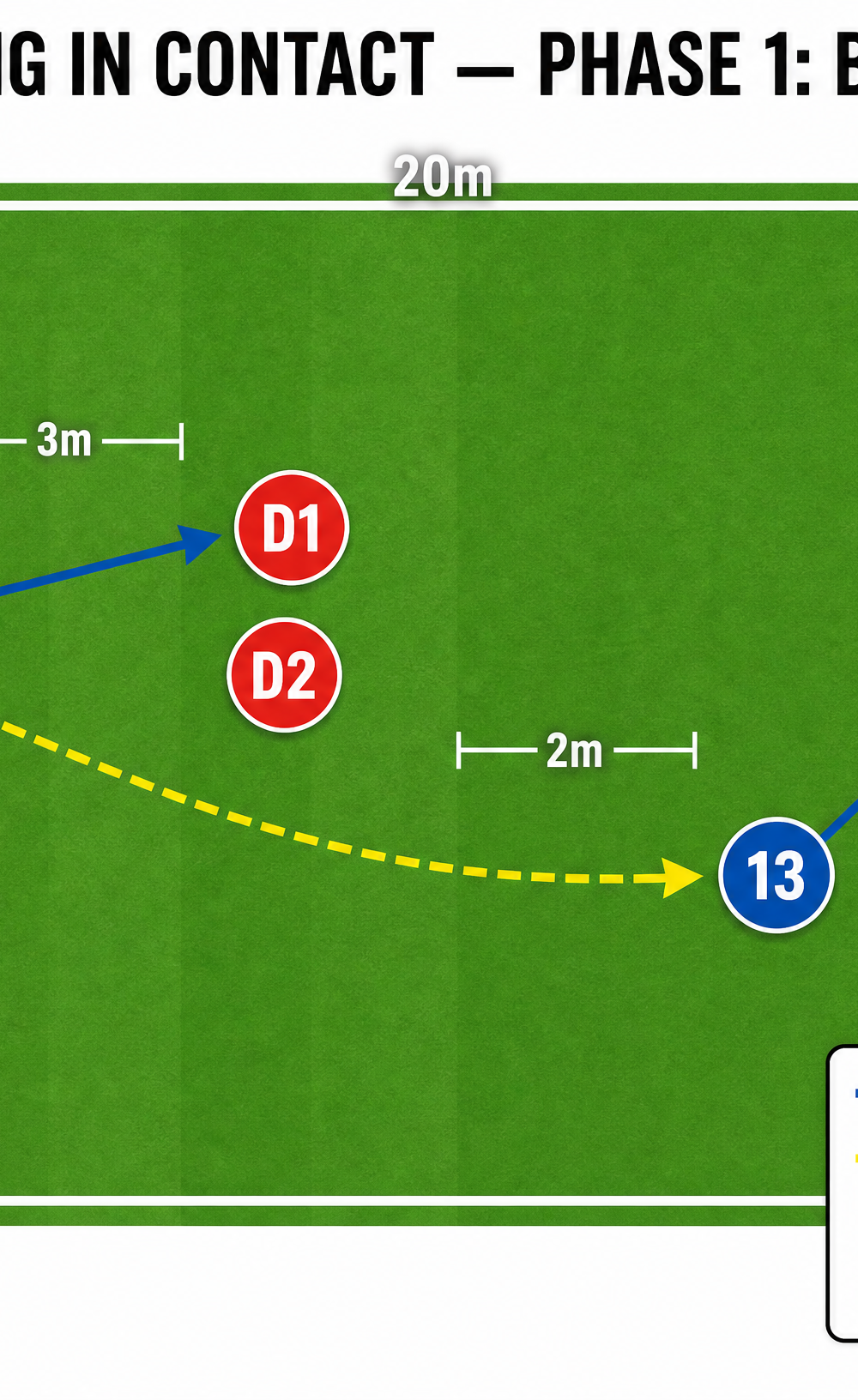
- Player Positions: You will need groups of 4-5 players per grid. Designate one Ball Carrier (e.g., 12), one Support Runner (e.g., 13), and two Defenders (D1 and D2).
3. Step-by-Step Instructions
Phase 1: The Basic Offload Setup
- Starting Positions: The Ball Carrier (12) starts at one end of the grid. The Support Runner (13) starts 2m behind and slightly to the side of the carrier. Two Defenders (D1, D2) stand 3m ahead of the carrier, holding tackle shields.
- The Approach: On the coach's whistle, the Ball Carrier accelerates toward D1, ensuring they carry the ball in two hands.
- The Contact: The Ball Carrier steps late to attack the weak shoulder of D1. Upon contact, the carrier must fight to stay upright, driving their legs through the tackle.
- The Offload: As the carrier breaks the tackle line or is held up, they must identify the Support Runner (13) calling for the ball. The carrier executes a one-handed or two-handed pop pass (the offload) to the support runner.
- The Finish: The Support Runner accelerates onto the ball and sprints through the end of the grid.
Phase 2: Adding Defensive Pressure and Decision Making
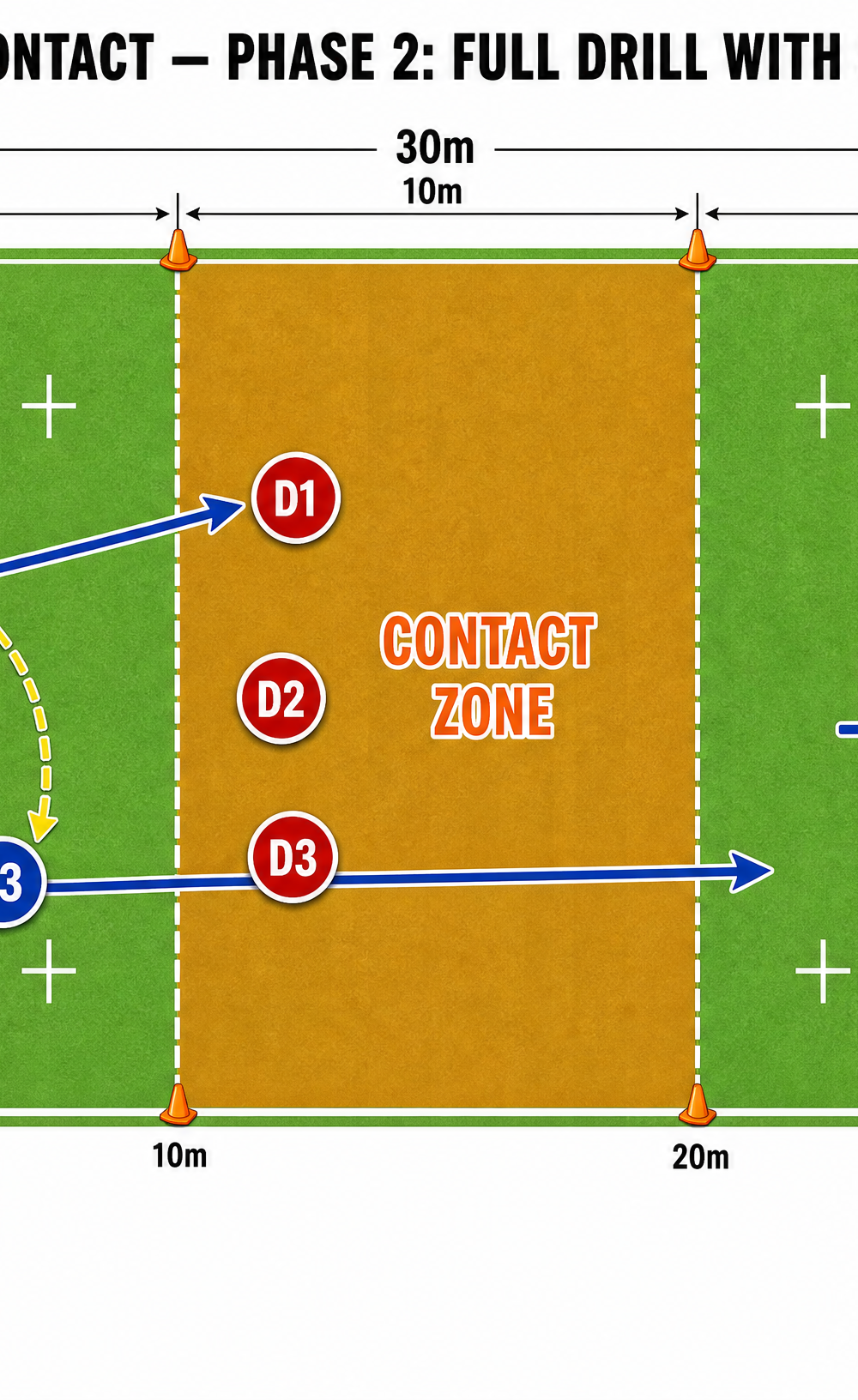
- Expanded Grid: Widen the grid to 30m x 20m. Introduce a third defender (D3).
- Dynamic Support: The Ball Carrier (8) attacks the line. The primary Support Runner (12) runs a hard line off the carrier's shoulder. A secondary Support Runner (13) wraps around for an outside option.
- Read and React: The Defenders are now 'live' (tackling below the waist). The Ball Carrier must read the defensive commitment. If D1 commits fully, offload to 12. If D2 drifts, offload wide to 13.
- Continuous Play: Once the offload is made, the original Ball Carrier must quickly get back to their feet (if tackled) and become a support option for the new carrier.
Phase 3: Game-Realistic Progression
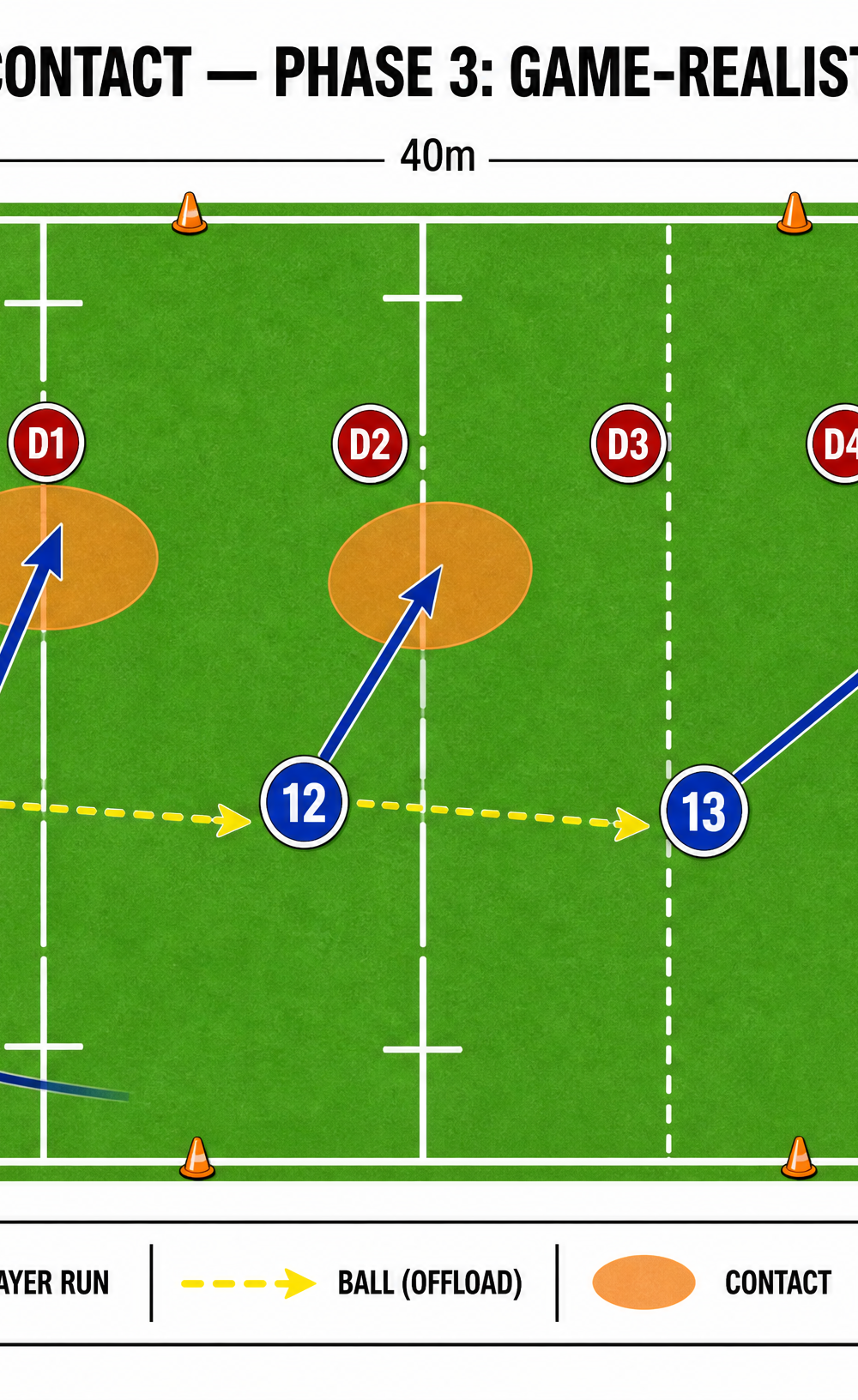
- Full Backline Integration: Set up a wider 40m x 25m channel. Integrate a Scrum-half (9) to initiate the play.
- Phase Play: The 9 passes to the Fly-half (10), who takes the ball to the line against D1. The 10 offloads to the Inside Centre (12).
- Second Phase Offload: The 12 immediately attacks D2, fighting through contact and looking to offload to the Outside Centre (13) or Wing (11) in the wider channels.
- Exploiting Space: The focus here is on rapid ball movement post-contact to exploit the space created on the outside before the defense can drift.
4. Key Coaching Points
- Ball Presentation: Always carry the ball in two hands prior to contact to keep defensive options guessing.
- Footwork Before Contact: Do not run straight into the defender. Use late footwork to attack their weak shoulder, ensuring you dominate the collision.
- Arm Freedom: When taking contact, the ball carrier must fight to keep the ball-carrying arm free from the tackler's wrap.
- Sympathetic Passing: The offload must be 'sympathetic'—popped softly into the space in front of the support runner, not fired like a bullet.
- Support Lines: Support runners must communicate early and run lines that anticipate the offload, staying close enough to receive a short pop pass.
5. Common Mistakes
- Forcing the Pass: Players often try to offload when the tackle is dominant and the ball is wrapped up, leading to turnovers. Teach players to recognize when to go to ground and present the ball cleanly.
- Poor Support Angles: Support runners arriving too flat or too deep. They must read the carrier's momentum and adjust their depth accordingly.
- Taking Eyes Off the Ball: The support runner looking up field before securing the offload, resulting in dropped balls.
- Upright Running: Ball carriers entering contact too high, making it easy for defenders to wrap the ball and prevent the offload.
6. Variations & Progressions
- The 'Offload Only' Game: Play a game of touch or grab rugby where the only way to advance the ball after being touched is via an immediate offload. If the player goes to ground, it's a turnover.
- Numbered Defenders: Assign numbers to defenders. As the ball carrier approaches, the coach calls a number. That defender drops back, forcing the carrier to identify the gap and offload to the appropriate support runner.
7. Age Adaptations
- Under 8s - Under 10s: Focus entirely on the mechanics of the 'pop pass' using tackle bags instead of live defenders. Emphasize running forward and passing backward safely.
- Under 12s - Under 14s: Introduce live, controlled tackling (below the waist). Focus on the decision of whether to offload or go to ground.
- Under 16s - Open: Full contact. Focus on dynamic support lines, secondary offloads, and exploiting the spaces created by the initial line break.