Pressing Trigger and Recovery Drill: Mastering the Mid-Block Press
Teach your players how to recognize pressing triggers, execute a coordinated mid-block press, and rapidly recover shape when the press is broken.
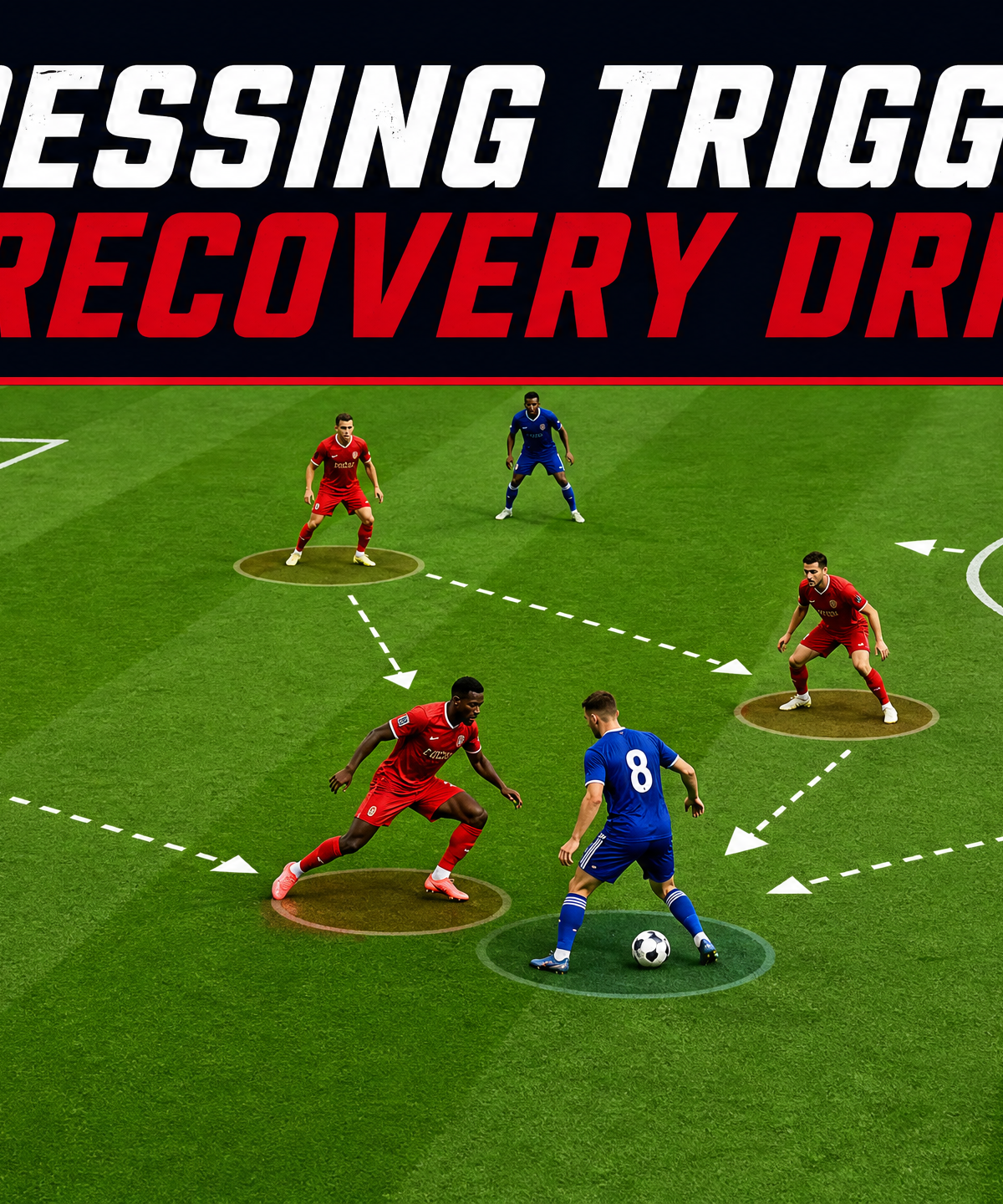
Equipment Needed
1. Overview
The Pressing Trigger and Recovery Drill is designed to develop a team's ability to execute a coordinated press from a mid-block and rapidly transition into a recovery shape if the initial press is bypassed. Modern football demands not only aggressive pressing but also the tactical intelligence to know when to press and how to react when the opposition successfully plays out.
This drill focuses on recognizing specific triggers—such as a poor touch, a slow sideways pass, or a backward pass to the goalkeeper—and launching a unified team press. Equally important, it trains the critical transition moment: the high-intensity recovery sprint to re-establish a compact defensive block if the pressing trap fails.
2. Setup
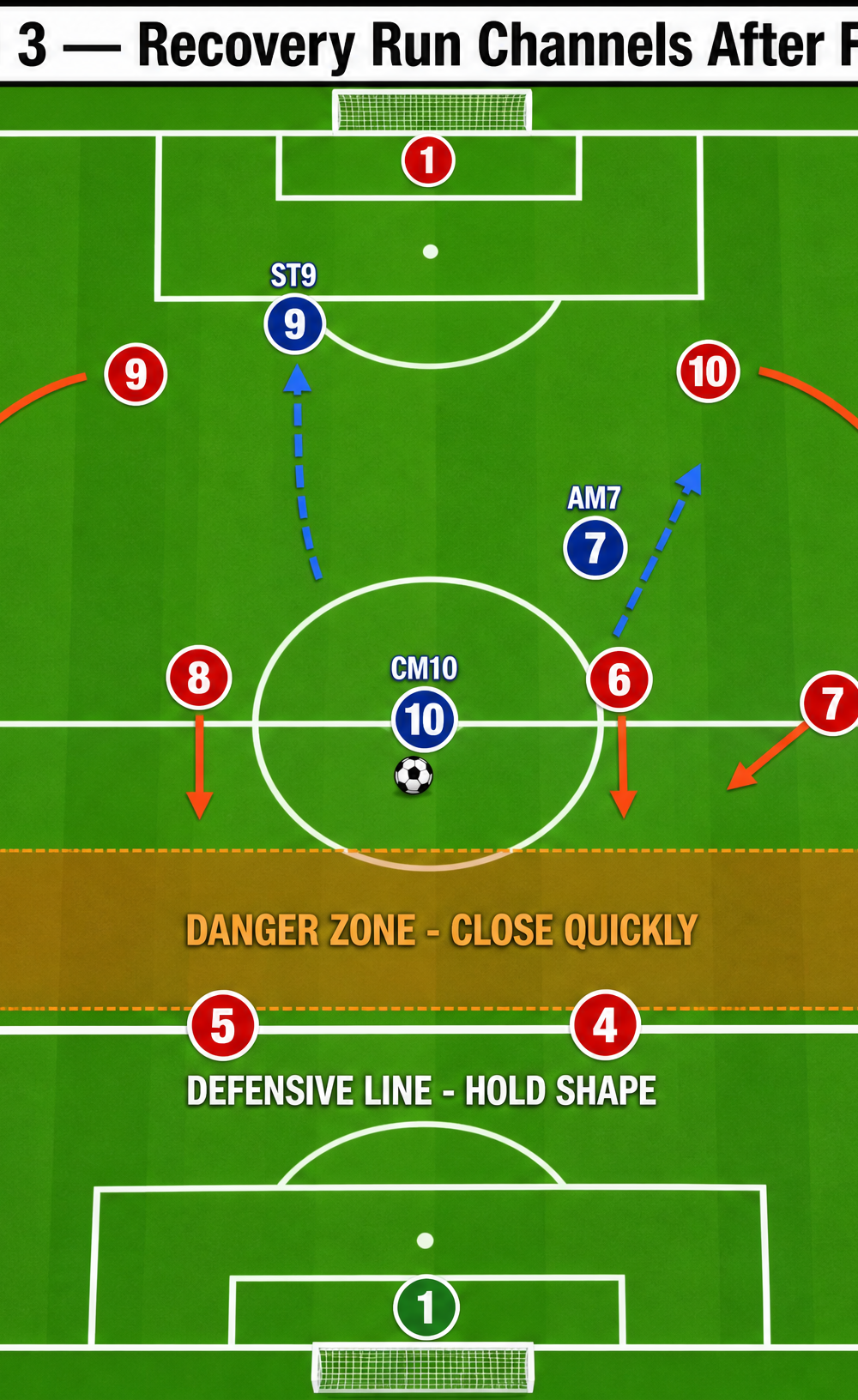
- Pitch Dimensions: 60m x 40m (Adjustable based on age group; standard 11v11 pitch width is ideal, using the area between the penalty box and halfway line).
- Players Required: 14-16 players (e.g., 8 attackers vs. 6 defenders + GK).
- Equipment Needed: 1 full-size goal, 3 mini-goals (or target zones), 10-15 training bibs (two colors), plenty of footballs, and cones to mark the pressing and recovery zones.
- Player Positions: Set up the defending team (Red) in a 4-4-2 or 4-3-3 mid-block shape. The attacking team (Blue) sets up as a back four with holding midfielders, looking to build out from the back.
3. Step-by-Step Instructions
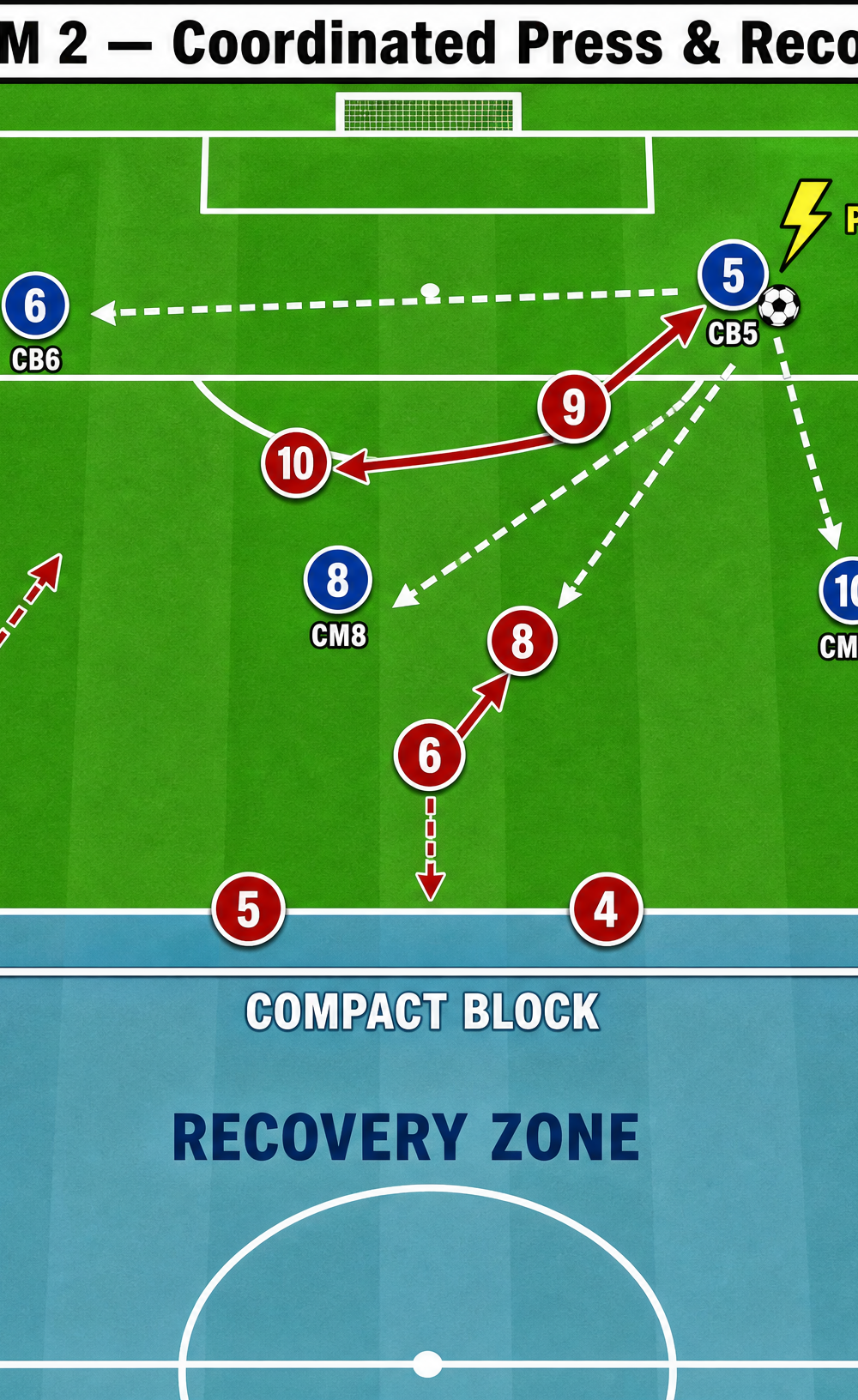
- Initial Shape: The attacking team (Blue) starts with the ball from their goalkeeper. The defending team (Red) sets up in a compact mid-block, allowing the Blue center-backs to have the ball initially.
- Identifying the Trigger: The Red team must hold their shape until a predefined pressing trigger occurs. Triggers can include:
- A slow, square pass between center-backs.
- A pass played backward to the goalkeeper.
- A poor first touch by a Blue defender.
- The ball being played to a fullback facing their own goal.
- Executing the Press: Once the trigger is identified, the closest player (usually the 9 or 10) initiates the press with a high-intensity sprint. The rest of the team must immediately step up to close down passing lanes, applying aggressive, coordinated pressure on the ball carrier.
- Winning the Ball: If the Red team successfully wins the ball in the pressing zone, they have 8 seconds to transition and score in the main goal.
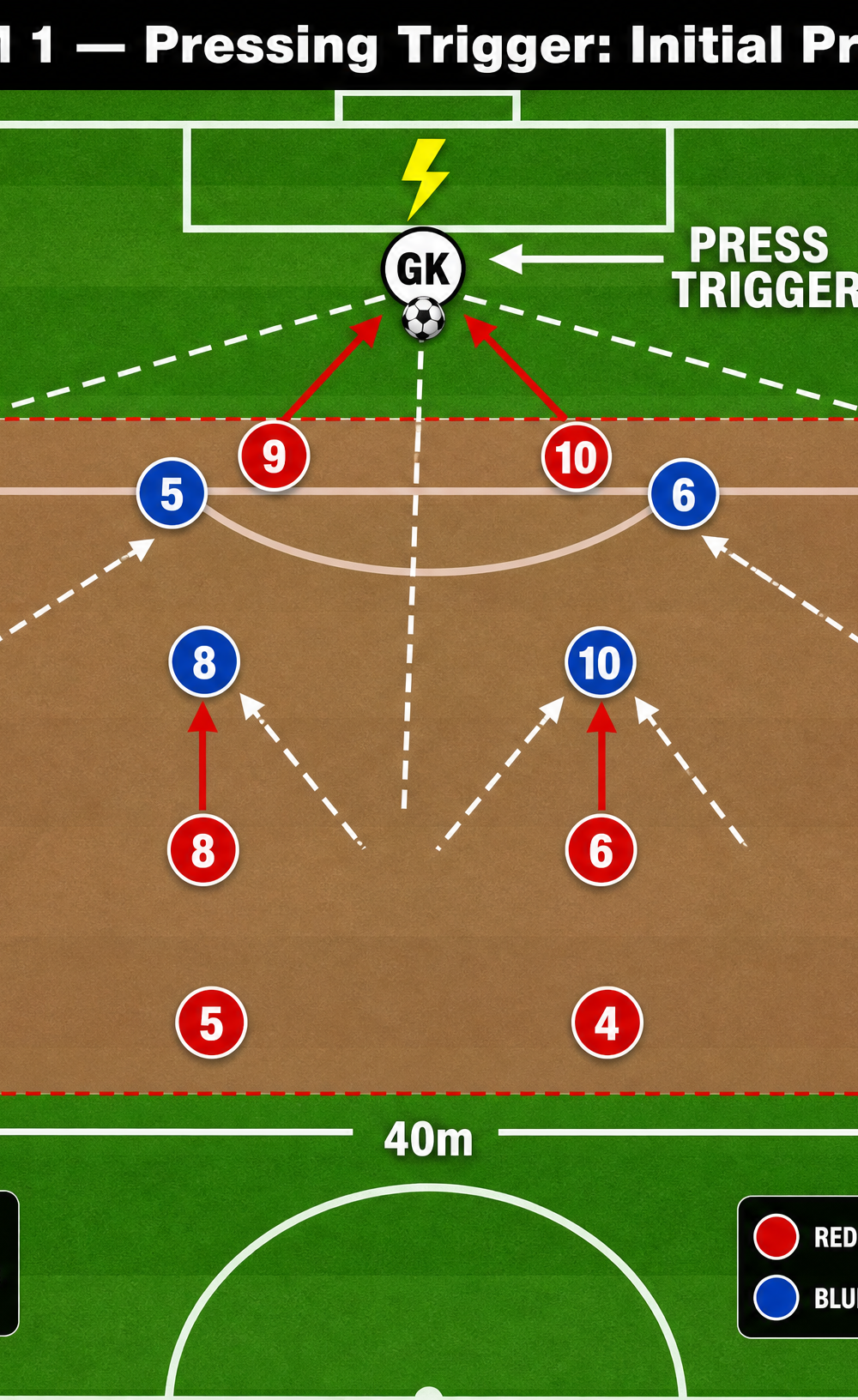
- The Recovery Phase: If the Blue team successfully plays through the initial press (e.g., by playing a line-breaking pass to their midfielders), the coach blows the whistle. The Red team must immediately abandon the press and execute a high-intensity recovery sprint to drop back into their designated recovery zone, re-establishing a compact defensive block.
4. Key Coaching Points
- Unified Movement: The press must be initiated together. If one player presses while the others hold back, the opposition will easily bypass the lone presser. The trigger must be a clear signal for the entire unit to shift.
- Body Shape on the Press: Approaching defenders must angle their runs to cut off passing options (curved runs) and force the ball carrier into predictable areas, usually toward the touchline or into a pressing trap.
- Communication: Constant communication is vital. Players behind the initial presser must dictate the intensity and direction of the press, calling out "Step!" or "Hold!"
- Transition Urgency: The moment the press is broken, the mindset must instantly shift from aggressive pressing to desperate recovery. The first 3-5 seconds after the press is bypassed are critical for dropping into a compact shape.
5. Common Mistakes
- Pressing Without a Trigger: Players pressing individually out of frustration or impatience, breaking the team's compact shape and leaving massive gaps for the opposition to exploit.
- Straight-Line Pressing: Defenders running straight at the ball carrier without curving their run to block the passing lane behind them.
- Jogging During Recovery: Players jogging back into position after the press is broken instead of executing a maximal-intensity recovery sprint to get behind the ball.
- Lack of Rest Defense: Defenders getting too carried away with the high press and failing to leave adequate cover at the back, leaving the team vulnerable to a quick counter-attack.
6. Variations & Progressions
- Add a Time Limit: Give the attacking team a strict 10-second time limit to play out of the pressing zone. This forces them to play quicker, increasing the difficulty for the pressing team.
- Overload the Attack: Add a neutral player (a "Joker") who always plays for the team in possession. This makes it harder for the pressing team to win the ball, emphasizing the importance of cutting off passing lanes rather than just chasing the ball.
- Specific Trigger Focus: Dedicate a 5-minute block to focusing solely on one specific trigger (e.g., only pressing when the ball is played to the fullback).
7. Age Adaptations
- Under-10 to Under-12: Focus heavily on the individual mechanics of pressing (body shape, curving the run) and the basic concept of "when one goes, we all go." Keep the space smaller and reduce the number of players to simplify decision-making.
- Under-14 to Under-16: Introduce more complex triggers and emphasize the tactical coordination of the entire unit. The recovery sprint becomes a non-negotiable physical requirement.
- Open/Senior: Implement position-specific pressing traps (e.g., forcing the ball wide to trap the fullback) and demand flawless execution of the transition between pressing and recovery shapes.