Mastering Support Angles: The 3v2 Wave Attack Drill
Develop your players' ability to run aggressive, late support angles that manipulate defenders and create line breaks in live game scenarios.
Equipment Needed
1. Overview
Support play is the lifeblood of attacking rugby. Too often, players arrive at the breakdown late, or worse, they run flat lines that make them easy targets for drift defense. The 3v2 Wave Attack Drill is designed to teach players how to hold their depth, read the defender's shoulders, and accelerate onto the ball at sharp, decisive angles. This drill bridges the gap between static passing exercises and live game scenarios, forcing support players to time their runs perfectly to exploit the space created by the ball carrier.
Use this drill during the tactical phase of your session, ideally after a dynamic warm-up and some basic handling skill work. It's highly effective for developing the connection between your playmakers (9, 10) and your strike runners (12, 13, or loose forwards).
2. Setup
To run this drill effectively, you need a defined space that forces players to make quick decisions under pressure.
- Pitch Dimensions: Create a grid measuring 30m long by 20m wide. For advanced players, narrow the width to 15m to decrease the available space and increase pressure.
- Equipment: 4 cones to mark the grid corners, 2 different colored bibs for the defenders, and 2-3 rugby balls at the starting point.
- Player Positions:
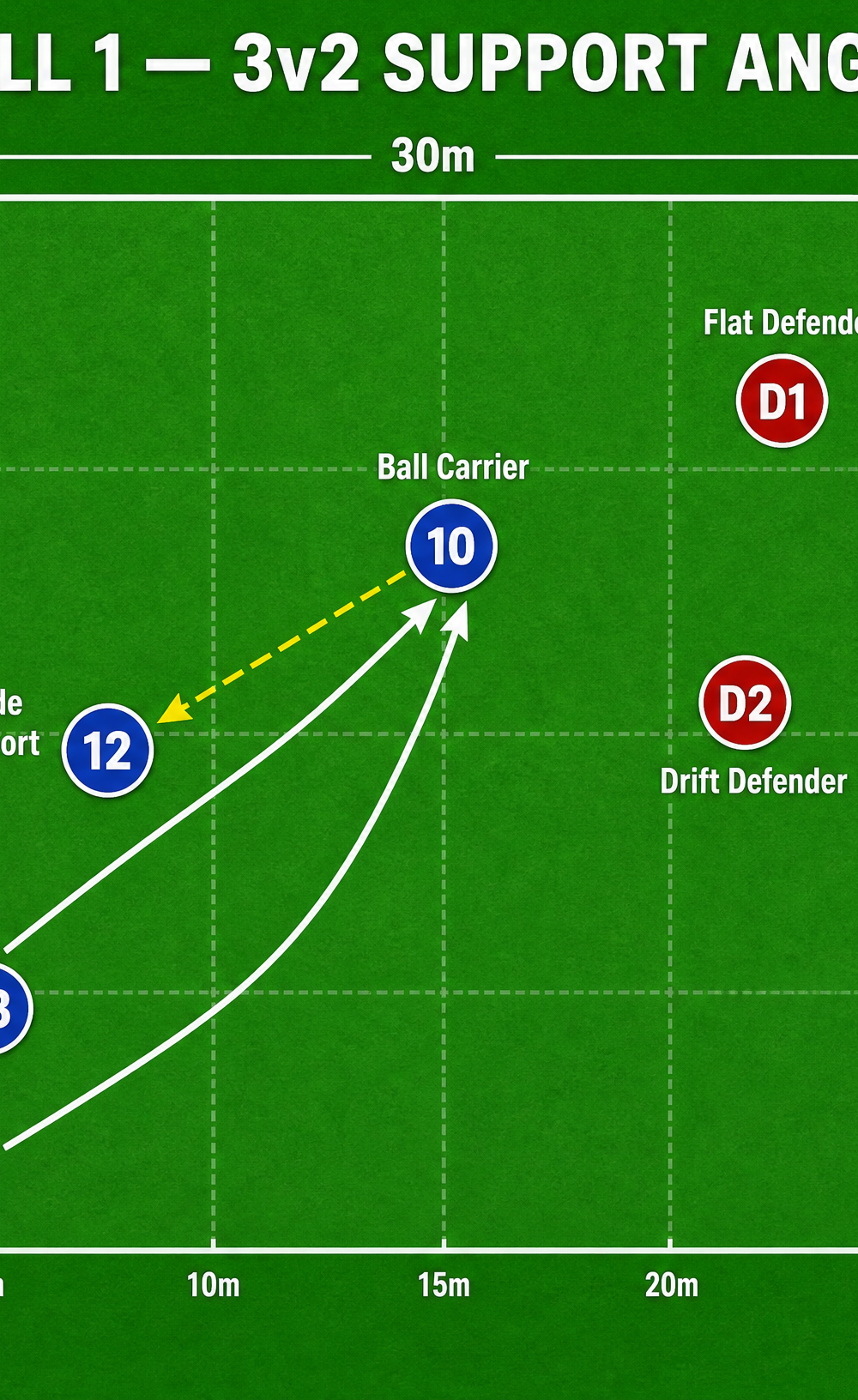
- Attackers (Blue): 3 players. A designated Ball Carrier (e.g., 10), an Inside Support runner (e.g., 12), and an Outside Support runner (e.g., 13).
- Defenders (Red): 2 players. One Flat Defender (D1) and one Drift Defender (D2).
3. Step-by-Step Instructions
- Starting Positions: The attacking trio starts at one end of the grid. The Ball Carrier (10) is central. The Inside Support (12) starts 3 meters behind and slightly to the side of the 10. The Outside Support (13) starts 5 meters behind and wider.
- The Initiation: The coach calls "Go!" The Ball Carrier (10) attacks the line aggressively, aiming at the inside shoulder of the Flat Defender (D1) to fix them in place.
- The Support Runs: As the 10 engages D1, the support runners (12 and 13) must hold their depth until the last possible second. They then accelerate, running sharp, converging angles toward the ball carrier.
- The Decision: The Drift Defender (D2) must make a choice.
- If D2 bites in on the Inside Support (12), the 10 passes out the back to the Outside Support (13).
- If D2 drifts wide to cover 13, the 10 hits 12 on a hard, flat line through the gap.
- The Finish: The attacking team must break the gain line (the 20m mark) cleanly without being touched. Reset and repeat.
4. Key Coaching Points
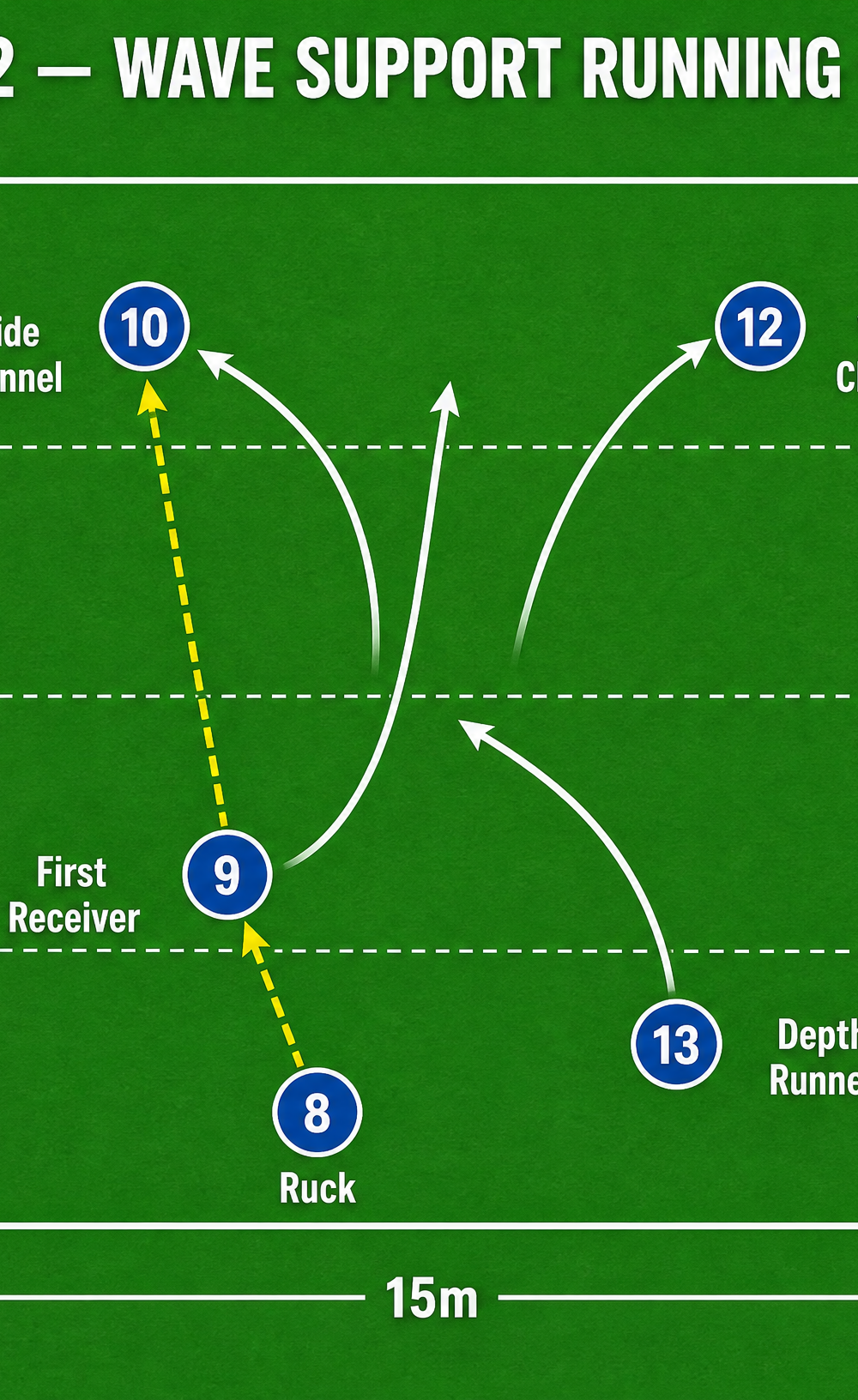
- Hold Depth: Support runners must resist the urge to flatten out too early. Depth buys time and vision. They should only accelerate when the ball carrier has committed the defender.
- Late Angles: The angle of the run should be late and sharp. A curved or arcing run allows the defense to drift. A sharp, hard angle cuts back against the grain of the drifting defense.
- Communicate Early, Demand the Ball: Support players must be vocal. They need to call for the ball before they hit the gap, giving the ball carrier confidence to make the pass.
- Ball Carrier's Shoulders: The ball carrier must stay 'square' to the defense for as long as possible. Turning the shoulders early telegraphs the pass and allows defenders to slide off.
- Catch on the Move: Receivers must take the ball at pace. Catching while static kills the momentum of the attack.
5. Common Mistakes
- Flattening Out: Support runners getting level with the ball carrier before the pass is made. This makes the pass forward or forces the receiver to stop and wait for the ball.
- Running Behind the Ball Carrier: Support runners crossing behind the ball carrier's back without communicating, leading to obstruction penalties or dropped passes.
- Ball Carrier Drifting: The ball carrier running sideways instead of attacking the line vertically, which pushes the support runners toward the touchline and closes down their space.
- Silent Running: Lack of communication from the support players, leaving the ball carrier guessing where their options are.
6. Variations & Progressions
- Progression 1: Add a Sweeper. Introduce a third defender (a fullback) starting 15m deep. This forces the attackers to not only break the initial line but also execute a 2v1 or make a smart kick decision after the line break.
- Progression 2: Touch/Tackle Transition. Start the drill as 'touch' to build confidence in the running lines. Once the timing is right, progress to full contact to test the players' ability to execute under physical pressure.
- Variation 1: The 'Pop' Pass. Constrain the drill so the ball carrier must take the tackle and execute a late offload or 'pop' pass from the floor to the support runner.
7. Age Adaptations
- Under 10s / Minis: Focus purely on the concept of "staying behind the ball." Use a wider grid (25m) and start with no defenders, just cones to run around, emphasizing catching on the move.
- Under 14s / Juniors: Introduce the 2 defenders but make them passive (walking or jogging) initially. Focus heavily on the ball carrier fixing the first defender and staying square.
- Under 16s / Colts: Run the drill at full speed with live, aggressive defense. Emphasize the speed of the late angle and the quality of the communication under pressure.