T20 Innings Acceleration Plan: Phased Scoring Strategy
A structured, three-phase blueprint to help your batting unit maximize their 20 overs, build momentum, and execute under pressure.

Equipment Needed
1. Overview
In modern T20 cricket, a haphazard approach to scoring rarely yields match-winning totals. The T20 Innings Acceleration Plan provides coaches and captains with a structured, three-phase blueprint to maximize the 20 overs. This set play is designed to ensure your batting unit capitalizes on fielding restrictions, consolidates effectively during the middle overs, and executes high-percentage boundary options at the death. Use this plan when preparing your top six batters for tournament play or when your team struggles to build momentum without losing clusters of wickets.
2. Setup
To effectively drill this acceleration plan in a net or middle practice scenario, you will need to set the environment to mimic match conditions as closely as possible.
- Pitch: Standard 22-yard turf or artificial pitch.
- Field: Full oval ground setup. Mark the 30-yard fielding restriction circle clearly with cones or discs. Place additional cones on the boundary rope at key positions (Long-off, Long-on, Deep Mid-wicket, Deep Square Leg, Fine Leg, Third Man).
- Equipment: Match-quality white or pink cricket balls, full batting kit, stumps at both ends, and a whiteboard for tactical briefings.
- Player Roles: 2 Batters (padded up and ready), 1 Wicketkeeper, 4-6 Fielders (rotating positions), 2-3 Bowlers (mix of pace and spin).
3. Step-by-Step Instructions
This plan is broken down into the three critical phases of a T20 innings. Run these scenarios in your middle practice.
Phase 1: The Powerplay (Overs 1-6)
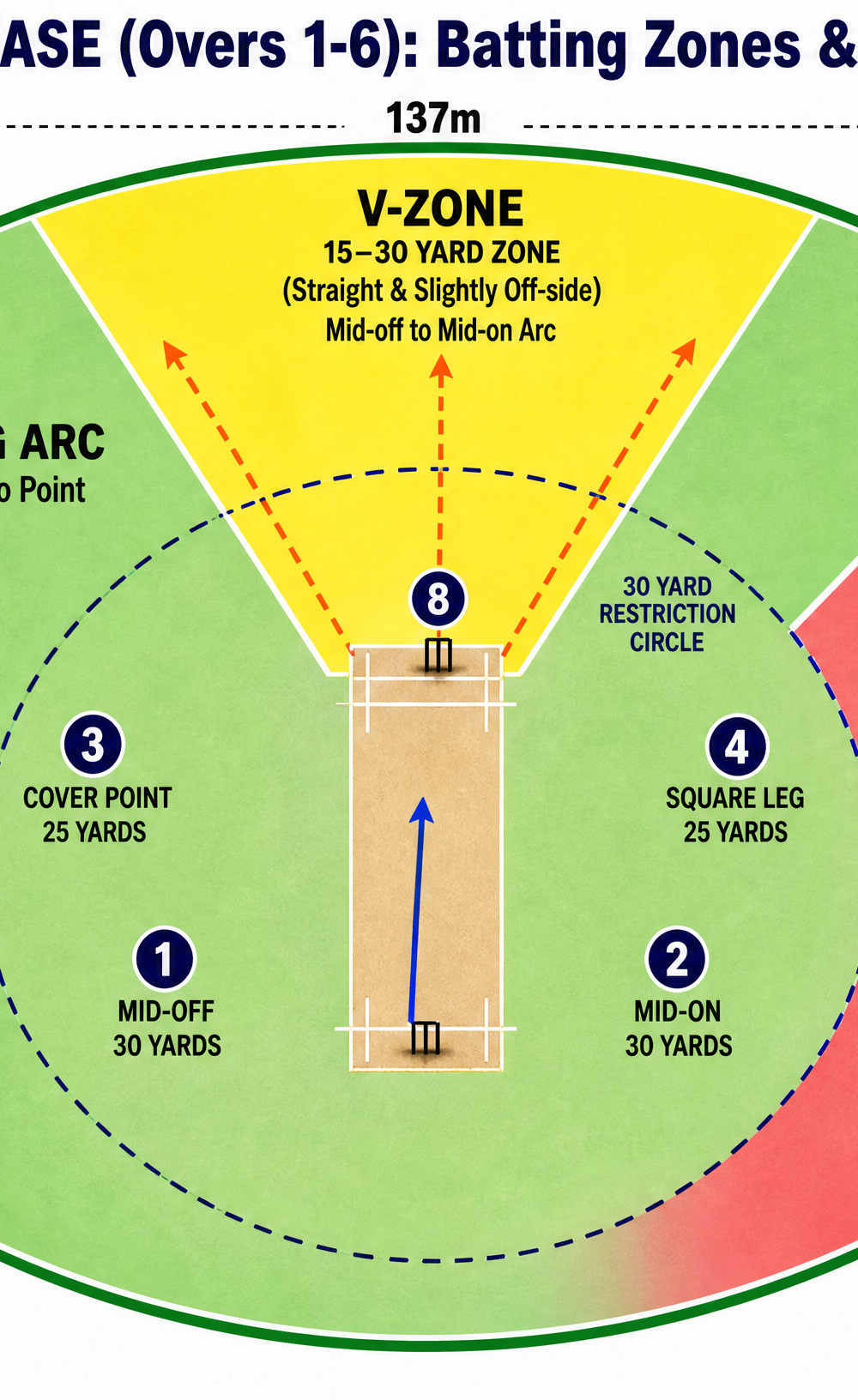
Objective: Maximize the fielding restrictions by targeting the 'V' and the scoring arc, aiming for a run rate of 8-10 RPO.
- Set the Field: Place two fielders outside the 30-yard circle (e.g., Third Man and Fine Leg). Keep the rest inside the ring, focusing on saving the single (Mid-off, Mid-on, Cover Point, Square Leg, Point).
- Batting Instruction: Instruct the batters to hold their shape and hit over the infield. The primary target area is the 'V-Zone' (Mid-off to Mid-on arc).
- Execution: Batters must step forward to the pitch of the ball, utilizing strong, orthodox cricket shots to clear the 30-yard circle. Avoid the 'Danger Zone' (fine sweeps or ramps) early on.

Phase 2: Middle Overs Consolidation (Overs 7-16)
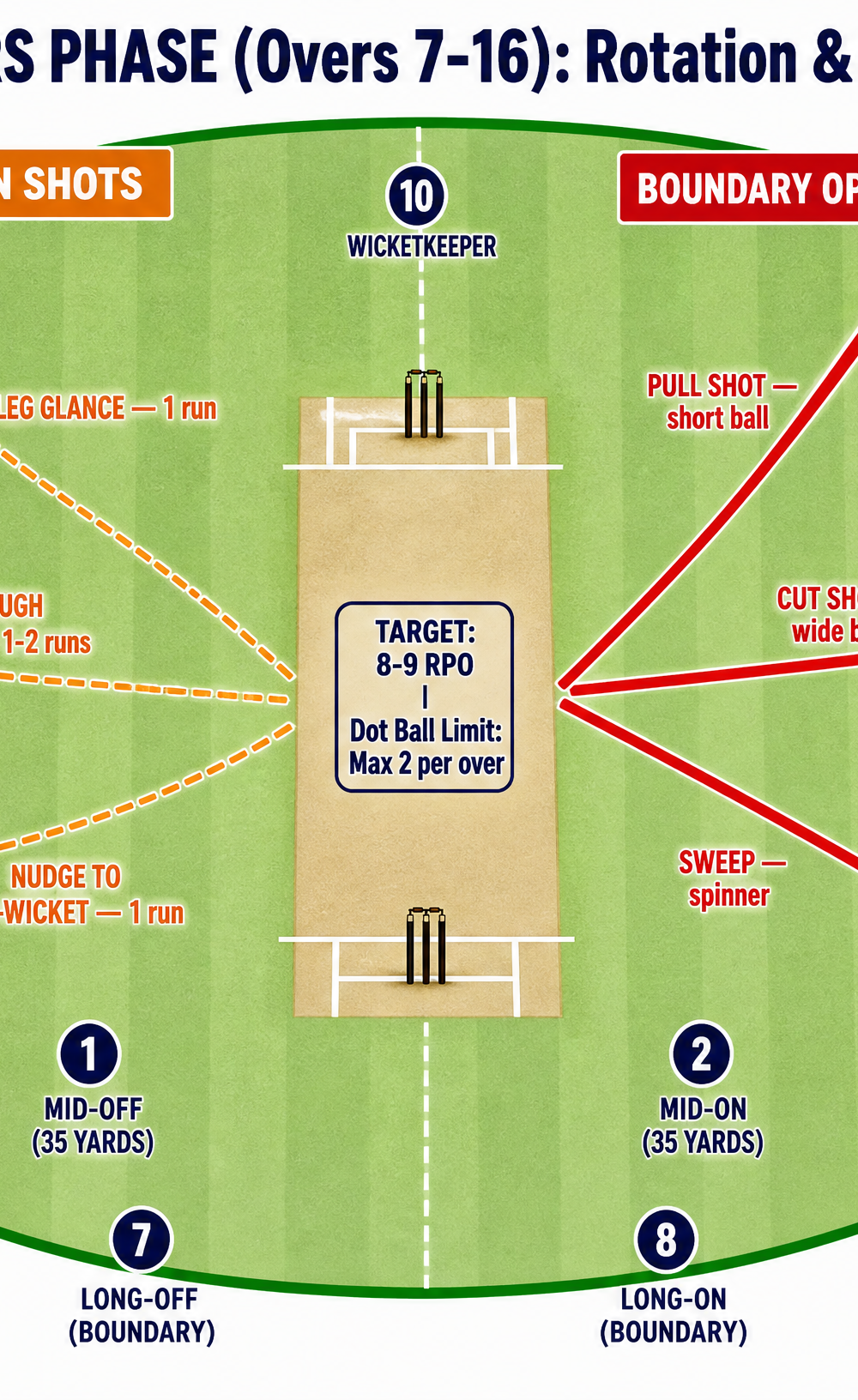
Objective: Maintain momentum (target 8-9 RPO) by rotating the strike relentlessly and punishing the bad ball, limiting dot balls to a maximum of two per over.
- Set the Field: Push up to five fielders out to the boundary (e.g., Long-off, Long-on, Deep Mid-wicket, Deep Square Leg, Point). Bring some ring fielders slightly deeper to cut off the hard push.
- Batting Instruction: Focus on finding the gaps for singles and twos. The batters must proactively look to work the ball into the outfield.
- Execution: Utilize the 'Rotation Shots'—leg glances, pushes through the covers, and nudges to mid-wicket. When a loose delivery (short or wide) is bowled, execute 'Boundary Opportunities'—pull shots, cut shots, and sweeps.
Phase 3: The Death Overs (Overs 17-20)
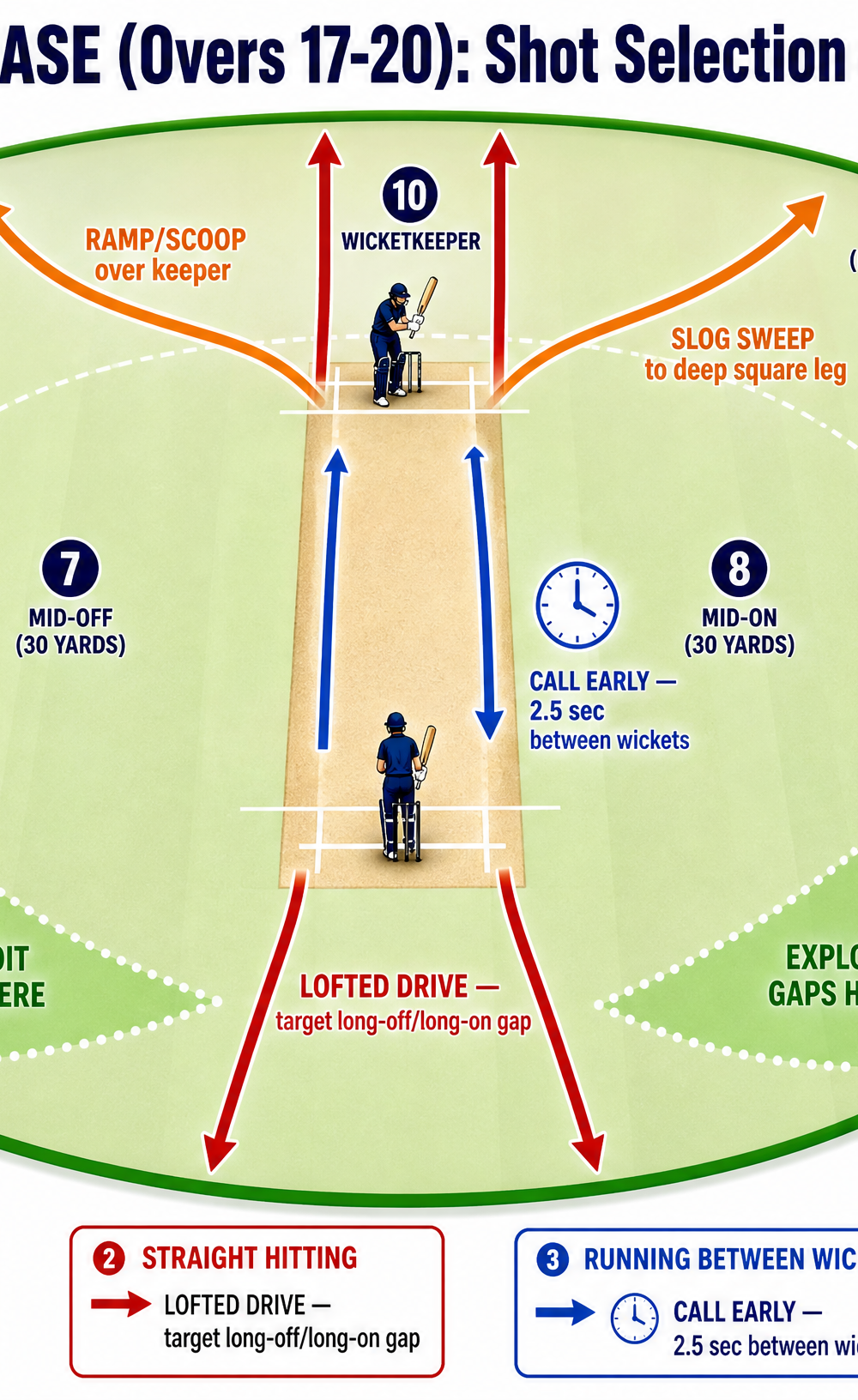
Objective: Maximum acceleration. Exploit field placements and bowler predictability to add 40-60 runs in the final four overs.
- Set the Field: Standard death bowling field (five out). Ensure the boundary riders are perfectly positioned on the rope.
- Batting Instruction: Batters must be prepared to use the depth of the crease and access 360 degrees of the field.
- Execution: Target the gaps. Use straight hitting (lofted drives targeting the long-off/long-on gap) for full deliveries. Utilize slog sweeps to deep square leg or ramp/scoop shots over the keeper to exploit the fine leg/third man areas. Crucially, call early and run hard (aim for 2.5 seconds between wickets) to turn ones into twos.
4. Key Coaching Points
- Intent over Aggression: Teach batters that intent means looking to score off every ball (even a single), whereas mindless aggression leads to poor shot selection and wickets.
- Targeting the 'V' Early: Emphasize the importance of hitting straight during the Powerplay. The highest percentage of boundaries with the lowest risk comes from hitting over mid-off and mid-on.
- Strike Rotation is King: During the middle overs, the inability to rotate strike builds pressure. Drill the 'drop and run' and hitting to the sweepers.
- Crease Utilization at the Death: Coach batters to move around the crease (deep back, or stepping across) in the final overs to disrupt the bowler's length and open up new scoring areas.
- Communication: Loud, early calls ("Yes", "No", "Wait") are non-negotiable. Hesitation costs runs and wickets.
5. Common Mistakes
- Pre-meditating Too Early: Batters deciding on a shot before the ball is released, often leading to dismissals if the bowler varies pace or length.
- Ignoring the Field: Trying to hit boundaries to the longest part of the ground or straight to a boundary rider instead of manipulating the field.
- Stagnation in Middle Overs: Allowing spinners to bowl consecutive dot balls because batters are waiting for a 'bad ball' rather than actively working a single.
- Panic at the Death: Losing shape and swinging wildly at every delivery rather than executing practiced boundary options (like the ramp or straight drive).
6. Variations & Progressions
- Progression 1: Target Scores: In middle practice, set specific target scores for each phase (e.g., 50 runs off the 6-over Powerplay scenario) to simulate match pressure.
- Progression 2: Wicket Penalties: Introduce a run penalty (-5 runs) for losing a wicket during the middle overs scenario to emphasize the importance of consolidation.
- Variation 1: The 'Match-Up' Scenario: Assign specific bowlers to specific batters based on matchups (e.g., Left-arm spin vs. Right-hand batter) and challenge the batting pair to score at 9 RPO.
7. Age Adaptations
- Under 10s/12s: Focus purely on the basics of hitting straight and running hard between the wickets. Simplify the phases into 'Start well' and 'Finish strong'. Do not introduce complex shots like the ramp.
- Under 14s: Introduce the concept of strike rotation in the middle overs. Teach them to identify where the gaps are in the field.
- Under 16s/Open: Implement the full three-phase plan. Focus heavily on game awareness, reading the field, and executing advanced boundary options (sweeps, ramps) under pressure.