Basketball Skills
Master the Ball: 5 Dribbling Exercises to Elevate Your Team's Game
Discover five essential dribbling and ball handling exercises that will transform your basketball and netball players into confident, skilled athletes with superior court control.
Master the Ball: 5 Dribbling Exercises to Elevate Your Team's Game
In the fast-paced worlds of basketball and netball, exceptional ball handling is not just a skill—it's a game-changer. For basketball players, a confident and controlled dribble is the foundation of every offensive move, from breaking through a high-pressure defense to creating the perfect scoring opportunity. For netballers, while the rules differ, the underlying principle of secure and precise ball handling is just as critical for maintaining possession and executing swift, effective passes.
As a coach, you understand that mastering ball control is a journey, not a destination. It requires consistent practice, smart drills, and a deep understanding of body mechanics. This comprehensive guide provides five fundamental dribbling and ball handling exercises designed to build confidence, improve coordination, and give your players a competitive edge. We'll explore drills that are effective for both basketball and netball, with specific adaptations to suit the unique demands of each sport.
The Foundation of Control: Why Ball Handling Matters
Before diving into the drills, it's essential to understand the core principles of effective ball handling. For both sports, the goal is to make ball control an unconscious competence, freeing up the player's mind to focus on game strategy, court awareness, and decision-making. This means developing a strong connection between the player's hands and the ball, enabling them to manipulate it with precision and confidence.
In basketball, this translates to a low, powerful dribble that is difficult for defenders to steal. In netball, it means having soft, reliable hands that can secure any pass, and the ability to release the ball quickly and accurately. The drills that follow are designed to build this foundational control, which will benefit players in all aspects of their game.
Coaching Cue: Eyes Up, Always
One of the most common mistakes young players make is watching the ball while they dribble or catch. Encourage your players to keep their eyes up at all times. This simple yet crucial habit allows them to read the court, anticipate defensive moves, and make smarter decisions. The drills below are designed to be performed without looking at the ball, helping players develop a feel for it and build the muscle memory needed for elite-level play.
1. The Pound Dribble Series: Building Power and Control
The pound dribble is the cornerstone of a strong handle. It teaches players to dribble with force and purpose, making the ball an extension of their body. This drill is fundamental for basketball players and can be adapted for netballers to improve their hand strength and reaction time.
For Basketball Coaches:
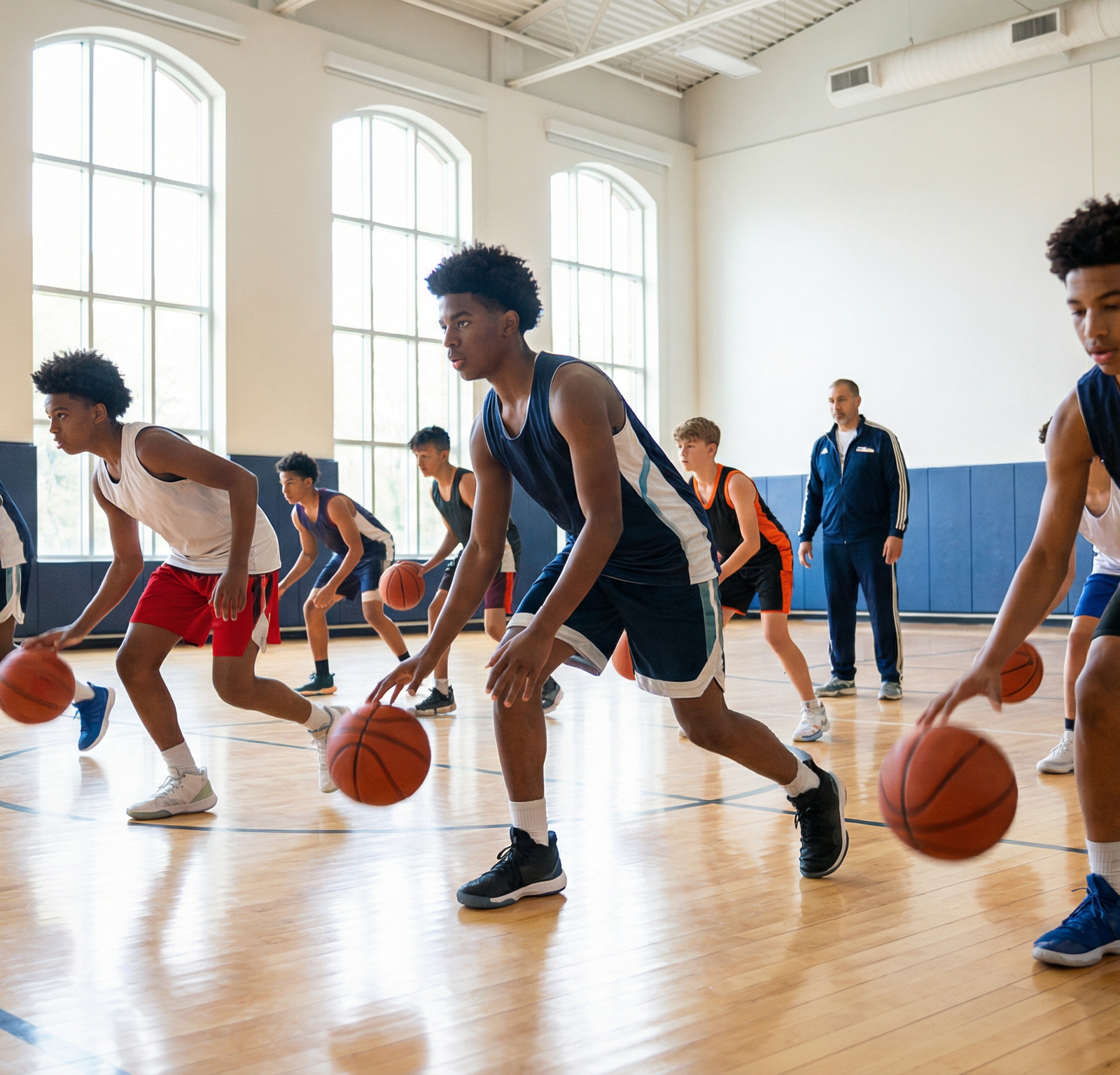
Instruct your players to get into a low, athletic stance with their knees bent and their back straight. They should then pound the ball into the ground with their fingertips, not their palm. The goal is to dribble with enough force that the ball comes back up to their hand quickly and powerfully. The series should include:
- Waist-High Pounds: 30 seconds with the right hand, then 30 seconds with the left.
- Ankle-High Pounds: 30 seconds with the right hand, then 30 seconds with the left. This variation improves control in tight spaces.
- Shoulder-High Pounds: 30 seconds with each hand. This challenges players to control the ball at a higher point, which is useful for seeing over defenders.
For Netball Coaches:
While netballers don't dribble, a variation of this drill can significantly improve their hand strength and ability to handle powerful passes. Have players stand in a ready stance and forcefully throw the ball against a wall, catching it cleanly with both hands. This simulates receiving a fast, hard pass and helps build the hand and forearm strength needed to secure the ball in traffic.
2. Figure 8 Series: Developing Coordination and Feel
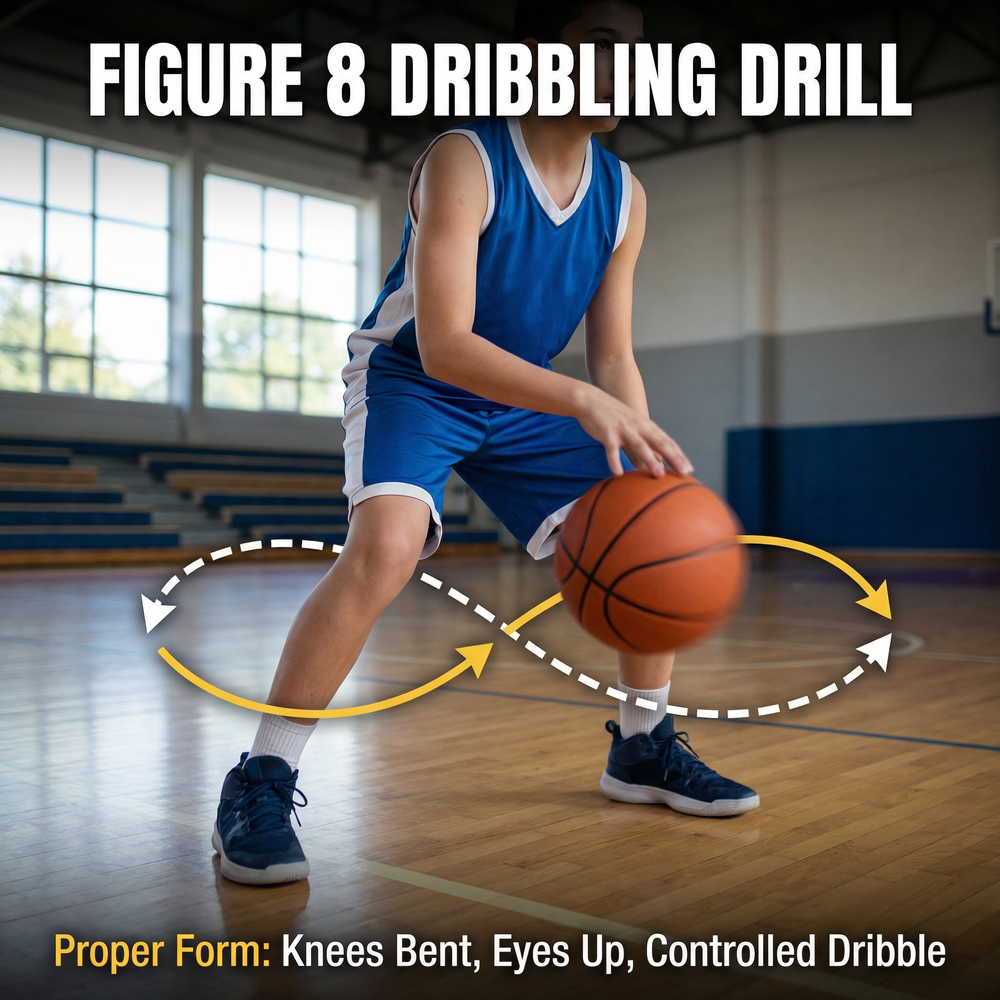
The Figure 8 drill is a classic for a reason. It forces players to control the ball as it moves around their body, developing a superior feel for the ball and improving hand-eye coordination. This drill is excellent for both basketball and netball players.
The Basic Drill:
Players should stand with their feet shoulder-width apart and their knees bent. They then pass the ball in a figure-eight pattern around and through their legs. The goal is to do this smoothly and without the ball touching the ground (for the non-dribbling version).
For Basketball Coaches:
Start with the non-dribbling version to build coordination, then progress to the dribbling version. Players should dribble the ball in a figure-eight pattern, keeping the dribble low and controlled. Encourage them to increase their speed as they become more comfortable. A further progression is the Spider Dribble, where players stay in a low squat and perform one dribble in front of their right leg, one in front of their left, then one behind their right leg, and one behind their left, continuously.
For Netball Coaches:
The non-dribbling version of the Figure 8 is perfect for netballers. It improves their ability to handle the ball in different positions and strengthens their core as they bend and move. Encourage players to keep their heads up and to feel where the ball is without looking at it. This drill can be done individually or in pairs, with one player passing the ball to their partner in a figure-eight motion.
3. Zig-Zag Dribble with Crossovers: Mastering Change of Direction
This drill is essential for any player who needs to move with the ball, teaching them to change direction quickly and effectively while protecting the ball from defenders. It's a basketball-specific drill, but the principles of footwork and body control are transferable to netball.
The Drill Setup:
Set up a series of cones in a zig-zag pattern up the court. Players will dribble from one cone to the next, performing a crossover move at each cone to change direction.
Key Coaching Points:
- Attack the Cones: Players should dribble at speed towards each cone before making their move.
- Low and Wide: The crossover dribble should be low (below the knees) and wide, pushing the ball out in the new direction of travel.
- Protect the Ball: On the crossover, the player's body should be between the defender and the ball.
- Variations: As players improve, introduce other moves at the cones, such as between-the-legs or behind-the-back crossovers.
4. Two-Ball Dribbling: Supercharging Ambidexterity
Two-ball dribbling is a fantastic way to challenge players and accelerate their skill development. It forces both hands to work independently, dramatically improving a player's off-hand and overall coordination. This is a more advanced drill, best suited for players who have mastered the fundamentals.
The Drills:
- Simultaneous Pounds: Players dribble both balls at the same time, at the same height.
- Alternating Pounds: Players dribble the balls in an alternating rhythm.
- One High, One Low: One ball is dribbled at waist height, while the other is dribbled at ankle height. This is a significant coordination challenge.
- Walking Drills: Once players are comfortable with the stationary drills, have them walk forward and backward while performing the two-ball patterns.
Coaching Tip: Embrace Mistakes
Two-ball dribbling is difficult, and players will make mistakes. Encourage them to push through the frustration. Losing the ball is a sign that they are challenging themselves and stepping outside of their comfort zone, which is where true growth happens.
5. Trap Escape Drill: Thriving Under Pressure
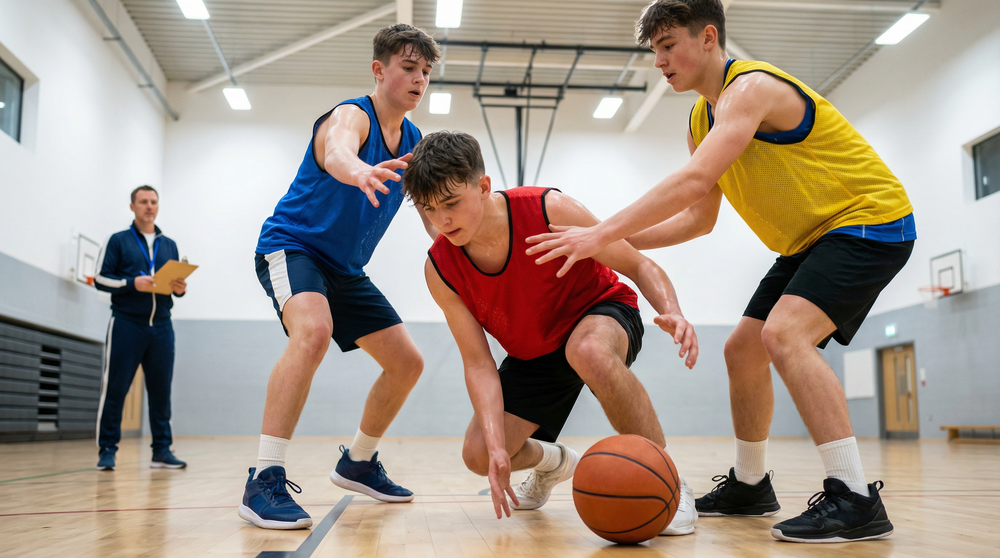
For both basketball and netball, being able to handle pressure is what separates good players from great ones. This drill simulates a common game scenario where a player is trapped by two defenders and must protect the ball and make a smart decision.
For Basketball Coaches:
Have two defenders trap the ball handler in a corner or on the sideline. The ball handler's goal is to protect the ball using their body and a low, controlled dribble, and then to escape the trap by either splitting the defenders with a quick dribble or by pivoting to create space for a pass.
For Netball Coaches:
This drill can be adapted for netball by having two defenders pressure a player who has just received the ball. The player must secure the ball, pivot effectively to protect it from the defenders, and make a clear, decisive pass to a teammate within the three-second limit. This drill is excellent for developing composure and decision-making in tight situations.
Integrating Technology for Smarter Training
In today's digital age, technology can be a powerful ally for coaches. While drills are the foundation of skill development, modern tools can help you manage your team, plan your sessions, and track your players' progress more effectively. This is where a dedicated platform like Vanta Sports becomes invaluable.
Instead of juggling multiple apps and spreadsheets, Vanta Sports provides a complete ecosystem for youth basketball and netball organizations. The Vanta Coach App, which is free for volunteer coaches, allows you to plan your training sessions with ease, incorporating drills like the ones above. You can track attendance, monitor player development, and communicate with your team all in one place.
For the wider club, Vanta Club handles everything from registrations and payments to ensuring all compliance and safeguarding requirements are met. Parents can stay connected through the Vanta Guardian app, managing schedules and payments, while players can use the Vanta Player App to track their goals and achievements. By streamlining the administrative side of coaching, Vanta Sports frees you up to focus on what you do best: developing your players.
Ready to Take Your Training to the Next Level?
Discover how Vanta Sports helps coaches run better practices. Learn more about Vanta Sports
Tags