Basketball Skills
Mastering the Mayhem: Your Ultimate Guide to Fast Break Transition Drills
Transform your team into a transition powerhouse with these game-tested fast break drills for basketball and netball coaches. Learn the principles and strategies that turn defense into instant offense.

Mastering the Mayhem: Your Ultimate Guide to Fast Break Transition Drills
In the fast-paced worlds of basketball and netball, the difference between a good team and a great one often lies in their ability to turn defense into instant offense. The fast break, or transition offense, is more than just a chaotic sprint down the court; it's a strategic weapon that, when honed, can dismantle even the most organized defenses. It's a widely accepted coaching axiom that even a poorly executed fast break often yields a better scoring opportunity than a well-rehearsed half-court set. Why? Because it creates mismatches, exploits defensive disorganization, and generates high-percentage shots before the opposition can even react.
For coaches dedicated to elevating their team's performance, mastering the art of transition is non-negotiable. It's about instilling a mindset, teaching principles, and drilling the habits that make fast-break execution second nature. This comprehensive guide will provide you with the foundational principles and practical, game-tested drills for both basketball and netball to transform your team into a formidable transition powerhouse.
The Unstoppable Advantage: Why Every Coach Should Master the Fast Break
A relentless transition attack does more than just add points to the scoreboard; it fundamentally changes the tempo and forces opponents to play on your terms. By consistently pushing the pace, you put immense pressure on the other team, forcing them into rushed shots and turnovers. This creates a virtuous cycle: your strong defense fuels your fast break, and your fast break wears down their offense. The result is not only more scoring opportunities but also a significant boost in team morale and confidence. Players love to play fast, and empowering them to do so within a structured system is one of the most effective ways to build a positive and aggressive team culture.
Universal Principles of a Killer Transition Game
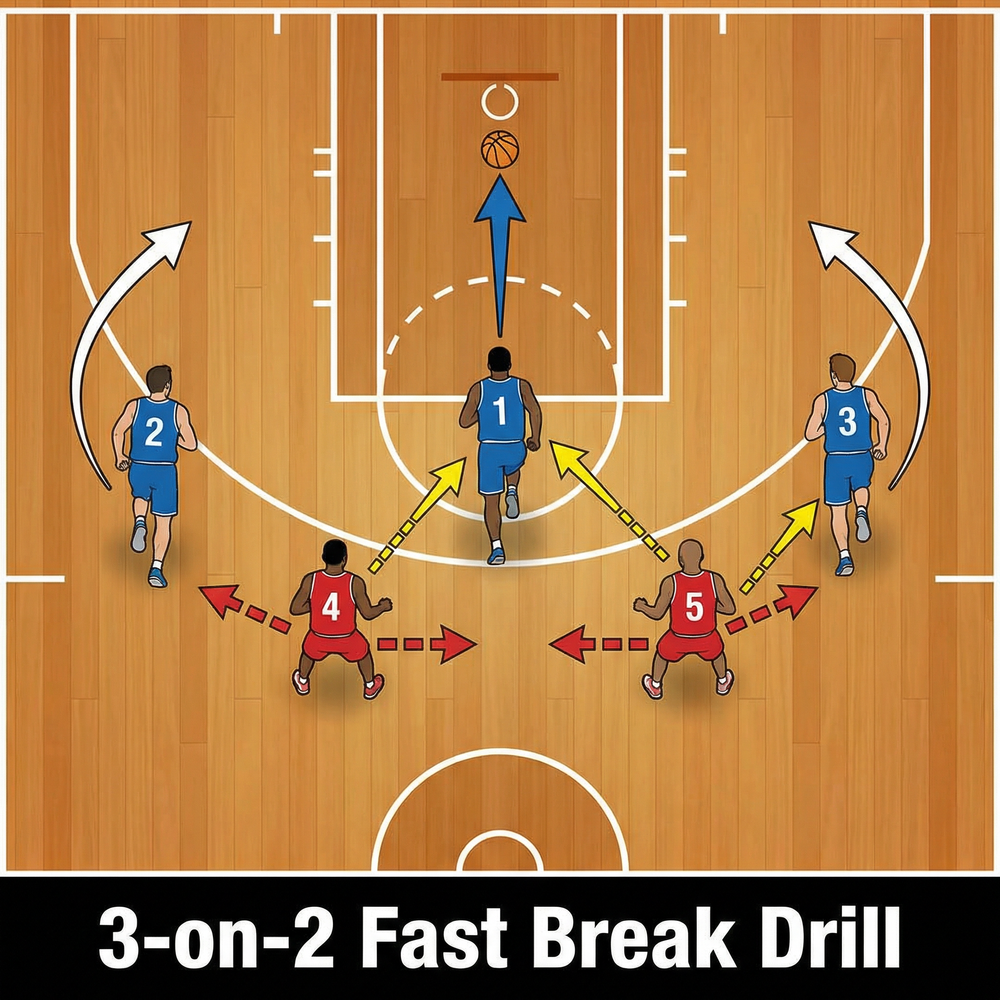
Before diving into specific drills, it's crucial to understand the universal principles that underpin any successful transition offense, regardless of the sport.
Elite Running Habits: The First Three Steps Matter Most
The opportunity for a fast break is fleeting. It appears the instant possession changes and can vanish just as quickly. The teams that capitalize are the ones whose players react without hesitation. Coaches should instill the concept of "winning their first three steps." This means an explosive, immediate sprint the moment a turnover is secured or a rebound is controlled. There is no time for a casual jog or a moment of observation. The players who win their first three steps are the ones who create the numerical advantages that lead to easy scores.
Recognizing the Numerical Advantage: The 2-on-1, 3-on-2, and Beyond
The entire purpose of the fast break is to create a temporary numbers-up situation. Whether it's a 2-on-1, 3-on-2, or even a 4-on-3, players must be trained to instantly recognize and exploit these advantages. This involves quick decision-making: making the right pass at the right time to the open player. The goal is simple: get the ball to the player with the highest percentage shot as quickly as possible. This often means a kick-ahead pass to a sprinting teammate or a drive-and-kick sequence to an open shooter. The key is to attack decisively before the defense can recover and neutralize the advantage.
Push the Pace, But Know When to Flow
While the primary objective is to push the ball up the court as fast as possible, players also need the intelligence to recognize when a fast break opportunity isn't there. If the defense successfully gets back and sets up, forcing a contested shot is counterproductive. In these moments, teams must seamlessly "flow" into their half-court offense. A good rule of thumb is that if a clear advantage isn't established within the first three to four seconds of crossing half-court, it's time to initiate a set play or motion offense. This prevents the dreaded "wasted possession" and ensures that every offensive trip is a purposeful one.
Game-Changing Basketball Transition Drills
Here are three fundamental basketball drills designed to build the habits and decision-making skills essential for a lethal fast break.
Drill 1: The Continuous 3-on-2, 2-on-1
This classic drill is a staple for a reason. It's a high-energy, continuous drill that forces players to make quick decisions in common fast-break scenarios.
- Setup: Two lines of players at one end of the court, under the basket. One defender starts at the free-throw line of the opposite basket.
- Execution: The first three players from one line attack the lone defender, creating a 3-on-1 situation. They must make at least two passes before shooting. After the shot, the player who shot the ball sprints back on defense. The other two offensive players now become the defenders at the other end. The first two players from the opposite line immediately attack them, creating a 2-on-2. This pattern continues, creating a continuous flow of 3-on-2 and 2-on-1 situations.
- Coaching Points: Emphasize quick, sharp passes and decisive cuts to the basket. Encourage players to attack the gaps in the defense and make the easy pass. On the defensive side, focus on communication and forcing the ball handler to make a difficult decision.
Drill 2: The 5-on-4 Advantage Creator
This drill, adapted from a concept by Transforming Basketball, is excellent for teaching players to recognize and convert a numerical advantage under pressure.
- Setup: Five offensive players and four defensive players start inside the paint at one end. A fifth defender (the "+1") waits on the baseline.
- Execution: The coach tosses the ball to any offensive player to initiate the break. The five offensive players attack the other end against the four defenders. The +1 defender can only start their sprint back to help once the ball crosses the half-court line. The offense is challenged to score a high-quality shot before the +1 defender can recover and create a 5-on-5 (neutral) situation.
- Coaching Points: This drill puts a time pressure on the offense to make quick decisions. You can introduce constraints to improve shot selection, such as requiring the shot to be a layup or a catch-and-shoot three-pointer. This forces players to not just play fast, but to play smart.
Drill 3: Outlet and Fill the Lanes
A successful fast break starts with a clean outlet pass and players sprinting to their designated lanes. This drill hones those foundational habits.
- Setup: A coach or player starts with the ball under the basket. Three lines of players are positioned at the three-point line: one in the middle (the point guard) and one on each wing.
- Execution: The coach throws the ball off the backboard. The point guard sprints to the sideline to receive the outlet pass. Simultaneously, the two wing players sprint down the court, staying wide to fill the outside lanes. The point guard receives the outlet, takes one or two dribbles to advance the ball, and then makes a kick-ahead pass to one of the wing players for a layup.
- Coaching Points: The emphasis here is on speed and spacing. The outlet pass must be quick and accurate. The wing players must sprint hard and stay wide to stretch the defense. The point guard's job is to get their head up immediately and advance the ball with the pass, not the dribble.
Dominating Transition in Netball
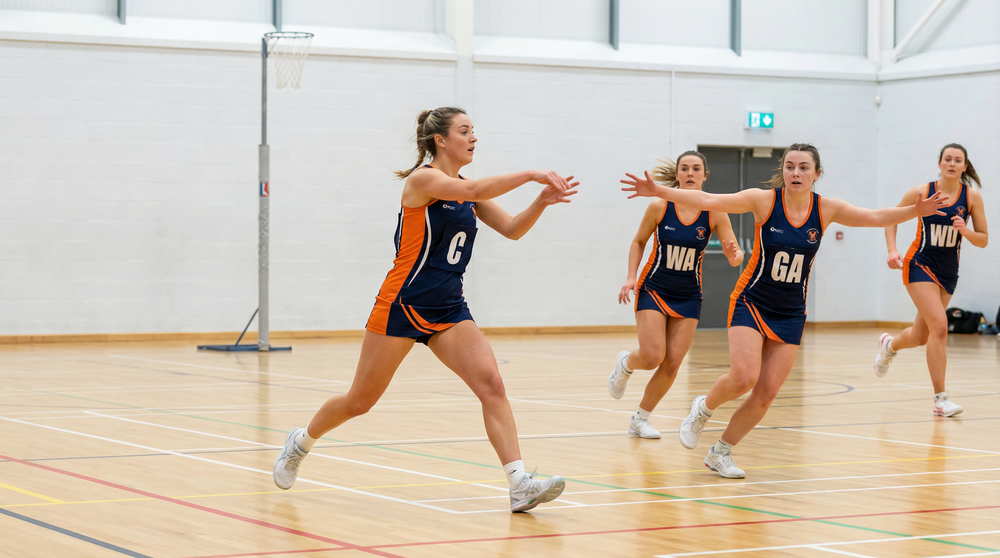
While the core principles are the same, netball's unique rules and court dimensions require specific strategies for transition play, particularly from the centre pass.
The Centre Pass: Your First and Best Attack
Statistics from elite competitions tell a clear story: teams with a high centre-pass-to-goal conversion rate win games. Loughborough Lightning, for example, boasted an 80% conversion rate in their NSL Grand Final victory. This isn't a coincidence. The centre pass is the one moment in the game where your team has guaranteed possession in a structured attacking position. It is your single best opportunity to launch a pre-planned, lightning-fast attack.
Netball Transition Drills and Strategies
Here are two effective centre pass strategies and a drill to turn your team into a transition threat.
Strategy 1: The Side Stack
This strategy is designed to create space and keep defenders guessing.
- Setup: The Wing Attack (WA) and Goal Attack (GA) start on the same side of the court, close to the sideline. This "stacks" one side, leaving a large open space in the middle of the court.
- Execution: The WA and GA communicate. One player makes a hard drive into the open space in the centre third to receive the first pass. The other player immediately drives downcourt, providing a clear second-phase option. The Centre, after passing, should drive with depth into the space on the opposite side of the court, creating width and another attacking option.
- Coaching Points: This play relies on clear communication and players reading off each other's movements. The goal is to use the created space to get the ball to the circle edge in just two or three quick passes.
Strategy 2: The Backup Pass
This strategy takes the pressure off your primary attackers and utilizes your defensive players to initiate the attack.
- Setup: The WA and GA still present as initial options to keep their defenders occupied.
- Execution: The Centre signals for a backup pass. The Wing Defence (WD) or Goal Defence (GD) makes a strong drive to receive the centre pass, ideally ahead of the Centre to gain depth. As soon as the pass is made, the WA or GA makes a driving cut downcourt to receive the second pass near the circle edge, ready for a quick feed to the Goal Shooter.
- Coaching Points: This is a great settling play to use when the opposition is on a run. It provides a reliable and controlled way to get the ball into your attacking third and can break the opponent's momentum.
Drill: Full-Court Transition Flow
This drill helps players practice the full flow of transition, from defense to attack.
- Setup: Start with a 4-on-4 half-court situation. The attacking team tries to score.
- Execution: As soon as the defending team secures a turnover or a rebound, they immediately transition into their attack. The player with the ball looks for a quick outlet, and the other three players sprint to create width and depth. They attack the full length of the court against the four defenders who are scrambling to get back.
- Coaching Points: Encourage players to think "transition" the moment possession changes. The first pass is critical. Players should be looking to move the ball quickly up the court with passes, not slow dribbles (in basketball) or hesitant holds (in netball).
Leveraging Technology to Perfect Your Transition Game
Drilling these plays in practice is essential, but modern coaching tools can take your team's execution to the next level. This is where a purpose-built platform like Vanta Sports becomes a coach's most valuable asset. Instead of juggling multiple apps for communication, scheduling, and development, Vanta Sports provides a complete ecosystem designed specifically for the needs of youth basketball and netball.
With the Vanta Coach App, which is free for volunteer coaches, you can easily plan your training sessions, incorporating the drills mentioned above. You can use the app to share video examples of professional teams executing the fast break, providing your players with a clear visual model. Attendance tracking ensures you know who is at practice, and the integrated messaging allows you to send out reminders and coaching points to your team. For players, the Vanta Player App allows them to track their own goals and review practice plans, reinforcing the concepts you're teaching. Meanwhile, the Vanta Guardian app keeps parents informed and engaged, streamlining everything from schedules to payments.
By using Vanta Sports, you're not just organizing your team; you're creating a connected and efficient environment where players can thrive. You can spend less time on administration and more time on what you do best: coaching.
Ready to Take Your Training to the Next Level?
Discover how Vanta Sports helps coaches run better practices. Learn more about Vanta Sports
[1] Transforming Basketball: Coaching the Fast Break: Key Transition Offense Principles. (https://transformingbball.com/coaching-the-fast-break-key-transition-offense-principles/)
[2] Breakthrough Basketball: Transition & Fast Break Offense: Guide, Drills & Tips. (https://www.breakthroughbasketball.com/offense/transition-fast-break-offense.html)
[3] Elite Netball Academy: Netball Centre Pass Strategies in Attack. (https://elitenetballacademy.co.uk/netball-centre-pass-attack/)
Tags