Player Training
Gamification in Youth Sports Training: Does It Really Work?
Discover the science behind gamification in youth sports and learn practical drills to boost engagement and skill development for basketball and netball players.
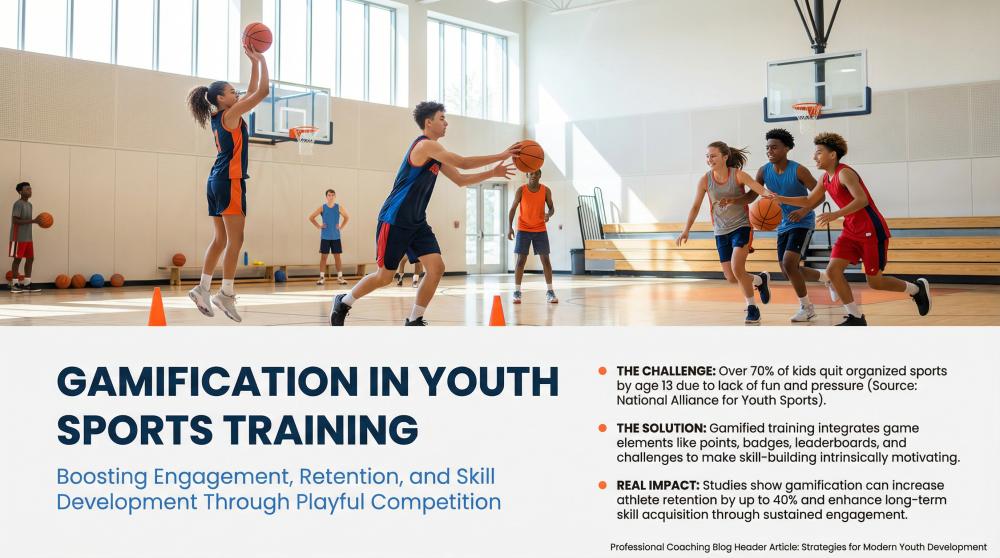
Gamification in Youth Sports Training: Does It Really Work?
As a basketball or netball coach, you know the familiar challenge: how do you keep young athletes focused, motivated, and genuinely excited to show up for practice week after week? In an age of digital distractions, the traditional playbook of repetitive drills can sometimes fall flat. Enter gamification, a coaching strategy that’s rapidly gaining traction for its remarkable ability to boost engagement and accelerate skill development. But is it just another buzzword, or is there real science behind the fun and games? This article will explore the evidence, provide practical drills, and show you how to effectively implement gamification in your youth sports training.
What Exactly is Gamification in Sports Training?
First, let's clear up a common misconception. Gamification is not simply about playing a scrimmage at the end of practice. While small-sided games are a component, true gamification is the strategic use of game design elements in non-game contexts. It involves applying mechanics like points, badges, leaderboards, and challenges to drills and other aspects of training to make them more engaging and motivating. [1]
Think about the apps you use every day. A language app rewards you with a streak for daily practice. A fitness app gives you a badge for hitting a new personal best. These are examples of gamification. In a sports context, it’s about reframing a standard passing drill into a team challenge to achieve 20 consecutive passes, or turning shooting practice into a level-up game where players earn points for hitting targets.
This approach shifts the focus from the monotony of the drill to the excitement of the challenge, tapping into the natural competitiveness and desire for achievement that young athletes possess.
The Million-Dollar Question: Does It Actually Work?
The evidence is increasingly clear: yes, when implemented correctly, gamification works. A major 2025 systematic review and meta-analysis published in a leading medical journal looked at 16 randomized controlled trials and found that gamification interventions significantly increased moderate-to-vigorous physical activity (MVPA) in children and adolescents. [2] Crucially, the study also found that these positive effects were sustained long after the intervention ended, suggesting that gamification can foster lasting habits and a genuine enjoyment of physical activity.
The key takeaway from the research is that the efficacy of gamification is directly tied to its design. The most successful interventions were those grounded in established motivational theories and used a thoughtful mix of game elements over a consistent period.
This isn't about a chaotic free-for-all. It’s about structured, purposeful play that drives specific coaching outcomes. It transforms the question from "Do I have to do this drill?" to "Can I beat my score from last time?"
The Psychology of Play: Why Gamification Motivates Young Athletes
Gamification is effective because it taps into fundamental psychological needs. At its core, it leverages both intrinsic and extrinsic motivation.
- Extrinsic Motivation: This is the drive to perform an activity to earn a reward or avoid punishment. Points, badges, and topping a leaderboard are classic extrinsic motivators. They provide clear, immediate feedback and a sense of accomplishment.
- Intrinsic Motivation: This is the desire to do something because it is inherently interesting or enjoyable. This is the holy grail for coaches. A well-designed gamified system uses extrinsic rewards to build a bridge to intrinsic motivation. When a player starts enjoying the process of improving their score (competence) and seeing their choices impact the outcome (autonomy), they are building an intrinsic love for the sport.
Many gamification strategies align with Self-Determination Theory, a leading theory of motivation, which posits that humans are most motivated when three psychological needs are met: Competence, Autonomy, and Relatedness. [3]
| Psychological Need | How Gamification Meets It |
|---|---|
| Competence | Players feel a sense of mastery and progress as they earn points, level up, or achieve new personal bests. |
| Autonomy | Drills that offer choices (e.g., "Choose your shooting spot for double points") give players a sense of control over their training. |
| Relatedness | Team-based challenges and leaderboards foster a sense of connection, camaraderie, and friendly competition. |
By structuring drills to satisfy these needs, you create an environment where players are not just participants, but engaged and empowered stakeholders in their own development.
Putting Theory into Practice: 4 Gamified Drills for Your Next Session
Ready to try it out? Here are four practical, gamified drills you can adapt for both basketball and netball.
1. King/Queen of the Court (Shooting Challenge)
- Objective: Improve shooting accuracy under pressure and add a competitive element to practice.
- Setup: Place 5-7 markers (cones or spots) at various positions around the shooting circle/three-point line. Assign point values to each spot (e.g., closer shots are 1 point, mid-range are 2, long-range are 3).
- Execution: Players are divided into small teams. Each player takes a turn shooting from a spot of their choice. If they make the shot, their team gets the points. The first team to reach a target score (e.g., 21 points) wins. To increase the challenge, add a "bonus ball" every few rounds that is worth double points.
- Gamification Elements: Points, Competition, Levels (increasing the target score).
2. Ultimate Passing (Teamwork and Movement)
- Objective: Develop communication, spacing, and moving without the ball.
- Setup: In a defined area (e.g., half-court), two teams play against each other. The goal is not to score in a hoop, but to complete a certain number of consecutive passes (e.g., 10) without the other team intercepting the ball or the ball hitting the floor.
- Execution: When a team successfully completes 10 passes, they earn one point. The first team to 5 points wins. For basketball, players can dribble, but with a limit (e.g., three dribbles max) to encourage passing. For netball, the standard no-dribble rule applies. This drill forces players to think strategically about creating space and passing lanes.
- Gamification Elements: Team Challenge, Points, Rules/Constraints.
3. Gate Dribbling / Ball Handling (Skill Progression)
- Objective: Improve ball control and defensive footwork.
- Setup: Set up several "gates" (pairs of cones) randomly within a grid. One player is on offense (with a ball) and one is on defense.
- Execution: The offensive player scores a point for every gate they can dribble (basketball) or pass (netball, to a stationary partner on the other side) through in 60 seconds. The defender tries to prevent them. After 60 seconds, they switch roles. The player with the most points at the end wins the round. This is a fantastic 1-on-1 drill that doubles as both an offensive and defensive workout.
- Gamification Elements: Points, Time-based Challenge, 1v1 Competition.
4. The Attendance Streak Challenge (Commitment & Accountability)
- Objective: Encourage consistent attendance and build team accountability.
- Setup: This isn't a drill, but a season-long game. Track attendance for every player at every practice and game.
- Execution: A player earns a "streak" for attending consecutive events. For every 5 consecutive practices they attend, they might earn a small reward or public recognition. If the entire team achieves a perfect attendance week, they could unlock a "team reward," like choosing the final drill for the next practice. This strategy was used with great success by organizations like MLSE LaunchPad to reduce no-shows and build a culture of commitment. [4]
- Gamification Elements: Streaks, Rewards, Team Goals.
The Modern Coach's Toolkit: Leveraging Technology
Tracking points, leaderboards, and attendance streaks manually can be time-consuming. This is where modern technology becomes a coach's best friend. While some apps focus on just one aspect of team management, a comprehensive ecosystem like Vanta Sports is designed to integrate these gamification principles seamlessly.
Instead of juggling spreadsheets and chat groups, Vanta Sports provides a purpose-built platform for youth basketball and netball. The Vanta Coach App, which is free for volunteer coaches, allows you to plan sessions and track attendance effortlessly. This data can then be used to power your gamified challenges. Players can use the Vanta Player App to see their achievements, track their goals, and stay connected with team events, creating a digital hub for their engagement.
For the wider organization, Vanta Club handles everything from registration and payments to compliance, while the Vanta Guardian app keeps parents informed. This integrated approach ensures that the principles of engagement and motivation are woven into every aspect of the club experience, saving coaches valuable time and administrative headaches.
Avoiding the Pitfalls: How to Gamify the Right Way
While powerful, gamification is not a magic bullet. Poor implementation can do more harm than good. Research highlights several potential risks to be aware of. [5]
Don't Kill the Intrinsic Fun
The biggest risk is that an overemphasis on external rewards (points, badges) can undermine a player's intrinsic love for the sport. If players only show up to earn points, you've replaced passion with a transaction. The goal is to use rewards to celebrate effort and progress, not to be the sole reason for participation.
Focus on Effort, Not Just Outcomes
As seen in the MLSE LaunchPad case study, the most successful systems reward engagement, not just talent. Award points for showing up, trying a new move, or encouraging a teammate. This creates an inclusive environment where every player, regardless of skill level, feels they can succeed and contribute.
Keep it Age-Appropriate and Inclusive
A highly competitive leaderboard might motivate a team of 16-year-olds but could discourage a group of 10-year-olds. Be prepared to adapt your system. For younger athletes, focus on personal bests and team challenges rather than individual rankings. For older, more competitive players, individual leaderboards can be a powerful motivator.
It Should Complement, Not Replace, Great Coaching
Remember, gamification is a tool in your coaching toolbox—it is not the toolbox itself. It cannot replace the need for clear instruction, positive reinforcement, and building strong relationships with your players. Use it to make your fundamental drills more engaging, not as a substitute for teaching the fundamentals.
The Final Whistle
So, does gamification in youth sports training work? The answer is a resounding yes—with a crucial caveat. It works when it is thoughtful, purposeful, and designed to foster a love for the game, not just a desire for points. By incorporating elements of challenge, progression, and achievement into your practices, you can create a highly motivating environment that keeps players engaged and eager to improve.
By combining evidence-based drills with modern tools like Vanta Sports, you can spend less time on administration and more time doing what you do best: coaching the next generation of athletes.
Ready to Take Your Training to the Next Level?
Track your shots and level up with the Vanta Player App. Learn more about Vanta Sports
References
[1] Gkintoni, E., et al. (2024). Promoting Physical and Mental Health among Children and Adolescents via Gamification—A Conceptual Systematic Review. Behavioral Sciences.
[2] Wang, M., et al. (2025). Effectiveness of Gamification Interventions to Improve Physical Activity and Sedentary Behavior in Children and Adolescents: Systematic Review and Meta-Analysis. JMIR Serious Games.
[3] Dahlstrøm, C. (2017). Impacts of gamification on intrinsic motivation. NTNU.
[4] Warner, M., & Heal, B. (2020). The Digital Gamification of Youth Sport Engagement. SIRC - Sport Information Resource Centre.
[5] Grech, E.M., et al. (2024). A field experiment on gamification of physical activity. International Journal of Human-Computer Studies.
Tags