Netball Technique
Wing Attack Feeding Techniques: The Ultimate Guide for Netball and Basketball Coaches
Unlock the secrets of elite wing attack feeding with proven techniques, practical drills, and expert coaching strategies that will transform your team's attacking play in netball and basketball.
The Ultimate Guide to Wing Attack Feeding Techniques: Elevating Your Offensive Game
As a coach in netball or basketball, you know that the offensive flow often hinges on the ability of your playmakers to deliver precise, timely passes into the scoring zone. The Wing Attack (WA) in netball, much like a point guard or wing player in basketball, serves as the critical link between midcourt possession and circle or post feeding. Mastering wing attack feeding techniques is essential for creating high-percentage scoring opportunities and keeping defenders off balance.
In this comprehensive guide, we will explore the essential feeding techniques, positional strategies, and practical drills that will help your wing attacks dominate the circle edge and the perimeter. Whether you are coaching a youth team or fine-tuning an elite squad, these strategies will elevate your team's attacking prowess.
The Role of the Wing Attack: More Than Just a Passer
The primary responsibility of a wing attack is to transition the ball effectively into the attacking third and feed the shooters. However, a great WA is much more than just a passer; they are the offensive engine. They must possess exceptional agility, court vision, and the ability to make split-second decisions under pressure.
A successful wing attack must control the tempo of the game, read the defensive setup and adjust accordingly, establish strong connections with the Goal Attack (GA) and Goal Shooter (GS) or post players, consistently hit the circle edge or the optimal feeding spots on the perimeter, and act as the vocal leader of the attacking unit, maintaining positive energy and resetting the play when the offense becomes frantic.
In modern netball and basketball, the defensive structures have become increasingly complex, often employing zone defenses, double teams, and switching tactics. This means the WA must not only be technically sound but also tactically astute. They need to understand when to force the issue and when to exhibit patience, recycling the ball back to the transverse line or the top of the key to reset the offensive structure.
Essential Feeding Techniques for Wing Attacks
To be an effective feeder, a wing attack must have a diverse passing repertoire. Predictability is the enemy of a good offense. If a WA relies solely on chest passes, a smart defense will quickly intercept or deflect the ball. Here are the core techniques every WA should master to ensure they can deliver the ball under any circumstance:
1. The High Release Pass
When faced with tall, rangy defenders—a common scenario for many wing attacks who rely more on speed than height—the high release pass is a game-changer. This technique involves looking long and releasing the ball from above the head, often using a quick finger flick rather than a full arm wind-up.
Coaching Tip: Encourage your players to use a baulk (fake pass) to shift the defender's hands before stepping through with the inside foot to create a clear passing lane. The high release is particularly effective when feeding a holding GS or a post player who has established deep position.
2. The Bounce Pass and Pocket Pass
In tight spaces, especially against a zone defense or when feeding a post player who has sealed their defender, a sharp bounce pass can be highly effective. The key is to pass away from the defender, placing the ball where only the attacker can reach it.
Coaching Tip: Teach your players to read the defender's positioning. If the defender is playing high on the shooter, a bounce pass to the baseline side is often the best option. The bounce pass must be thrown with enough velocity to prevent the defender from recovering in time to make a play on the ball.
3. The Quick Release and No-Look Pass
A quick release is crucial to exploit momentary gaps in the defense. The less time the ball spends in the feeder's hands, the less time the defense has to react. Advanced players can incorporate no-look passes or use their peripheral vision to deliver feeds while looking elsewhere, freezing the defense.
Coaching Tip: Developing a quick release requires wrist strength and exceptional hand-eye coordination. Drills that emphasize catching and passing in a single motion without bringing the ball down to the waist will help develop this skill.
4. The Overhead Lob Pass
When a shooter has successfully pinned their defender behind them, an overhead lob pass is the perfect way to exploit the mismatch. This pass requires a delicate touch; it must be high enough to clear the defender's reach but drop precisely into the shooter's hands without floating out of bounds.
Coaching Tip: The lob pass should be thrown with two hands for maximum control. It is vital that the WA and the shooter have a strong connection, as the timing of the lob must perfectly match the shooter's hold.
Mastering the Circle Edge and Perimeter Positioning
A wing attack's positioning is just as important as their passing technique. If they are not in the right spot, even the best pass will be difficult to execute. The battle for the circle edge is often where the game is won or lost.
Hitting the Sweet Spots
In netball, the ideal feeding zones are often referred to as the "ten and two" positions on the circle edge. Being in these spots gives the shooters room to execute front cuts, run the baseline, or pop out for a shot.
Coaching Tip: Ensure your WA does not get stuck in the deep pockets. If forced wide, they must quickly reset to the top or mid-circle edge to maintain better passing angles. When a WA is trapped in the pocket, their vision is restricted, and the defense can easily trap them against the sideline.
Preliminary Movements and Dodging
A static wing attack is an easy target for a Wing Defence (WD). WAs must use preliminary movements—dodges, front cuts, back cuts, and changes of pace—to lose their defender before receiving the ball.
Coaching Tip: Emphasize the importance of "going somewhere first before your drive" to outmaneuver defenders and create separation. A common mistake young players make is leading straight toward the ball without any deceptive movement. Teach them to drive away from the intended receiving spot before cutting hard back to the ball.
Reading the Second Phase
The WA's job begins long before they reach the circle edge. On a center pass or a transition out of defense, the WA must read the play and anticipate the second phase of the attack. If the GA takes the center pass, the WA must immediately drive deep into the goal third to offer a strong option.
Coaching Tip: Timing is everything. If the WA drives too early, they will be forced to hold their position and become static. If they drive too late, the offense will stall. Work on timing drills that simulate game-like transition speeds.
Practical Drills to Improve Wing Attack Feeding
Implementing these concepts requires targeted practice. Here are three highly effective drills to incorporate into your training sessions, designed to improve decision-making, positioning, and passing accuracy under pressure:
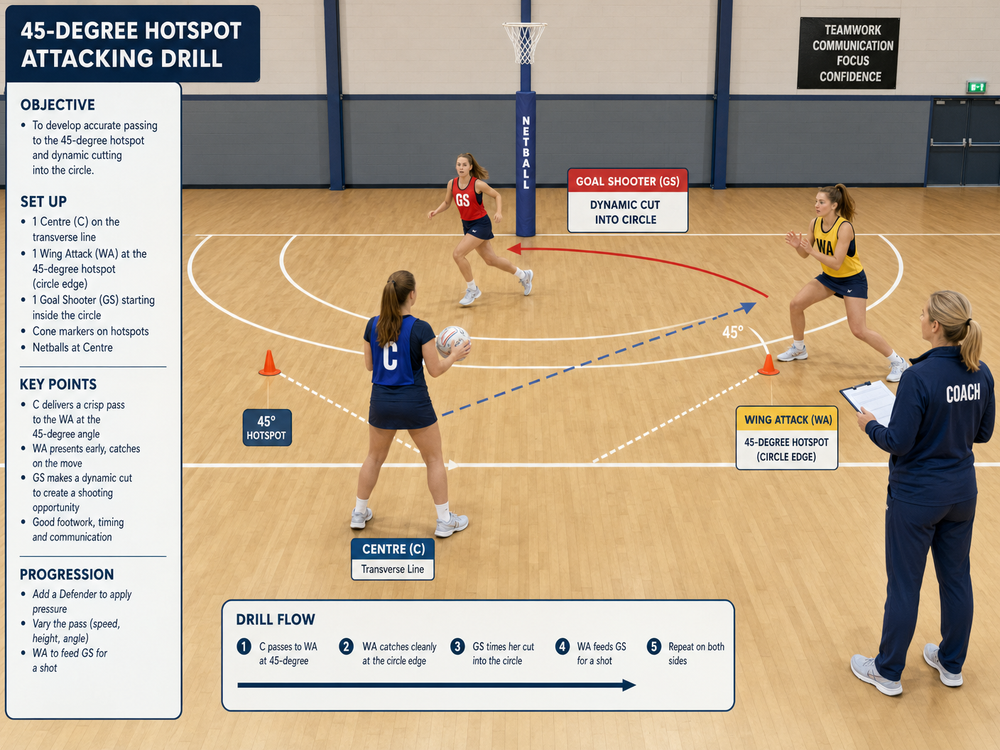
Drill 1: The Circle Edge Hotspot Drill
Objective: Develop the WA's ability to hit optimal feeding positions and balance the circle edge.
Setup: Place markers at key hotspots on the circle edge (top, 45 degrees, corners). Have two attackers (e.g., WA and C) start outside the goal third.
Execution: Attackers drive to hit the various hotspots, ensuring they balance the edge (not crowding the same space). They receive passes from a feeder on the transverse line and immediately look to feed a shooter inside the circle. Attackers must not stay on the edge for more than a second or two; if the feed isn't on, they reset.
Progression: Add defenders to increase the pressure and force quicker decision-making. You can also specify the type of pass required (e.g., only high release or only bounce passes).
Drill 2: The Triangle Feeding Drill
Objective: Improve communication and passing angles between the WA, C, and shooters.
Setup: Position a WA and C on the circle edge with a GA and GS inside.
Execution: The WA and C pass the ball between themselves (swinging the ball) while the shooters make dynamic movements (e.g., holding, cutting). The WA must read the shooters' movements and deliver the appropriate pass (high release, bounce, or chest pass) into the space created. Focus on quick ball movement and using fakes to move the defenders.
Vanta Sports Integration: Use the Vanta Coach App to diagram this drill and share it with your team before practice. The app's session planning tools make it easy to ensure everyone understands the objective before they step on the court.
Drill 3: The Post Feed and Spot Up (Basketball/Netball Crossover)
Objective: Teach the wing player to feed the post/circle and immediately reposition for a return pass.
Setup: A wing player on the perimeter and a post player/shooter inside.
Execution: The wing player makes a strong entry pass to the post player, focusing on passing away from the defender. Immediately after passing, the wing player relocates (e.g., cuts to the baseline or slides to the top). The post player can either take the shot or pass back out to the repositioned wing player.
Progression: Require the wing player to use a specific type of pass (e.g., one-handed off the dribble or a quick wrist-flick). This drill is excellent for teaching players that their job isn't done once the pass is made; they must remain an active threat.
The Mental Game: Building Confidence in Your Wing Attacks
Technical skills and physical attributes are only part of the equation. The mental aspect of playing wing attack is arguably the most challenging. The WA is often the focal point of the opposition's defensive strategy, facing relentless physical pressure and double teams.
Coaches must actively build the confidence of their playmakers. When a feed goes astray or is intercepted, the immediate reaction of the WA is crucial. They must have the mental resilience to shake off the mistake and execute the next play with conviction.
Positive Reinforcement: Celebrate the successful feeds and the smart decisions, not just the goals. Acknowledge the effort it takes to get to the circle edge, even if the final pass isn't made.
Review and Reflect: Use video analysis to show your WAs what they are doing well and where they can improve. Seeing the game from a different perspective often unlocks new understanding.
Managing Your Team with Vanta Sports
Developing elite wing attacks requires dedicated coaching, precise session planning, and seamless team communication. This is where having the right sports management platform becomes invaluable.
While you focus on the X's and O's, Vanta Sports handles the rest. Purpose-built for youth basketball and netball, Vanta provides a complete ecosystem that empowers everyone involved in the game.
- For Coaches: The Vanta Coach App is completely free for volunteer coaches. It allows you to effortlessly plan training sessions, track player attendance, and share drill diagrams (like the Circle Edge Hotspot Drill) directly with your squad.
- For Clubs: Vanta Club offers a comprehensive management platform, handling everything from registrations and Stripe-integrated payments to compliance and safeguarding tools.
- For Parents and Players: Vanta Guardian keeps parents informed about schedules and payments, while the Vanta Player App allows athletes to track their goals and celebrate their achievements.
By streamlining the administrative side of coaching, Vanta Sports gives you more time to do what you do best: developing your players and winning games. With its modern, intuitive design, Vanta Sports is the ultimate tool for modern coaches who want to elevate their program.
Ready to Take Your Training to the Next Level?
Discover how Vanta Sports helps coaches run better practices. Learn more about Vanta Sports
Tags