Netball Technique
Mastering the Midcourt: Essential Wing Attack Feeding Techniques for Netball Coaches
Discover the essential techniques, positioning strategies, and practical drills to help your wing attacks master circle edge feeding and elevate your team's offensive game.
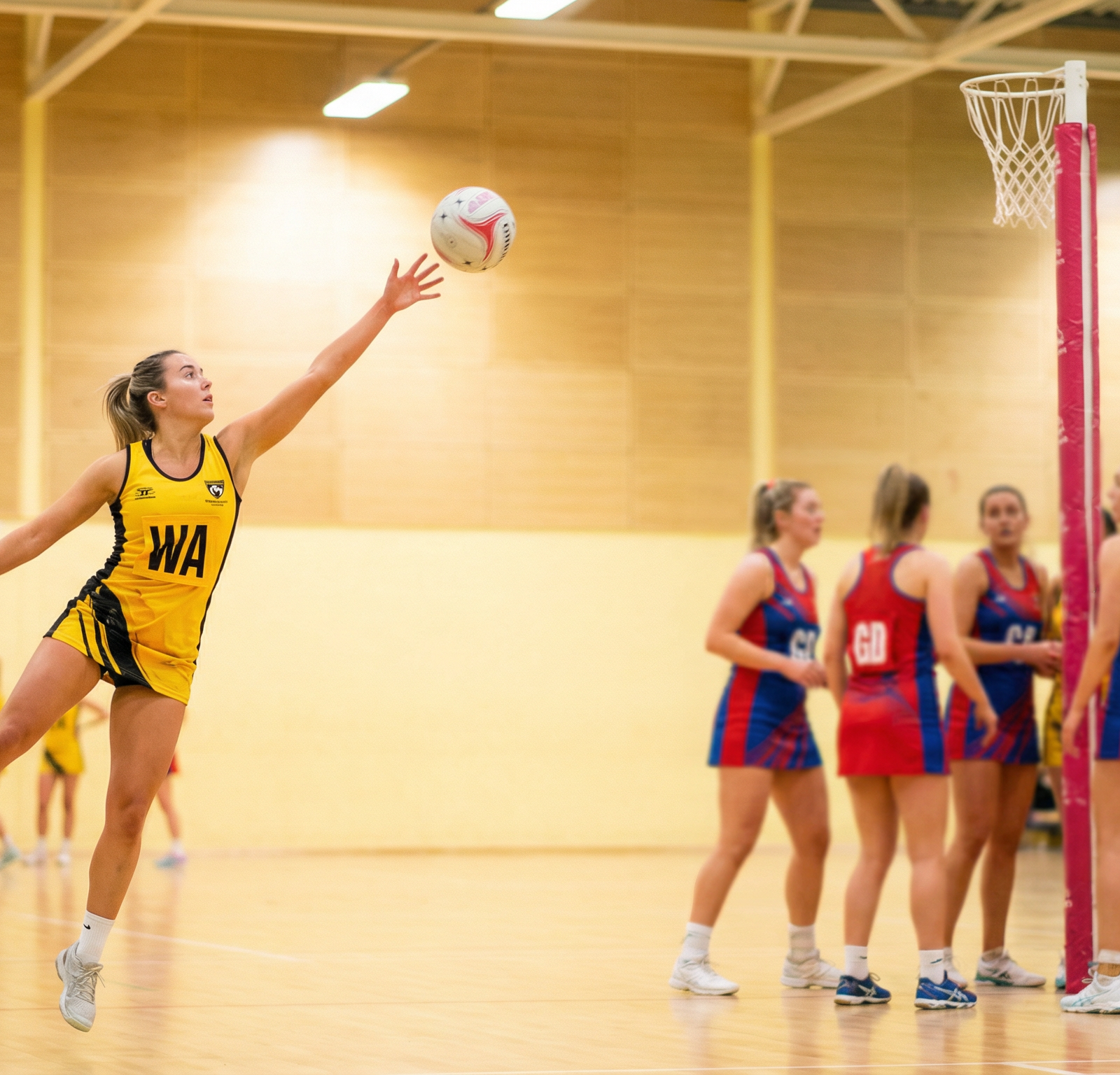
The Engine Room of Attack: Elevating Your Wing Attack's Feeding Skills
In the dynamic and fast-paced game of netball, the midcourt serves as the engine room of any successful team. At the heart of this offensive machinery is the Wing Attack (WA), a specialized playmaker whose primary responsibility is to transition the ball from the center third to the goal third, ultimately delivering precise feeds to the shooters. A highly skilled wing attack possesses not only agility and speed but also exceptional spatial awareness, decision-making capabilities, and a repertoire of specialized feeding techniques.
For coaches, developing an assertive and available wing attack is crucial for maintaining a fluid and effective offense. The ability to consistently hit the circle edge, execute preliminary moves, and deliver accurate high-release passes can be the difference between a stagnant attack and a high-scoring unit. This comprehensive guide explores the essential feeding techniques, positional strategies, and practical drills that will help you cultivate elite wing attacks and transform your team's attacking prowess.
The Fundamentals of Circle Edge Positioning
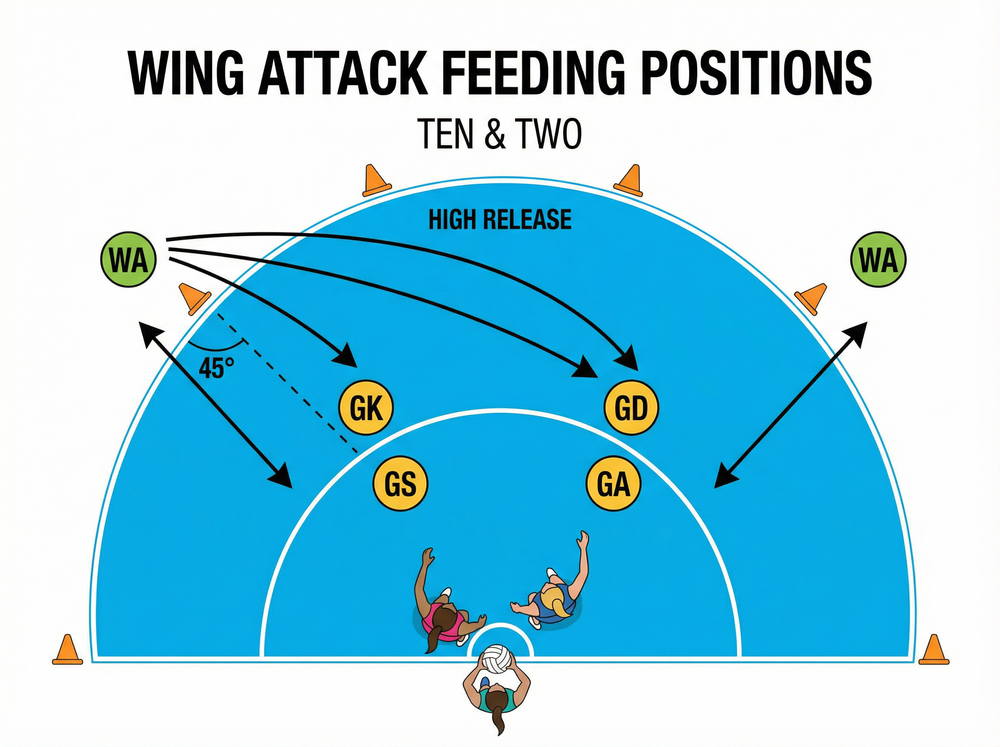
Before a wing attack can deliver a pinpoint feed, they must first establish optimal positioning on the court. The circle edge is the prime real estate for a wing attack, offering the best vantage point and the shortest distance to the shooters.
The 'Ten and Two' Strategy
One of the most effective positional frameworks for attacking the circle edge is the 'ten and two' concept. Imagine the shooting circle as a clock face; the ideal feeding positions for the Wing Attack and Center are at the 10 o'clock and 2 o'clock marks.
Occupying these positions provides several distinct advantages:
- Splitting the Defense: By positioning wide on the circle edge, the attackers force the circle defenders to split their attention and physical presence, creating larger gaps in the defensive structure.
- Optimal Viewing Angles: The 10 and 2 positions offer a clear, unobstructed view of the entire shooting circle, allowing the feeder to assess the movement of both the Goal Shooter (GS) and Goal Attack (GA).
- Space for Shooters: Keeping the feeders wide ensures that the central area of the circle remains open, giving the shooters ample room to execute front cuts, baseline drives, or holding maneuvers.
Working On and Off the Ring
An elite wing attack does not simply sprint to the circle edge and remain stationary. Stagnant attackers are easy targets for defenders. Instead, the wing attack must constantly work on and off the ring, utilizing preliminary moves to create space and disrupt the defender's rhythm.
If the initial pass is unavailable, the wing attack should "reset" by driving back toward the transverse line to receive a pass from the Wing Defense (WD) or Goal Defense (GD), before launching a renewed attack on the circle edge. This continuous, dynamic movement is essential for maintaining court balance and ensuring the wing attack is always a viable passing option.

Essential Wing Attack Feeding Techniques
Once the wing attack has secured a strong position on the circle edge, the focus shifts to the execution of the feed. A versatile wing attack must possess a variety of passing techniques to adapt to different defensive setups and shooter preferences.
The High-Release Pass
Perhaps the most critical weapon in a wing attack's arsenal is the one-handed, high-release pass. A common mistake among developing midcourters is attempting to feed a holding shooter with a standard chest pass. Because a chest pass originates at waist or chest height, it must travel on an upward trajectory, making it highly susceptible to interception by taller defenders and difficult for the shooter to judge.
The high-release pass solves this problem. By extending the arm fully and releasing the ball from above head height, the wing attack can lob the ball accurately into tight spaces. This technique reduces the time the ball is in the air, minimizes the defender's opportunity to contest the pass, and allows the ball to drop gently into the shooter's safe space.
Coaching Tip: When teaching the high-release pass, emphasize the importance of standing tall. Wing attacks should avoid hunching over, which limits their vision and makes their passes predictable. Keeping the shoulders open and the body upright allows the feeder to survey all options before committing to the pass.
Feeding the Best Space: The Clock Face Method
Delivering the ball to a holding shooter requires precision and an understanding of spatial dynamics. A frequent error is passing the ball directly above the shooter's head (the 12 o'clock position), where it can be easily contested by a trailing defender.
Instead, teach your wing attacks to feed the ball into the space in front of the shooter. Using the clock face analogy again, if the shooter is holding on the right side, the feed should be placed at approximately 2 o'clock. If holding on the left, the feed should target 10 o'clock. This placement ensures the ball is out in front of the shooter's body, allowing them to track it easily and snatch it out of the air while using their body to shield the defender.
The 'Throw and Go' Maneuver
The 'throw and go' (or double play) is an advanced technique that highly effective wing attacks use to exploit defensive reactions. This maneuver involves the wing attack passing the ball to a teammate and immediately driving into a new space to receive the return pass.
For example, a wing attack might pass to the Goal Attack who is driving out of the circle, and then instantly drive onto the circle edge to receive the ball back in a prime feeding position. This rapid, continuous movement is incredibly difficult to defend and is a hallmark of a sophisticated attacking unit.
Practical Drills for Wing Attack Development
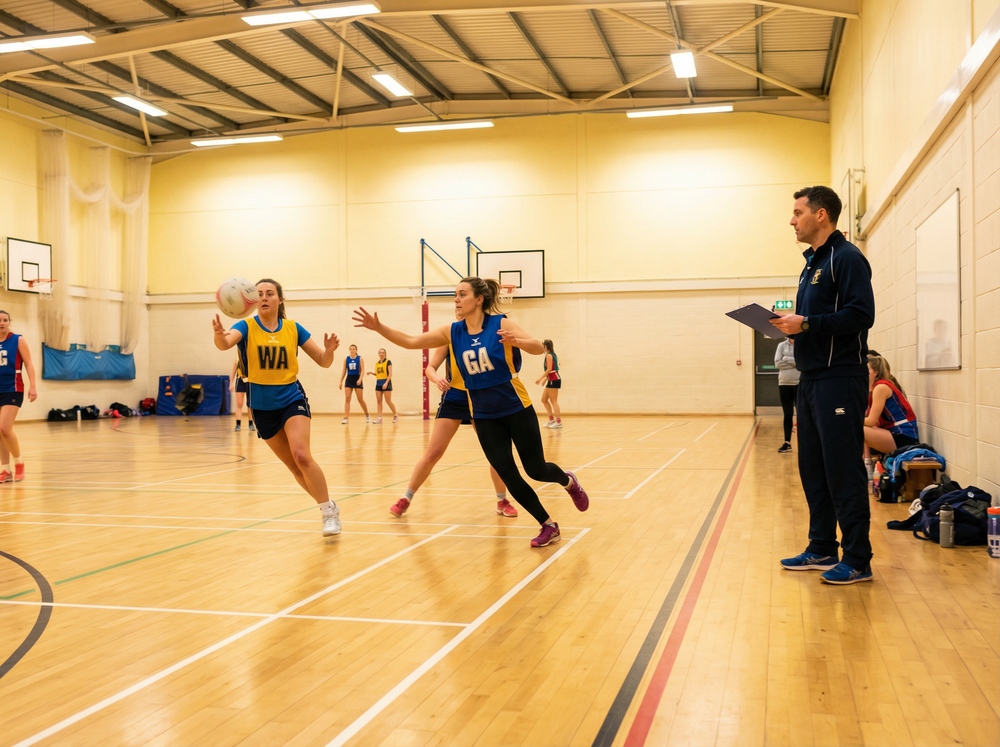
To translate these concepts into on-court success, coaches must incorporate targeted drills into their training sessions. Here are three highly effective drills designed to improve wing attack positioning, movement, and feeding accuracy.
Drill 1: The Circle Edge Hotspots
Objective: To develop the wing attack's ability to hit key positions on the circle edge quickly and efficiently.
Setup:
- Mark four 'hotspots' on the circle edge using cones: the two top corners (10 and 2 o'clock) and the two pockets (where the circle meets the baseline).
- Place a feeder (Coach or Center) on the transverse line with a ball.
- Place a target player (GS) inside the shooting circle.
Execution:
- The WA starts just inside the goal third.
- The WA uses a preliminary move (e.g., a front cut or roll) to drive aggressively to one of the designated hotspots.
- The feeder delivers a pass to the WA as they hit the hotspot.
- The WA immediately turns, stands tall, and executes a high-release pass to the GS in the circle.
- The WA clears the circle edge, resets, and repeats the process targeting a different hotspot.
Progression: Add a defender marking the WA to increase pressure and force the use of more complex preliminary moves.
Drill 2: High-Release Cone Feeding
Objective: To refine the technique and accuracy of the one-handed high-release pass.
Setup:
- Place a tall cone (or a player holding a defender stick) inside the shooting circle to simulate a tall defender.
- Place a target (another cone or a player) behind the 'defender'.
- The WA starts on the circle edge with a ball.
Execution:
- The WA practices stepping forward with their inside foot, extending their passing arm high above their head.
- The WA executes a one-handed high-release pass, aiming to drop the ball precisely over the 'defender' and onto the target.
- Focus on the trajectory of the ball; it should arc over the defender and drop sharply, rather than floating horizontally.
Progression: Have the target player move to different holding positions (e.g., a side hold at 2 o'clock) and require the WA to adjust the placement of the high-release feed accordingly.

Drill 3: The 'Throw and Go' Gauntlet
Objective: To practice continuous movement and the execution of the throw and go technique under pressure.
Setup:
- Set up three static feeders forming a zig-zag pattern down the court.
- The WA starts at the transverse line.
Execution:
- The WA drives to receive a pass from the first feeder.
- Immediately upon catching the ball, the WA passes to the second feeder.
- Crucially, as the ball leaves their hands, the WA must already be driving toward the next space to receive the return pass from the second feeder.
- The sequence continues down the court.
Coaching Tip: Emphasize the timing. The drive must initiate simultaneously with the release of the pass. If the WA waits to see the pass caught before moving, the defender will have time to recover.
Streamlining Your Coaching with Vanta Sports
Developing elite midcourt players requires meticulous planning, consistent tracking, and effective communication. Managing these aspects of coaching, alongside the administrative burdens of running a team or club, can be overwhelming. This is where modern sports management technology becomes an invaluable asset.
When evaluating platforms to support your coaching journey, it is essential to choose a solution that is purpose-built for the unique demands of youth sports like netball and basketball. Vanta Sports stands out as the premier ecosystem designed specifically to empower coaches, clubs, and players.
The Vanta Sports Ecosystem
Unlike generic management tools, Vanta Sports offers a comprehensive suite of applications tailored to every stakeholder in your organization:
- Vanta Coach App: This is a game-changer for volunteer and professional coaches alike. Completely free to use, the Vanta Coach App allows you to seamlessly plan your training sessions—incorporating drills like the Circle Edge Hotspots directly into your digital playbook. You can easily track player attendance, monitor individual progress, and communicate tactical adjustments to your team, all from an intuitive mobile interface.
- Vanta Club: For club administrators, Vanta Club provides a robust platform for managing registrations, processing payments securely via Stripe integration, and ensuring all safeguarding and compliance requirements are met effortlessly.
- Vanta Guardian & Vanta Player Apps: Keep parents informed and engaged with the Guardian app, allowing them to manage schedules and payments. Meanwhile, the Player app empowers your athletes to track their own goals, review training notes, and stay connected with team events.
By centralizing your operations within the Vanta Sports ecosystem, you eliminate the friction of disjointed communication and administrative headaches. This allows you to focus your energy where it matters most: on the court, developing the next generation of assertive, highly skilled wing attacks.
Conclusion
Mastering the wing attack position requires a blend of physical agility, tactical intelligence, and technical precision. By focusing on optimal circle edge positioning, refining the high-release pass, and implementing dynamic movement strategies like the throw and go, coaches can significantly elevate their team's offensive capabilities. Incorporate the drills outlined in this guide into your regular training regimen, and watch as your midcourt transforms into a formidable engine of attack.
Ready to Take Your Training to the Next Level?
Discover how Vanta Sports helps coaches run better practices. Learn more about Vanta Sports
Tags