

Basketball
The 1-3-1 Zone Offense: Mastering the High Post and Corner Attack
Dismantle any zone defense by effectively utilizing the high post, rapid ball reversals, and targeted baseline cuts in this comprehensive 1-3-1 offensive scheme.

What you need
1 Basketball, Half court or full court (FIBA dimensions)
1. Overview
The 1-3-1 zone offense is a strategic alignment designed to combat traditional even-front (2-3) and odd-front (1-2-2 or 3-2) zone defenses. By positioning players in the gaps of the zone, this offense forces defenders to make difficult choices, creating numerical advantages on the perimeter and in the paint. The primary objectives of the 1-3-1 offense are to get the ball into the high post (free throw line area), force the defense to collapse, and generate high-percentage shots from the perimeter or via baseline cuts. This set play is particularly effective when you have a skilled passing big man at the high post and capable shooters on the wings.
2. Setup

Equipment Needed:
- 1 Basketball
- Full court (28m x 15m FIBA standard)
- 5 offensive players
Player Positions & Court Setup:
The initial setup requires precise spacing to stretch the defense. Players must maintain their designated areas to ensure the passing lanes remain open.
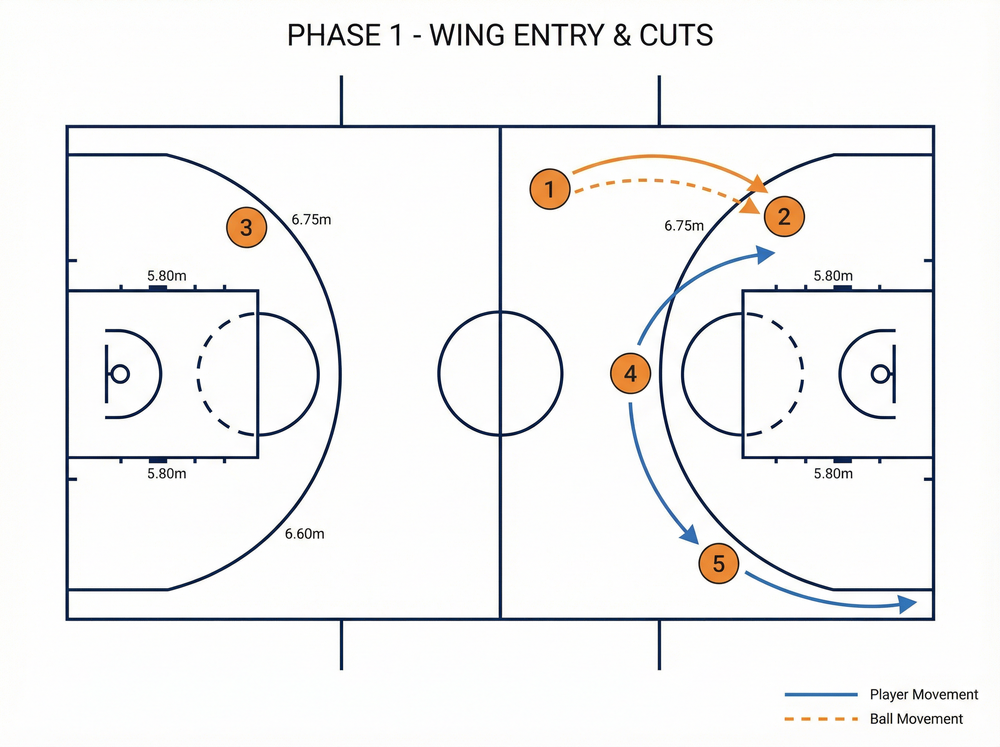
- Player 1 (Point Guard): Positioned at the top of the key, slightly above the three-point line (6.75m).
- Player 2 (Right Wing): Positioned on the right wing, extended from the free-throw line, outside the three-point arc.
- Player 3 (Left Wing): Positioned on the left wing, mirroring Player 2 on the opposite side.
- Player 4 (High Post): Positioned directly in the center of the free-throw line (5.8m from the baseline).
- Player 5 (Baseline/Short Corner): Positioned on the baseline, starting centrally under the basket or slightly shaded to the strong side.

3. Step-by-Step Instructions
Executing the 1-3-1 zone offense requires patience, rapid ball movement, and synchronized player cuts. Follow these steps to initiate the primary action.
Step 1: The Wing Entry
Player 1 brings the ball down the court and initiates the offense by passing to either wing. In this example, Player 1 passes to Player 2 on the right wing. This initial pass forces the zone defense to shift toward the ball side.
Step 2: The High Post Flash and Baseline Shift
As the ball is in the air to Player 2, Player 4 (High Post) must aggressively flash toward the ball-side elbow (the intersection of the free-throw line and the lane line). Simultaneously, Player 5 (Baseline) shifts along the baseline to the strong-side short corner (just outside the paint on the baseline). This movement creates a strong-side triangle between the Wing, High Post, and Short Corner.

Step 3: Reading the Defense
Player 2 catches the ball in a triple-threat position and immediately looks to the High Post (Player 4). If the pass to Player 4 is open, Player 2 delivers the ball. Once Player 4 receives the ball at the elbow, they pivot to face the basket. From here, Player 4 has three primary options: shoot the mid-range jumper, pass to Player 5 cutting baseline, or kick out to opposite wing (Player 3) if the defense collapses.
Step 4: The Corner Attack and Skip Pass
If the pass to the High Post is denied, Player 2 looks to attack the baseline or utilize the skip pass. If Player 2 drives toward the baseline, Player 5 must cut sharply along the baseline to the opposite corner to create a passing window. Player 4 dives to the strong-side block, and Player 1 relocates to the right wing to provide a safety outlet. Alternatively, if the defense overloads the ball side, Player 2 can execute a skip pass directly to Player 3 on the weak-side wing for an open three-point attempt.
4. Key Coaching Points
- Patience and Ball Reversals: Do not rush the first available shot. Reversing the ball from side to side at least once forces the zone to shift continuously, eventually exposing gaps and creating closeout situations for the defense.
- High Post Activity: The High Post player (Player 4) is the linchpin of this offense. They must be active, constantly flashing to the ball-side elbow, and must possess the vision to distribute the ball effectively once they receive it in the middle of the zone.
- Baseline Movement: The Baseline player (Player 5) must read the penetration of the wing players. When a wing drives baseline, Player 5 must vacate the area and cut to the opposite side to avoid bringing an extra defender to the ball.
- Spacing and Spacing: Wing players (Players 2 and 3) must stay wide, hugging the three-point line. If they creep inside the arc, they compress the floor, allowing a single defender to guard two offensive players.
- Pass Fakes: Utilize aggressive pass fakes to manipulate the zone defenders. A strong fake to the wing can open up the passing lane to the high post.
5. Common Mistakes
- Static Offense: Players standing still after passing the ball. The 1-3-1 requires continuous subtle movements and relocations to maintain passing angles.
- Ignoring the High Post: Perimeter players passing only around the three-point arc (a 'U' shape) without attempting to penetrate the zone via the high post. This is exactly what the defense wants.
- Poor Spacing: Wing players drifting inward, which clogs the passing lanes to the high post and allows the defense to recover more quickly on skip passes.
- Telegraphing Passes: Staring down the intended receiver, allowing the zone defenders to anticipate the pass and jump into the passing lane for a steal.
6. Variations & Progressions
- The High-Low Look: Once the ball is entered to the High Post (Player 4), Player 5 can immediately seal their defender under the basket. Player 4 looks for the quick high-low pass for an easy layup.
- Dribble Entry: Instead of a pass to initiate the offense, Player 1 can use a dribble entry toward the wing. This pushes Player 2 down to the corner, rotating the formation and forcing a different rotation from the zone defense.
- Screening the Zone: Introduce off-ball screens against the zone. For example, the weak-side wing can set a pin-down screen on the back-side zone defender to free up a shooter on a skip pass.
7. Age Adaptations
- Under 10 / Under 12: Focus heavily on the basic spacing and the concept of passing rather than dribbling against a zone. Emphasize the entry pass to the wing and the immediate look to the high post. Do not introduce complex baseline cuts yet.
- Under 14 / Under 16: Introduce the skip pass and the concept of ball reversals. Teach the High Post player how to pivot and face the basket immediately upon receiving the ball. Emphasize the timing of the baseline player's cuts.
- Open / Advanced: Implement all variations, including dribble entries and screening the zone. Expect rapid ball movement, advanced reading of defensive rotations, and high-level decision-making from the High Post position.
