The 4-Point Star Wicket-Keeping Agility Drill
Develop explosive lateral movement, forward diving, and quick recovery skills with this high-intensity 4-point agility drill for wicket-keepers.
Equipment Needed
1. Overview
The 4-Point Star Agility Drill is a high-intensity, match-specific exercise designed to improve a wicket-keeper's footwork, reaction time, and explosive movement in all directions. Wicket-keeping requires more than just good hands; it demands the ability to cover ground quickly, whether diving for an edge, springing forward for a drop-in, or moving laterally to take wide deliveries. This drill isolates those essential movement patterns, forcing the keeper to react, move, catch, and recover rapidly.
Use this drill during the skill-development phase of your practice session, ideally after a thorough warm-up but before the keeper is fatigued, to ensure maximum explosiveness and correct technique.
2. Setup
Equipment Needed:
- 1 set of stumps (with bails)
- 4 marker cones (2 yellow, 2 orange)
- 6-8 cricket balls (or incrediballs/tennis balls for juniors)
- Full wicket-keeping gear (pads, gloves, box, helmet if standing up)
Pitch/Field Setup:
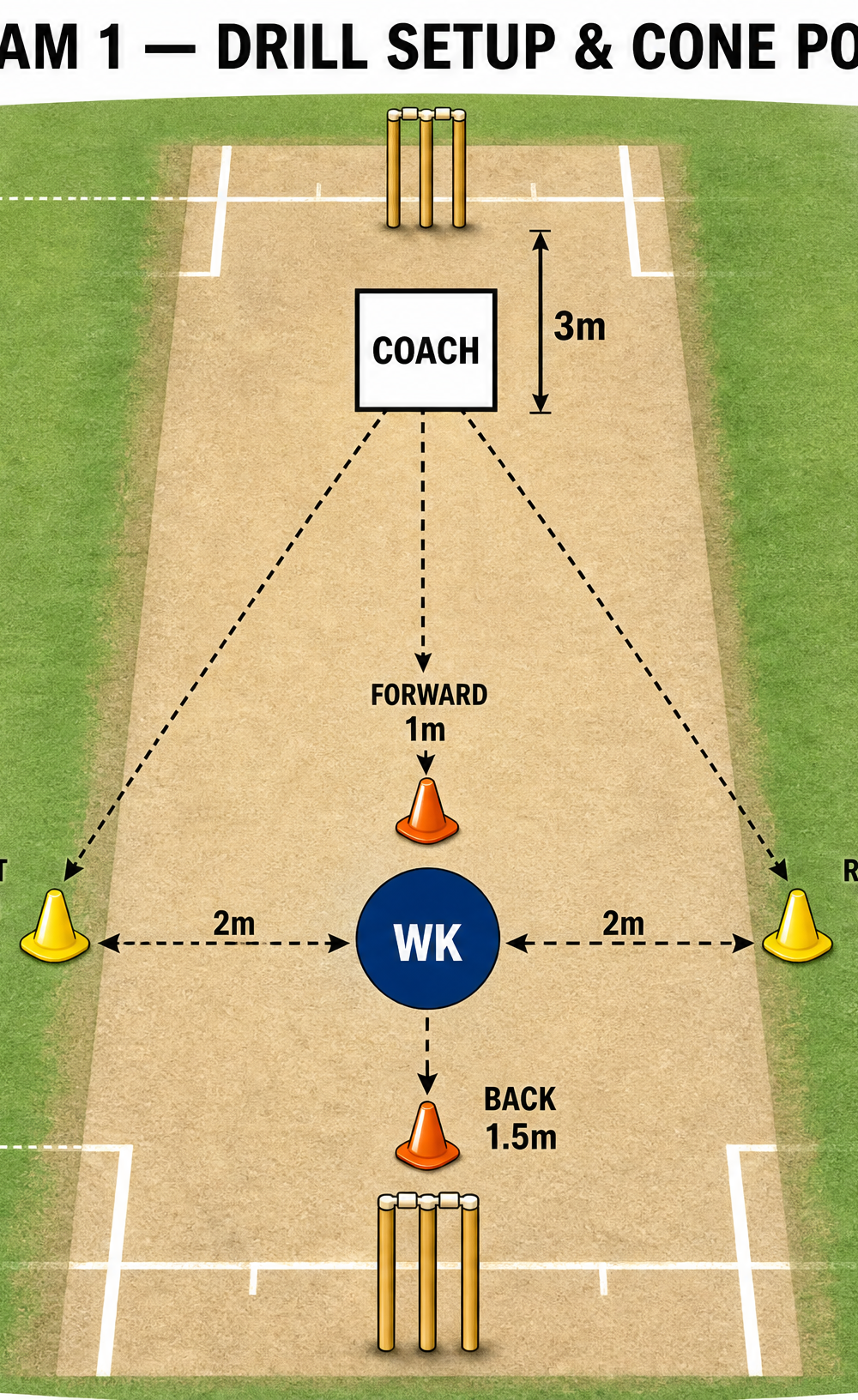
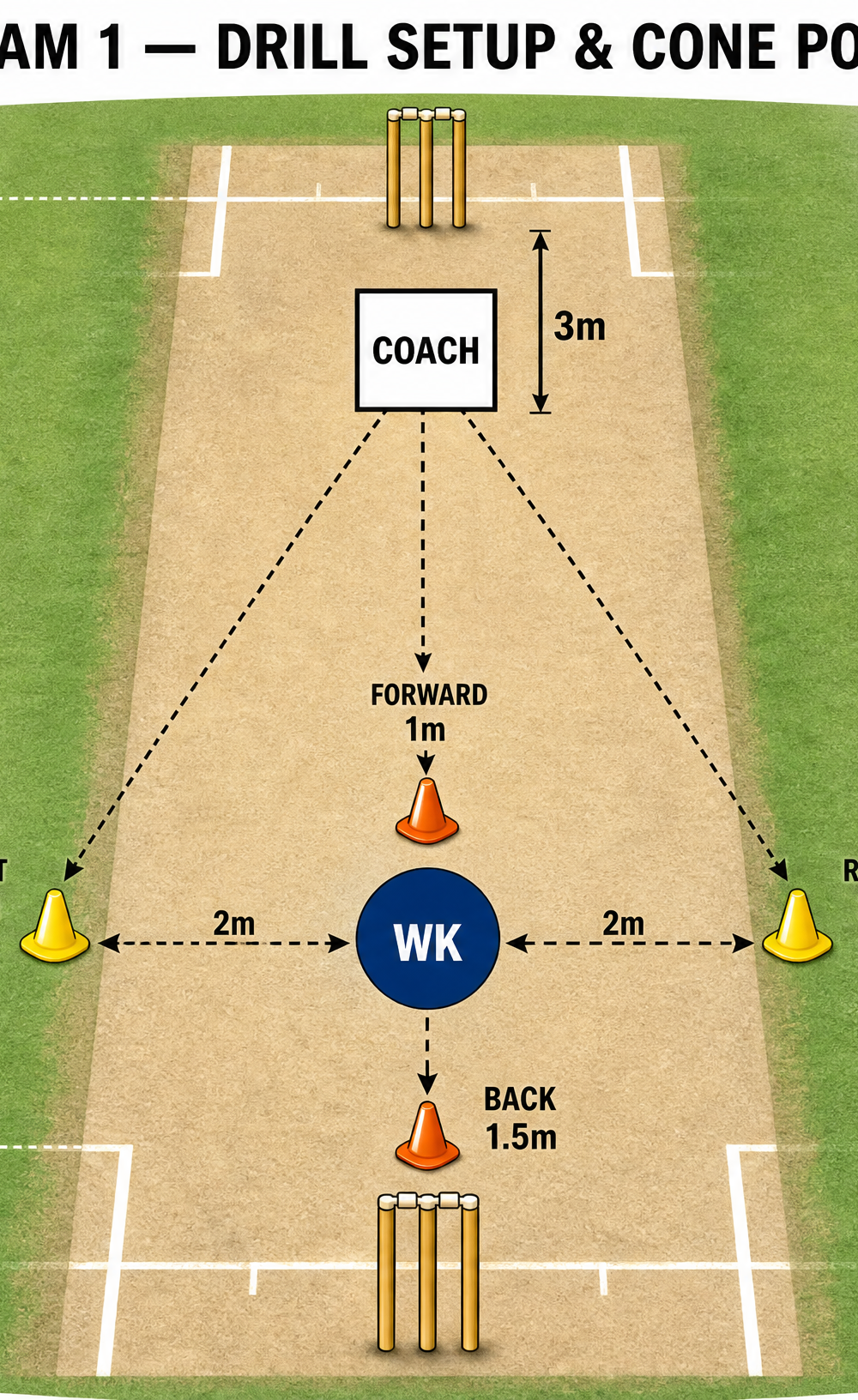
Set up on a standard 22-yard cricket pitch (or any flat grass/turf surface).
- Place the stumps at the bowling end.
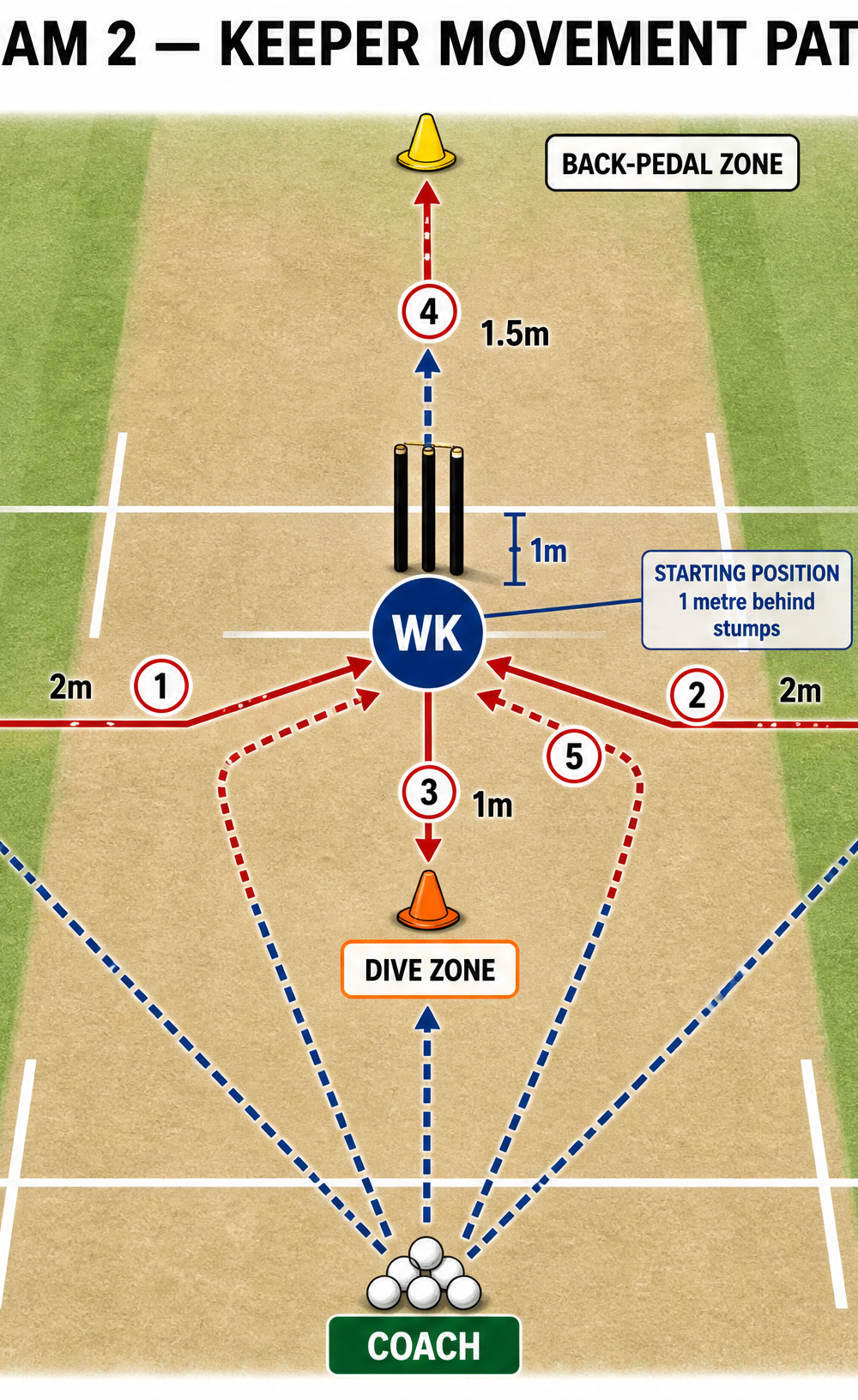
- Mark the wicket-keeper's (WK) starting position exactly 1 metre behind the stumps.
- Place the 4 cones in a diamond shape around the WK:
- Left Cone (Yellow): 2 metres directly to the keeper's left.
- Right Cone (Yellow): 2 metres directly to the keeper's right.
- Forward Cone (Orange): 1 metre directly in front of the keeper (next to the stumps).
- Back Cone (Orange): 1.5 metres directly behind the keeper.
- The coach/feeder stands 3-4 metres in front of the stumps with the balls.
3. Step-by-Step Instructions
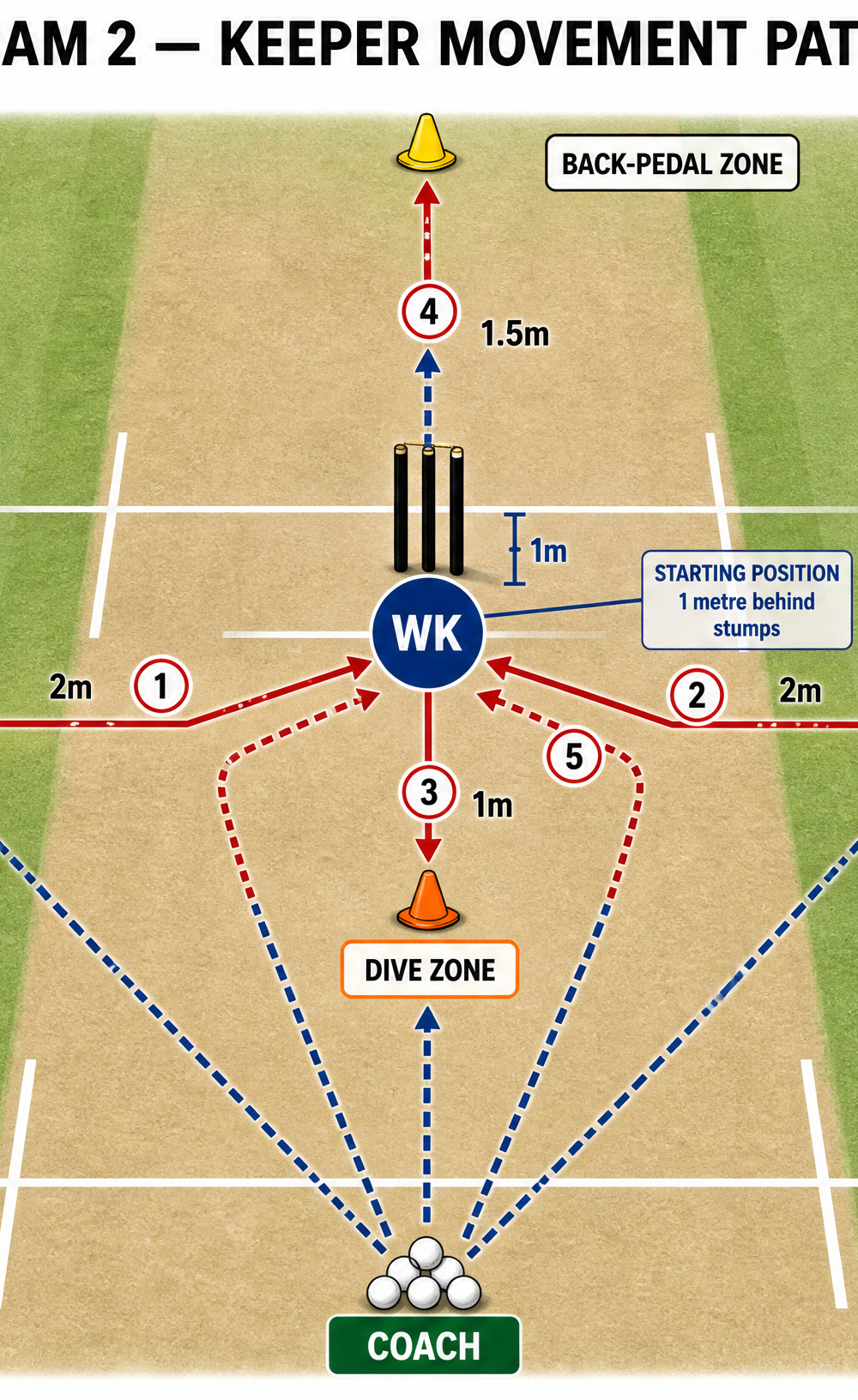
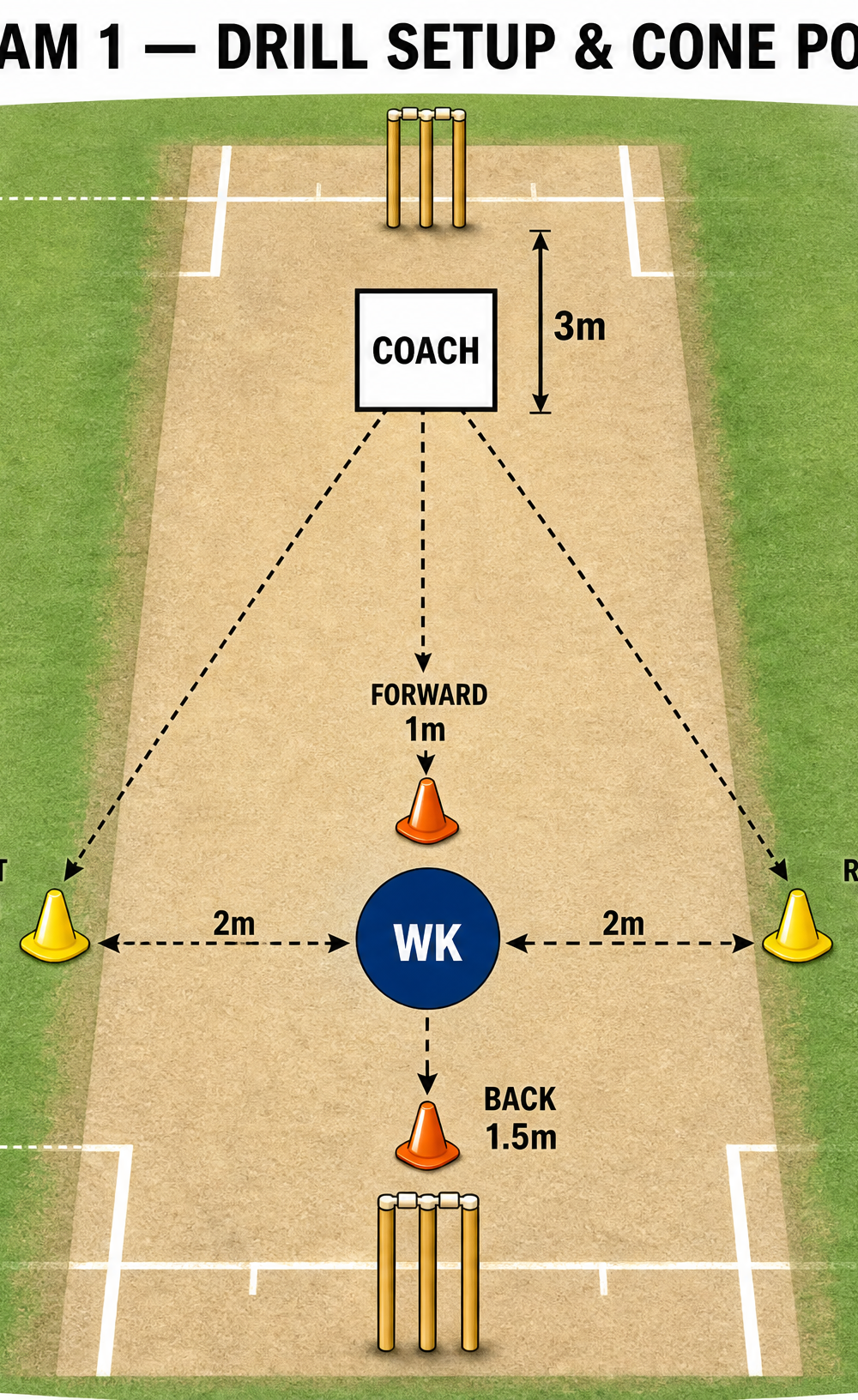
- Starting Position: The wicket-keeper assumes their standard crouch position at the starting mark (1m behind stumps), eyes on the coach.
- The Call: The coach calls out a direction (Left, Right, Forward, or Back) or points to a specific cone.
- The Movement:
- Left/Right: The keeper executes a rapid lateral shuffle (staying low) to the designated cone.
- Forward: The keeper springs forward, staying low, simulating taking a ball down the leg side or a drop-in.
- Back: The keeper back-pedals quickly, simulating adjusting to a fast, bouncy delivery.
- The Feed: As the keeper arrives at the cone, the coach throws a ball (underarm for speed, overarm for bounce) to that specific zone.
- The Take: The keeper catches the ball cleanly with soft hands, bringing it into their body.
- The Recovery: The keeper immediately tosses the ball back to the coach (or drops it in a bucket) and hustles back to the central starting position.
- Repetition: Repeat for 6-8 deliveries per set, ensuring the keeper moves to all four points randomly.
4. Key Coaching Points
- Stay Low During Movement: The keeper must maintain a low centre of gravity while moving. Standing up breaks momentum and increases reaction time. 'Head level' should remain constant during lateral shuffles.
- Weight on the Balls of the Feet: Ensure the keeper's weight is slightly forward, ready to explode in any direction. Flat-footed keepers cannot react quickly enough.
- Lead with the Head and Hands: When moving laterally or diving, the head and hands should lead the movement, with the feet following naturally.
- Soft Hands on the Take: Even though the drill is fast-paced, emphasise 'giving' with the ball upon impact. The hands should act as shock absorbers.
- Explosive Recovery: The drill doesn't end with the catch. The speed at which the keeper returns to the starting position is just as critical as the initial movement.
5. Common Mistakes
- Crossing the Feet: During lateral movements, keepers often cross their feet instead of shuffling. This leads to a loss of balance and inability to change direction quickly.
- Standing Up Too Early: Rising out of the crouch before moving to the ball. This is a common flaw that limits lateral reach and diving ability.
- Snatching at the Ball: In the rush of the drill, keepers may push their hands out hard at the ball rather than letting it come into their gloves, leading to dropped catches.
- Ignoring the Return: Jogging back to the start position lazily. The recovery must be at match intensity.
6. Variations & Progressions
- Progression 1 — Blind Start: The keeper starts facing away from the coach. On the coach's call of 'Turn', the keeper spins around, identifies the cone the coach is pointing to, and executes the movement. This adds a cognitive reaction element that closely mirrors match conditions.
- Progression 2 — Deflection Board: The coach throws the ball onto a deflection board or Katchet ramp placed near the cones, forcing the keeper to adjust to unpredictable bounce and deviation at the end of their movement.
- Variation 1 — The Double Move: Call two cones in quick succession (e.g., 'Left, then Forward'). The keeper shuffles left, touches the cone, then immediately springs forward to take a catch at the front cone. This builds the chained movement patterns common in real match situations.
7. Age Adaptations
| Age Group | Distance Adjustment | Ball Type | Key Focus |
|---|---|---|---|
| Under 8 – Under 10 | Reduce all cones to 1m | Tennis/Incrediball | Movement mechanics only |
| Under 12 – Under 14 | Standard distances | Standard cricket ball | Footwork technique, no foot-crossing |
| Under 16 – Open | Full distances + max intensity | Standard cricket ball | Speed, deflection board, mixed feeds |