4v4 Transition Chaos: High-Intensity Small-Sided Game
Master the critical moments of transition with this fast-paced 4v4 small-sided game designed to improve reaction speed, pressing, and counter-attacking efficiency.

Equipment Needed
1. Overview
In modern football, the most decisive moments often occur during transitions—the split seconds immediately after winning or losing possession. This 4v4 small-sided game (SSG) is a high-intensity drill specifically designed to train players to react instantly to these changes. By keeping player numbers low and the pitch compact, players are forced into constant decision-making scenarios.
This drill achieves three primary objectives:
- Attacking Transition (Win the ball): Securing the first pass and launching a rapid counter-attack before the opposition can organize.
- Defensive Transition (Lose the ball): Executing an immediate counter-press or making high-speed recovery runs to delay the attack and regain shape.
- Physical Conditioning: The continuous nature of the drill builds anaerobic endurance and replicates the physical demands of match-day transitions.
Use this drill during the main tactical phase of your session, particularly when preparing for a match against a team that is dangerous on the counter-attack or vulnerable when disorganized.
2. Setup
Proper setup is crucial to maintain the intensity and flow of the drill.
Pitch Dimensions
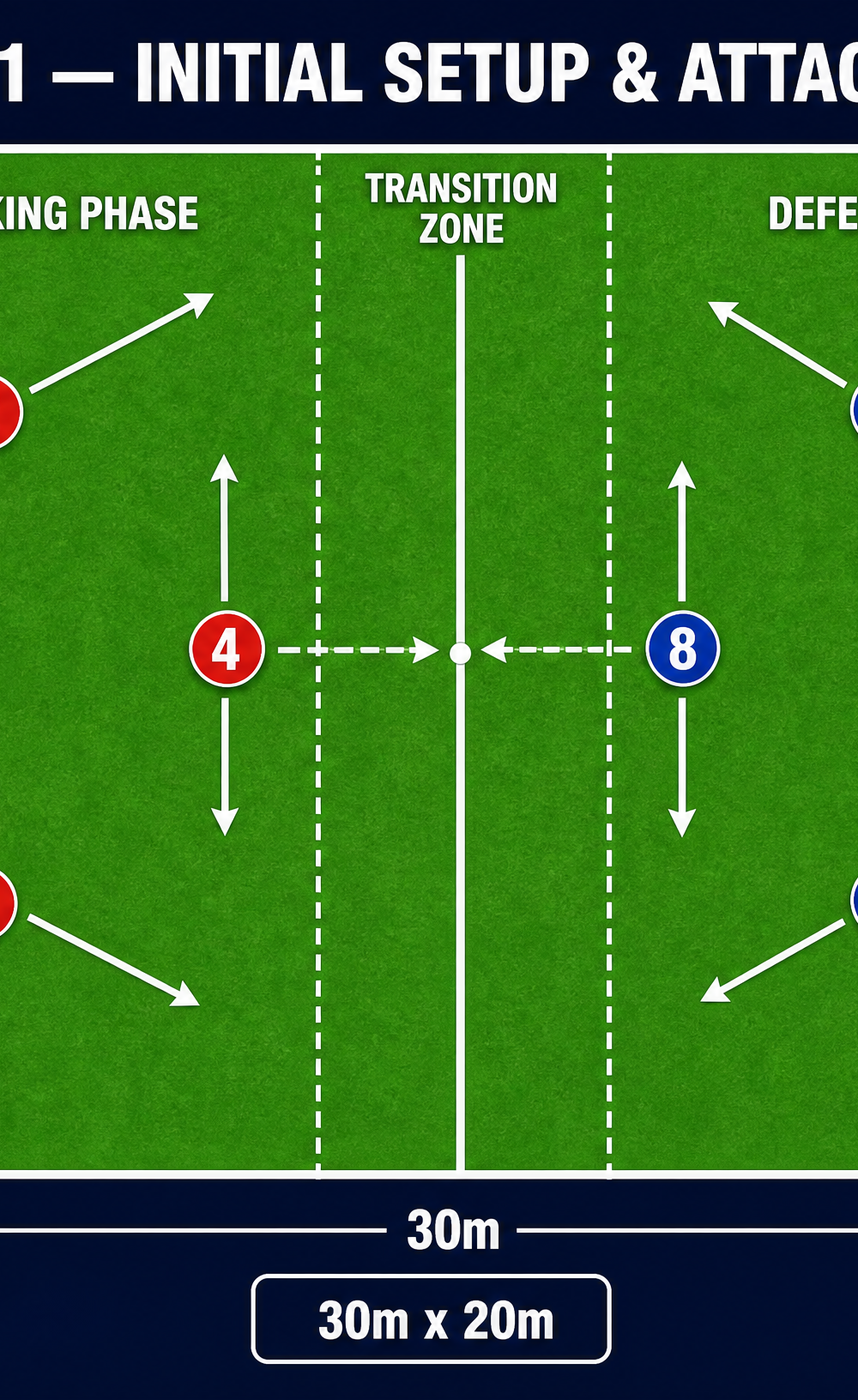
- Size: 30m x 20m (adjust slightly based on age and ability; a tighter pitch increases pressure, a larger pitch increases physical load).
- Markings: Use cones to clearly define the boundaries and a halfway line.
Equipment Needed
- 4 small pop-up goals (or use cones to create 2m wide gates).
- 2 sets of contrasting bibs (e.g., 4 Red, 4 Blue).
- Minimum of 8–10 footballs placed around the perimeter to ensure quick restarts.
- Flat marker cones for pitch boundaries.
Player Positions
- Total Players: 8 (divided into two teams of 4).
- Roles: No fixed goalkeepers. Players must dynamically rotate between attacking and defending roles (e.g., 1 covering defender, 2 wide players, 1 advanced forward).
3. Step-by-Step Instructions
- Initial Setup: Divide the players into two teams of four (Red vs. Blue). Each team defends two small goals on their baseline and attacks the two goals on the opponent's baseline.
- Starting the Game: The coach serves a ball into the center of the pitch to initiate play. Both teams compete to win the first ball.
- General Play: Teams attempt to score in either of the opponent's two goals. The inclusion of two goals stretches the defense and creates passing lanes.
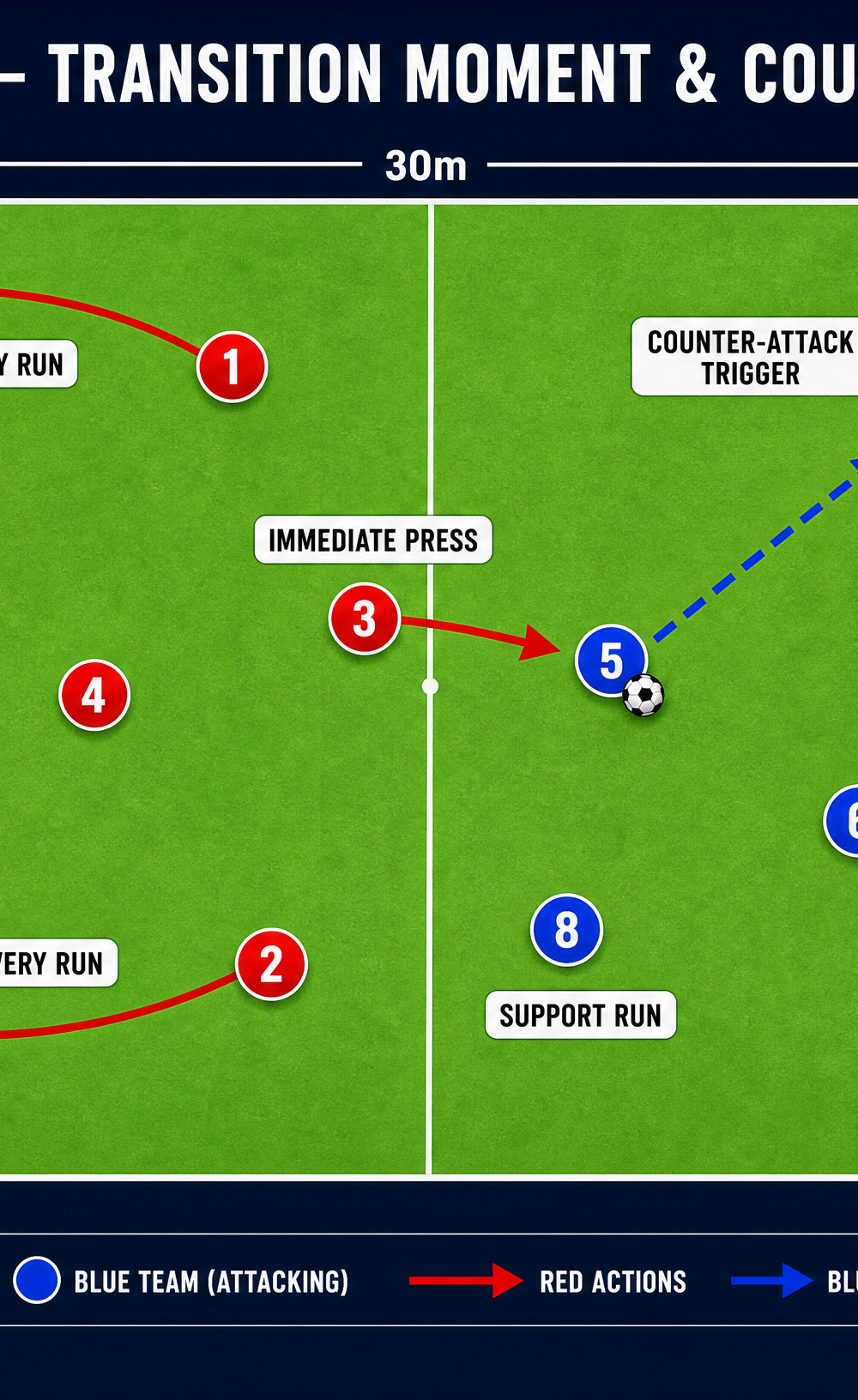
- The Transition Trigger: When a team loses possession, they must immediately react. The closest player to the ball must press instantly, while the others must sprint to recover their defensive shape or block passing lanes to the goals.
- Quick Restarts: If the ball goes out of play or a goal is scored, the coach immediately feeds a new ball to the team that should have possession, or into a neutral area to spark a new transition battle. There are no throw-ins or corners.
- Duration: Play in high-intensity blocks. A standard format is 4 blocks of 3 minutes, with 1–2 minutes of active recovery between blocks.
4. Key Coaching Points
- Immediate Reaction: The mental switch from attacking to defending (and vice versa) must be instantaneous. Praise players who react before the ball has even settled.
- First Pass on Regain: When winning the ball, the first pass is critical. It should ideally be forward to break lines, or away from pressure to secure possession. Avoid blind clearances.
- Counter-Pressing (Gegenpressing): Upon losing the ball, the nearest player must apply aggressive pressure to the ball carrier within 3 seconds to prevent a forward pass, while teammates compress the space.
- Recovery Runs: If the initial press is beaten, players must make high-speed, direct recovery runs toward their own goal to get behind the ball and establish a compact defensive block.
- Exploiting Disorganization: In attacking transition, encourage players to attack with speed and verticality before the defense can set up. Look for the furthest forward option early.
5. Common Mistakes
- Hesitation: Players stopping to complain about a lost ball or a foul instead of reacting immediately to the transition.
- Poor First Touch in Transition: Winning the ball but immediately giving it away due to a loose first touch or a rushed, inaccurate pass.
- Jogging to Recover: Players failing to sprint back into a defensive position after the initial press is bypassed, leaving their team outnumbered.
- Over-Committing: All four players pressing the ball simultaneously upon losing possession, leaving the goals completely exposed to a single pass.
6. Variations & Progressions
- Progression 1 (The Time Limit): To encourage faster counter-attacks, stipulate that a team must score within 8 seconds of winning possession. If they don't, the goal doesn't count.
- Progression 2 (The Overload): Add a neutral player (a 'Joker' or 'Magic Man') who always plays for the team in possession, creating a constant 5v4 overload and forcing the defending team to work harder in transition.
- Variation 1 (Directional Play): Instead of four small goals, use one full-size goal with a goalkeeper at one end, and two small goals at the other. This creates a more realistic attack vs. defense scenario.
7. Age Adaptations
- Under 8 – Under 10: Focus primarily on the reaction to losing the ball. Simplify the coaching points. Make the pitch slightly larger to give them more time on the ball. Reduce the duration of the blocks (e.g., 2-minute games).
- Under 12 – Under 14: Introduce the concept of the immediate press versus the recovery run. Demand higher intensity and quicker decision-making. Enforce the 'first pass forward' rule upon winning possession.
- Under 16 – Open: Run the drill at match speed. Demand tactical discipline in the defensive shape. Implement the time limit progression (score within 8 seconds) to simulate elite-level transition speed.