4v4 Transition Mastery: Small-Sided Game for Quick Reactions
Develop rapid reactions, quick decision-making, and structural organization during the critical transition moments of a match with this intense 4v4 small-sided game.

Equipment Needed
1. Overview
The 4v4 transition game is an essential drill designed to train players in the critical moments of a match: the transition from defense to attack (attacking transition) and from attack to defense (defending transition). In modern football, matches are often won or lost in these fleeting seconds.
This small-sided game (SSG) places players in a high-intensity, realistic match environment where possession changes frequently. By limiting the space and numbers, players are forced to react instantly when the ball is won or lost. It improves spatial awareness, quick decision-making under pressure, and the physical conditioning required for repeated sprints.
Use this drill during the main tactical phase of your session to bridge the gap between isolated technical work and full 11v11 match play.
2. Setup
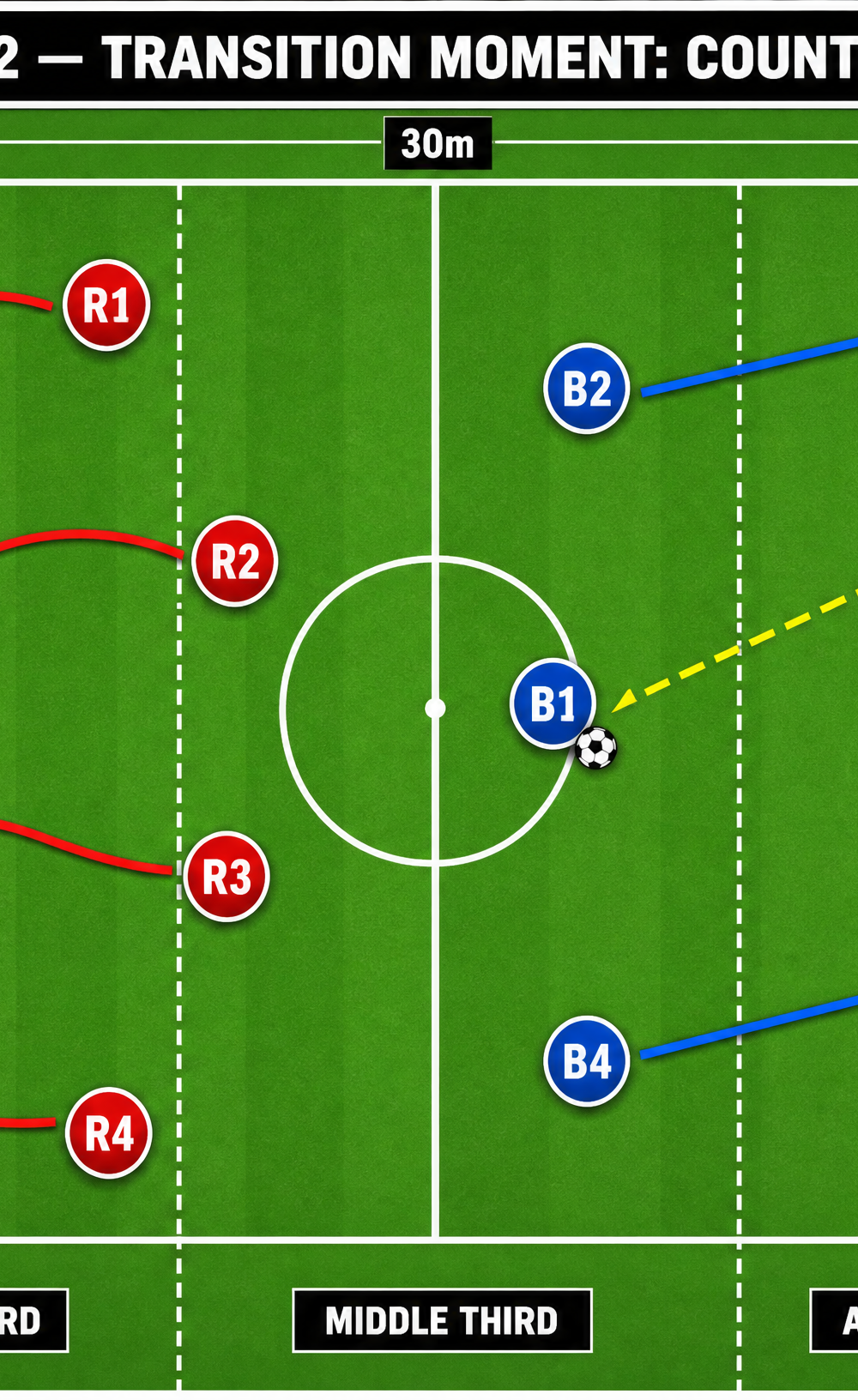
Creating the right environment is crucial for the success of this drill. The tight space will force quick play.
- Pitch Size: 30 meters long by 20 meters wide. This dimension can be adjusted based on the age and physical capacity of your players, but it should remain tight to encourage quick transitions.
- Goals: Two small goals (pop-up goals or cone gates), one placed at each end of the pitch.
- Players: 8 players in total, divided into two teams of 4 (e.g., Red vs. Blue).
- Equipment: Minimum of 8 cones to mark the pitch boundaries, plenty of footballs (kept near the coach on the sideline to keep the drill flowing), and two sets of colored bibs.

3. Step-by-Step Instructions
- Starting Position: Divide the players into two teams of four. One team starts with possession. The game begins with a pass from the coach on the sideline or from one of the defending players to the attacking team.
- Objective (In Possession): The attacking team aims to keep possession and score in the opponent's small goal. They must utilize width and depth to stretch the defending team.
- Objective (Out of Possession): The defending team must stay compact, press the ball carrier aggressively, and attempt to win the ball back as quickly as possible.
- The Transition Moment: The critical part of the drill occurs when possession changes hands.
- If the defending team wins the ball: They must immediately transition into attack and attempt to score in the opposite goal. Their first thought should be a forward pass or a forward run.
- If the attacking team loses the ball: They must instantly transition into defense, applying immediate pressure (counter-pressing) to win the ball back or dropping into a compact shape to deny space.
- Restarts: If the ball goes out of play or a goal is scored, the coach immediately feeds a new ball to the team that should have possession to maintain a high tempo and ensure continuous transitions.
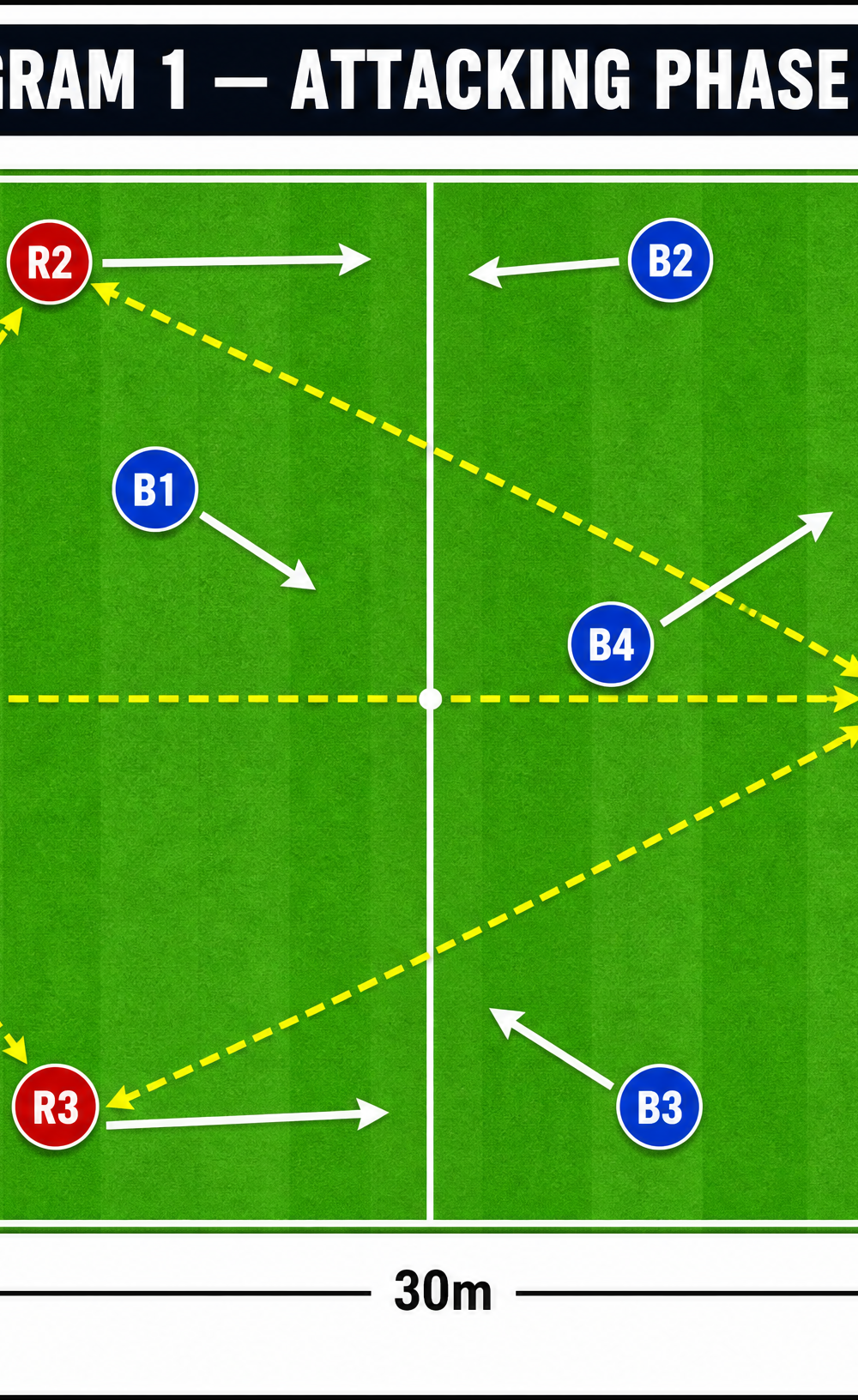
4. Key Coaching Points
- Immediate Reaction (The 3-Second Rule): Emphasize the importance of the first three seconds after possession changes. Players must react instantly, either springing forward into space (attacking transition) or aggressively closing down the ball carrier (defending transition).
- First Pass Forward: Upon winning the ball, encourage the first pass to be forward if possible. This catches the opponent disorganized before they can recover their defensive shape.
- Compactness in Defense: When possession is lost, the team must immediately squeeze the space, getting compact to deny passing lanes through the middle.
- Communication: Players must talk to each other constantly. Triggers like "Press!", "Drop!", or "Time!" are vital for a coordinated team response during chaotic transition moments.
- Scanning: Encourage players to constantly scan their surroundings before receiving the ball. This allows them to know where the space is and make quicker decisions during the transition.
5. Common Mistakes
- Slow Reactions: Players dwelling on a mistake or taking too long to switch their mindset from attack to defense (or vice versa).
- Forcing the Play: Trying to force a forward pass when the space isn't there, rather than securing possession first.
- Lack of Counter-Pressing: Failing to apply immediate pressure upon losing the ball, allowing the opposition easy time and space to launch a counter-attack.
- Stretching Too Early: Attackers making forward runs before possession is fully secured, leaving the team vulnerable if the ball is lost again.
6. Variations & Progressions
- Progression 1: Touch Restrictions: Limit players to two or three touches. This forces quicker decision-making and faster ball circulation, increasing the speed of the transitions.
- Progression 2: Target Players (Bumpers): Add two neutral players on the outside of the pitch who play with the team in possession. This creates an overload (6v4) in attack and forces the defending team to work harder, emphasizing the defensive transition.
- Variation 1: Directional Play: Instead of small goals, use target zones at each end. Teams score by dribbling or passing to a teammate inside the target zone. This encourages penetrating passes and forward runs.
7. Age Adaptations
- Under-8 to Under-10: Focus on the basic concept of "attack when we have it, defend when we don't." Keep the pitch slightly larger to give them more time on the ball. Don't focus too heavily on strict tactical shapes.
- Under-12 to Under-14: Introduce the concepts of compactness and the "first pass forward." Start emphasizing the speed of the reaction.
- Under-16 and Open: Demand high intensity, quick counter-pressing, and sophisticated movement patterns. Implement touch restrictions to increase the cognitive load.