

Football
4v4 Transition Mastery: High-Intensity Small-Sided Game
Develop rapid transition reactions, counter-attacking speed, and defensive recovery in this intense 4v4 small-sided game.

What you need
Footballs, Bibs (2 colours), Cones/Markers, 2 Small Goals
1. Overview
In modern football, matches are frequently won or lost in the moments of transition. The 4v4 Transition Mastery drill is a high-intensity, small-sided game (SSG) specifically designed to train players to react instantaneously when possession changes. By keeping player numbers low, this drill guarantees high involvement, forcing rapid decision-making in both attacking (positive) and defensive (negative) transitions.
When your team wins the ball, the objective is to exploit the disorganized opponent with a swift counter-attack before they can regain their defensive shape. Conversely, when the ball is lost, players must instantly decide whether to counter-press immediately or drop and delay to protect the goal. This drill replicates these chaotic match scenarios in a controlled, repeatable environment, making it an essential component of any competitive training cycle.
2. Setup

Creating the right environment is crucial for eliciting the desired physical and tactical responses from your players.
Pitch Dimensions:
- Create a playing area of 30 metres long by 20 metres wide.
- Mark a centre line to divide the pitch into two equal 15x20 metre halves.
Equipment:
- 2 small goals (approx. 5 metres wide) placed at opposite ends of the pitch.
- Flat markers or cones to define the boundaries and the centre line.
- An abundant supply of footballs placed with the coach on the touchline to ensure continuous play.
- 2 sets of contrasting coloured bibs (e.g., Red and Blue).
Player Allocation:
- Divide 8 players into two teams of 4 (4v4).
- No goalkeepers are used in this variation to encourage precise finishing and rapid transitions.
3. Step-by-Step Instructions

- Starting Position: The coach starts with the ball on the touchline near the centre of the pitch. Both teams begin in their respective defensive halves.
- Initiating Play: The coach plays a firm pass into one of the teams (e.g., the Red team). The receiving team immediately becomes the attacking team.
- Attacking Phase: The Red team attempts to build an attack and score in the Blue team's goal. They must utilize width and depth to stretch the defending team.

- The Transition Moment: If the Blue team wins possession (intercepts a pass or tackles a Red player), a transition occurs.
- Counter-Attack: The Blue team must immediately look to counter-attack and score in the Red team's goal. The Red team must instantly react to the loss of possession by either counter-pressing the ball carrier or recovering into a defensive block.
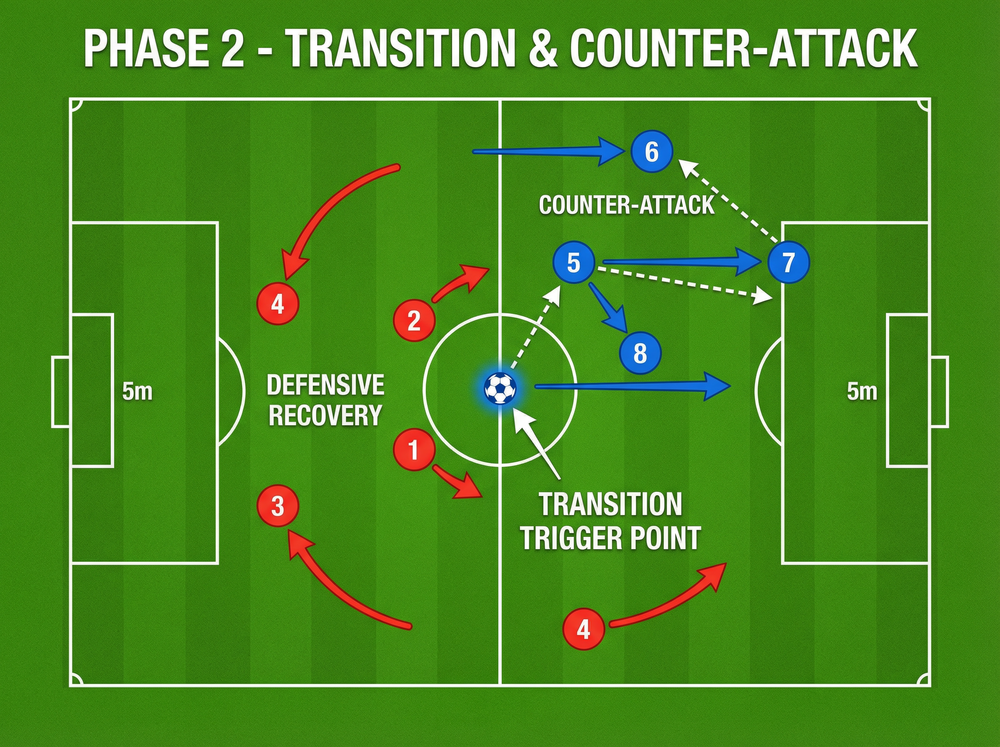
- Continuous Play: If a goal is scored, or if the ball goes out of bounds, the play is dead. The coach immediately feeds a new ball to the team that conceded or the team that did not touch the ball last, ensuring high tempo and continuous action.
- Rotation: Play for high-intensity intervals (e.g., 3-4 minutes) followed by a 1-2 minute active recovery period. Repeat for 4-6 blocks.
4. Key Coaching Points

- Instant Reaction to Turnover: The most important aspect of this drill is the speed of thought. Players must shift their mindset from attack to defense (or vice versa) the millisecond the ball changes hands. Demand immediate action.
- First Pass in Transition: Upon winning the ball, the first pass should ideally be forward to break defensive lines and launch the counter-attack. If a forward pass isn't available, secure possession to initiate a structured build-up.
- Defensive Recovery Runs: When possession is lost, players must make aggressive, high-speed recovery runs to get behind the ball. Delaying the attacker to allow teammates to recover is vital.
- Exploiting Space: Attacking players must quickly recognize and exploit the spaces left by the disorganized defense during a transition before they can regroup.
- Communication: Constant, clear communication is essential, especially during the chaotic moments of transition. Players must organize the press or direct the counter-attack verbally.
5. Common Mistakes

- Dwelling on the Ball: Players taking too many touches after winning possession, allowing the opposition time to recover their defensive shape.
- Negative Reactions to Losing the Ball: Players dropping their heads, complaining, or jogging back after losing possession instead of immediately fighting to regain it or recovering defensively.
- Forcing the Forward Pass: Attempting a risky forward pass when it's not on, leading to an immediate turnover and a counter-counter-attack.
- Lack of Compactness: The defending team failing to stay compact, leaving large gaps through the middle for the attacking team to exploit.
6. Variations & Progressions
- Add Goalkeepers (Progression): Increase the pitch size to 40x25 metres and add full-size goals with goalkeepers. This adds realism to the finishing phase and allows for goalkeeper distribution to start transitions.
- Touch Limit (Progression): Impose a 2-touch or 3-touch limit to increase the speed of play and force quicker decision-making.
- Time Limit to Score (Variation): After winning the ball, the team has a maximum of 8 seconds to get a shot on target. This emphasizes the urgency of the counter-attack.
- Neutral Player/Joker (Variation): Add one neutral player who always plays for the team in possession, creating a continuous 5v4 overload to facilitate attacking success and force the defending team to work harder.
7. Age Adaptations
- Under 8s - Under 10s: Focus heavily on the fun aspect. Emphasize basic dribbling and passing. Don't be too strict on tactical shape; encourage them to quickly try to score when they win the ball. Keep the area relatively large to give them space.
- Under 12s - Under 14s: Introduce the concepts of counter-pressing and defensive recovery. Start demanding quicker reactions to transitions. The touch limit variation can be introduced here to speed up their play.
- Under 16s - Open Age: Demand high tactical understanding and execution. The speed of play should be extremely high. Focus on the quality of the first pass in transition and the organization of the defensive block.
