

Basketball
5-Out Motion Offense Continuity: Drive & Kick Backdoor Action
A foundational 5-out motion offense play designed to create spacing, force defensive rotations, and generate high-percentage layups through continuous drive-and-kick and backdoor cut actions.

What you need
1 Basketball, Full or half court, Optional: Floor spots or cones for spacing drills
Overview
The 5-Out Motion Offense is a staple in modern basketball, emphasizing spacing, ball movement, and player decision-making. This specific continuity play focuses on a simple but devastatingly effective action: the drive-and-kick combined with a backdoor cut. It is an excellent set play to use against aggressive man-to-man defenses that try to deny the passing lanes. By utilizing the full 28m x 15m FIBA court, this offense forces the defense to cover maximum ground, creating natural gaps for penetration and easy scoring opportunities at the rim.
Setup

Equipment Needed:
- 1 Basketball
- 5 Players
- Full or half court with clear markings (three-point line, key, etc.)
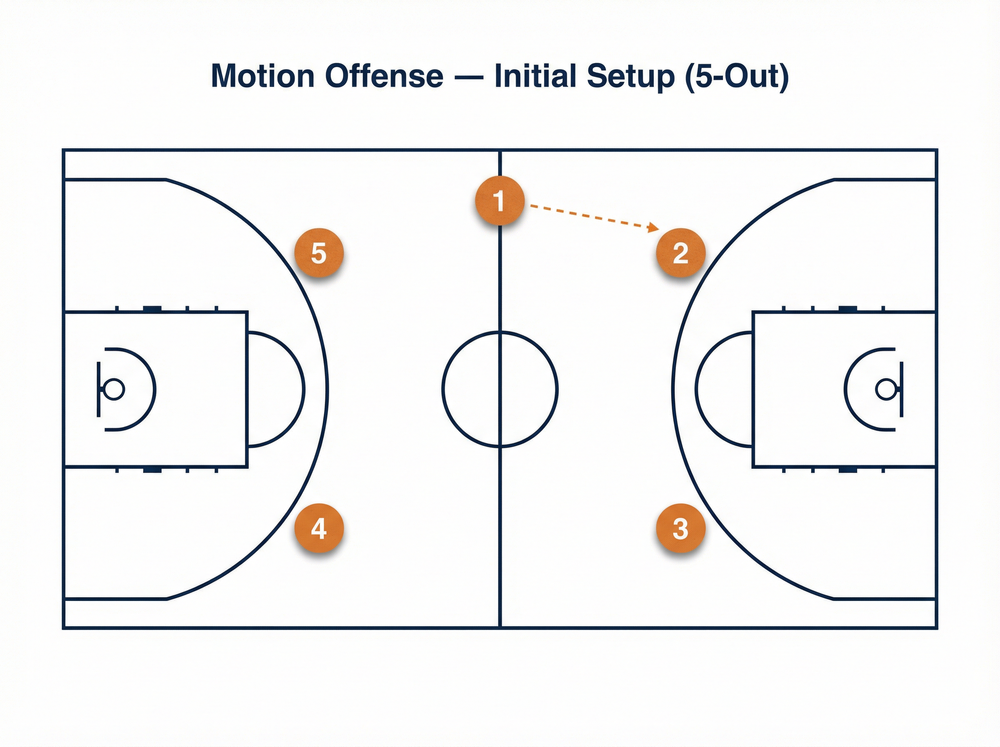
Player Positions (5-Out Setup):
- Player 1 (Point Guard): Top of the key, initiating the offense.
- Player 2 (Shooting Guard): Right wing, free-throw line extended.
- Player 3 (Small Forward): Right deep corner.
- Player 4 (Power Forward): Left deep corner.
- Player 5 (Center): Left wing, free-throw line extended.
All five players should be positioned outside the three-point arc, spaced approximately 4 to 5 meters apart to maximize floor spacing and force the defense to stretch.

Step-by-Step Instructions

- Initiation: The play begins with Player 1 (Point Guard) at the top of the key with the basketball. Players 2 through 5 are in their respective 5-Out spots, maintaining wide spacing.
- The Dribble Drive: Player 1 executes a hard, aggressive dribble drive toward the right side of the court, aiming for the gap between the top of the key and the right wing.
- The Backdoor Cut: As Player 1 drives toward Player 2's side, Player 2 reads the defense. If Player 2's defender steps up to help or denies the pass, Player 2 immediately executes a hard backdoor cut toward the basket.
- The Read and Pass: Player 1 has two primary options. Option A: If Player 2 is open on the backdoor cut, Player 1 delivers a crisp bounce pass for an easy layup. Option B: If the defense collapses and takes away the cut, Player 1 kicks the ball out.
- Continuity and Filling Spots: As Player 2 cuts to the basket, Player 3 (right corner) must drift slightly up to improve the passing angle. Simultaneously, Player 5 (left wing) sprints up to fill the empty spot at the top of the key left by Player 1.
- Resetting the Action: If Player 2 does not receive the ball on the cut, they clear out to the opposite corner (left corner), while Player 4 moves up to the left wing. Player 1 passes the ball to Player 5 at the top of the key, and the 5-Out spacing is re-established, ready to run the action again on the opposite side.

Key Coaching Points

- Spacing is Everything: Players must stay wide and deep in the corners and wings. Poor spacing allows a single defender to guard two offensive players, ruining the driving lanes.
- Timing the Cut: Player 2 must not cut too early. The cut should happen as Player 1 commits to the drive and draws the defender's attention, not before.
- Hard Cuts: The backdoor cut must be a sprint, not a jog. A slow cut allows the defense to recover and clogs the paint for the driver.
- Read the Defense: Player 1 must keep their head up on the drive. If the help defense comes from the corner, the kick-out pass to Player 3 should be automatic.
- Fill the Open Spots: The continuity relies on players instantly recognizing empty spots and filling them. Player 5 must hustle to the top of the key to provide a pressure-release pass for Player 1.
Common Mistakes

- Drifting Inside the Arc: Players tend to slowly drift inside the three-point line while waiting for the ball, which destroys the 5-Out spacing and brings defenders closer to the paint.
- Staring Down the Cutter: The ball handler (Player 1) telegraphs the pass by staring at Player 2 during the entire drive, allowing the defense to anticipate and intercept the pass.
- Standing Still After the Cut: If Player 2 doesn't get the ball on the backdoor cut, they often stop in the paint. They must immediately clear out to the opposite side to keep the lane open.
- Weak Passes: Bounce passes on the backdoor cut must be sharp and precise. Floated passes will be easily tipped or stolen by recovering defenders.
Variations & Progressions

- Dribble Handoff (DHO) Option: Instead of a backdoor cut, Player 1 can dribble directly at Player 2 for a dribble handoff. Player 2 then attacks the middle of the floor while Player 1 rolls or pops.
- Pin-Down Screen: If the defense sags off, instead of cutting backdoor, Player 2 can set a pin-down screen for Player 3 in the corner, allowing Player 3 to curl for a shot.
- Post-Up Option: If Player 2 has a size mismatch after the backdoor cut, they can briefly post up on the low block before clearing out to the opposite side.
Age Adaptations
- Under 10 / Under 12: Focus heavily on the spacing and the basic mechanics of the backdoor cut. Do not worry too much about the full continuity aspect; just teach the initial drive and cut action. Use floor markers (cones or spots) to help them understand the 5-Out positions.
- Under 14 / Under 16: Introduce the continuity aspect (filling the open spots and reversing the ball). Demand harder cuts and better reads on the defense. Introduce the DHO variation as a secondary option.
- Open / Advanced: Execute the offense at full game speed. Focus on reading the secondary line of defense and making skip passes if the defense over-rotates. Players should seamlessly transition between the backdoor cut, DHO, and screening variations based on defensive reads.
