

Cricket
The Attack and Gather: Dynamic Ground Fielding & Pick-Up Drill
A high-intensity fielding drill designed to improve attacking the ball, clean pick-ups under pressure, and accurate return throws to the stumps.

What you need
10-15 cricket balls, 6-8 marker cones, 1 set of stumps, 1 fielding bat (optional)
Overview
Ground fielding is the heartbeat of any strong cricket team. The 'Attack and Gather' drill is designed to train fielders to aggressively attack the ball, execute clean one-handed or two-handed pick-ups, and transition smoothly into a balanced throwing position. This drill is perfect for warming up a squad before a match or as a core component of a dedicated fielding session. It emphasizes intensity, low body position, and game-like pressure, simulating scenarios where fielders must cut off boundaries or execute run-outs.
Setup
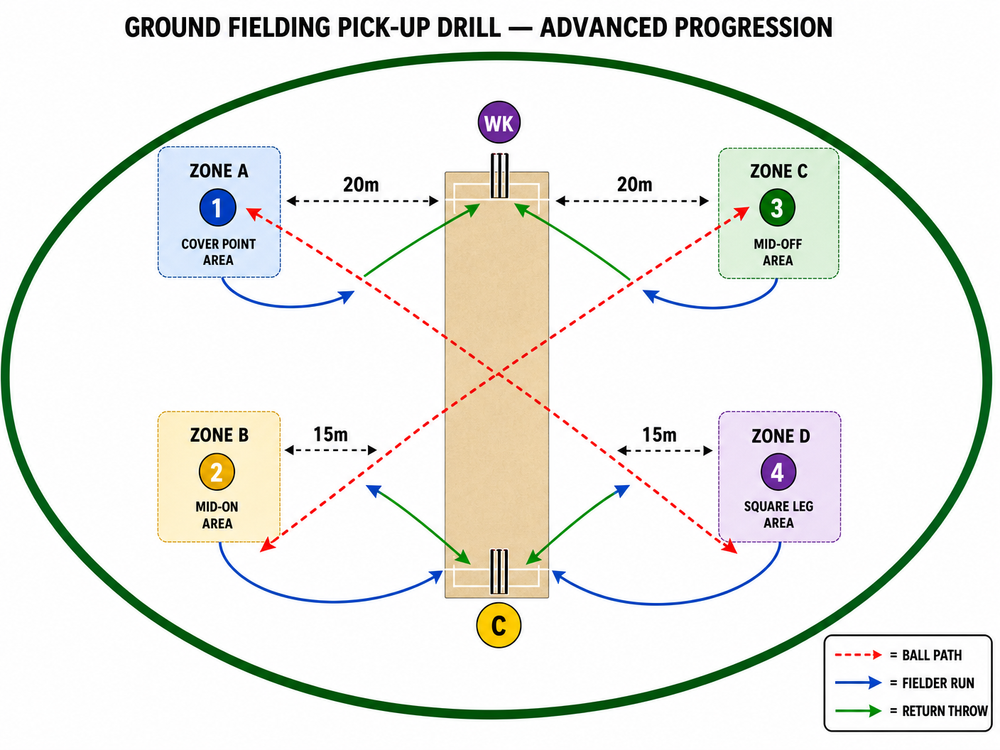
To run this drill effectively, you will need a clear area on the outfield or a dedicated fielding practice zone. The setup requires minimal equipment but relies heavily on accurate feeding from the coach.
Equipment Needed:
- 10-15 cricket balls (or softer practice balls for younger age groups)
- 6-8 marker cones
- 1 set of stumps (or a target stump)
- 1 fielding bat (optional, for the coach to hit the ball)
Pitch/Field Setup:
Set up a set of stumps at one end. Place a starting cone for the fielders about 20 meters away from the stumps. Place a secondary cone 5 meters closer to the stumps (at 15 meters) to mark the point where the fielder must pick up the ball. The coach stands near the stumps to feed the ball.

Step-by-Step Instructions
- The Starting Position: Fielders line up behind the starting cone (20m from stumps). The active fielder adopts a ready position—knees slightly bent, weight on the balls of their feet, hands out in front.
- The Feed: The coach (or a designated feeder) rolls or hits the ball along the ground towards the 15m pick-up cone.
- The Attack: As soon as the ball is fed, the fielder sprints towards the ball, aiming to intercept it near the 15m cone. The approach must be aggressive but controlled.
- The Pick-Up: The fielder decelerates slightly, getting their body low. Depending on the speed of the ball, they execute either a two-handed gather (for harder hit balls) or a one-handed pick-up outside their lead foot (for slower balls).
- The Transition: After gathering the ball, the fielder immediately takes a 'crow hop' or transitional step to align their shoulders with the target (the stumps).
- The Throw: The fielder executes a strong, flat throw aiming to hit the base of the stumps. The coach or a wicketkeeper receives the throw if it misses.
- Rotation: After the throw, the fielder jogs back to the end of the line, and the next fielder steps up.
Key Coaching Points
- Stay Low Early: Fielders should drop their hips and get low well before reaching the ball. "Head over the ball" is a crucial cue.
- Soft Hands: Emphasize giving slightly with the hands upon gathering the ball to prevent it from popping out.
- Footwork on Pick-Up: For a right-handed thrower picking up one-handed, the left foot should be planted next to the ball. This allows for a smooth transition into the throwing stride.
- Momentum Towards Target: Fielders must ensure their momentum continues towards the stumps after the pick-up, rather than falling away.
- Follow Through: A strong follow-through after the throw ensures accuracy and power.
Common Mistakes
- Approaching Too Upright: Fielders who stay tall often snatch at the ball, leading to fumbles.
- Stopping Before Gathering: Fielders must learn to pick up the ball through the line of movement, rather than stopping completely, which kills momentum.
- Poor Alignment: Throwing across the body instead of aligning the front shoulder with the target, resulting in inaccurate throws.
- Taking Eyes Off the Ball: Looking up at the target before the ball is securely in the hands.
Variations & Progressions
Once the basic drill is mastered, introduce these progressions to increase difficulty and game realism.
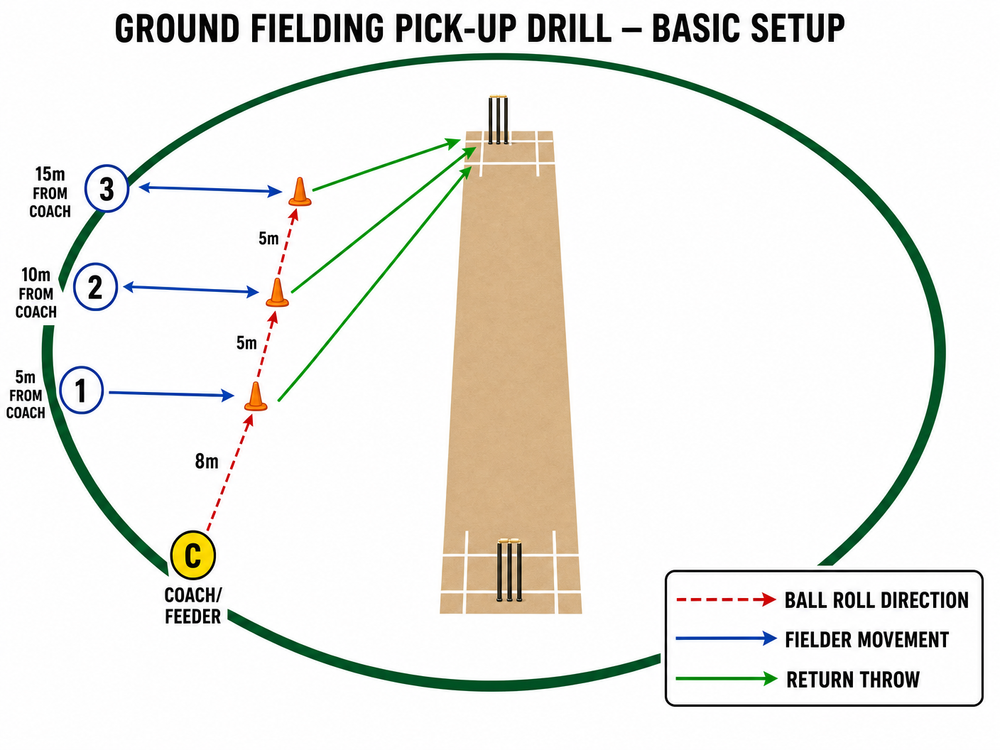
- The Multi-Zone Pressure Drill: As shown in the advanced progression diagram, set up four fielding zones (Cover Point, Mid-Off, Mid-On, Square Leg). The coach rapidly feeds balls to different zones randomly. Fielders must react instantly, attack the ball, and throw down the stumps at either the striker's or non-striker's end.
- The Chase Down: Instead of hitting the ball towards the fielder, the coach hits the ball away from them. The fielder must sprint, execute a sliding stop or a one-handed pick-up on the run, turn, and throw.
- Add a Batter: Have a batter running between the wickets. This forces the fielder to judge the pace of the runner and decide whether to throw to the keeper or the bowler's end.
Age Adaptations
- Under 8s / Under 10s: Use softer tennis balls or 'Incrediballs'. Focus entirely on the two-handed gather (the 'long barrier' technique if necessary) and basic throwing mechanics over shorter distances (10m).
- Under 12s / Under 14s: Introduce the one-handed pick-up outside the foot. Emphasize the speed of the transition from gathering to throwing.
- Under 16s / Open: High intensity. Focus on flat, hard throws directly over the stumps. Introduce complex scenarios like throwing off balance or hitting a single stump target.
