

Football
Mastering the Back-Four Offside Trap: A Comprehensive Defensive Drill
Equip your defensive line with the timing, communication, and synchronization needed to execute a flawless offside trap and neutralize through-ball threats.
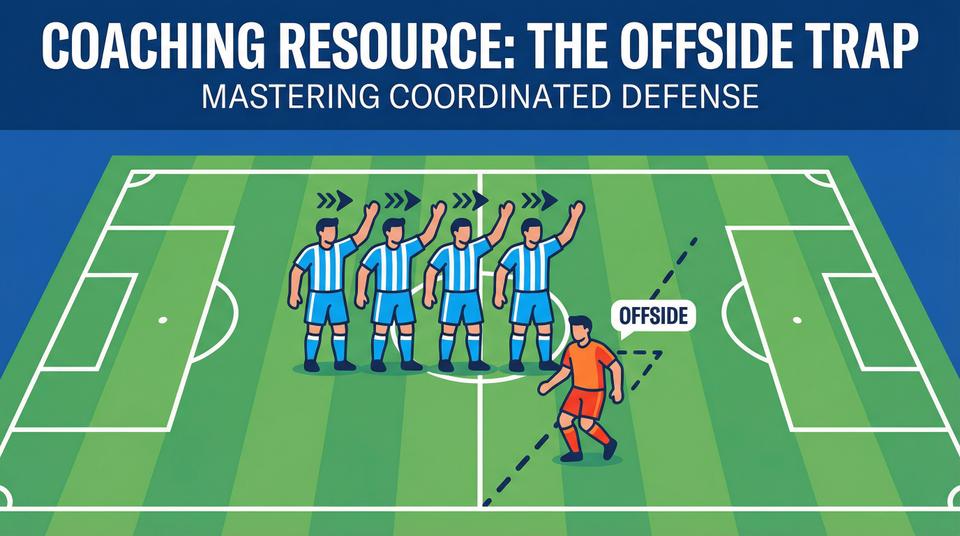
What you need
1 full-size goal, 10-12 cones, Footballs
1. Overview
The offside trap is a high-risk, high-reward defensive mechanism that requires absolute synchronicity among your back four. When executed correctly, it not only nullifies the opponent's attacking threat by catching their forwards offside, but it also instantly compresses the playing area, forcing the opposition to play in tighter spaces. This drill is designed to develop the non-verbal communication, visual cues, and collective timing required for your defensive line to step up as a single, cohesive unit. It is particularly effective against teams that rely heavily on pacing forwards and penetrating through-balls.
2. Setup
To ensure this drill translates effectively to match-day scenarios, the setup must replicate realistic game distances.
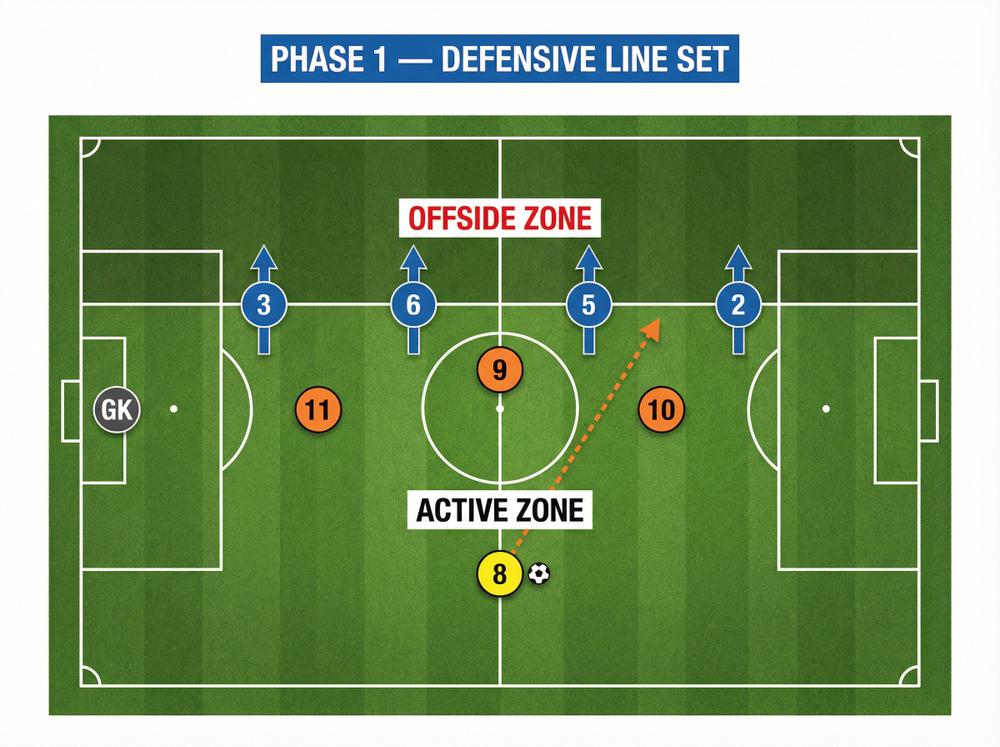
- Pitch Dimensions: Utilize a half-pitch setup, approximately 50m long by 68m wide.
- Players Required: 9 players minimum (1 Goalkeeper, 4 Defenders, 3 Attackers, 1 Midfielder).
- Equipment Needed: 1 full-size goal, 10-12 cones (to mark starting positions and offside zones), and a generous supply of footballs for the midfield server.
- Positions:
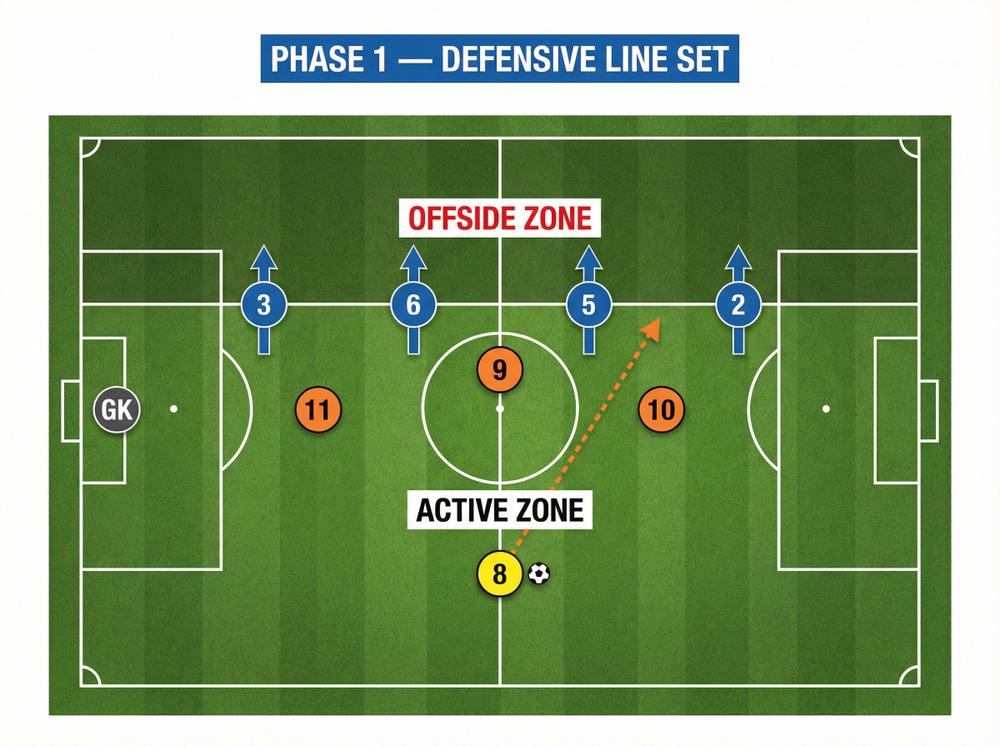
- Set your back four (Right Back [2], Right Centre-Back [5], Left Centre-Back [6], Left Back [3]) in a flat horizontal line approximately 35 metres from their own goal.
- Position the three attackers (Right Winger [11], Striker [9], Left Winger [10]) roughly 5 metres ahead of the defensive line.
- Place the central midfielder (Server [8]) 20 metres behind the attackers, in possession of the ball.
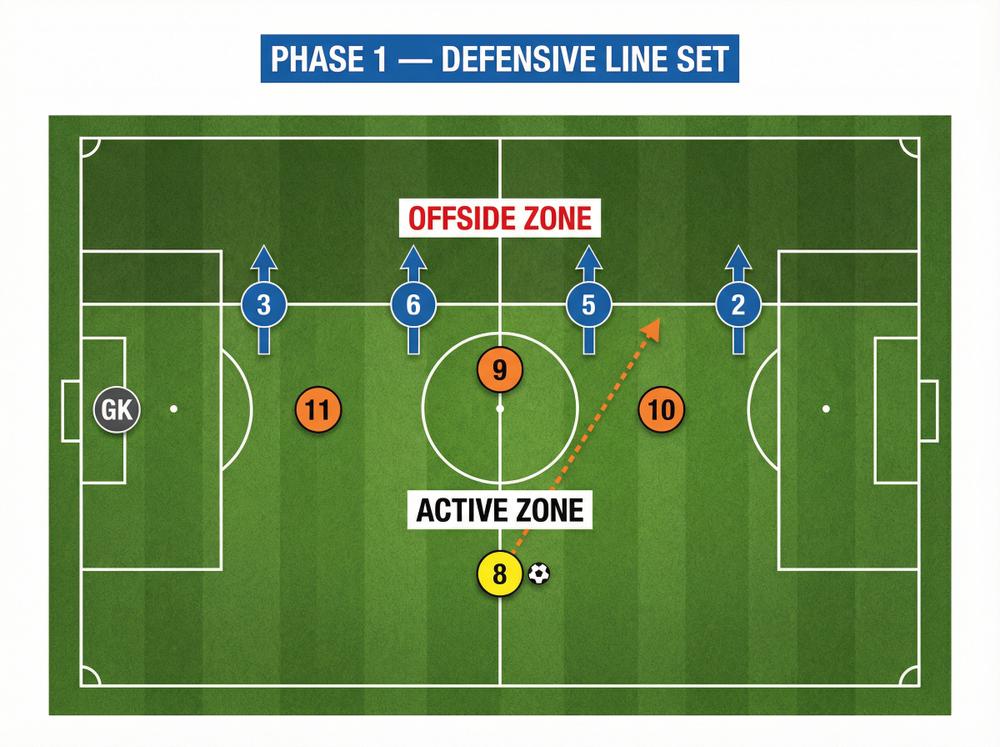
3. Step-by-Step Instructions
Executing the trap requires precise timing triggered by the server's body language.
Step 1: The Initial Stance
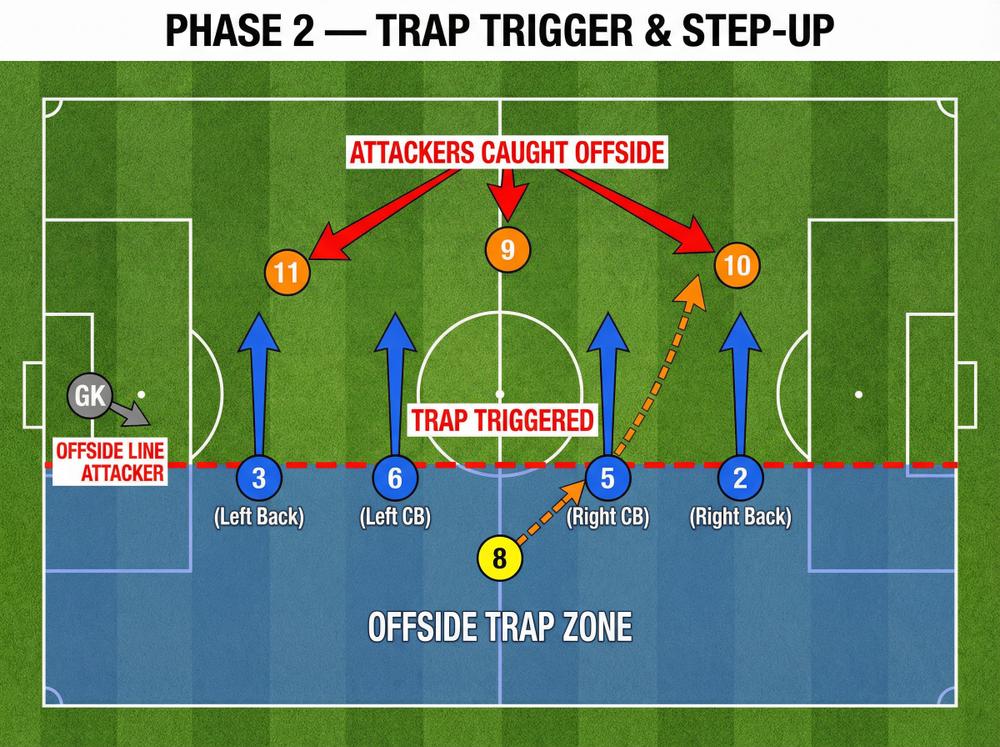
The back four must maintain a perfectly flat line. The designated leader (usually the most central or vocal Centre-Back, e.g., No. 5) ensures everyone is horizontally aligned by constantly checking their shoulders. The Goalkeeper should be positioned slightly off their line, ready to sweep up any balls that breach the trap.
Step 2: Reading the Trigger
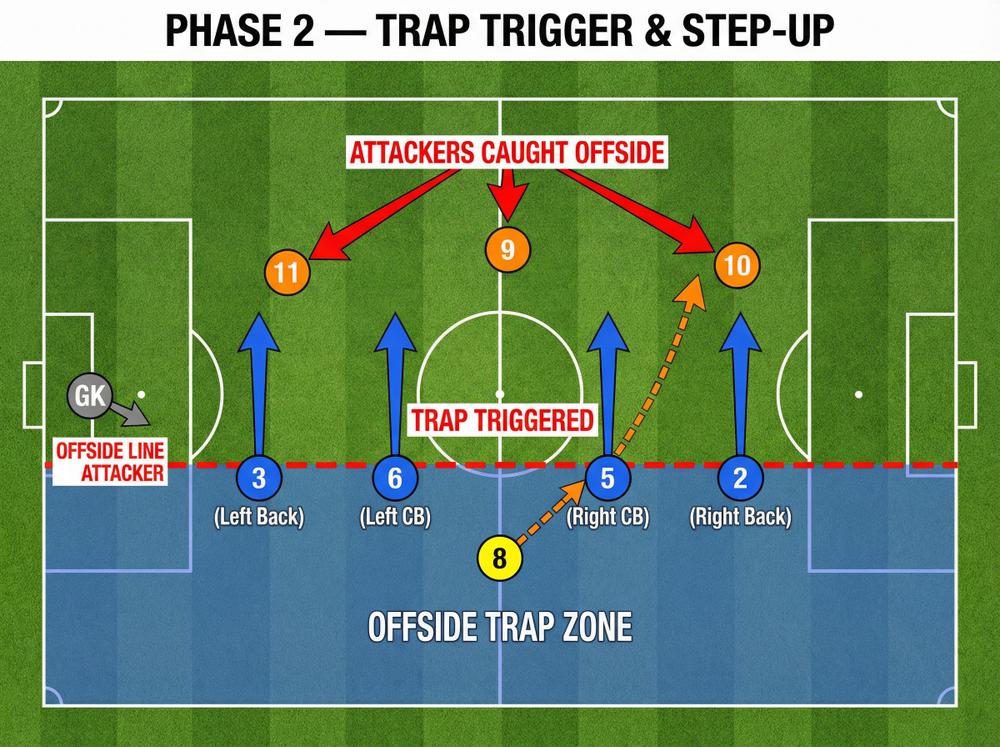
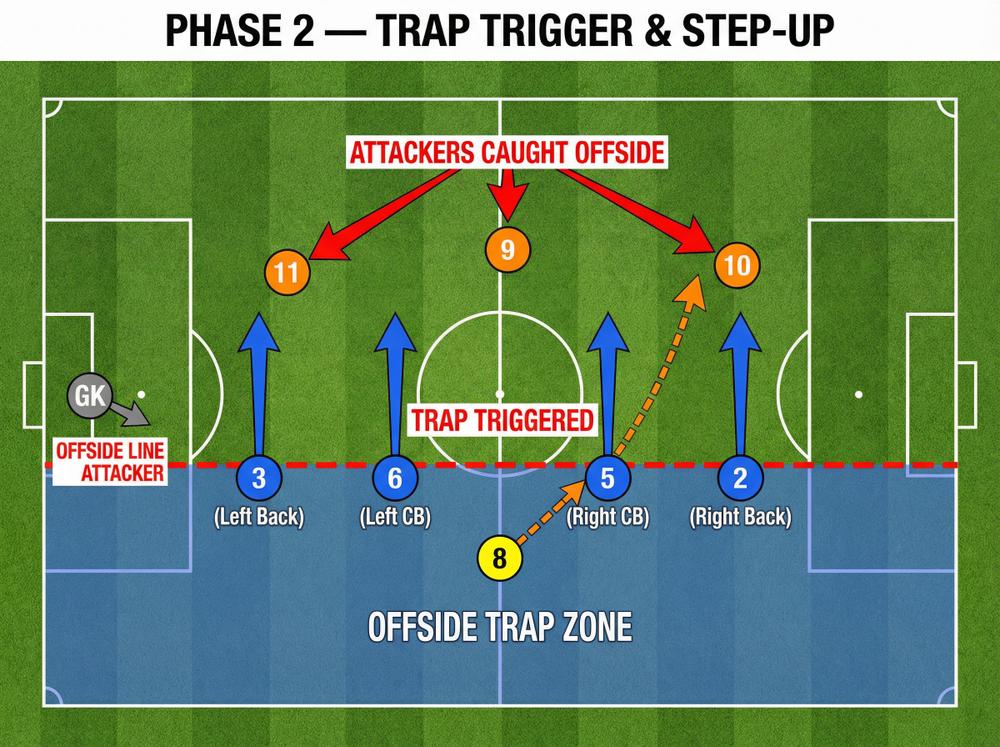
The trigger for the trap is not the pass itself, but the preparation for the pass. The defenders must fixate on the server (No. 8). When the server drops their head and pulls their leg back to strike the through-ball, the trap is triggered.
Step 3: The Synchronized Step-Up
Upon the visual trigger, the designated leader shouts "STEP!" or "UP!". Simultaneously, all four defenders must take two to three explosive steps forward (towards the halfway line). It is crucial that no player lags behind, as a single trailing foot will play the attackers onside.
Step 4: The Offside Call
As the ball is released, the attackers (9, 10, 11) should be caught behind the newly established defensive line. The defenders should immediately raise their arms to signal for offside, ensuring the assistant referee's attention is drawn to the trap.
Step 5: Recovery and Reset
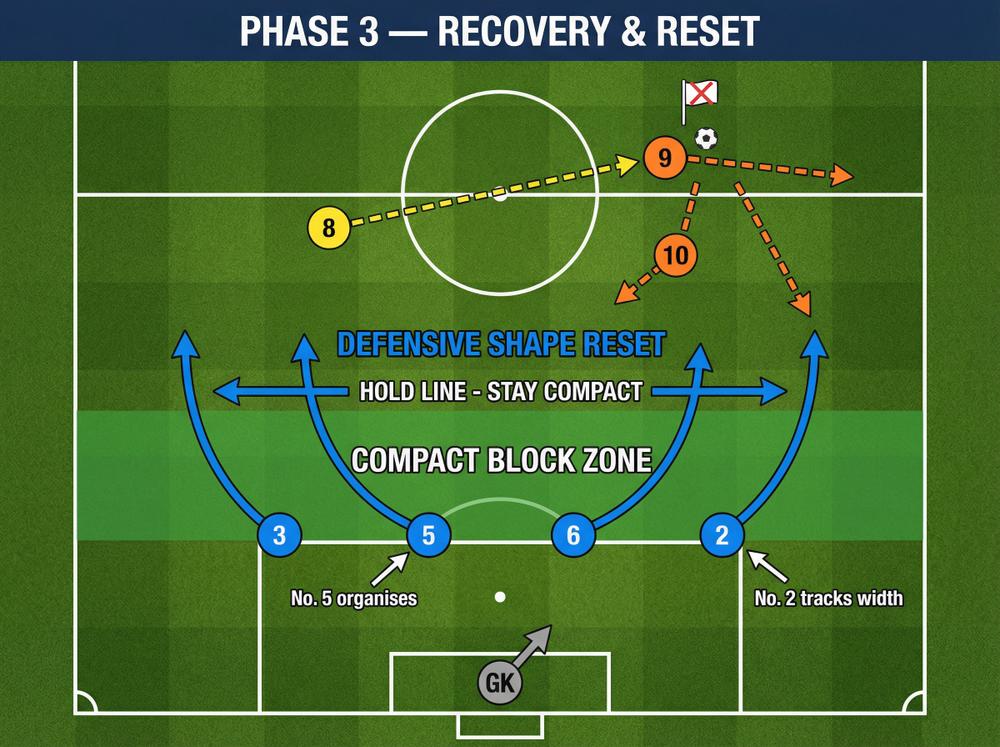
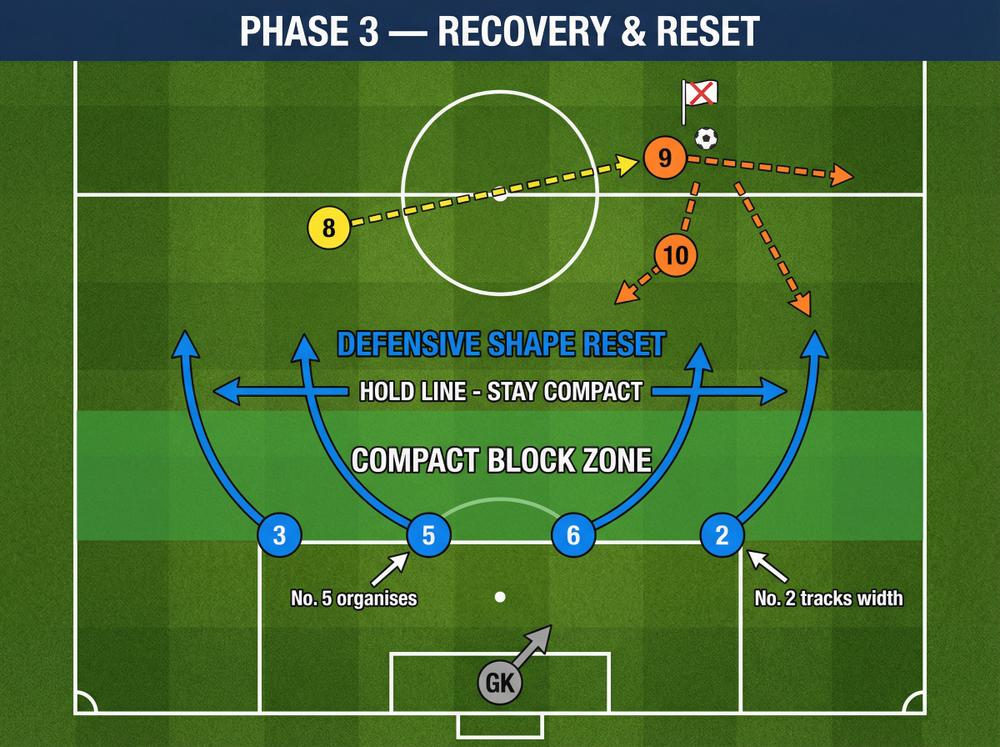
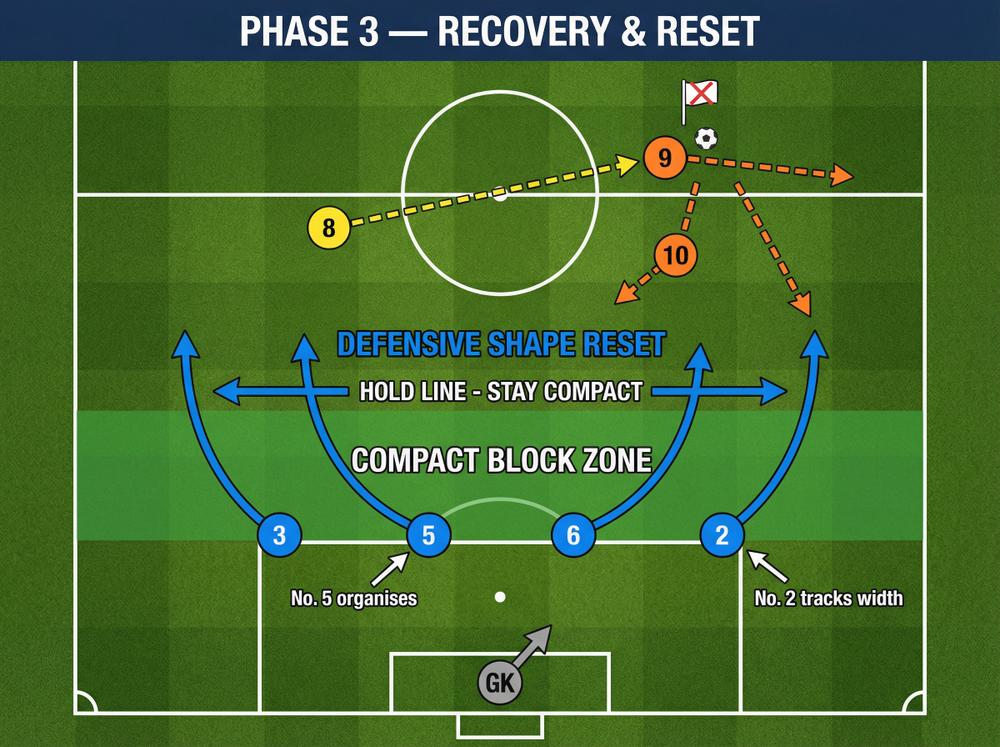
Regardless of whether the offside is given, the defensive line must immediately react to the next phase of play. If the trap fails or the whistle is not blown, the defenders must swiftly drop back, narrow their shape, and establish a compact block around 25 metres from goal.
4. Key Coaching Points
- Visual Triggers Over Verbal Cues: While a shout of "STEP!" is helpful, the primary trigger must be visual. Defenders must read the server's body shape. If the server's head is down and foot is drawn back, the pass is imminent.
- The Designated Leader: Appoint one Centre-Back to dictate the line's depth. The other three defenders must constantly adjust their positioning relative to this leader.
- Explosive Movement: The step-up must be aggressive and synchronized. A hesitant half-step from a full-back will ruin the entire trap.
- Goalkeeper Integration: The Goalkeeper acts as the ultimate safety net. If the trap is beaten, the Goalkeeper must be prepared to act as a sweeper-keeper, aggressively clearing the ball.
- Shoulder Checking: Defenders must continuously scan their shoulders to monitor the positioning of both their teammates and the opposing forwards.
5. Common Mistakes
- Late Reactions: Stepping up as the ball is kicked, rather than during the preparation phase, often results in the attackers remaining onside.
- The Sagging Full-Back: Full-backs positioned on the far side of the pitch often lose focus and hang deeper than the centre-backs, playing the entire attacking line onside.
- Ignoring the Reset: Players celebrating a successful trap or arguing a failed one instead of immediately dropping into a compact defensive block to defend the next phase.
- Over-reliance on the Trap: Attempting the trap when there is no pressure on the ball carrier. If the server has time and space to delay the pass, the trap is easily bypassed.
6. Variations & Progressions
- Progression 1: Active Midfield Pressure: Introduce a defensive midfielder to apply passive, then active, pressure on the server (No. 8). This forces the defenders to decide whether to trap or drop based on the quality of pressure on the ball.
- Progression 2: Rotational Attackers: Allow the three attackers to criss-cross and interchange positions before the pass is played. This tests the defenders' ability to maintain a flat line while tracking dynamic movement.
- Variation 1: The Deep Drop: Instead of stepping up, trigger the defenders to aggressively drop 10 metres towards their own goal when the server prepares to pass, simulating a scenario where the trap is deemed too risky.
7. Age Adaptations
- Under-10 to Under-12: Focus purely on maintaining a flat horizontal line and moving together as a unit holding a rope. Avoid complex offside traps; instead, teach them to step up to compress space when the ball goes backwards.
- Under-14 to Under-16: Introduce the concept of the visual trigger. Practice the trap at a walking pace before progressing to full speed. Emphasize the role of the defensive leader.
- Open / Senior: Execute the drill at match intensity. Incorporate complex attacking movements and require the Goalkeeper to actively participate in sweeping duties. Focus on the immediate transition and recovery if the trap fails.
