

Football
Mastering the Back-Four Offside Trap: Synchronization and Timing
Teach your defensive line how to execute a perfectly timed offside trap to neutralize attacking threats and compress the pitch.

What you need
1 full-size goal, 10-12 cones, Footballs, Bibs (2 colors)
1. Overview
The offside trap is a high-risk, high-reward defensive tactic designed to catch opposing attackers in an offside position. When executed correctly, it immediately neutralizes an attacking threat, wins back possession, and allows the defending team to push higher up the pitch. This drill focuses specifically on the synchronization, communication, and timing required by a flat back-four to step up in unison. It is essential for teams looking to play a high defensive line and compress the space between the midfield and defense, making it difficult for opponents to play through the middle.
2. Setup

Pitch Dimensions: Use a half-pitch setup (approximately 50m x 70m) to simulate realistic game distances.
Players: 10 players minimum (4 Defenders, 2 Central Midfielders, 3 Attackers, 1 Goalkeeper).
Equipment: 1 full-size goal, 10–12 cones for marking zones, plenty of footballs, and bibs (2 colors).
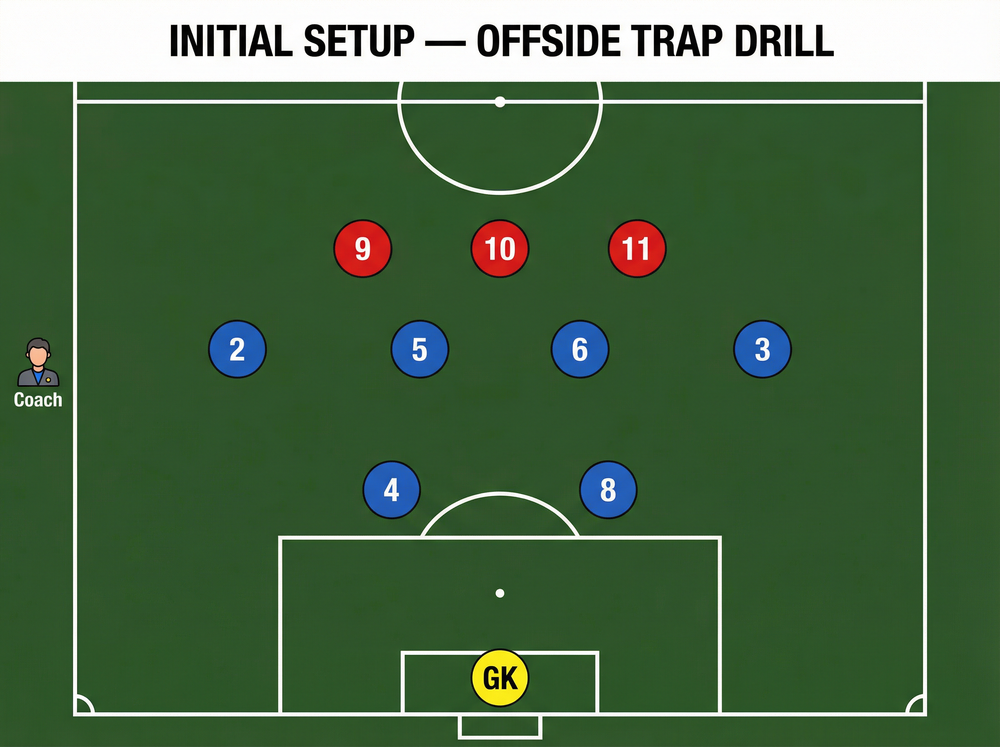
Initial Positioning:
- Set up a flat back-four defensive line (Right Back #2, Center Backs #5 and #6, Left Back #3) approximately 35 meters from their own goal.
- Place two central midfielders (#4 and #8) about 10 meters ahead of the defensive line.
- Position three attackers (#9, #10, #11) in front of the defensive line, actively looking to make runs in behind.
- The Goalkeeper (GK) starts in goal, ready to act as a sweeper-keeper if the trap fails.

3. Step-by-Step Instructions

- Ball Circulation: The drill begins with the three attackers circulating the ball amongst themselves, approximately 10–15 meters in front of the defensive line. The central midfielders apply passive pressure to dictate the direction of play but do not tackle.
- Identifying the Trigger: The key to the offside trap is identifying the "trigger" — the moment the player on the ball puts their head down to play a forward pass, or when a backward pass is played. The designated defensive leader (usually a Center Back) must recognize this cue.
- The Call: The defensive leader shouts a clear, concise command (e.g., "STEP!" or "UP!") the exact moment the trigger is identified.
- Stepping Up in Unison: Upon hearing the command, all four defenders must immediately and simultaneously sprint forward 3–5 meters in a straight line. This movement must be explosive and synchronized.
- Catching the Attacker: As the defenders step up, the attacker making the forward run should be caught behind the newly established defensive line just as the ball is played, resulting in an offside.
- Reset and Repeat: If the trap is successful, the coach blows the whistle and the defense resets. If the trap fails (a defender drops deep, or the timing is off), the attackers attempt to score against the Goalkeeper. Reset after the phase of play concludes.
4. Key Coaching Points

- Clear Communication: A single, authoritative voice must dictate the line. The command must be loud and decisive. Ambiguity leads to broken lines and easy goals.
- Body Shape and Awareness: Defenders must keep an open body shape, allowing them to see both the ball carrier and the runners. They must constantly check their shoulders to maintain the flat line.
- Explosive Movement: The step up is not a jog; it is a coordinated sprint. The faster the line moves up, the larger the offside margin and the harder it is for the referee to miss.
- Reading the Trigger: The entire defensive unit must learn to read the body language of the player on the ball. If there is no pressure on the ball carrier, stepping up is highly dangerous.
5. Common Mistakes

- The Deep Defender: One defender (often a full-back on the opposite side of the pitch) fails to step up with the rest of the line, playing the attackers onside. This is usually due to a lack of concentration or poor body shape.
- Stepping Too Late: Waiting until the ball is actually kicked before stepping up. By then, the attacker is already in motion and will likely stay onside or break through.
- Stepping Without Pressure on the Ball: If the ball carrier has time and space, they can easily dink the ball over a stepping defensive line. The trap should only be sprung when the ball carrier is under pressure or forced to play backward.
- Hesitation: The defensive leader calls "STEP," but players hesitate, breaking the line. Commitment to the call must be absolute.
6. Variations & Progressions

- Progression 1 — Active Midfield Press: Introduce full tackling for the central midfielders. The defense must now read the trap trigger based on live, unpredictable pressure on the ball carrier.
- Progression 2 — The High Line: Push the starting position of the defensive line up to the halfway line. This compresses the space even further and requires the Goalkeeper to act aggressively as a sweeper-keeper to cover the vast space behind.
- Variation — Wide Attack Overloads: Shift the starting position of the attackers to one side of the pitch to test the full-back's positioning and the center-backs' ability to shift and step up diagonally.

7. Age Adaptations

| Age Group | Adaptation |
|---|---|
| Under 12s | Coach triggers the step with a whistle; focus on flat line shape only |
| Under 14s | Designated Center Back calls the trap; introduce reading the ball carrier |
| Under 16s | Full trigger-reading responsibility; add passive midfield pressure |
| Senior/Open | Full live press; integrate sweeper-keeper; discuss when NOT to trap |
