

Basketball
Baseline Inbound: The Backdoor Screen & Curl Play
Master this highly effective baseline inbound play that utilizes a decoy curl and a weak-side screen to create a wide-open backdoor layup or an open jump shot at the elbow.

What you need
Basketball, Half-court with standard FIBA markings
Overview
The 'Backdoor Screen & Curl' is a versatile and highly effective baseline out-of-bounds (BLOB) play designed to create high-percentage scoring opportunities directly under the basket. This set play leverages misdirection and precise screening to exploit aggressive defensive schemes that overplay the passing lanes. It is particularly effective in late-game situations when a quick bucket is needed or when the opposing team is aggressively denying the primary inbound pass. By initiating a strong curl cut toward the ball side, the defense is forced to shift their attention, opening up a devastating backdoor cut on the weak side.
Setup
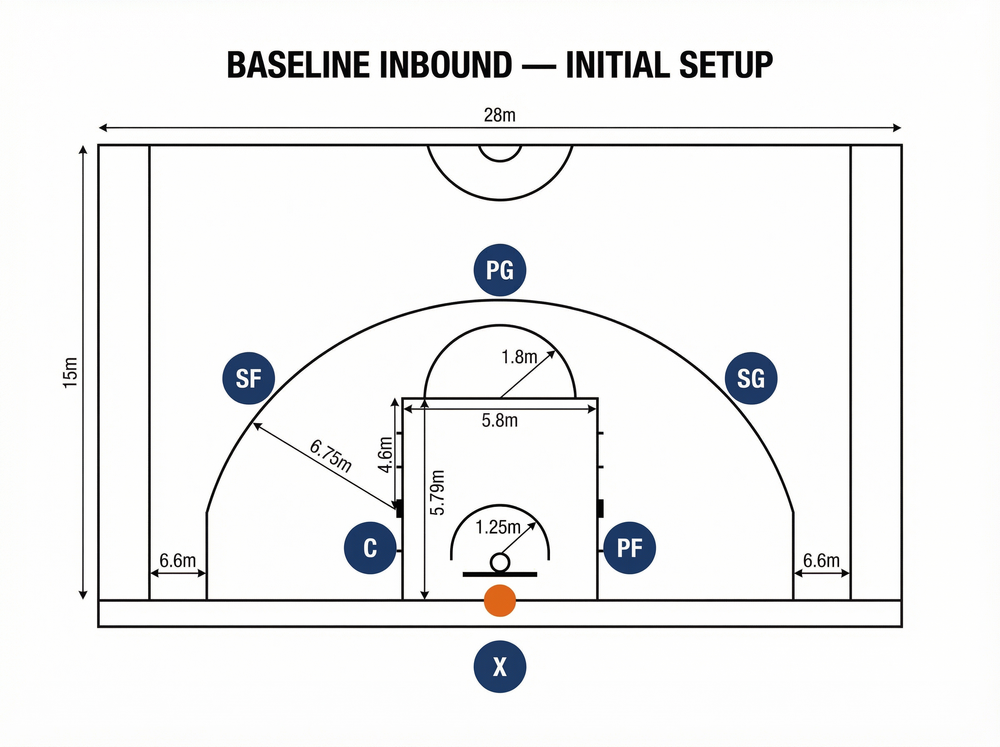
Court Dimensions: Standard FIBA half-court (28m x 15m) with accurate markings including the three-point arc (6.75m), the paint (5.8m wide, 5.79m deep), and the free throw line.
Player Positions:
- Player X (Inbounder): Positioned out of bounds behind the baseline, directly under the basket or slightly offset depending on the referee's placement.
- Player 1 (Point Guard): Starts at the top of the key, ready to initiate the primary decoy action.
- Player 2 (Shooting Guard): Positioned on the right wing, acting as the primary target for the backdoor cut.
- Player 3 (Small Forward): Positioned on the left wing, serving as a safety valve and floor spacer.
- Player 4 (Power Forward): Positioned on the right low block, ready to set the crucial weak-side screen.
- Player 5 (Center): Positioned on the left low block, responsible for sealing their defender and occupying the paint.

Step-by-Step Instructions
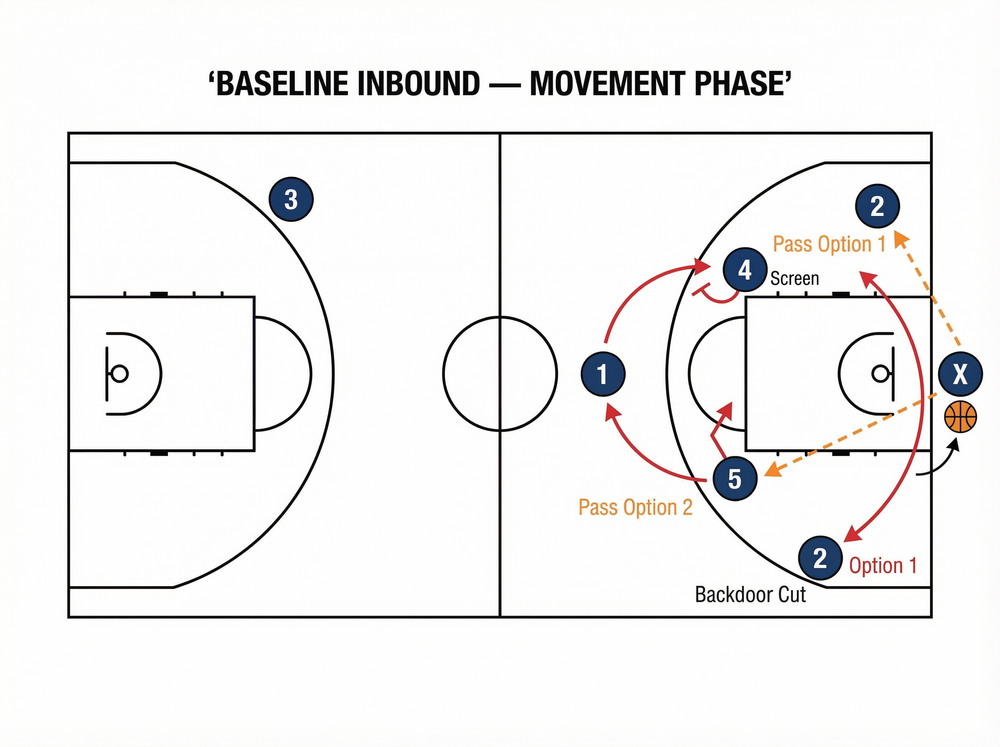
- The Decoy Curl: On the referee's whistle, Player 1 (PG) initiates the play by making a hard, aggressive curl cut from the top of the key toward the ball-side elbow. This movement is designed to draw the attention of the defense and force a reaction from the help defenders.
- The Weak-Side Screen: Simultaneously, Player 4 (PF) steps up from the right low block to set a solid down screen for Player 2 (SG) at the right elbow area. The screen must be set with a wide base and legal positioning to avoid an offensive foul.
- The Backdoor Cut (Primary Option): Player 2 (SG) reads the screen and the defender's reaction. Instead of using the screen to come out for a jump shot, Player 2 makes a sharp, explosive backdoor cut along the baseline toward the basket. Player X (Inbounder) delivers a crisp bounce pass or a lob pass leading Player 2 to the rim for a layup.
- The Elbow Jumper (Secondary Option): If the defense sags off to protect the backdoor cut, Player 1 (PG) will be open at the ball-side elbow following their initial curl cut. Player X can deliver a firm chest pass to Player 1 for an open mid-range jump shot.
- The Safety Valve: If both primary options are covered, Player 3 (SF) remains spotted up on the left wing. Player X can execute a skip pass to Player 3 to reset the offense and avoid a five-second violation.

Key Coaching Points
- Timing is Everything: The success of this play relies entirely on the synchronization of the curl cut, the screen, and the backdoor cut. The inbounder must not rush the pass; they must wait for the play to develop and read the defense.
- Sell the Decoy: Player 1 must execute the curl cut with maximum effort and intent to score. If the decoy is unconvincing, the defense will not shift, and the backdoor cut will be easily defended.
- Solid Screening Fundamentals: Player 4 must set a wide, stationary screen. They must anticipate the defender's path and establish legal guarding position to avoid moving screen violations.
- Explosive Cutting: Player 2 must change pace dramatically. They should start slow to set up the defender, then explode into the backdoor cut the moment the screen is set.
- Inbounder Vision: The inbounder (Player X) must have excellent court vision and passing accuracy. They need to read the defense's reaction to the screen and deliver the ball on time and on target.
Common Mistakes

- Telegraphing the Pass: The inbounder staring down the primary target (Player 2) before the cut develops, allowing the defense to anticipate the play and jump the passing lane.
- Weak or Illegal Screens: Player 4 setting a narrow screen or moving during contact, resulting in an offensive foul and a turnover.
- Poor Spacing: Players crowding the paint or failing to maintain proper spacing on the perimeter, making it difficult for the inbounder to find an open passing lane.
- Rushing the Execution: Players moving before the inbounder is ready or before the screen is properly set, destroying the timing of the play.
Variations & Progressions
- Slip the Screen: If the defense aggressively switches on the screen set by Player 4, Player 4 can immediately slip the screen and dive to the basket for a quick pass and finish.
- Flare Screen Option: Instead of a down screen, Player 4 can set a flare screen for Player 2, allowing Player 2 to fade to the corner for an open three-point shot.
- Double Screen Action: Incorporate Player 5 to set a staggered double screen with Player 4, creating even more confusion for the defense and opening up multiple cutting options.
Age Adaptations
- Under 10 / Under 12: Focus heavily on the fundamental mechanics of the bounce pass and the basic concept of cutting to the basket. Simplify the play by removing the decoy curl and focusing solely on the screen and backdoor cut.
- Under 14 / Under 16: Introduce the timing elements and the importance of reading the defense. Emphasize setting solid screens and executing explosive cuts. Introduce the secondary option (the elbow jumper).
- Open / Advanced: Execute the full play with all variations and reads. Focus on advanced screening techniques (slipping, flaring) and exploiting specific defensive matchups.
