

Basketball
Baseline Inbound: The 'Elbow Rip' Screen & Cut Play
A highly effective baseline inbound play utilizing a back-screen to create an immediate layup opportunity or a secondary mid-range jumper.
What you need
Basketball, Half-court
1. Overview
The 'Elbow Rip' is a quick-hitting baseline out-of-bounds (BLOB) play designed to get a high-percentage shot right at the rim. It is best used when you need a quick score out of a timeout or when the defense is aggressively fronting the post. By utilizing a well-timed back-screen, this play forces the defense to communicate perfectly; any hesitation usually results in an uncontested layup for your point guard or a wide-open mid-range shot for your power forward.
2. Setup
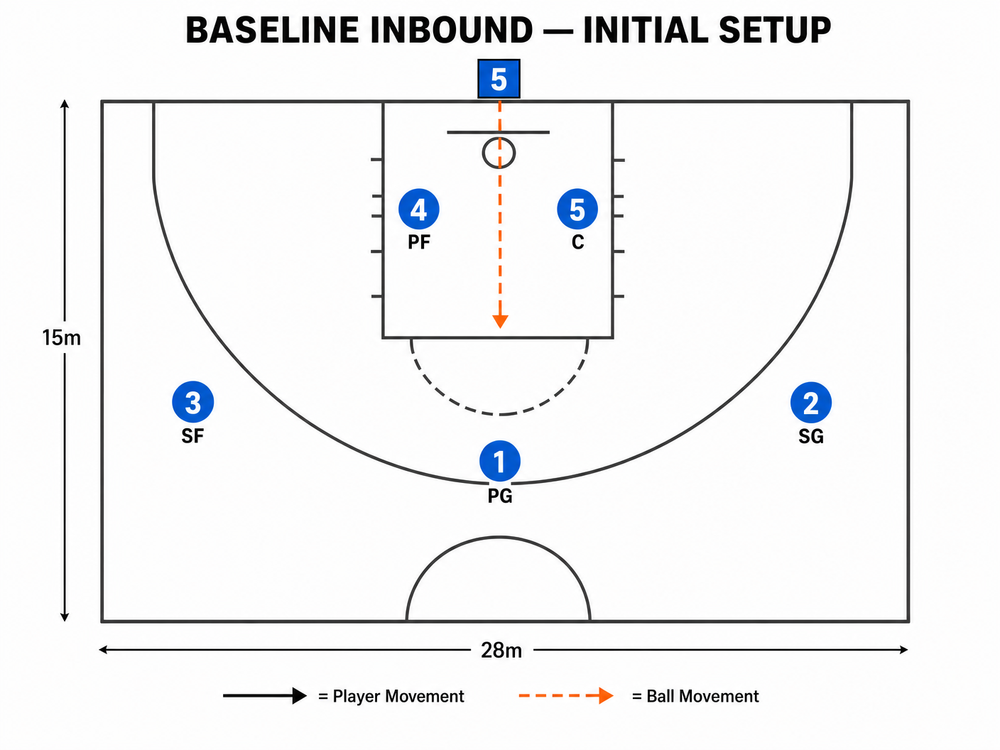
- Equipment Needed: 1 Basketball, half-court setting (28m x 15m FIBA dimensions).
- Player Positions:
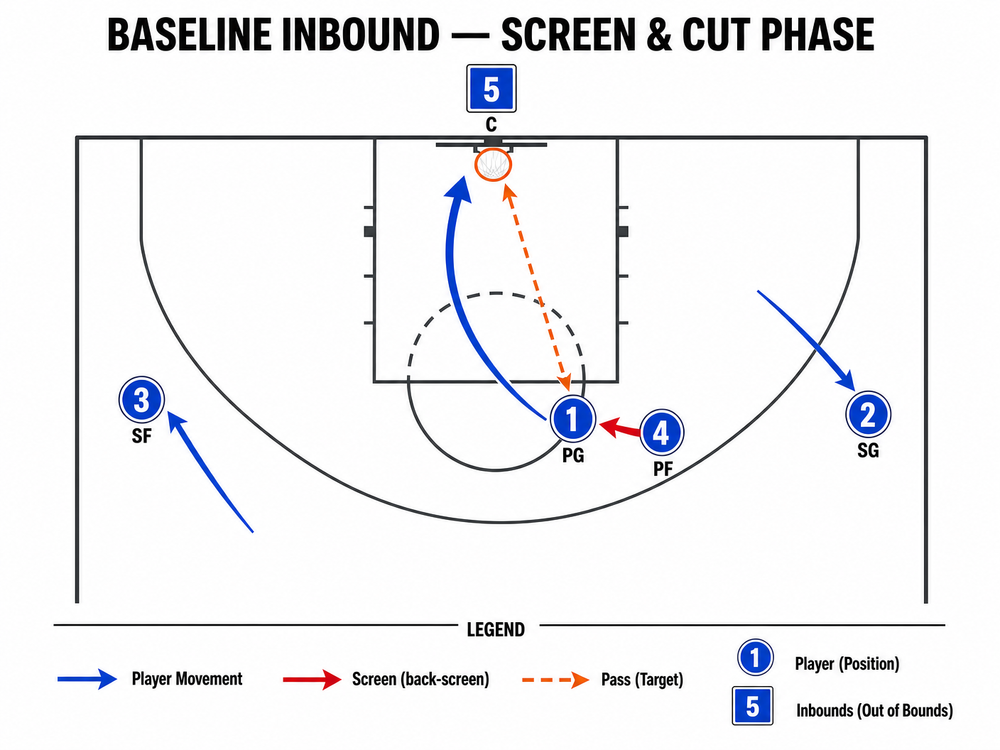
- Player 1 (PG): Starts at the top of the key.
- Player 2 (SG): Starts at the right wing/corner area.
- Player 3 (SF): Starts at the left wing.
- Player 4 (PF): Starts stacked in the lane near the left block.
- Player 5 (C): The inbounder, standing out of bounds directly under the basket.
3. Step-by-Step Instructions
- The Trigger: Player 5 (the inbounder) slaps the ball to signal the start of the play.
- The Setup Cut: Player 1 takes two hard steps toward the right wing to set up their defender, making them think a standard perimeter catch is coming.
- The Screen: Simultaneously, Player 4 sprints up from the block to set a firm back-screen on Player 1's defender near the free-throw line elbow.
- The Rip Cut: Player 1 plants their outside foot and makes a hard, aggressive 'rip cut' off Player 4's shoulder, sprinting directly down the middle of the paint toward the rim.
- The Primary Pass: Player 5 delivers a crisp, over-the-top or bounce pass to Player 1 in stride for the layup.
- Spacing: As this happens, Player 2 spaces to the deep right corner, and Player 3 drifts slightly lower on the left wing to keep their defenders out of the help-side lanes.
4. Key Coaching Points
- Screen Angle: Player 4 must set the screen at the correct angle—facing the opposite corner—to ensure Player 1 has a clear path to the rim.
- Patience by the Inbounder: Player 5 must wait for the screen to be set. Passing too early will lead to a turnover or a contested catch.
- Shoulder-to-Shoulder: Player 1 must run off the screen shoulder-to-shoulder with Player 4. Leaving space allows the defender to slip through and recover.
- Sell the Fake: Player 1's initial steps away from the screen are crucial to shift the defender's momentum.
5. Common Mistakes
- Moving Screen: Player 4 moving before Player 1 has completely passed, resulting in an offensive foul.
- Weak Cuts: Player 1 jogging through the cut rather than sprinting, allowing the help defense time to rotate over.
- Poor Spacing: Players 2 and 3 creeping into the paint, bringing their defenders into the passing lane.
6. Variations & Progressions
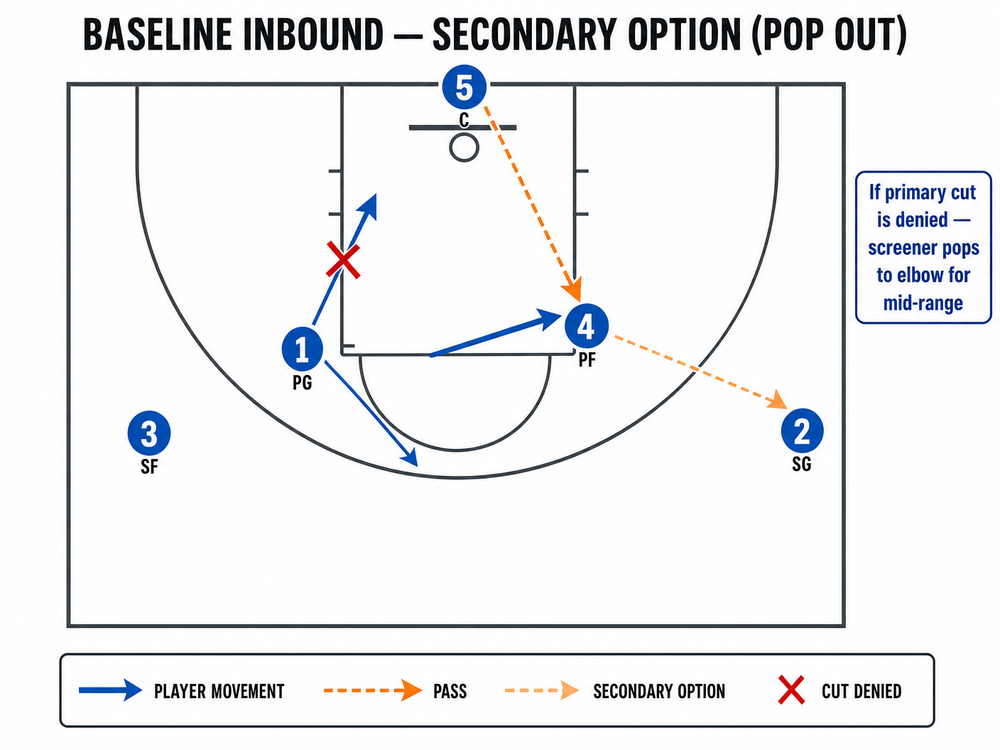
- The Pop-Out Option: If the defense switches on the back-screen or heavily denies Player 1's cut, Player 4 immediately pops out to the elbow or top of the key. Player 5 passes to Player 4 for an uncontested mid-range jumper.
- Corner Drift: If the help defense drops to stop Player 1's cut, Player 5 can skip the ball to Player 2 in the corner for an open three-point shot.
7. Age Adaptations
- Under 10 / Under 12: Focus purely on the spacing and the concept of cutting to the basket. You may remove the back-screen and just have Player 1 make a hard V-cut to get open.
- Under 14 / Under 16: Introduce the back-screen but emphasize the fundamentals of setting a legal, stationary screen. Teach the 'Pop-Out' secondary option as they begin to understand reading the defense.
- Open / Advanced: Execute at full game speed with all secondary options live. The inbounder must read the defensive rotation instantly to choose between the cutter, the popper, or the corner shooter.
