

Basketball
Elite Ball Handling and Dribbling Circuit
A comprehensive 5-station dribbling circuit that develops elite ball control, change-of-pace dribbling, and game-speed finishing skills for players of all levels.
What you need
Basketballs (1 per player), Training Cones (15-20), Whistle
Overview
The Elite Ball Handling and Dribbling Circuit is a high-intensity, multi-station drill designed to simulate game-like ball control scenarios across a full FIBA court (28m x 15m). This drill develops a player's ability to maintain a strong dribble while changing speeds, navigating through traffic, and executing precise crossover moves under pressure. It is an excellent conditioning tool that integrates skill development seamlessly, making it ideal for pre-season preparation, mid-season refinement, or as a focused warm-up for any practice session. By distributing players across five stations simultaneously, coaches can maximise court usage, keep all players active, and generate a high volume of quality repetitions within a 15-minute window.
Setup
Court: Full FIBA regulation court — 28m x 15m.
Equipment: 1 basketball per player, 15–20 training cones (standard orange, 30cm height).
Players: Minimum 5 (one per station). Works best with 10–15 players rotating through stations in groups.
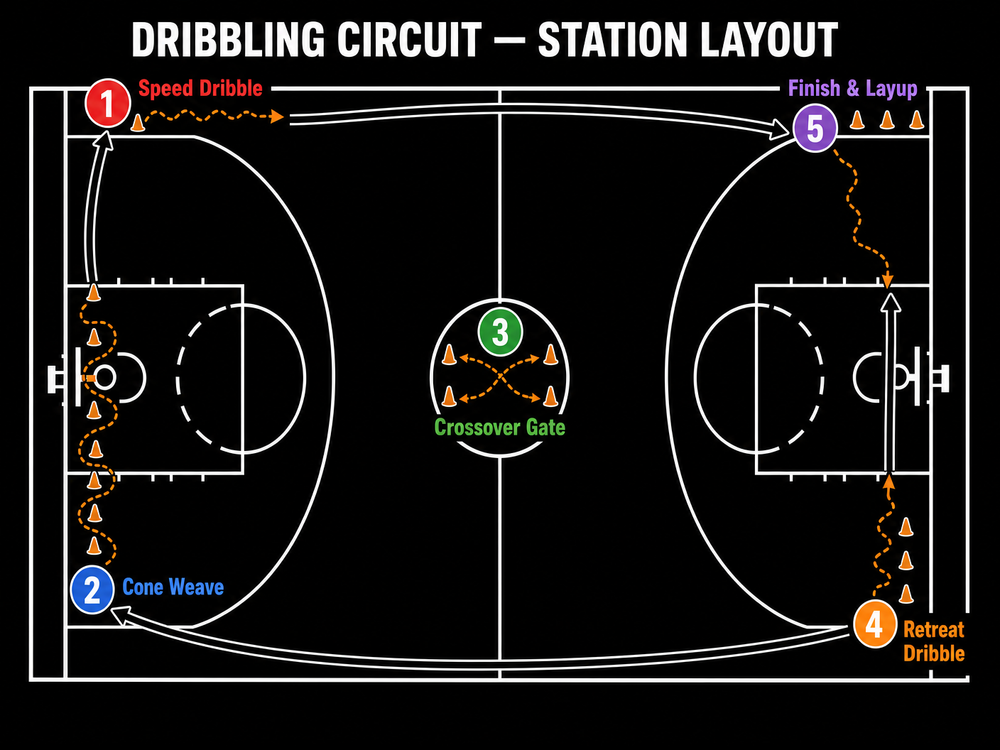
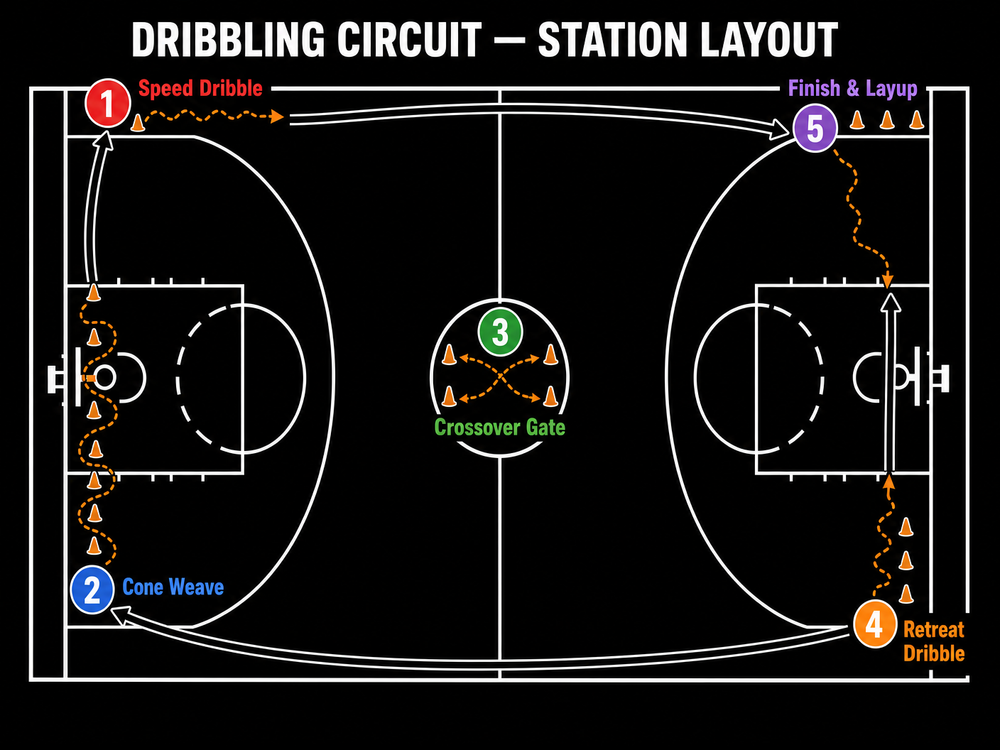
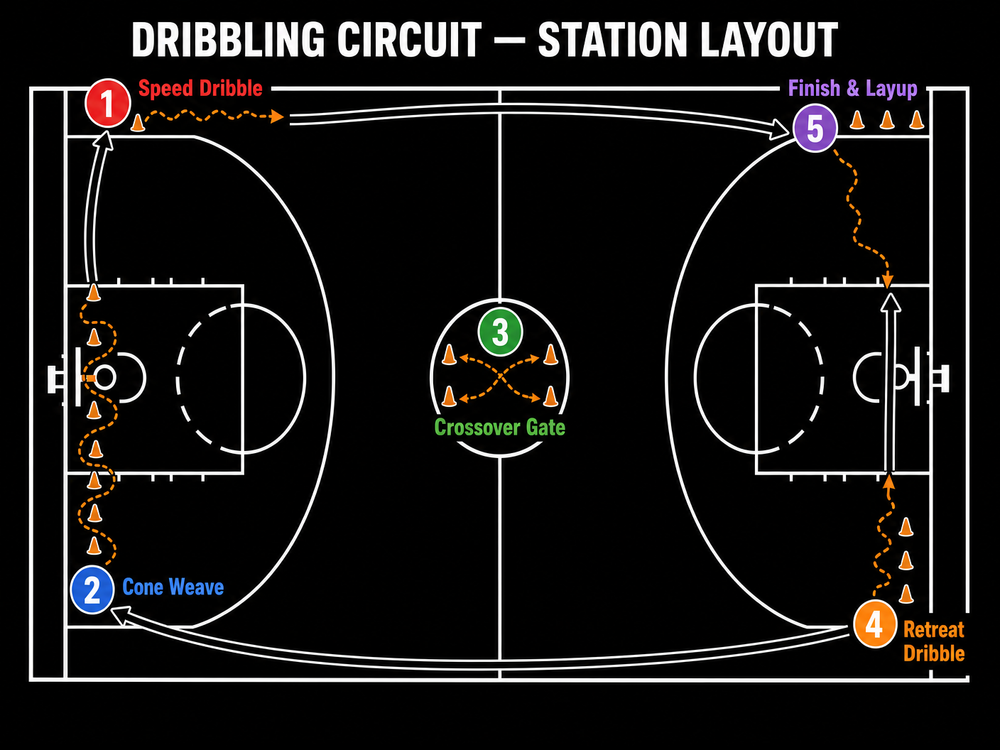
Station Layout (see Diagram 1):
| Station | Location | Skill Focus |
|---|---|---|
| 1 — Speed Dribble | Baseline corner (left) | Push dribble, full-court speed |
| 2 — Cone Weave | Left sideline, mid-court | Crossover, low stance, ball protection |
| 3 — Crossover Gate | Centre court circle | Explosive change-of-direction |
| 4 — Retreat Dribble | Right sideline | Backward dribble, court vision |
| 5 — Finish & Layup | Right baseline, key area | Game-speed finishing |
Place 3–4 cones at Station 2 spaced 1.5m apart along the sideline. At Station 3, place 2 cones 0.5m apart to form a narrow gate. At Station 5, place 2 cones at the elbow of the key to guide the attack angle.
Step-by-Step Instructions
Station 1 — Speed Dribble (Baseline to Mid-Court): The player starts at the left baseline corner in an athletic stance, ball in their dominant hand. On the coach's whistle, they execute a full-speed push dribble, driving the ball out in front at waist height and sprinting down the left sideline toward mid-court. Target: cover the 14m to mid-court in no more than 6 dribbles. Emphasis is on minimising touches and maximising ground covered per dribble.
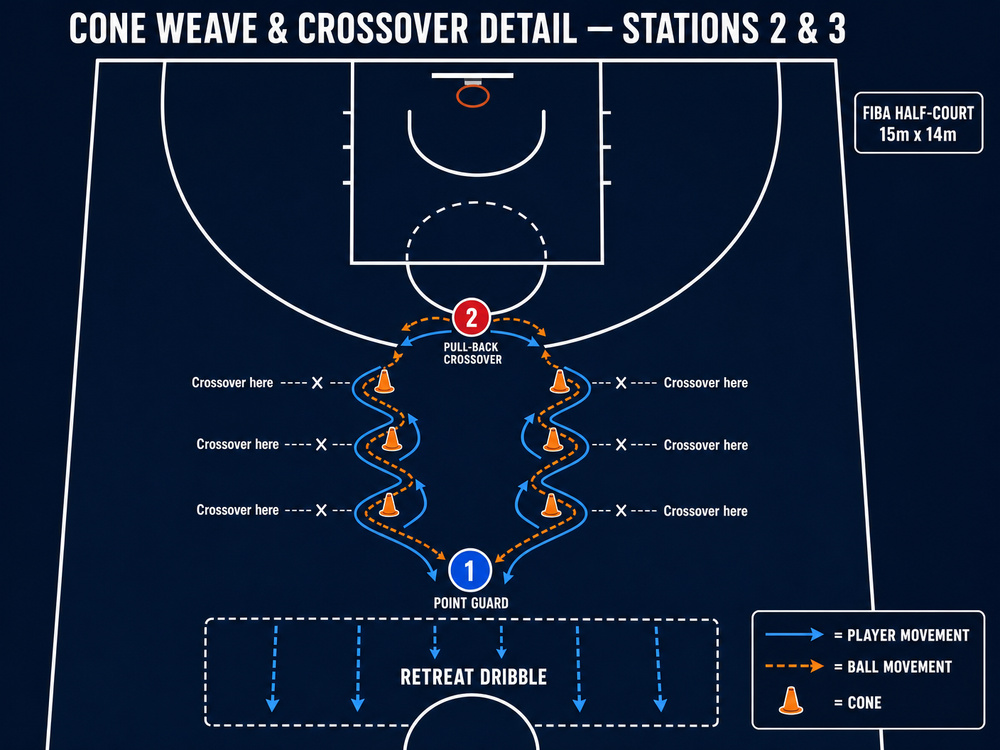
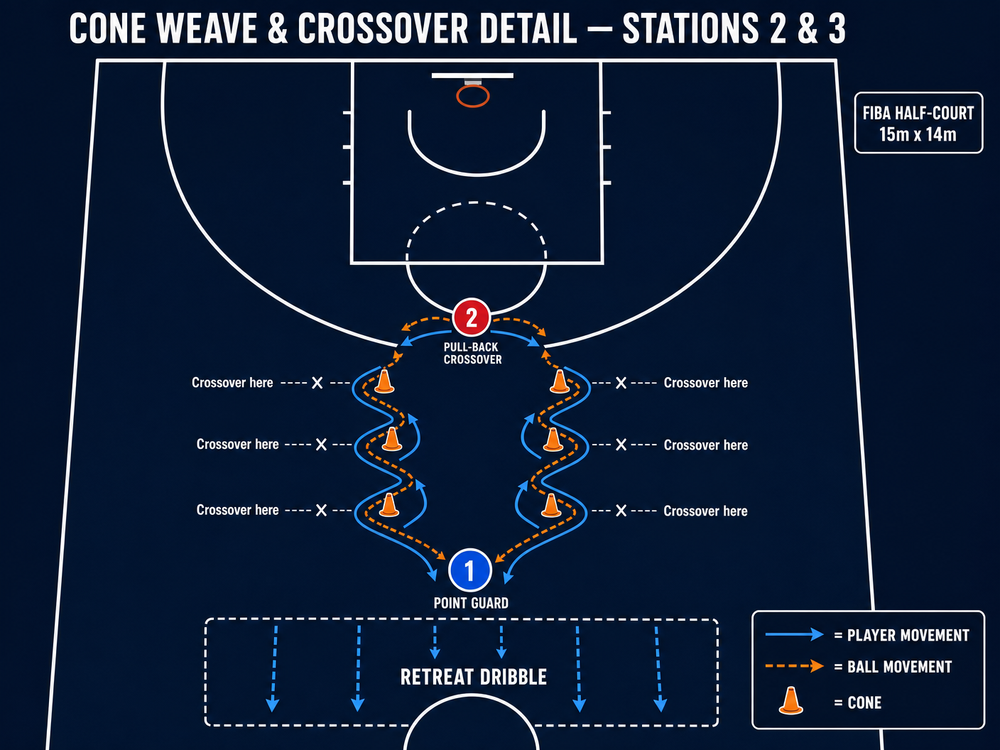
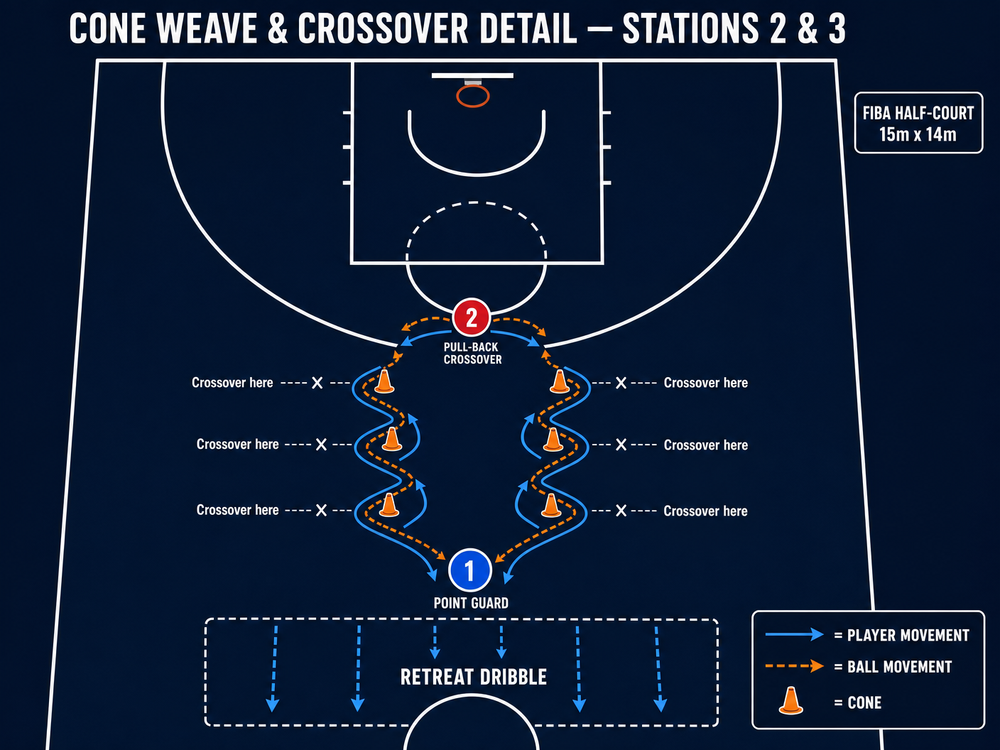
Station 2 — Cone Weave (Left Sideline, Mid-Court): Upon reaching the cone weave, the player drops into a low defensive stance (knees bent, back flat, hips below shoulder height) and weaves through 4 cones spaced 1.5m apart. At each cone, they execute a sharp crossover dribble, switching the ball from hand to hand below knee height. The off-arm shields the ball from the imaginary defender at each cone. Players should NOT stand upright between cones.
Station 3 — Crossover Gate (Centre Court): The player approaches the two-cone gate at pace. They must execute a single explosive crossover, between-the-legs, or behind-the-back dribble to pass cleanly through the 0.5m gap without disturbing the cones. This station rewards deceptive ball movement and body feinting. Coaches should call out which move to use (e.g., "Between the legs!") to add a reactive element.
Station 4 — Retreat Dribble (Right Sideline): Moving toward the right sideline, the player simulates being pressured by a defender. They execute two hard retreat dribbles — pushing the ball backward between their legs while stepping back — to create space, then immediately re-accelerate forward. Eyes must remain up throughout. The retreat covers approximately 2–3m before the player drives forward again.
Station 5 — Finish and Layup (Right Baseline): The player attacks the basket from the right baseline at full speed. They must execute a game-quality finish — a standard right-hand layup, a reverse layup around the baseline, or a floater in the lane. The ball must go through the net or hit the backboard squarely. Players retrieve their own rebound and jog back to Station 1 to begin the next repetition.

Key Coaching Points
Eyes Up at All Times. The most important habit in this circuit is court vision. Players must survey the floor ahead — not the basketball — at every station. This is non-negotiable for developing playmakers who can read the defence and find open teammates in transition.
Pound the Ball. Encourage a hard, forceful dribble at every station. The quicker the ball snaps back to the hand, the more control the player has and the harder it is for defenders to time a steal. A weak, bouncy dribble is a giveaway.
Change of Pace is the Weapon. The circuit is specifically designed to alternate between maximum speed (Station 1) and controlled, explosive bursts (Stations 2–3). Coaches should constantly reinforce the concept: slow down to set up the defender, then explode past them.
Protect the Basketball. At Stations 2 and 4, the off-arm must be active as a shield. Players should practise keeping their body between the defender and the ball at all times, using their shoulder and forearm (not their hand) to create separation.
Game-Speed Finishes Only. The layup at Station 5 is not a warm-up shot — it is a fast-break finish. If players slow down before the basket, stop the drill and reset. Every finish must be taken at the same speed the player attacked the lane.
Common Mistakes
Carrying the Ball on Crossovers. Players frequently turn their hand under the ball during the crossover at Station 2, which constitutes a carry violation in a game. Coaches should watch the palm orientation: it must face the floor or the side, never the ceiling, when pushing the ball across.
Standing Upright in the Weave. Losing the low athletic stance between cones at Station 2 is the most common error in this drill. A player who stands upright has no explosion, no balance, and no protection. Demand a consistent knee bend throughout the weave.
Staring at the Ball or Cones. Many players, especially younger ones, look directly at the cones or the basketball during the circuit. Coaches can place a visual cue (e.g., a coloured cone or a coach holding up fingers) at the far end of the court and ask players to call out what they see.
Weak or Hesitant Retreat Dribble. At Station 4, players often take short, shuffling steps backward rather than a decisive, powerful retreat. The retreat dribble must be aggressive — two hard pushes back, creating real separation — before the re-acceleration forward.
Slowing Down Before the Finish. Decelerating before the layup at Station 5 is a game-day habit killer. If the player slows down in practice, they will slow down in a game. Enforce full-speed finishes every single repetition.
Variations and Progressions
Two-Ball Circuit (Advanced). For players with strong fundamental ball-handling skills, run the entire circuit with two basketballs simultaneously. Both hands dribble in sync at Station 1, alternate at Station 2, and the player must keep both balls alive through the Crossover Gate. This variation dramatically increases the difficulty and forces players to develop genuine ambidextrous control.
Live Defender at Station 3 or 5. Introduce a semi-active or fully live defender at the Crossover Gate (Station 3) or at the finish (Station 5). The defender's job is to contest the move or the layup without fouling. This transforms the drill from a skills circuit into a competitive, game-realistic scenario and is the most effective progression for older players.
Timed Circuit Challenge. Set a target time for completing the full circuit (e.g., 18 seconds for intermediate players, 15 seconds for advanced). Players who miss the layup at Station 5 receive a 2-second penalty. Track times over multiple sessions to measure individual improvement and create healthy intra-squad competition.
Age Adaptations
Under 10 (Simplified 3-Station Version). Reduce the circuit to three stations: Speed Dribble (half-court only), a 3-cone weave, and a standard layup. Focus entirely on correct hand placement and a controlled dribble rather than speed. Use larger, lower-pressure balls if available.
Under 12–14 (Standard Version). Run the full 5-station circuit at a moderate pace. Introduce the retreat dribble concept carefully, spending extra time demonstrating the proper footwork before adding it to the circuit. Emphasise the crossover technique at Station 2 before progressing to between-the-legs moves.
Under 16 and Open (Full Intensity). Run the circuit at maximum intensity with all five stations. Introduce advanced finishing moves at Station 5 (euro step, floater, reverse layup). Add the timed circuit challenge and consider the two-ball progression for your most skilled players. Coaches can also run this as a competitive relay race between two groups to add a team element.
