

Basketball
Mastering the Flex Offense: A Complete Continuity Play Guide
Learn how to implement the classic Flex Offense, a structured continuity play that creates high-percentage shots through relentless screening and cutting.
What you need
1 Basketball, Half-court space
1. Overview
The Flex Offense is one of the most reliable and widely used continuity offenses in basketball history. It is a pattern-based offense that relies on constant movement, screening, and cutting to break down man-to-man defenses. The core philosophy of the Flex is simple: all five players are interchangeable, and the offense runs in a continuous loop until a high-percentage shot is created.
This system is particularly effective for teams that lack a dominant individual scorer, as it emphasizes teamwork, spacing, and precise execution. The primary scoring options are layups off the baseline flex cut and open jump shots off the down screen. Because the pattern repeats seamlessly from one side of the court to the other, defenses are forced to communicate flawlessly or risk giving up easy baskets.
2. Setup
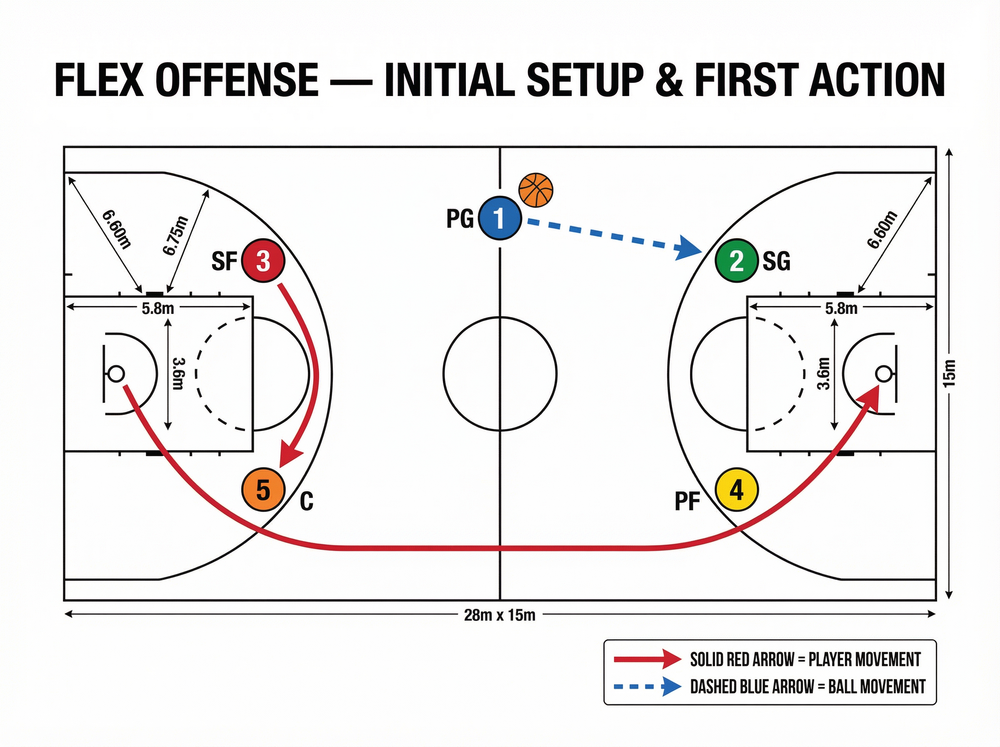
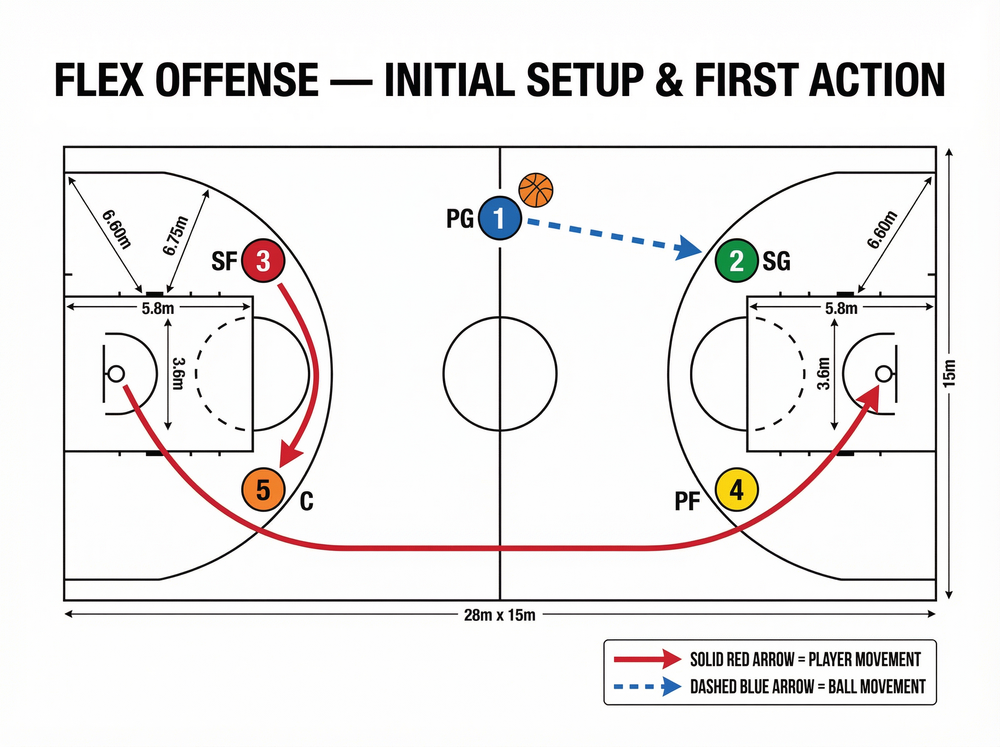
To run the Flex Offense effectively, coaches must ensure proper spacing and alignment on a standard FIBA court (28m x 15m).
Equipment Needed:
- 1 Basketball
- 5 Offensive Players
- 5 Defensive Players (for live drills)
- Half-court setup
Player Positions:
- Player 1 (Point Guard): Starts at the top of the key, slightly offset to the side of the initial action.
- Player 2 (Shooting Guard): Positioned on the right wing, near the three-point line (6.75m).
- Player 3 (Small Forward): Positioned on the left wing, near the three-point line.
- Player 4 (Power Forward): Starts on the right low post/block, just outside the 5.8m wide paint area.
- Player 5 (Center): Starts on the left low post/block.
3. Step-by-Step Instructions
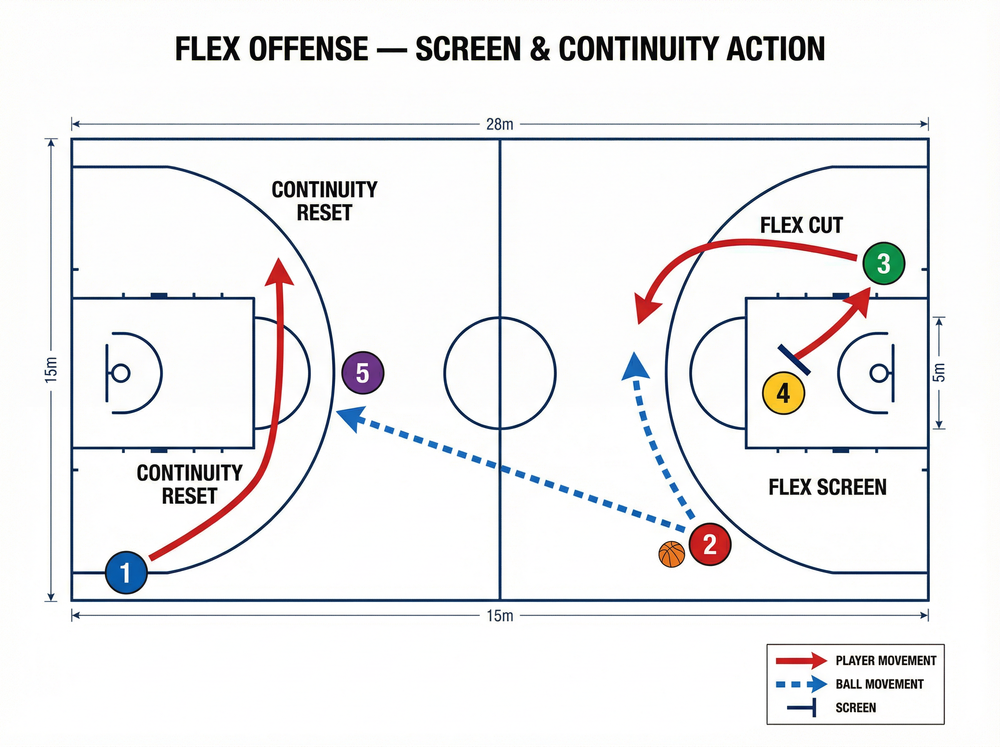
The beauty of the Flex Offense lies in its repetitive, rhythmic nature. Below is the breakdown of the initial setup and the first continuity cycle.
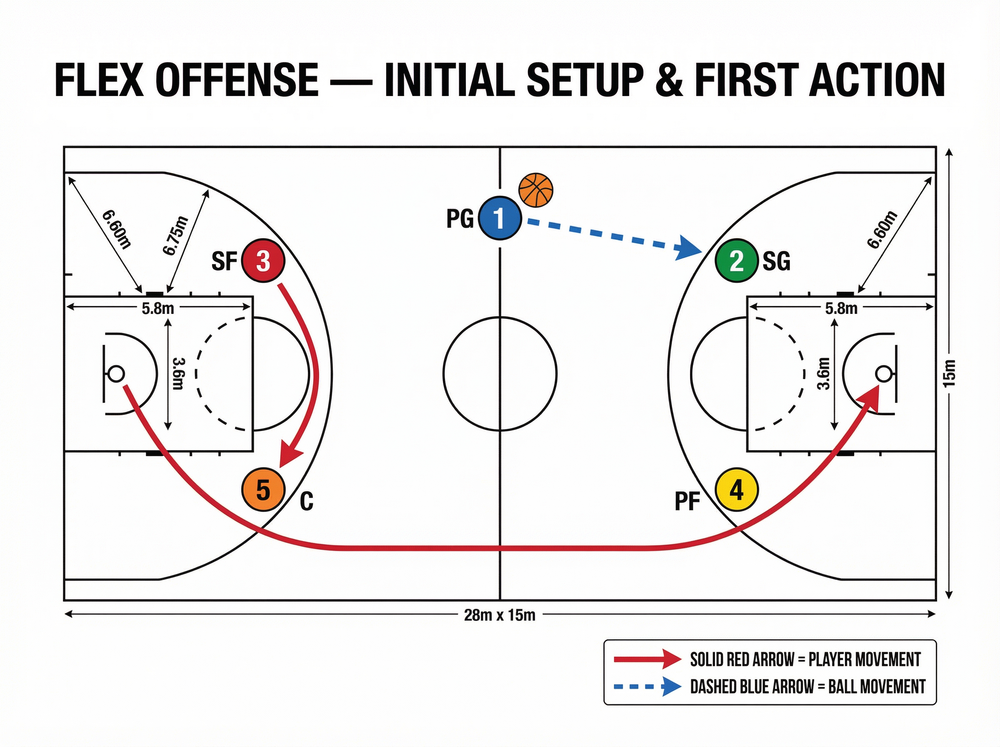
Step 1: The Entry Pass
Player 1 initiates the offense by passing the ball to Player 2 on the right wing. As soon as the ball leaves Player 1's hands, the flex action begins.
Step 2: The Flex Cut
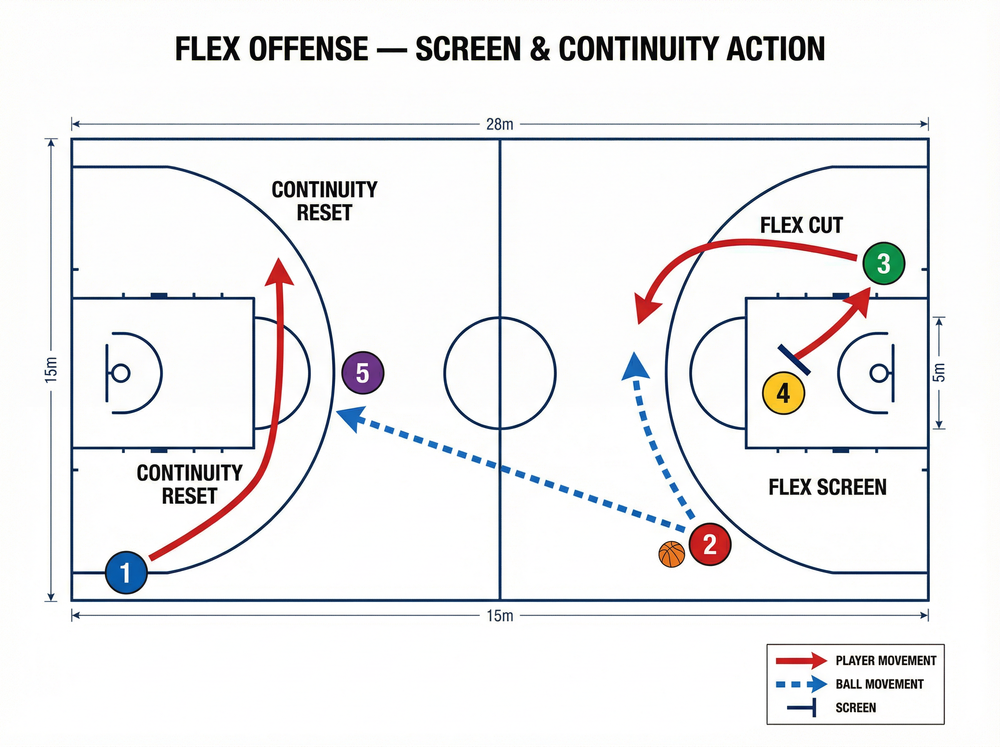
Player 5 sets a baseline screen (the "flex screen") for Player 3. Player 3 uses the screen to cut hard along the baseline, moving from the left wing toward the right low block. Player 2 looks to pass to Player 3 for an immediate layup if the defense trails the play.
Step 3: The Down Screen (Screen the Screener)
Immediately after setting the flex screen, Player 5 receives a down screen from Player 1. Player 5 cuts off Player 1's screen toward the top of the key. Player 2's second look is to pass to Player 5 for an open jump shot or to reverse the ball to continue the offense.

Step 4: Continuity Reset
If neither Player 3 nor Player 5 is open, Player 2 passes the ball to Player 5 at the top of the key. The players are now in the exact same formation as the initial setup, but on the opposite side of the court.
Step 5: The Second Cycle
Player 5 passes to Player 4 on the right wing. Player 1 now sets the flex screen for Player 2, who cuts along the baseline. Player 5 then sets the down screen for Player 1. The cycle continues indefinitely.
4. Key Coaching Points
- Wait for the Screen: Cutters must wait for the screener to get completely set before moving.
- Read the Defense: The flex cutter must read how the defender navigates the screen.
- Screen the Screener: The down screen action is just as important as the flex cut.
- Spacing is Non-Negotiable: Players must maintain proper spacing on the perimeter.
- Crisp Passing: Passes must be sharp and on target.
5. Common Mistakes
- Moving Screens: Screeners must establish a wide base and remain stationary upon contact.
- Ignoring the Post: Guards often forget to look inside for the layup.
- Robotic Execution: Players missing obvious scoring opportunities because they are focused on the pattern.
- Poor Spacing on the Weak Side: Players drifting toward the paint and clogging driving lanes.
6. Variations & Progressions
- Flex to Pick and Roll: Transitioning into a side pick-and-roll instead of continuing the pattern.
- Post Entry Variation: Entering the ball to the post to trigger different cutting actions.
- Dribble Entry: Point guard dribbles toward the wing to initiate the offense.
7. Age Adaptations
- Under 12s: Focus purely on the spacing and the baseline cut. Remove the down screen action to simplify.
- Under 14s/16s: Introduce the full continuity pattern and teach players to read the defense on the flex screen.
- Open/Adult: Incorporate advanced variations such as pick-and-roll actions and post isolation to exploit mismatches.
