The 'Lightning' Buzzer Beater: End-of-Game Baseline Set Play
Master the 'Lightning' set play, a high-percentage baseline out-of-bounds action designed to create an open three-point look in the final seconds of a close game.
Equipment Needed
1. Overview
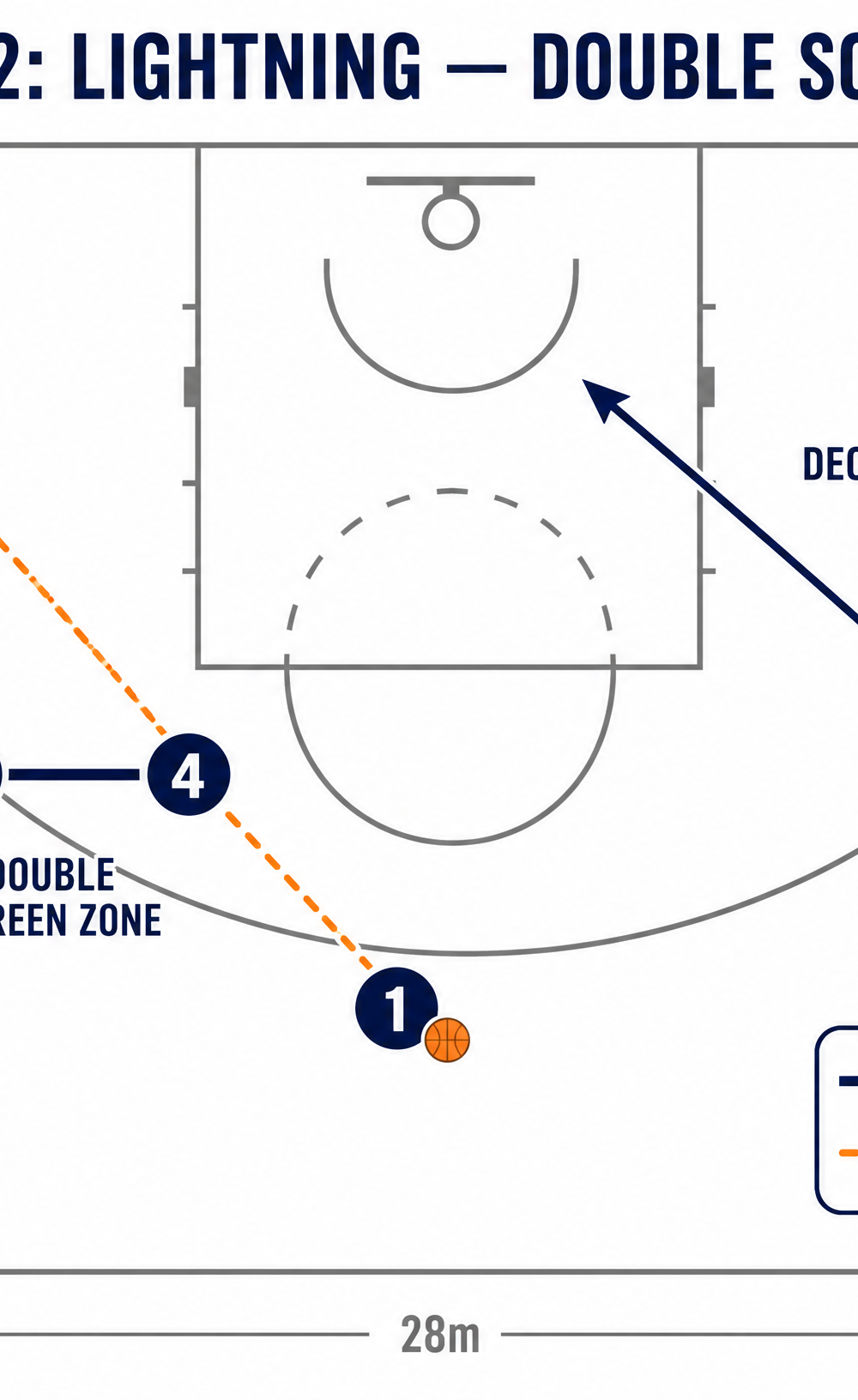
The "Lightning" set play is an essential late-game, baseline out-of-bounds (BLOB) action designed for situations where your team is trailing by 1 to 3 points with less than 5 seconds remaining on the game clock. This play utilizes misdirection, staggered double screens, and precise timing to free up your best shooter for a high-percentage look.
By forcing the defense to communicate through a complex screening action on the strong side while employing a decoy cut on the weak side, "Lightning" exploits defensive confusion in high-pressure moments. It is highly effective against both man-to-man and zone defenses, provided the execution is crisp and the spacing is optimal across the standard 28m x 15m FIBA court.
2. Setup
Court Position: Baseline Out-of-Bounds (BLOB) under your offensive basket.
Player Personnel:
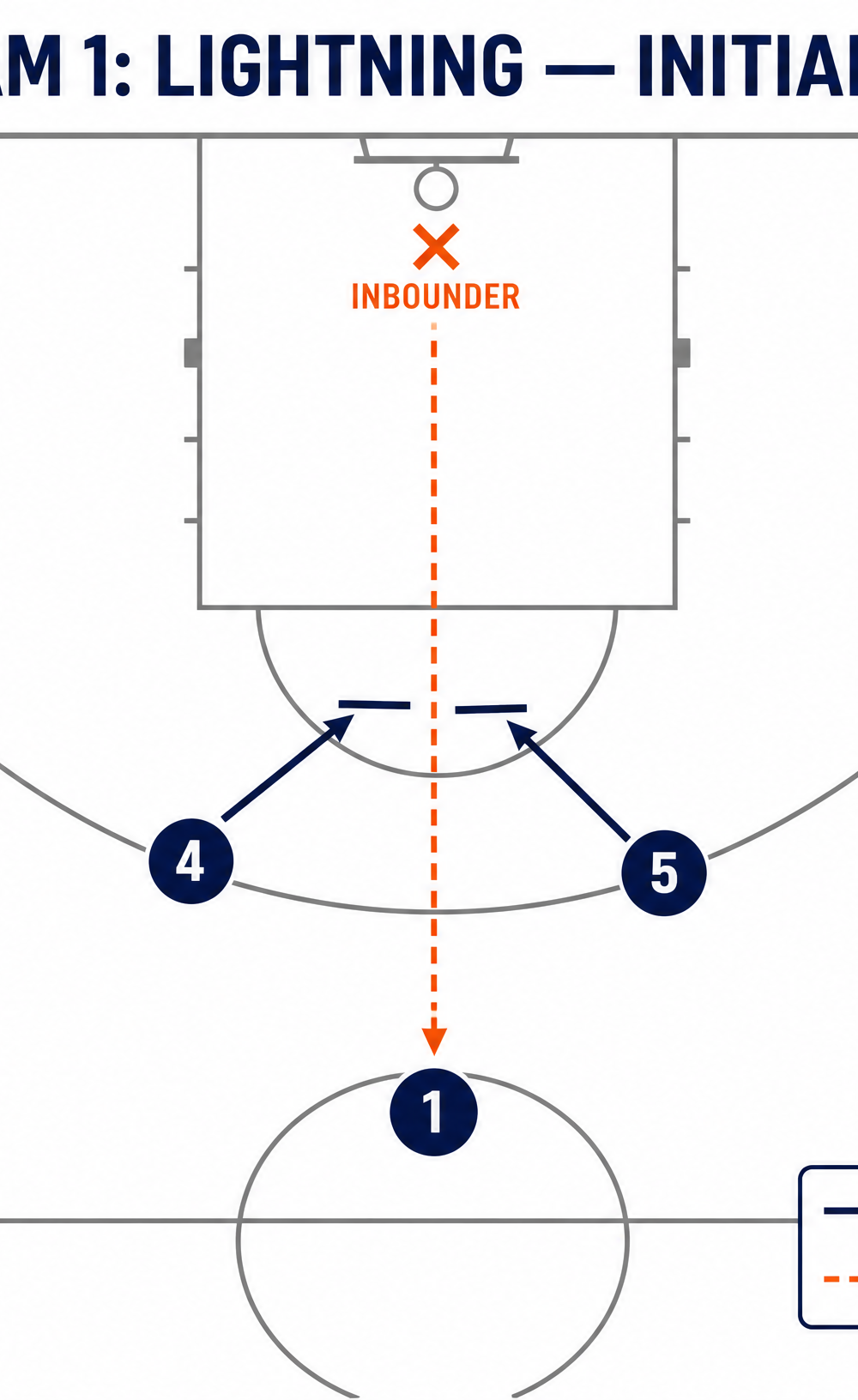
- Player 1 (Point Guard): The inbounder. Needs excellent court vision and passing accuracy under pressure.
- Player 2 (Shooting Guard): The primary shooter. Positioned initially on the left wing (strong side) near the three-point line.
- Player 3 (Small Forward): The decoy and secondary option. Positioned on the right wing (weak side).
- Player 4 (Power Forward): The first screener. Positioned at the left elbow of the key.
- Player 5 (Center): The second screener and offensive rebounder. Positioned at the right elbow of the key.
3. Step-by-Step Instructions
- The Trigger: As Player 1 slaps the ball to signal the start of the play, Player 4 and Player 5 immediately sprint from the elbows toward the left wing to set a staggered double screen for Player 2.
- The Setup Cut: Player 2 takes two hard steps toward the baseline to set up their defender, then violently plants their outside foot to explode off the double screen.
- The Decoy: Simultaneously, Player 3 on the weak side makes a hard backdoor cut toward the basket. This action is designed to pull the weak-side help defense away from the primary screening action.
- The Curl: Player 2 curls tightly off the shoulders of Player 5 and then Player 4. The tightness of this curl is critical; any space left between the shooter and the screeners allows the trailing defender to recover.
- The Pass: Player 1 reads the defense. If Player 2 is open coming off the staggered screen, Player 1 delivers a crisp, on-target chest pass to Player 2's shooting pocket.
- The Shot: Player 2 catches the ball in rhythm, squares their shoulders to the basket, and elevates for the shot.
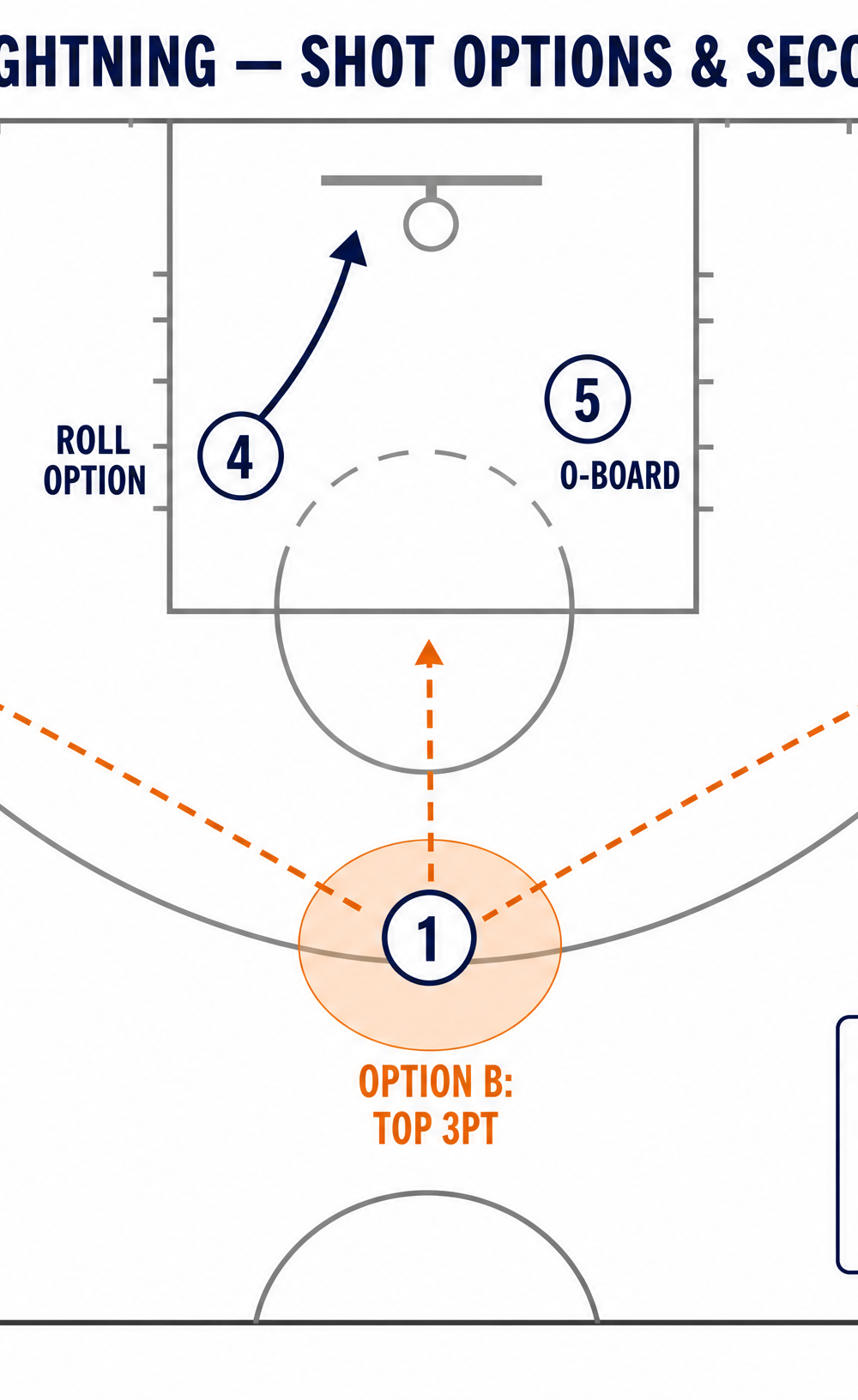
- Secondary Actions: If the defense switches heavily onto Player 2, Player 4 slips the screen and rolls hard to the basket. Player 5 immediately establishes inside position for a potential offensive rebound (O-Board).
4. Key Coaching Points
- Screening Angles: The angle of the staggered screens set by Player 4 and Player 5 must be perpendicular to the path of the defender chasing Player 2. If the angle is flat, the defender will easily slip under the screen.
- Shoulder-to-Shoulder Contact: Player 2 must run their defender into the screens. We teach "shoulder-to-shoulder" contact as the shooter comes off the screeners to ensure no gap is left for the defender to squeeze through.
- Pass Timing and Accuracy: Player 1 must anticipate Player 2's arrival. The pass should be delivered just as Player 2 clears the final screen, hitting them perfectly in the shooting pocket so they do not have to dip the ball before shooting.
- Decoy Commitment: Player 3 must sell the weak-side cut at full game speed. If the cut is lazy, the weak-side defender will cheat toward the strong side and disrupt the passing lane to Player 2.
5. Common Mistakes
- Leaving Early: Player 2 starting their cut before the screens are fully set, resulting in an offensive foul (moving screen) on Player 4 or 5.
- Fading on the Shot: Player 2 catching the ball and fading away rather than stepping into the shot, significantly lowering the shooting percentage.
- Telegraphing the Pass: Player 1 staring down Player 2 the entire time, allowing the inbound defender to deflect the pass or the help defense to rotate early.
- Soft Screens: Players 4 and 5 slipping their screens too early rather than holding the contact to ensure Player 2 gets completely free.
6. Variations & Progressions
- Slip the Screen (Counter to Switching): If the defense aggressively switches the staggered screens, have Player 4 immediately slip the screen and dive to the rim for a quick layup or dunk.
- Elevator Doors (Advanced): Instead of a standard staggered screen, Player 4 and Player 5 set a narrow gap for Player 2 to run through, then quickly close the gap (like elevator doors closing) to block the trailing defender.
- Inbounder Pop: After passing to Player 2, Player 1 immediately steps inbounds and receives a quick back-screen from Player 5 for a secondary three-point look in the corner.
7. Age Adaptations
- Under 12s: Simplify the action to a single down screen instead of a staggered double screen. Focus heavily on the fundamentals of setting up the cut and making a strong, accurate inbound pass.
- Under 14s/16s: Introduce the staggered screen, but emphasize the slip option, as younger defenders often struggle with communication during switches.
- Open/Adult: Execute the full "Lightning" play with the "Elevator Doors" variation to counter advanced defensive scouting and switching schemes.