

Basketball
Mastering the Pass: A Coach's Guide to Improving Accuracy Under Pressure
This comprehensive drill develops players' ability to make sharp, accurate passes and sound decisions while facing intense defensive pressure, a critical skill for maintaining offensive flow.
What you need
Basketballs, Cones (optional)
1. Overview
This drill, Passing Accuracy Under Pressure, is designed to elevate a team's ability to execute precise passes in high-stakes situations. It forces players to read the defense, communicate effectively, and deliver the ball on time and on target. It is an essential drill for any team looking to reduce turnovers and improve offensive efficiency, particularly effective when run in the main part of a practice session after warm-ups when players are physically and mentally ready for game-like intensity.
2. Setup
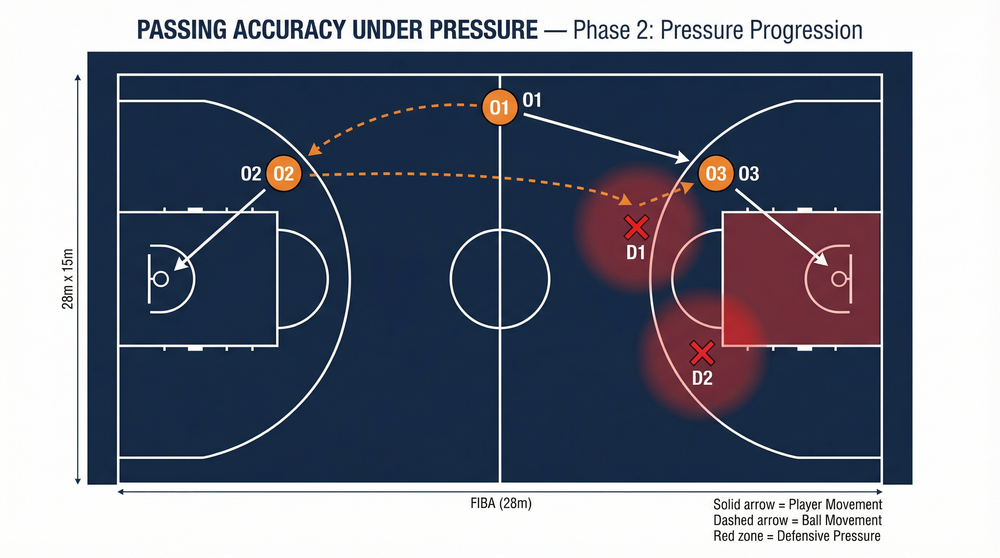
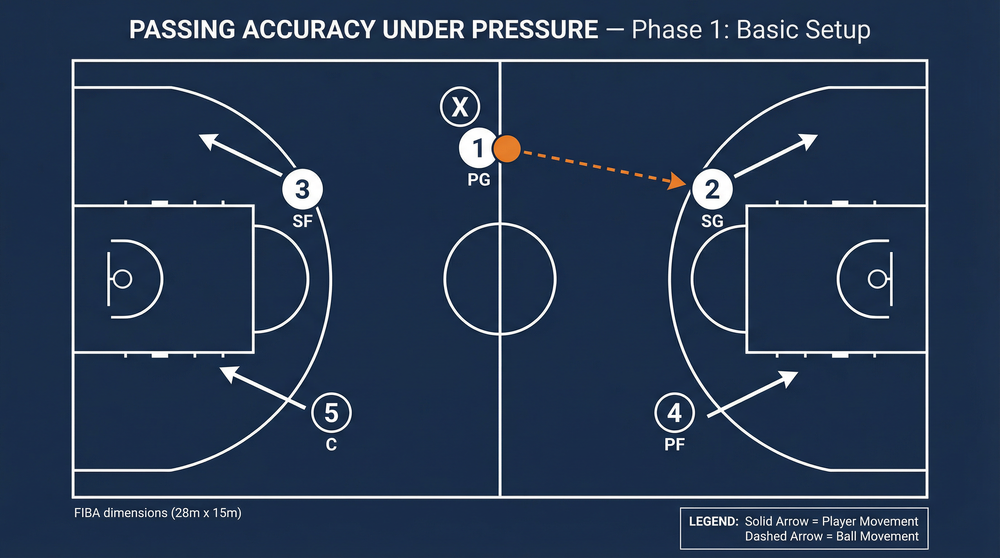
- Equipment: 1-2 basketballs, 5 cones (optional, for marking spots).
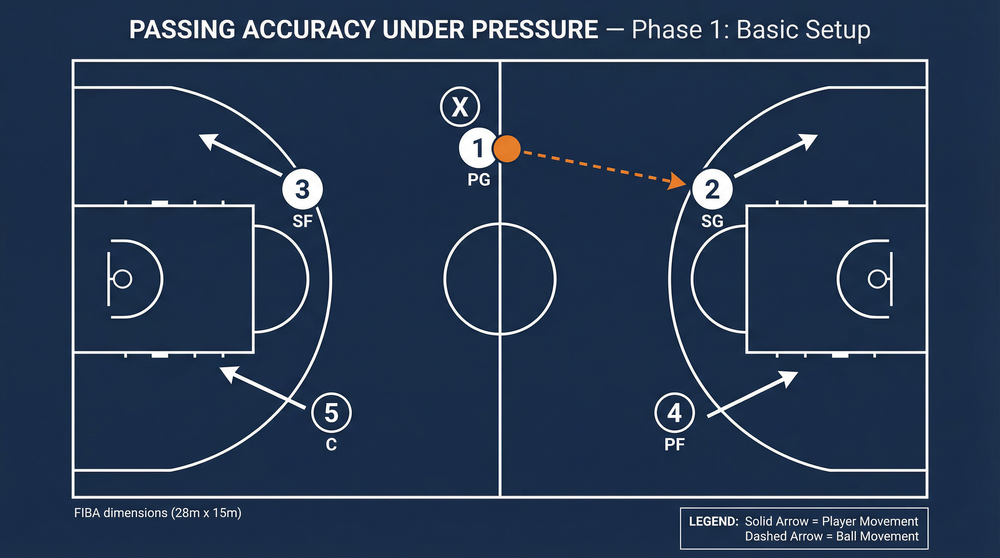
- Court Setup: Half-court or full-court depending on the progression. For the basic setup, use a half-court.
- Player Positions:
- Player 1 (Point Guard): Starts at the top of the key.
- Player 2 (Shooting Guard): On the right wing.
- Player 3 (Small Forward): On the left wing.
- Player 4 (Power Forward): On the right low post block.
- Player 5 (Center): On the left low post block.
- Defender (X1): Initially, one defender applies pressure on the Point Guard.
3. Step-by-Step Instructions
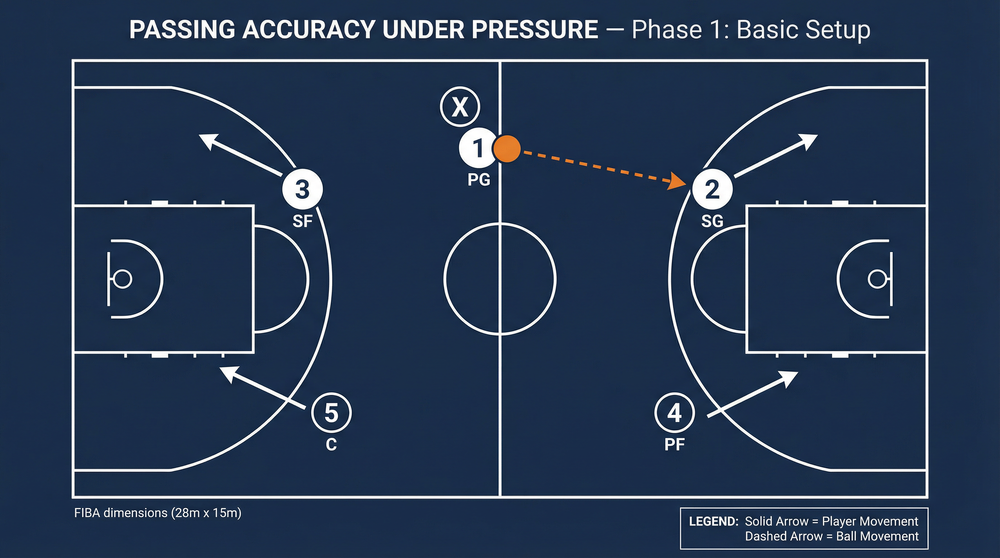
- The drill begins with Player 1 (PG) dribbling at the top of the key under pressure from Defender X1.
- Players 2, 3, 4, and 5 move dynamically off the ball, using V-cuts and L-cuts to create passing lanes.
- Player 1 must read the defensive pressure and the movements of their teammates to select the best passing option.
- The primary read is to the wing. Player 1 executes a strong chest pass or bounce pass to either Player 2 or Player 3.
- Once the pass is made, the player who receives the ball immediately looks to pass to one of the post players (Player 4 or 5) or back to Player 1.
- The drill continues with players constantly moving and passing, with the defender actively trying to deflect or intercept the ball.
- Run the drill for a set time (e.g., 2 minutes), then rotate the defender. Ensure every player gets a turn as the on-ball defender.
4. Key Coaching Points
- Pass Fakes: Encourage the use of pass fakes to move the defender and open up passing lanes. A good fake is as important as a good pass.
- Pivoting and Footwork: The ball-handler must use strong pivoting (front and reverse pivots) to protect the ball and create space and passing angles.
- Vision and Awareness: Players must keep their heads up ("eyes up") to see the entire floor, read the defense, and anticipate where teammates will be open.
- Pass Quality: Emphasize sharp, crisp passes. Chest passes should be flat and fast; bounce passes should hit the floor three-quarters of the way to the receiver.
- Communication: Both verbal (calling for the ball) and non-verbal (hand signals, eye contact) communication is critical for success.
- Spacing: Players must maintain proper spacing (12-15 feet) to stretch the defense and create clear passing lanes.
5. Common Mistakes
- Telegraphing Passes: Players staring down their intended receiver, making it easy for the defense to anticipate and intercept.
- Lazy Passes: Soft, looping passes that are easily deflected. Passes must be thrown with conviction.
- Standing Still: Offensive players off the ball remaining static, making it impossible to get open. Constant movement is key.
- Poor Footwork: The passer being off-balance, leading to inaccurate passes. Stress the importance of a solid base.
- Ignoring the Defender: Not reading the defender’s position and trying to force a pass through them.
6. Variations & Progressions
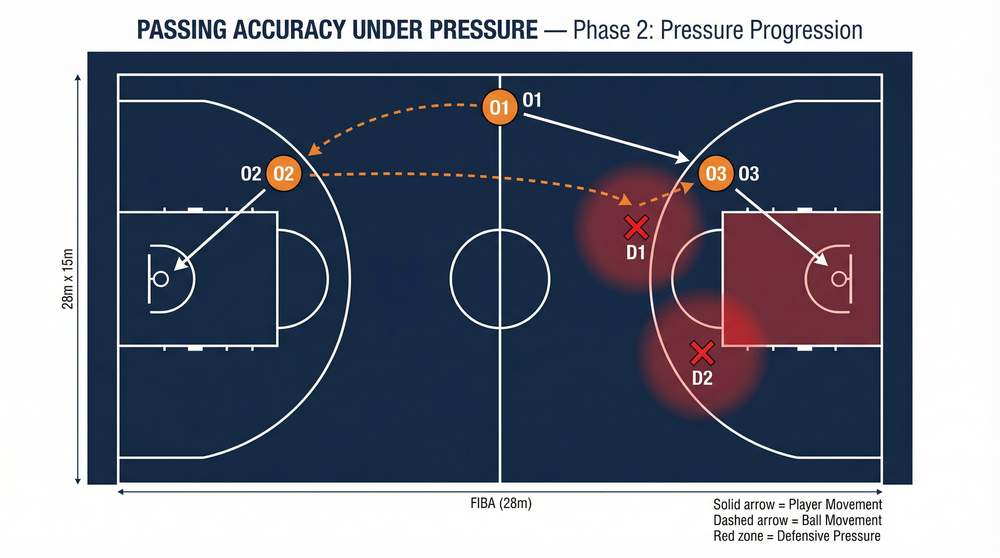
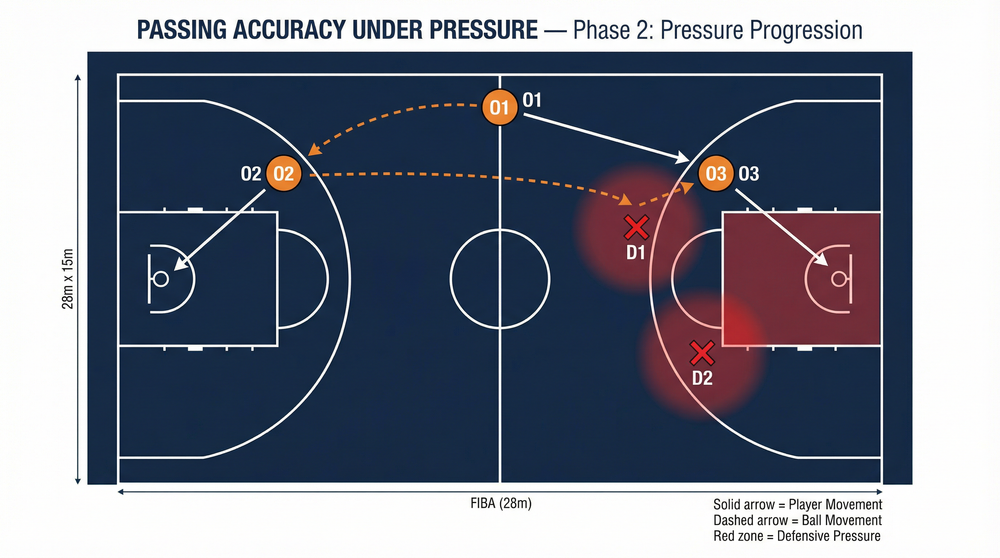
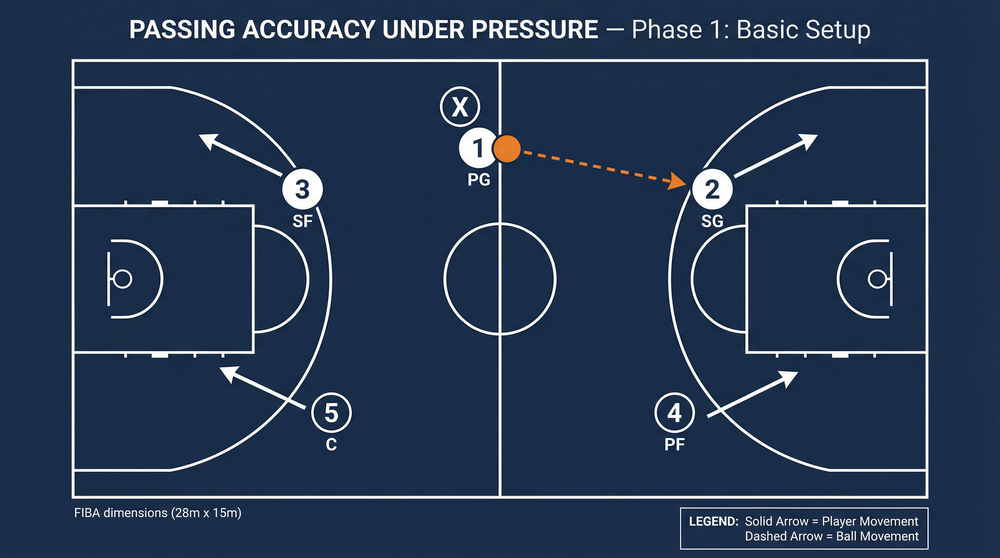
- Add a Second Defender: Introduce a second defender (X2) to roam the passing lanes, forcing players to make even smarter decisions and use fakes more effectively.
- 3-on-2 Fast Break: Progress the drill to a full-court 3-on-2 transition scenario. This forces quick decisions and accurate long-distance passes under pressure.
- Dribble Limit: Restrict the ball-handler to a maximum of three dribbles before they must pass. This speeds up decision-making and encourages ball movement.
7. Age Adaptations
- Under-12: Focus on the fundamentals. Use one passive defender who applies light pressure. Emphasize making a strong chest pass to a stationary target. Remove the post players to simplify the reads.
- Under-14: Introduce active defenders but start with a 4-on-1 advantage. Focus on V-cuts to get open and reading the single defender.
- Under-16/Open: Run the drill at full speed with multiple defenders (4-on-2 or 5-on-3). Add time constraints (e.g., must score within 10 seconds) to simulate game pressure.
