

Basketball
Mastering the Pick and Roll: High Screen Execution Drill
Develop elite decision-making and precise execution in your pick and roll offense with this comprehensive high screen drill.
What you need
2-3 Basketballs, Half-court, 4 Marker cones (optional)
1. Overview
The pick and roll is the foundational action of modern basketball. When executed with precision, it forces defensive rotations and creates high-percentage scoring opportunities. This drill focuses on the "high screen" variation, run at the top of the key. It is designed to develop the essential timing, spacing, and decision-making skills required for both the ball handler and the screener. Coaches should use this drill to teach players how to read the defense, set legal and effective screens, and exploit the resulting advantages.
2. Setup
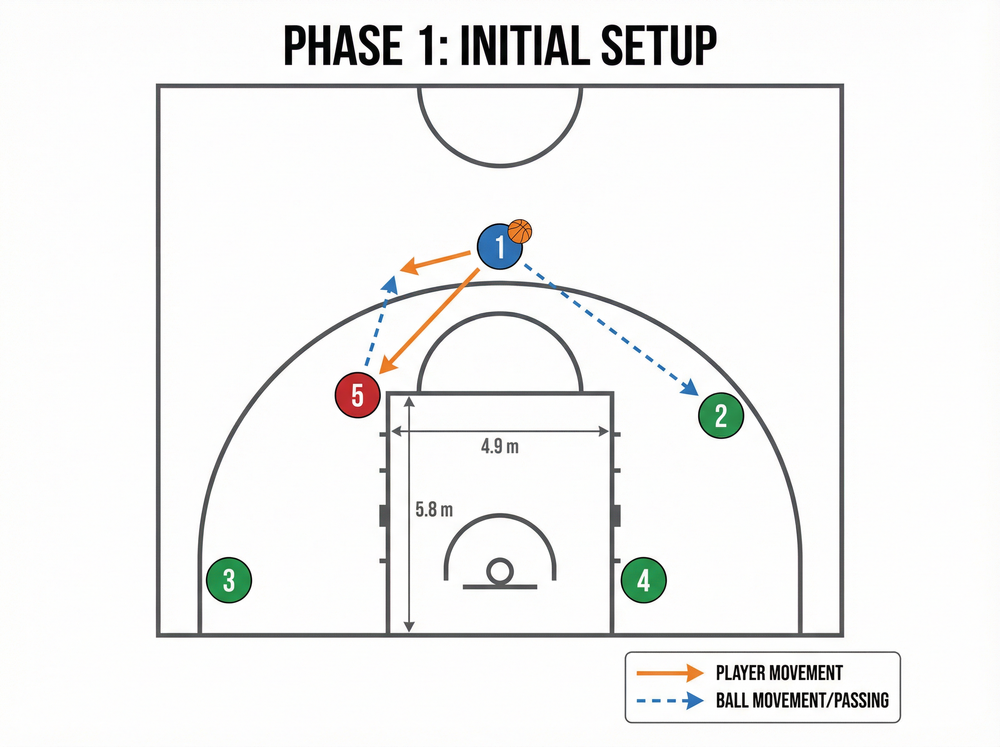
- Court Dimensions: Standard FIBA half-court (14m x 15m).
- Equipment Needed: 2-3 basketballs, 4 marker cones (optional, to designate spacing spots).
- Players Required: Minimum of 5 players per group (1 Ball Handler, 1 Screener, 3 Spacers). Can be run with up to 10 players rotating through positions.
- Player Positions:
- Player 1 (Point Guard/Ball Handler): Starts at the top of the key, just outside the three-point line.
- Player 5 (Center/Screener): Starts near the elbow or block, ready to sprint up and set the screen.
- Players 2, 3, 4 (Wings/Corners): Positioned wide in the corners and on the weak-side wing to maintain optimal floor spacing.
3. Step-by-Step Instructions
Phase 1: The Setup and Screen
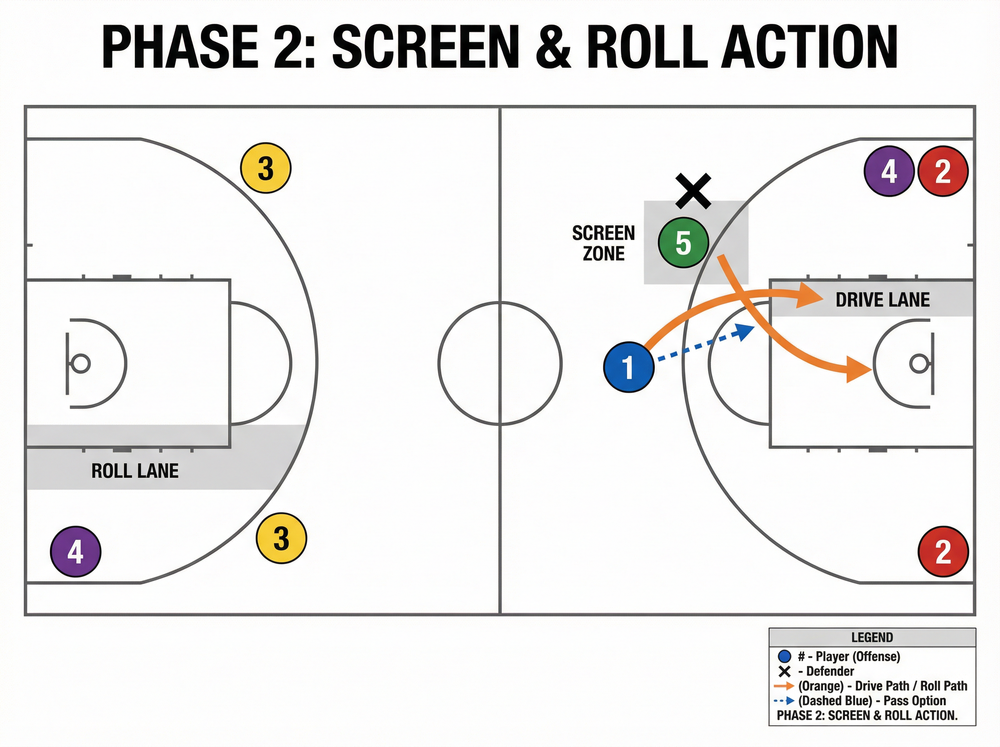
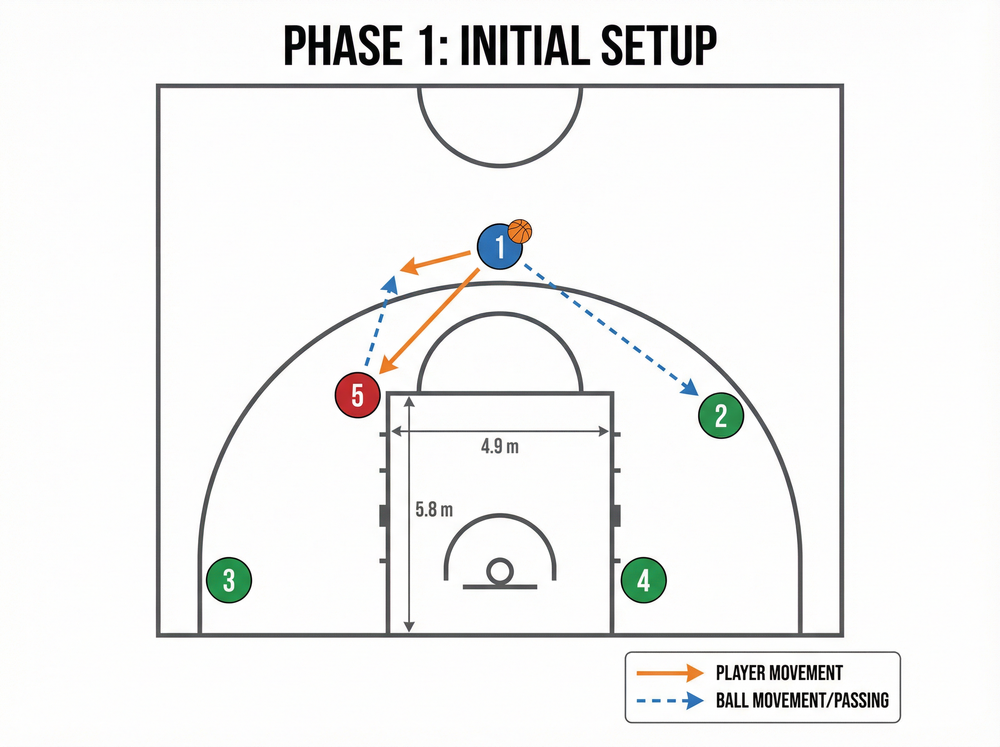
- Initiation: Player 1 brings the ball to the top of the key. The spacing players (2, 3, 4) must stay wide and stationary to stretch the defense.
- The Sprint: Player 5 sprints from the baseline or elbow area to the top of the key to set a high ball screen for Player 1.
- The Setup Dribble: As Player 5 approaches, Player 1 takes one or two setup dribbles in the opposite direction of the intended screen to shift the defender.
- The Screen: Player 5 comes to a complete jump stop, establishing a wide, solid base (feet slightly wider than shoulder-width apart) just outside the three-point arc. The screen must be set at an angle that forces the defender over the top.
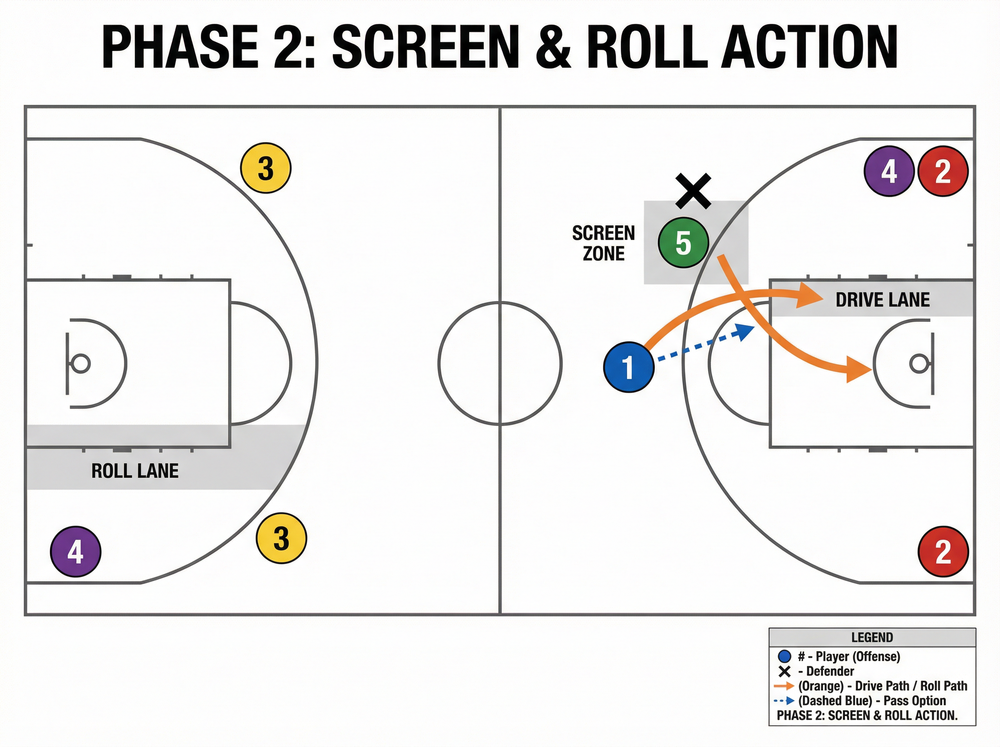
Phase 2: Execution and Reads
5. Shoulder-to-Shoulder: Player 1 aggressively drives off the screen, ensuring their shoulder brushes against Player 5's hip/shoulder. This "shoulder-to-shoulder" contact prevents the defender from slipping under the screen.
6. The Roll: Immediately after Player 1 clears the screen, Player 5 pivots on their inside foot and rolls hard to the basket. The roll should be a direct line to the rim, opening their chest to the ball handler.
7. The Decision: Player 1 attacks the paint and reads the defensive coverage:
- If the defense drops: Player 1 pulls up for the mid-range jumper or attacks the rim.
- If the defense hedges or traps: Player 1 delivers a crisp pocket pass or lob to the rolling Player 5.
- If the weak-side defense tags the roller: Player 1 kicks the ball out to the open shooter (Player 2, 3, or 4).
4. Key Coaching Points

- Patience is Crucial: The ball handler must wait for the screen to be completely set before attacking. Leaving early results in an offensive foul or an ineffective screen.
- Angle of the Screen: The screener's back should be pointing toward the area they want the ball handler to attack. A flat screen allows the defender to easily go under.
- Shoulder-to-Shoulder Contact: Emphasize the ball handler brushing off the screener. Any gap allows the on-ball defender to recover quickly.
- Hard Roll: The screener must roll to the basket with purpose and speed, keeping their hands up and eyes on the ball handler, ready to catch and finish.
- Read the Hips: Teach the ball handler to read the hips of the screener's defender (the big). If the big's hips are parallel to the sideline, attack downhill; if they are parallel to the baseline (hedging), look for the pass.
5. Common Mistakes

- Moving Screens: The screener fails to come to a complete stop or shifts their feet just as contact is made, resulting in an offensive foul.
- Refusing the Screen: The ball handler drives away from the screen or leaves too much space, rendering the screen useless.
- Weak Rolling: The screener slowly jogs to the basket or rolls with their back to the ball, missing passing windows.
- Tunnel Vision: The ball handler only looks to score and fails to read the weak-side defenders tagging the roller.
6. Variations & Progressions
- Add Live Defense: Start with dummy defense (coach or player offering passive resistance) and progress to 2v2 live (defending the ball handler and screener), then finally 5v5 live to incorporate weak-side reads.
- Pick and Pop: Instead of rolling to the basket, the screener pops out to the three-point line for a catch-and-shoot opportunity. This is excellent for teams with shooting bigs.
- Side Pick and Roll: Move the initiation point from the top of the key to the wing (free-throw line extended) to change the spacing and defensive rotation angles.
7. Age Adaptations
- Under 10 / Under 12: Focus purely on the mechanics of setting a legal, stationary screen and the ball handler dribbling tightly off it. Do not introduce complex defensive reads. Use cones as defenders.
- Under 14: Introduce basic 2v2 reads (drop coverage vs. hard hedge). Emphasize the timing of the roll and the pocket pass.
- Under 16 / Open: Run the drill at game speed with live 5v5 defense. Introduce complex coverages like "Ice" (pushing the ball handler away from the screen) or switching, and teach the appropriate offensive counters.
