

Basketball
Mastering the Motion Offense: A Continuity Play for Seamless Scoring
A comprehensive guide for basketball coaches on implementing a versatile motion offense continuity play to create constant movement and multiple scoring opportunities.
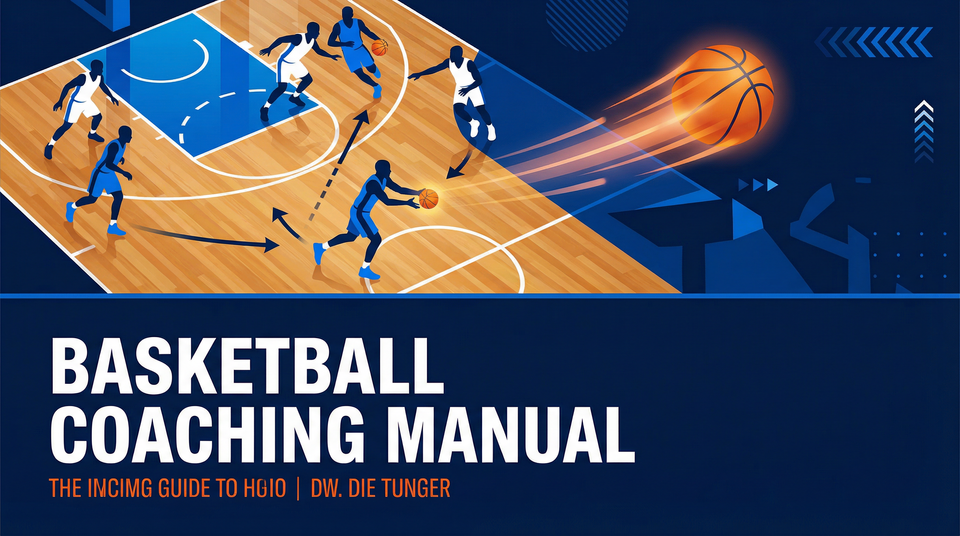
1. Overview
The Motion Offense is a flexible and dynamic offensive strategy that emphasizes player movement, passing, screening, and cutting to create scoring opportunities. Unlike rigid set plays, a continuity motion offense flows from one action to the next, making it difficult for defenses to predict and counter. This resource details a fundamental continuity play that teaches players to read the defense and work together, creating a foundation for a highly efficient offense. The primary goal is to create high-percentage shots through ball reversal and off-ball screens, forcing the defense to constantly adjust and communicate.
This play is best used against man-to-man defenses but can be adapted for zones. It is particularly effective for teams that may not have a single dominant scorer but possess good overall basketball IQ, passing skills, and a willingness to move without the ball. It encourages an unselfish style of play where every player is a threat.
2. Setup
Equipment
- 1-2 Basketballs
- 5 players
- A full-sized FIBA basketball court (28m x 15m)
- Cones (optional) to mark starting positions for younger players.
Player Positions
This play utilizes a standard 5-out or 4-out, 1-in formation. Players should be comfortable in multiple spots, but here is a typical alignment:
- 1 (Point Guard): Initiates the offense at the top of the key.
- 2 (Shooting Guard): On the right wing, outside the three-point line.
- 3 (Small Forward): On the left wing, outside the three-point line.
- 4 (Power Forward): In the right short corner or low post area.
- 5 (Center): In the left low post area.

3. Step-by-Step Instructions
This continuity can be repeated on either side of the floor. The sequence described below starts with the ball on the right side.
- Initiation: The play begins with 1 (PG) dribbling towards the right wing, looking to engage the defender. This movement signals the start of the sequence.
- Wing Entry & Backdoor Cut: As 1 dribbles towards 2 (SG), 2 makes a sharp 'V-cut' to get open for a pass. If 2's defender overplays the pass (denies the wing entry), 2 immediately cuts backdoor towards the basket, looking for a quick bounce pass from 1 for a layup. This is the first and simplest scoring option.
- Ball Reversal: If the backdoor cut isn't open, 1 passes the ball to 4 (PF) who has popped out to the top of the key from the low post. This pass initiates the ball reversal.
- Screen and Fill: After passing to 4, 1 cuts through to the opposite (left) corner. Simultaneously, 3 (SF) moves up from the left wing to fill the spot at the top of the key just vacated by 4. This maintains spacing and offensive structure.
- Weak-Side Action: As the ball is at the top of the key with 4, 5 (C) moves up from the left low post to set a screen for 2, who is now cutting across the key under the basket. 2 uses the screen to curl towards the left wing/elbow area, looking for a pass from 4 for a potential shot.
- Continuity: The ball is now with 4 at the top, who can pass to the cutting 2 or reverse the ball to 3 on the left wing. The players are now in a similar formation on the opposite side of the floor. 3 can now initiate the same sequence by dribbling towards the wing, and the pattern continues. The play flows seamlessly from one side to the other.

4. Key Coaching Points
- Read the Defense: This is the most critical element. Players must not be robots. If a defender denies a pass, the offensive player must cut backdoor. If a defender goes under a screen, the cutter should pop out for a shot instead of curling tight.
- Pace and Timing: Cuts must be sharp and timed perfectly with the pass. The offense should not be rushed, but players must move with purpose. A pass should be thrown to where the cutter will be, not where they are.
- Spacing is Everything: Players must maintain a distance of at least 4-5 meters from each other. This stretches the defense and opens up passing and cutting lanes. After cutting, players must fill the next open spot to maintain the structure.
- Hard Screens and Sharp Cuts: Screens are only effective if they are set properly and make contact (legally). The screener must have a wide base and be stationary. The cutter must wait for the screen to be set and then rub their shoulder right off the screener to create separation.
- Communicate: Players should use verbal and non-verbal cues. A hand signal for a backdoor cut or a call for a screen makes the offense more cohesive.
5. Common Mistakes
- Standing Still: The biggest killer of a motion offense. If a player is not involved in the primary action, they should be moving to get open or set a screen for someone else.
- Poor Spacing: Players drifting too close to each other allows one defender to guard two players, clogging the offense.
- Telegraphed Passes: Lazy, looping passes are easily stolen. Passes must be crisp, accurate, and often disguised with a pass fake.
- Forcing the Action: Players should take what the defense gives them. If the first option (e.g., backdoor cut) isn't there, they must move to the next phase of the offense instead of forcing a bad pass or shot.
- Screener Not Waiting: The screener often rolls to the basket or pops out before the cutter has even used the screen, rendering the action useless.
6. Variations & Progressions
Variations
- UCLA Cut: Instead of a simple wing entry, the point guard (1) can pass to the high post (4) and then make a 'UCLA cut' off 4's back towards the basket. This is a classic and effective way to start the offense.
- Flex Cut Option: The continuity can flow into a 'Flex' offense. For example, after the wing player (2) cuts across the baseline, the corner player (1) can receive a screen from the post player (5) to cut to the top of the key.
Progressions
- Add a Shot Clock: Run the offense 5-on-5 with a 24-second shot clock to force quicker decisions and more efficient movement.
- Introduce Scenarios: Start the play from a disadvantageous position (e.g., after a simulated trap) to teach players how to flow into their offense under pressure.
7. Age Adaptations
- Under-12: Focus on the basic principles: pass, cut, and fill. Use a 3-out, 2-in motion. Remove the complex screening actions and focus on the 'give-and-go'. Use cones to show players where to cut and fill.
- Under-14/Under-16: Introduce off-ball screens (down screens, back screens). Run the offense 4-on-4 to create more space and simplify reads. Emphasize reading the defender on the wing for the backdoor cut.
- Open Age/Advanced: The full 5-on-5 continuity can be run. Introduce more complex actions like 'flare screens' and 'staggered screens' within the motion. Expect players to make multiple reads and counters based on how the defense is playing them.
