

Basketball
Mastering the UCLA Cut Entry Play
Learn how to execute the classic UCLA cut to create easy scoring opportunities at the rim and seamlessly transition into your half-court offense.
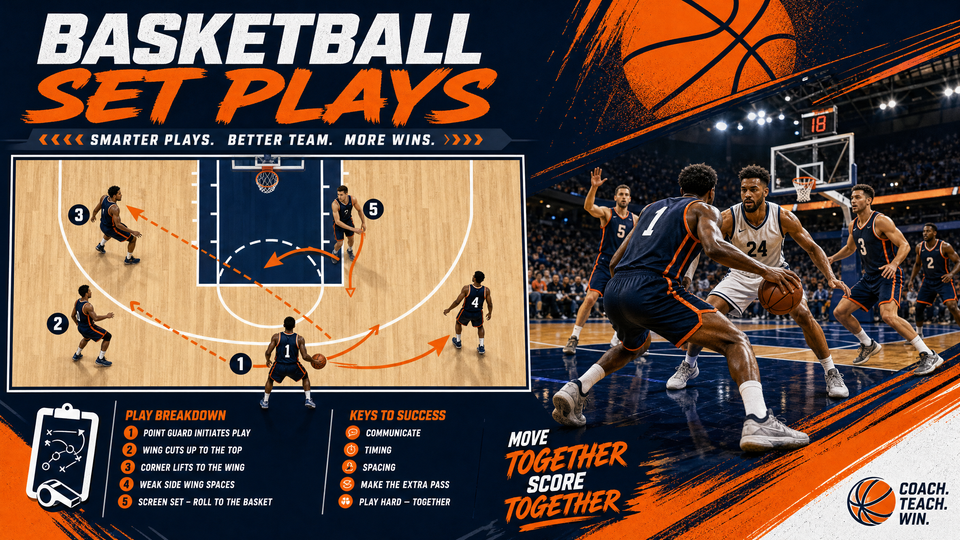
What you need
1 Basketball, Half-court (FIBA 28m x 15m), Cones (optional, for spacing markers)
1. Overview
The UCLA Cut is a foundational offensive action in basketball, popularized by legendary coach John Wooden at UCLA. It is an entry play designed to create a high-percentage scoring opportunity at the rim right at the start of a possession. When executed correctly, it forces the defense to make difficult decisions, often resulting in an open layup or a deep post touch. Even if the primary cut is defended, the action naturally flows into various secondary options, making it a highly effective and versatile tool for teams of all levels.
Best used when: Your point guard is a strong cutter, your big can catch and pass from the high post, or you need a reliable half-court entry against man-to-man defense.
2. Setup
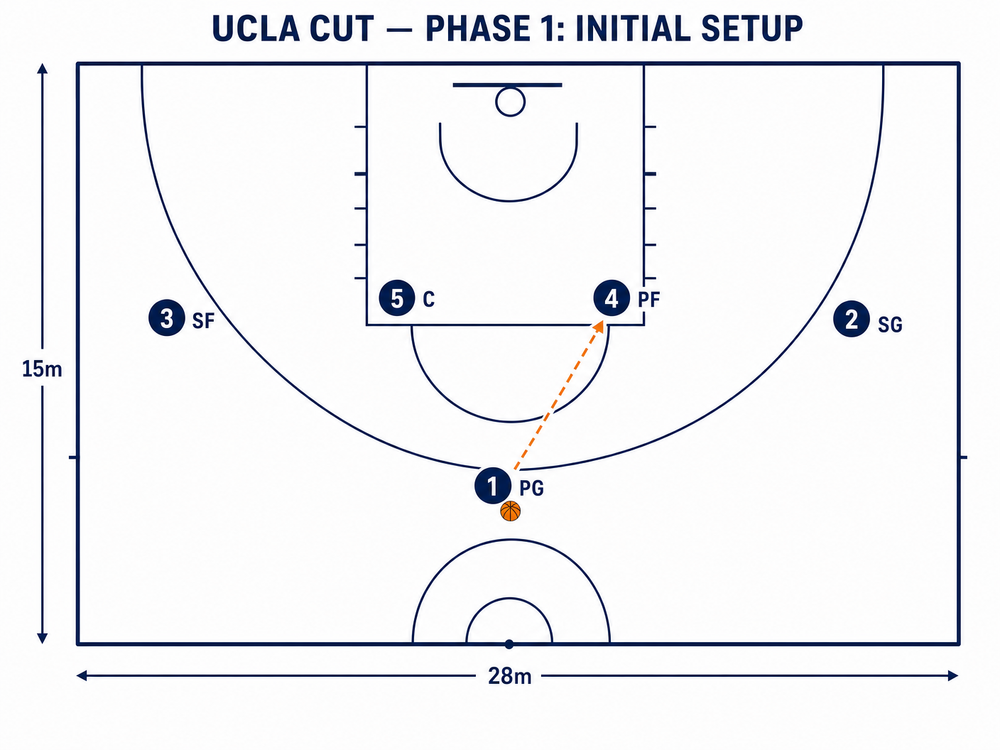
To run the UCLA Cut effectively, proper spacing and positioning are critical. All five players must be in their designated spots before the play is called.
| Player | Position | Starting Location |
|---|---|---|
| 1 | Point Guard (PG) | Top of the key, with the ball |
| 2 | Shooting Guard (SG) | Right wing, near the three-point line |
| 3 | Small Forward (SF) | Left wing, near the three-point line |
| 4 | Power Forward (PF) | Right high post (elbow), ~5.8m from the basket |
| 5 | Center (C) | Left high post (elbow), ~5.8m from the basket |
Equipment needed: 1 basketball, standard FIBA half-court (28m x 15m).
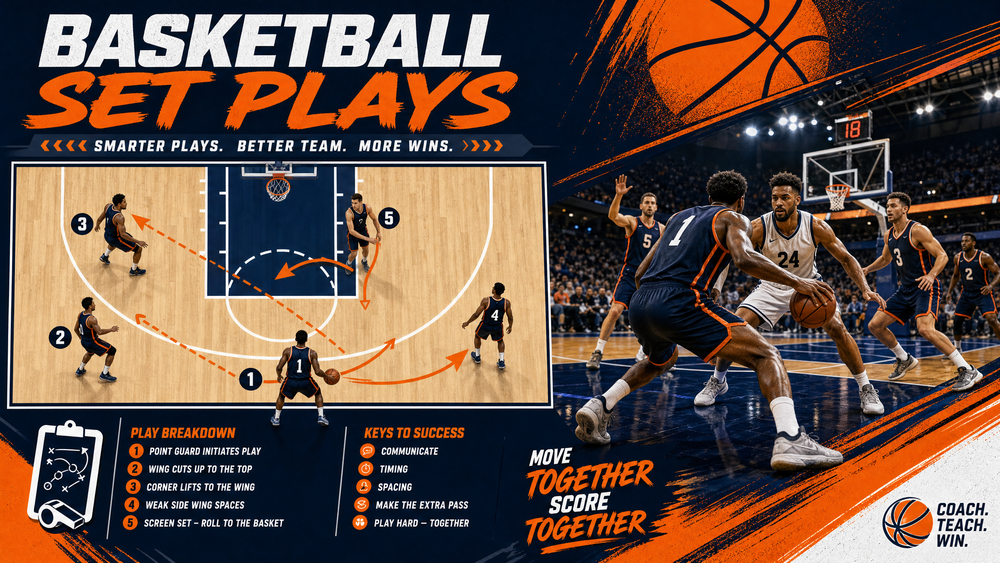
Diagram 1: Initial setup — Player 1 with the ball at the top of the key, Players 4 and 5 at the elbows, Players 2 and 3 spread on the wings. The dashed arrow shows the entry pass from 1 to 4.
3. Step-by-Step Instructions
Call the Play (0–1 sec): Player 1 calls the play signal at half-court while dribbling into the front court. All players sprint to their starting positions before Player 1 crosses the half-court line.
The Entry Pass (1–2 sec): Player 1 passes the ball to Player 4 at the right elbow. This pass should be a sharp, two-handed chest pass. Player 4 must catch the ball in a triple-threat position.
Set Up the Cut (1–2 sec): Immediately after releasing the pass, Player 1 takes one hard jab step to the left — away from the ball — to freeze their defender and create separation.
The Screen (2–3 sec): Player 5 sprints from the left elbow to set a firm, stationary back screen on Player 1's defender at the top of the key. Player 5 must be completely set (feet planted, arms crossed) before Player 1 makes contact.
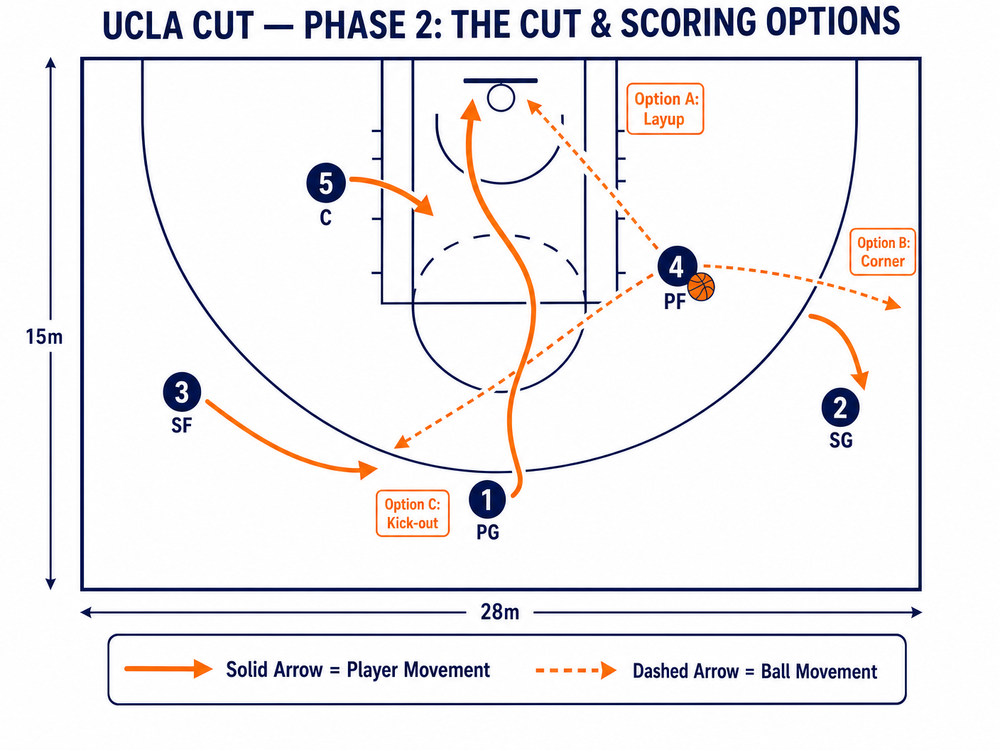
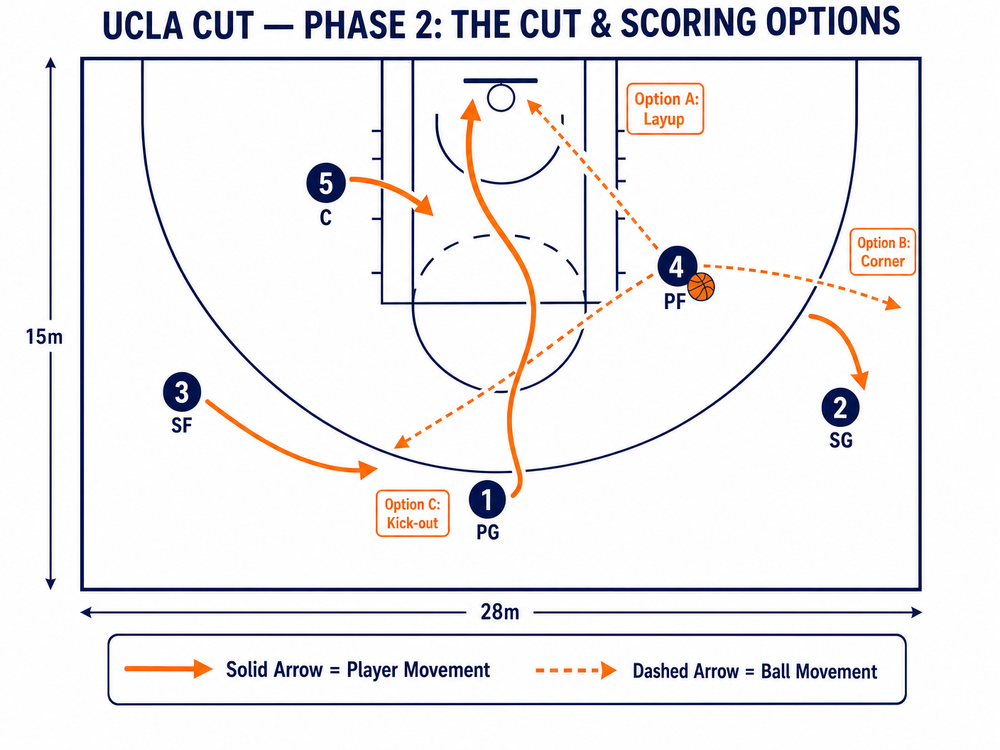
The UCLA Cut (3–4 sec): Player 1 cuts hard off Player 5's inside shoulder, driving directly down the middle of the lane toward the basket. The cut should be at full speed — this is not a jog.
The Finish (4–5 sec): Player 4 pivots toward the basket and delivers a crisp bounce pass to Player 1 for the layup. If Player 1 is on the right side of the lane, they finish with the right hand; if on the left, with the left.
Secondary Reads (simultaneous with steps 5–6): Player 2 spaces to the right corner. Player 3 lifts from the left wing to the top of the key to replace Player 1. Player 5, after setting the screen, dives to the left low post.
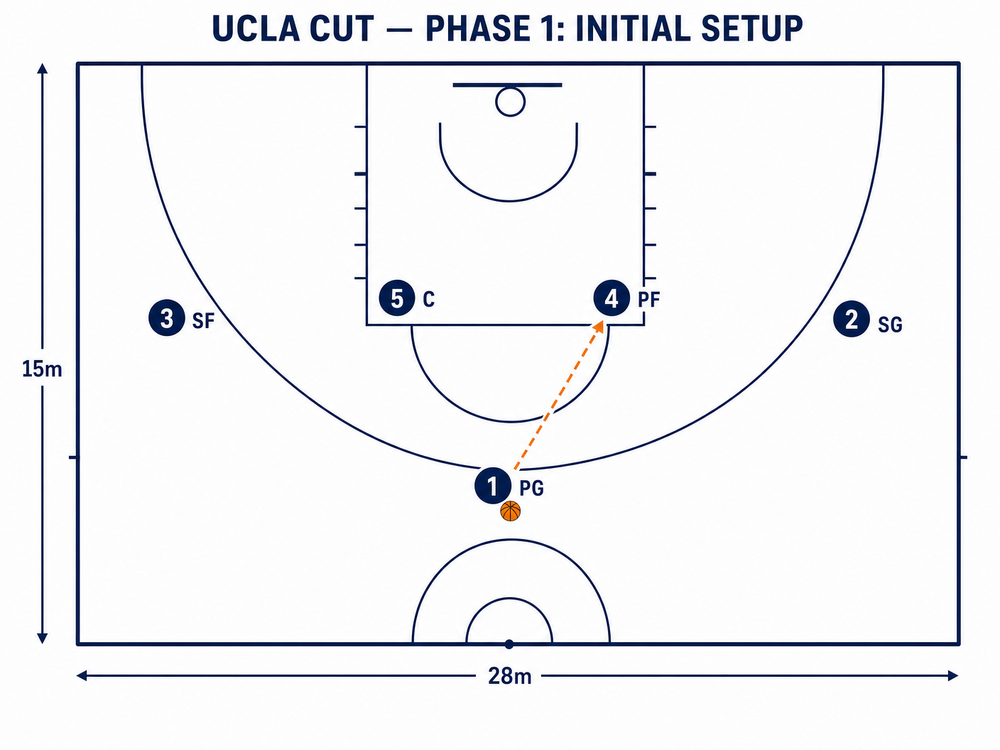
Diagram 2: The cut and scoring options — Player 1 cuts hard off Player 5's screen. Player 4 reads the defense and chooses between Option A (layup pass to Player 1), Option B (kick-out to Player 2 in the corner), or Option C (reversal to Player 3 at the top).
4. Key Coaching Points
Patience and Timing: The single most common error at every level is Player 1 cutting before the screen is set. Emphasize that the cut begins only when Player 5 is stationary. Use the cue: "Wait for the wall before you go."
Setting Up the Cut: The jab step away from the ball is what makes this play work. Without it, the defender can anticipate the cut and get over the top of the screen. Drill this footwork in isolation before running the full play.
Shoulder-to-Shoulder: Player 1 must brush shoulders with Player 5 when coming off the screen. Any gap — even half a metre — allows the defender to squeeze through and contest the layup. Cue: "Leave no daylight."
Passer's Vision: Player 4 must not stare at Player 1 before the cut. Looking away and then back to the cutter at the last moment prevents the defense from reading the pass. Cue: "Look off, then look on."
Screener's Role After the Screen: Player 5 should not stand still after setting the screen. The dive to the low post is a live scoring threat and keeps the weak-side defender occupied.
Spacing Discipline: Players 2 and 3 must stay wide on the wings. If they drift toward the key, they collapse the lane and eliminate the passing lane to the cutter.
5. Common Mistakes
Rushing the Screen: Player 5 moves before being fully set, resulting in an offensive foul. Fix: Run the play in slow motion during practice, freezing the action when Player 5 reaches the screen position to confirm both feet are planted.
Poor Spacing: Players 2 and 3 drift too high or too close to the key, clogging the driving lane and making the bounce pass to Player 1 impossible. Fix: Place cones at the correct wing positions and require players to touch the cone before the play begins.
Telegraphing the Pass: Player 4 stares down the cutter, allowing the defense to anticipate and intercept the pass. Fix: Drill Player 4 with a "look-away" exercise — they must look at the opposite wing before delivering the pass.
Soft Cut: Player 1 jogs through the lane instead of cutting at full speed, giving the defender time to recover. Fix: Use a stopwatch — the cut from the top of the key to the basket should take no more than 1.5 seconds.
Wrong Hand Finish: Player 1 finishes with the wrong hand, resulting in a missed layup under pressure. Fix: Drill the finish separately, emphasizing left-hand layups when cutting from the right side of the lane.
6. Variations & Progressions
Variation 1 — Slip the Screen: If the defense is aggressively fighting over the screen, Player 5 can slip the screen early — instead of setting the back screen, Player 5 fakes the screen and dives immediately to the basket. Player 4 delivers a lob or bounce pass to Player 5 for the easy score.
Variation 2 — Back-Door Rejection: If Player 1's defender is overplaying the cut to the basket, Player 1 can reject the screen entirely, cutting back-door to the weak-side corner. Player 4 delivers a skip pass to the corner.
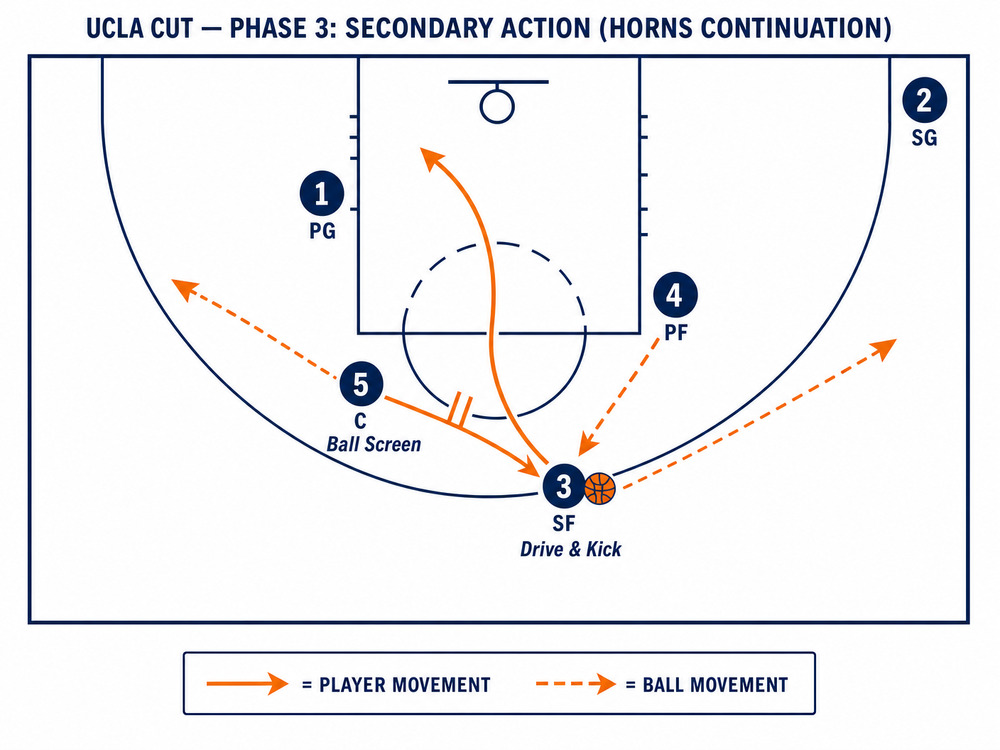
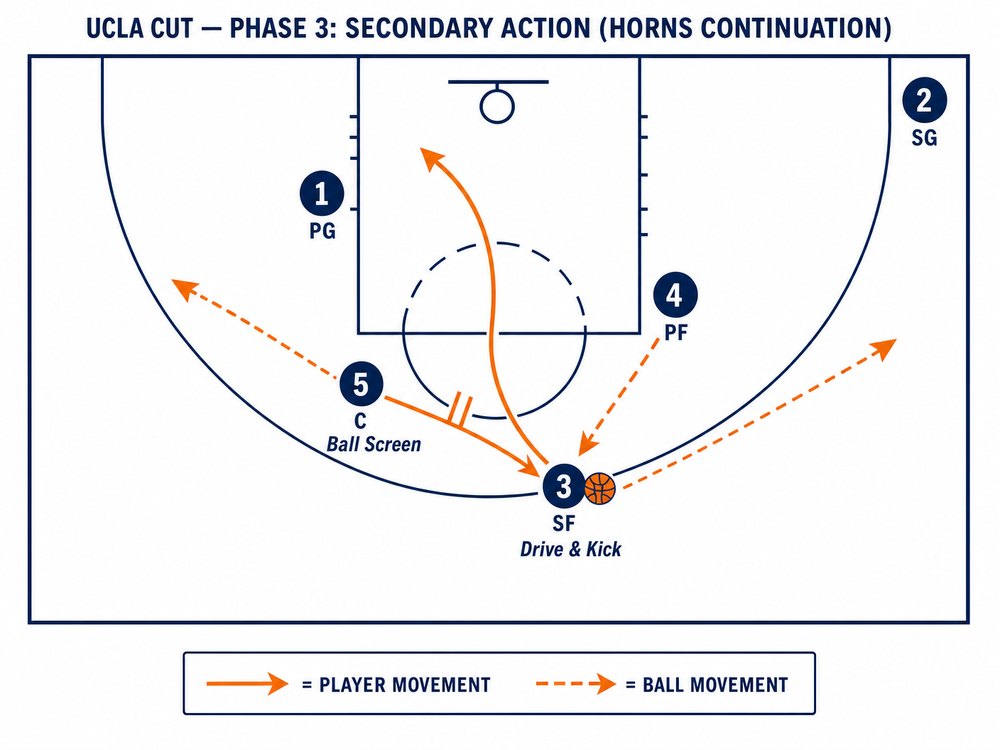
Progression — Horns Continuation: If the primary cut is covered, the play flows seamlessly into a Horns set. Player 3 has replaced Player 1 at the top of the key. Player 4 reverses the ball to Player 3. Player 5 pops from the low post back to the left elbow and sets a ball screen for Player 3. Player 3 uses the ball screen to drive or kick to Player 2 in the corner or Player 1 on the weak-side wing.
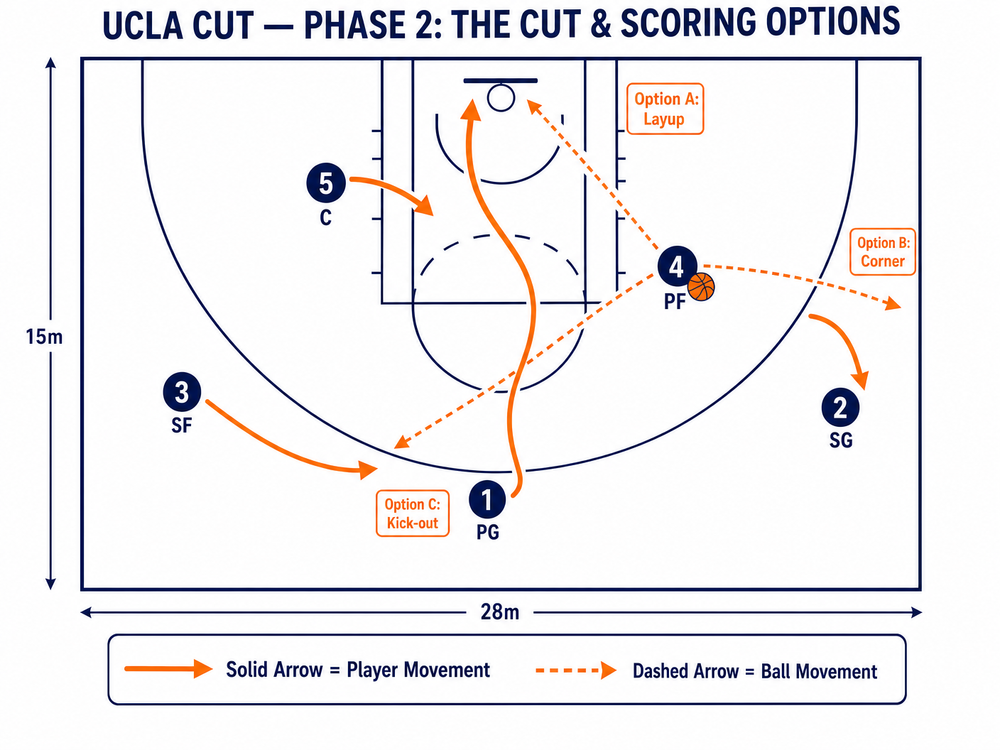
Diagram 3: Horns continuation — Player 3 receives the reversal at the top of the key. Player 5 sets a ball screen. Player 3 drives and kicks to Player 1 (weak-side wing) or Player 2 (strong-side corner).
7. Age Adaptations
| Age Group | Adaptation |
|---|---|
| Under 10 | Remove the screen entirely. Focus only on the entry pass to Player 4 and a hard straight-line cut to the basket. Emphasize catching and finishing. |
| Under 12 | Introduce the screen but allow Player 5 to be stationary from the start. Focus on the timing of the cut and the bounce pass. |
| Under 14 | Run the full play as described. Introduce secondary reads (Option B and C) once the primary action is consistent. |
| Under 16 | Add the Horns continuation. Begin teaching reads based on defensive coverages (switch, hedge, drop). |
| Open / Senior | Incorporate all variations, counters, and reads. Run the play against live defense in 5-on-5 situations. |
This play is immediately runnable in your next session. Walk through it step-by-step without defense first, then add a passive defender on Player 1, and finally run it live 5-on-5.
