

Basketball
Mastering the UCLA Cut Entry Play: A Complete Guide for Coaches
Learn how to execute the classic UCLA cut entry play to create high-percentage scoring opportunities and establish seamless offensive flow.
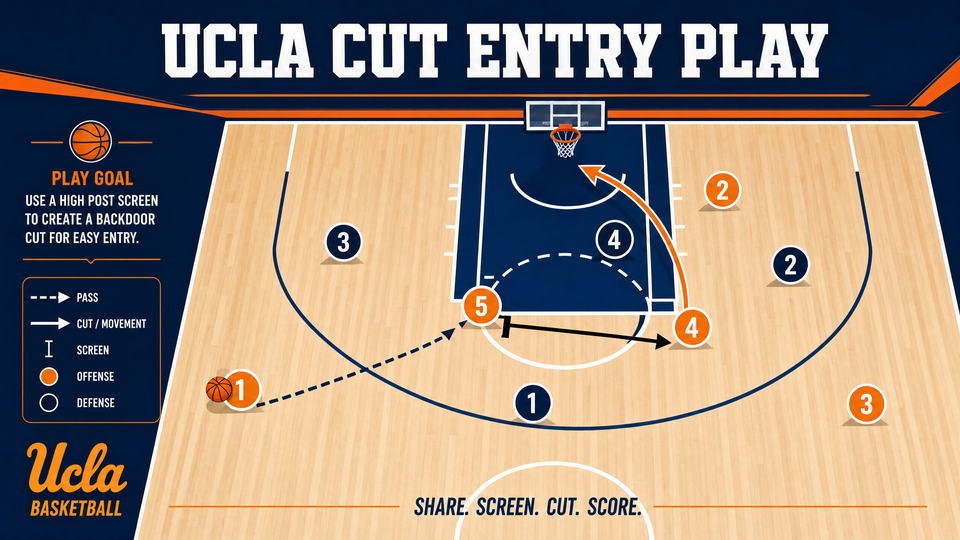
What you need
1 Basketball, Half-court with standard markings
1. Overview
The UCLA cut is one of the most fundamental and effective actions in basketball offense, popularized by legendary coach John Wooden. This entry play utilizes a high post screen to create a backdoor cut for the point guard or wing player, leading to easy layups or establishing excellent offensive spacing.
It is an ideal play to use against aggressive man-to-man defense that overplays the passing lanes. By utilizing the defense's pressure against them, the UCLA cut punishes over-eager defenders while seamlessly flowing into secondary offensive sets like the Flex or continuity offenses if the initial cut is covered.
2. Setup
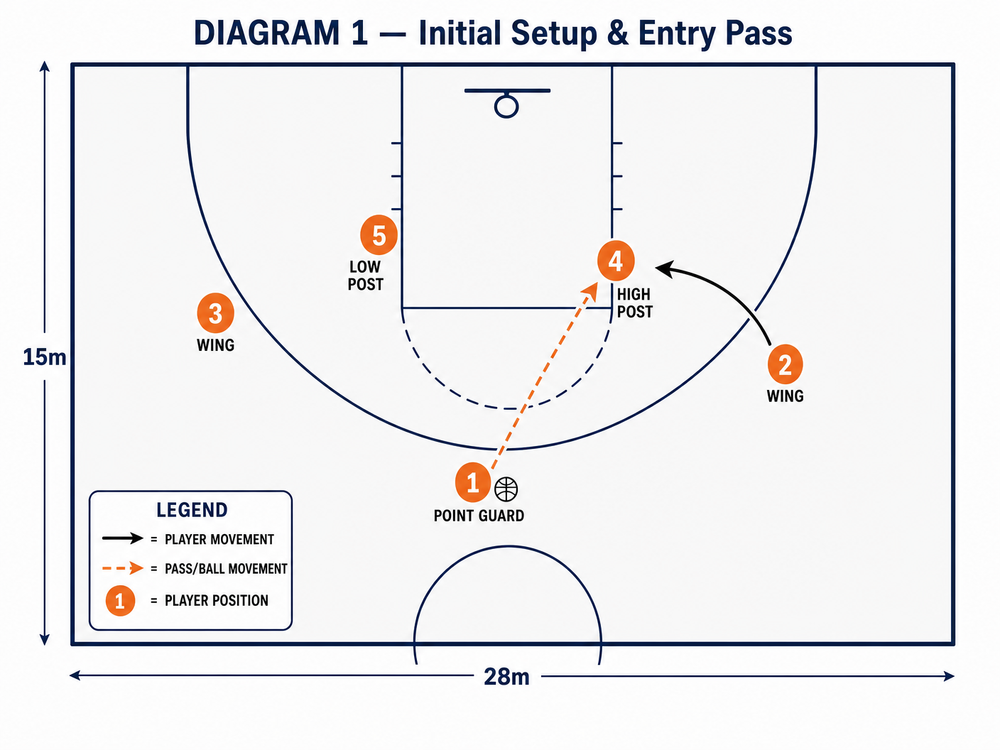
To effectively run this play, you need a standard half-court setup (28m x 15m FIBA dimensions) and five players.
Player Positions:
- Player 1 (Point Guard): Starts at the top of the key with the basketball.
- Player 2 (Shooting Guard): Positioned on the right wing, near the three-point line.
- Player 3 (Small Forward): Positioned on the left wing, near the three-point line.
- Player 4 (Power Forward): Starts on the right block and flashes to the high post (elbow).
- Player 5 (Center): Positioned on the left low block, ready to set the crucial back screen.
Equipment: 1 Basketball, standard court markings.
3. Step-by-Step Instructions
Step 1: The Entry Pass
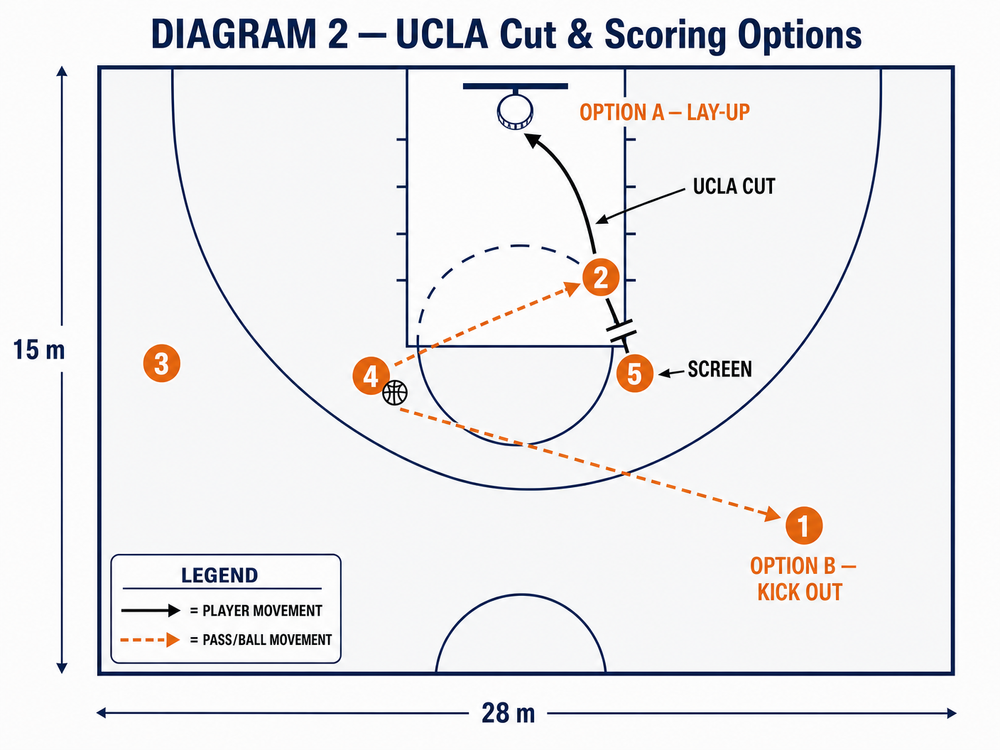
Player 1 dribbles to the right side of the floor to improve the passing angle. Player 4 flashes from the low block to the right high post (elbow) to receive the entry pass from Player 1.
Step 2: Setting the Screen
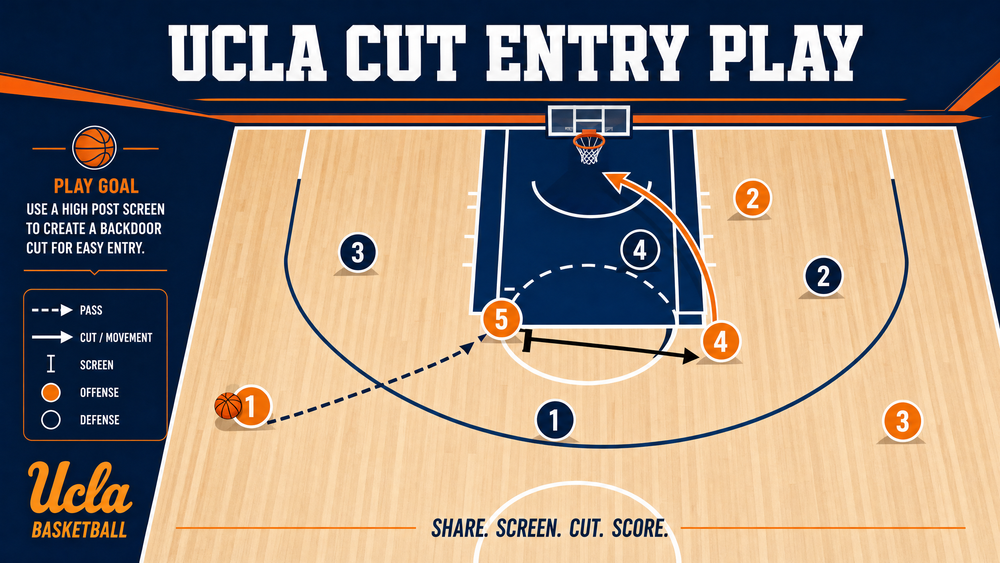
As the pass is in the air to Player 4, Player 5 sprints from the left low block up to the high post area (near the free-throw line) to set a solid back screen for Player 1.
Step 3: The UCLA Cut
Player 1 immediately sets up their defender by taking a hard step away from the screen, then cuts sharply off Player 5's shoulder toward the basket. This is the classic "UCLA Cut."
Step 4: The Read and Pass
Player 4 pivots to face the basket upon receiving the ball. They look immediately for Player 1 cutting to the rim. If Player 1 is open, Player 4 delivers a crisp bounce pass or lob for the layup.
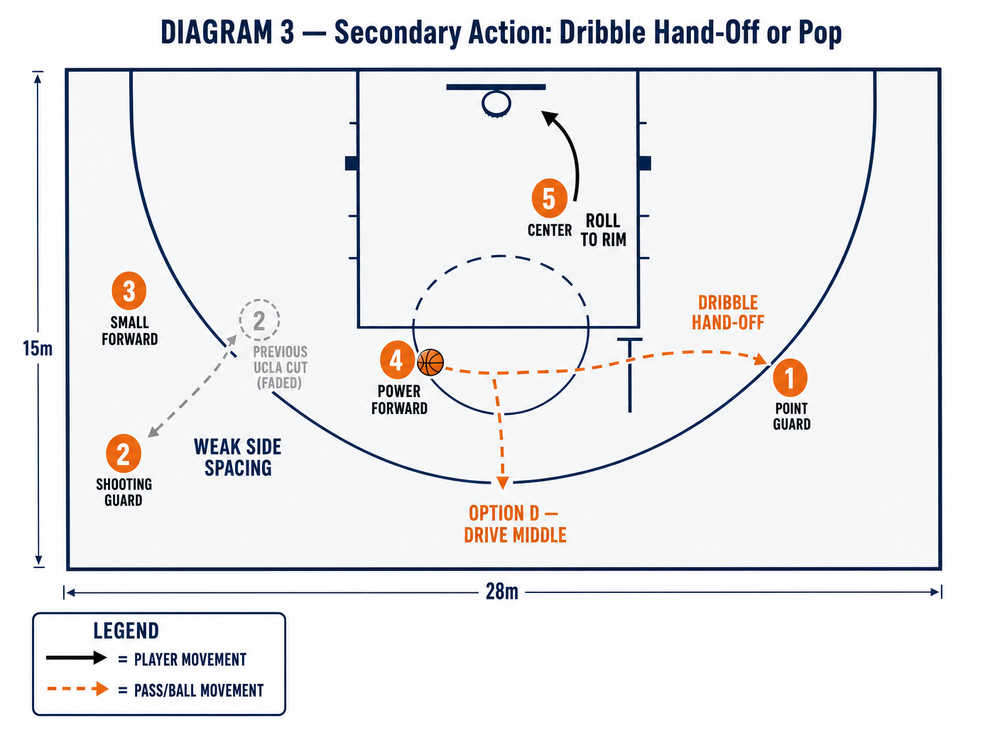
Step 5: Secondary Action (If Covered)
If the defense successfully covers Player 1's cut, Player 1 clears out to the weak side corner. Player 5, after setting the screen, can pop to the top of the key or roll to the basket. Player 4 can then initiate a dribble hand-off with Player 2 or reverse the ball to Player 5 to flow into your secondary offense.
4. Key Coaching Points
- Patience on the Screen: The cutter (Player 1) must wait for the screener (Player 5) to get fully set before making the cut. Leaving too early ruins the timing and allows the defender to slip through.
- Shoulder-to-Shoulder Cut: The cutter must brush shoulders with the screener. Any gap allows the trailing defender to squeeze through and disrupt the play.
- Target Hand: The cutter should present a clear target hand for the passer while keeping their eyes on the ball during the cut.
- Passer's Vision: Player 4 must catch, pivot, and face the rim immediately. They need to see the entire floor to make the correct read on the cut.
- Screening Angle: Player 5 must set the screen at the correct angle—perpendicular to the path the defender wants to take, forcing them to go over or under the screen.
5. Common Mistakes
- Telegraphing the Pass: Player 1 staring down Player 4 before the entry pass, allowing the defense to jump the passing lane.
- Moving Screen: Player 5 shifting their feet or leaning into the defender while setting the back screen, resulting in an offensive foul.
- Poor Spacing: Players 2 and 3 creeping in from the wings, clogging the driving lanes and bringing help defenders closer to the basket.
- Weak Cuts: Player 1 jogging through the cut instead of sprinting hard to the rim, making it easy for the defense to recover.
6. Variations & Progressions
- Dribble Entry: Instead of a pass to the high post, Player 1 can dribble at Player 2 on the wing, initiating a backdoor cut from Player 2, while Player 4 and 5 set staggered screens.
- Post Iso: If the defense switches the UCLA screen, Player 5 (often a bigger player) will have a mismatch against a smaller guard. Player 4 can immediately pass to Player 5 posting up near the basket.
- Pick and Roll: If the initial cut is covered, Player 5 can immediately step up and set an on-ball screen for Player 4, flowing directly into a high pick-and-roll action.
7. Age Adaptations
- Under 10s / Under 12s: Focus heavily on the fundamentals of passing and cutting. Remove the screen initially; just practice the entry pass and the hard backdoor cut. Introduce the screen only when they understand the timing.
- Under 14s: Introduce the back screen. Emphasize setting a legal, stationary screen and the cutter using it effectively (shoulder-to-shoulder).
- Under 16s / Open: Implement the full play with secondary reads. Teach players how to read the defense (e.g., what to do if the defense switches the screen or goes under it) and seamlessly transition into continuity offenses.
