

Cricket
Batting Partnership Rotation Play: Mastering the Art of Strike Rotation
A comprehensive guide to developing seamless strike rotation, improving communication, and building dominant batting partnerships.

What you need
2 Bats, Batting pads, Batting gloves, Helmets, Cricket balls, Stumps, Cones/Markers
1. Overview
The Batting Partnership Rotation Play is a fundamental tactical drill designed to enhance a batting pair's ability to manipulate the field and consistently rotate the strike. By focusing on soft hands, precise placement, and decisive calling, batsmen can relieve pressure and disrupt the bowler's rhythm. This set play is crucial for building long, match-winning partnerships in all formats of the game.
2. Setup

Equipment Needed:
- 2 Bats
- Full protective batting gear for two players (pads, gloves, helmet, box)
- 1 Cricket ball (or a bucket of balls for continuous drills)
- Stumps at both ends of a standard 22-yard pitch
- Cones or markers to designate specific fielding zones
Pitch/Field Setup:
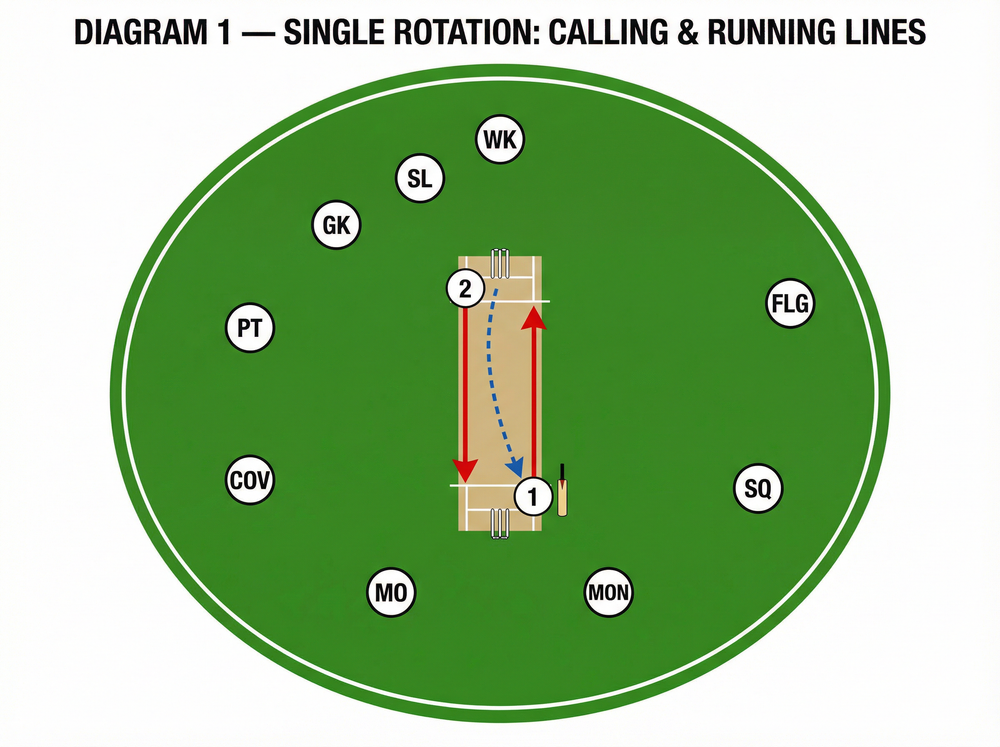
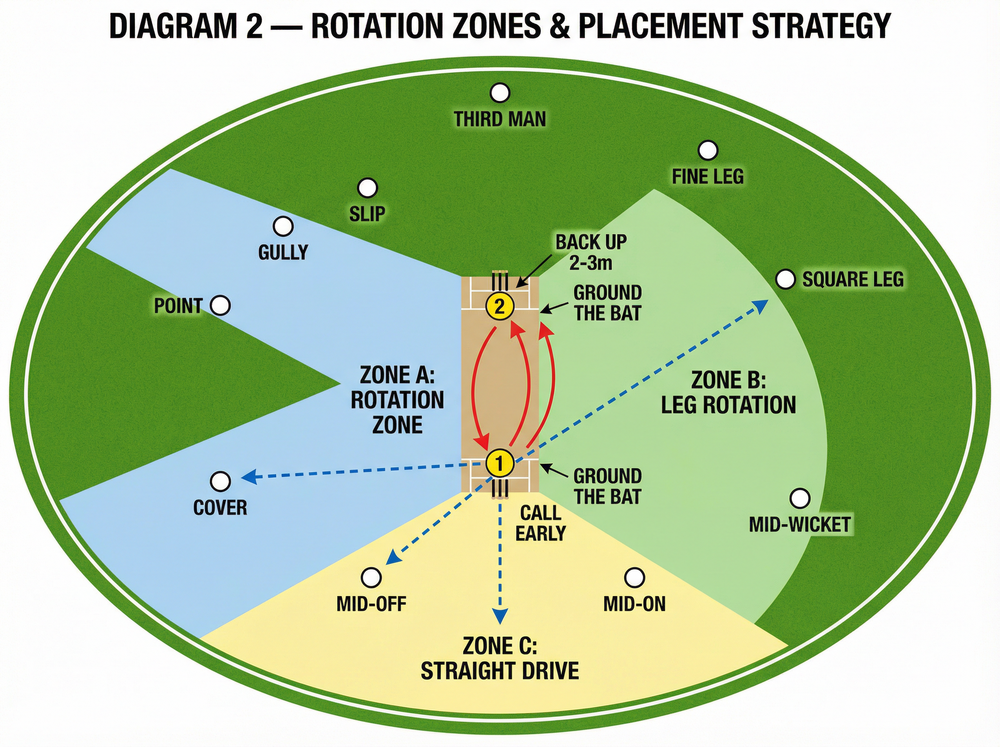
Set up a standard 22-yard pitch on the oval. Place cones to mark out key rotation zones: Zone A (off side, between cover and mid-off), Zone B (leg side, between mid-on and square leg), and Zone C (straight down the ground). Position fielders (or use more cones) at standard inner-ring positions: Point, Cover, Mid-off, Mid-on, Mid-wicket, and Square Leg.
Player Positions:
- Batsman 1 (Striker) at the batting crease.
- Batsman 2 (Non-striker) backing up at the bowler's end.
- Bowler (or coach with a sidearm/throwdown tool) operating from the non-striker's end.
- Optional: Fielders stationed in the designated zones to apply match pressure.
3. Step-by-Step Instructions


- The Setup: The bowler delivers the ball. The striker must assess the line and length early, deciding whether to defend, attack, or look for a quick single.
- The Execution: The striker plays the ball with soft hands, aiming to drop it into one of the designated rotation zones (Zone A, B, or C) where there is a gap or a deep fielder.
- The Call: As soon as the ball is struck, the striker makes a loud, decisive call ('Yes', 'No', or 'Wait').
- The Back-up: The non-striker must anticipate the shot, backing up 2-3 meters down the pitch as the bowler delivers, ready to sprint upon hearing the 'Yes' call.
- The Run: Both batsmen sprint aggressively between the wickets, running in straight lines to minimize distance. They must communicate midway if the situation changes.
- The Turn: Upon reaching the crease, both batsmen must ground their bats by sliding them across the line, ready to turn for a second run if the opportunity arises.
4. Key Coaching Points
- Soft Hands: Emphasize playing the ball with soft hands to drop it dead in the inner ring, allowing time for a quick single.
- Decisive Calling: The call must be loud, clear, and immediate. The striker calls for shots in front of square; the non-striker calls for shots behind square.
- Aggressive Backing Up: The non-striker should be walking in with the bowler and be 2-3 meters down the pitch when the ball is hit, ready to explode into a sprint.
- Running Lines: Batsmen must run straight down the pitch, avoiding the protected area, to ensure the shortest possible distance between wickets.
- Grounding the Bat: Always slide the bat across the crease to avoid run-outs and prepare for a quick turn.

5. Common Mistakes
- Hesitation: Waiting to see where the ball goes before calling or running, leading to missed opportunities or run-outs.
- Poor Calling: Quiet, late, or ambiguous calls ('Maybe', 'Let's see') that confuse the partner.
- Lack of Back-up: The non-striker remaining rooted to the crease, losing valuable time and momentum.
- Running on the Pitch: Running down the center of the pitch, which can damage the surface and lead to penalty runs.
6. Variations & Progressions
- Pressure Cooker: Introduce active fielders in the rotation zones. The batsmen must successfully rotate the strike 5 times in an over without getting run out.
- Target Zones: Award points for dropping the ball into specific, narrow zones marked by cones, encouraging precise placement.
- Fatigue Factor: Run the drill at the end of a session when players are tired, simulating the physical and mental demands of the final overs of a match.
7. Age Adaptations
- Under 10s: Focus heavily on the basics of loud calling ('Yes', 'No') and running straight. Use softer balls and shorter pitch lengths if necessary.
- Under 14s: Introduce the concept of backing up and sliding the bat. Start adding stationary fielders to create spatial awareness.
- Open/Senior: Implement full match-scenario pressure with active fielders, demanding precise placement and explosive running.
