

Cricket
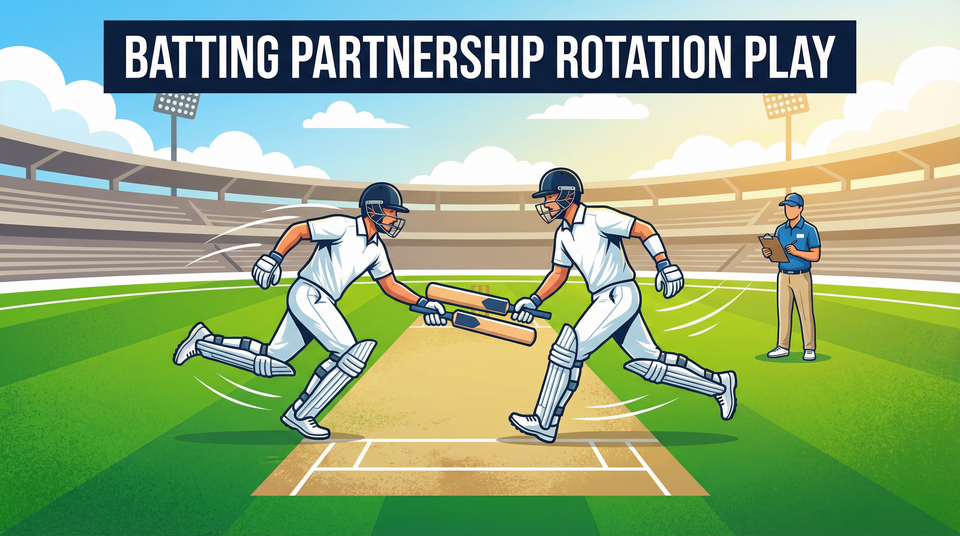
Batting Partnership Rotation Play: Mastering Strike Rotation and Communication
A comprehensive guide to developing a reliable strike rotation system that keeps the scoreboard moving and frustrates opposition bowlers.
What you need
Cricket ball, 2 Bats, Full batting protective gear, Wicket stumps, Cones or markers
1. Overview
The Batting Partnership Rotation Play is a foundational tactical system designed to ensure constant scoreboard pressure by rotating the strike efficiently. This set play focuses on communication, awareness of fielding gaps, and proactive running between the wickets. When executed correctly, it prevents bowlers from settling into a rhythm against one batter, disrupts fielding plans, and builds substantial partnerships without relying solely on boundary hitting. It is especially crucial in limited-overs formats but remains highly relevant in longer formats for maintaining momentum.
2. Setup
Equipment Needed:
- 1 Cricket ball (or appropriate training ball)
- 2 Bats
- Full batting protective gear (pads, gloves, helmet, box) for both batters
- Wicket stumps at both ends of a standard 22-yard pitch
- Cones or markers to designate fielding zones (optional for drills)
Pitch/Field Setup:
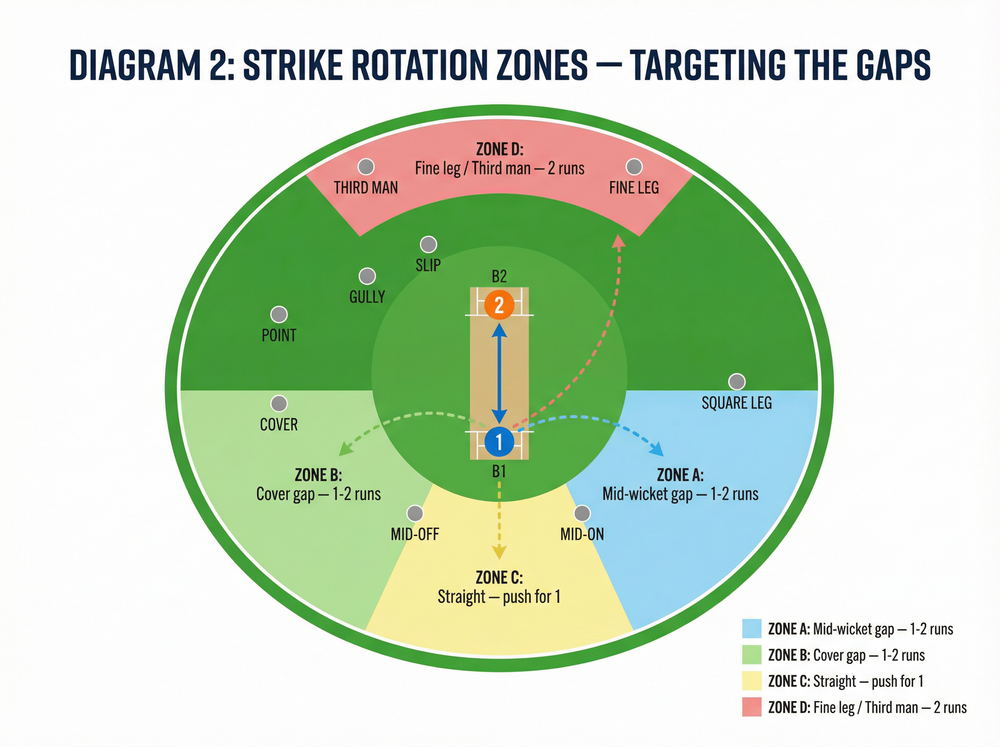
Set up on a standard 22-yard cricket pitch. For training purposes, you can use a center wicket or a net session with designated scoring zones. Place markers to simulate key fielding positions if full fielders are not available: Mid-On, Mid-Off, Cover, Point, Square Leg, Fine Leg, and Third Man.
Player Positions:
- Batsman 1 (Striker): Positioned at the batting crease, ready to face the delivery.
- Batsman 2 (Non-Striker): Positioned at the bowling crease, backing up as the bowler delivers.
- Bowler: Delivering the ball from the opposite end.
- Fielders: Deployed in standard positions based on the match scenario or drill setup.
3. Step-by-Step Instructions

Phase 1: Pre-Delivery Assessment
- Scan the Field: Before the bowler begins their run-up, both the Striker and Non-Striker must scan the field to identify gaps, particularly in the inner ring (e.g., between Cover and Point, or Mid-On and Mid-Wicket).
- Acknowledge the Plan: A brief nod or verbal cue between partners confirms the intent to look for a quick single if the ball is played into a specific gap.
Phase 2: The Delivery and Execution
- Play the Ball with Soft Hands: The Striker aims to play the ball into a pre-identified gap with "soft hands," dropping the ball into a safe zone rather than hitting it hard to a fielder.
- Immediate Call: As soon as the ball is struck, the player with the best view of the ball's trajectory (usually the Striker for shots in front of the wicket, and the Non-Striker for shots behind the wicket) must make a loud, clear call: "YES," "NO," or "WAIT."
Phase 3: The Run
- Explosive Start: Upon hearing "YES," both batters push off explosively. The Non-Striker should already be "backing up" (moving slightly down the pitch as the ball is delivered) to gain a head start.
- Run the First Run Hard: Both batters must sprint the first run at maximum effort, regardless of whether they think a second run is possible. This puts pressure on the fielders.
Phase 4: Turning and Assessment
- Turn Blind: When completing the first run, turn "blind" (facing the side of the field where the ball was hit) to keep an eye on the ball and the fielder.
- Communicate for the Second: As they turn, the batters must communicate again. A call of "TWO" indicates intent for a second run, while "NO" or "EASY" means stay for one.
- Slide the Bat: Always slide the bat across the crease line to ensure safety and save crucial fractions of a second.

4. Key Coaching Points
- Loud and Clear Calling: Hesitation is the enemy of strike rotation. Calls must be immediate, loud, and decisive. Use only "YES," "NO," or "WAIT."
- Backing Up: The Non-Striker must leave their crease as the bowler releases the ball, gaining a 1-2 yard advantage. However, they must watch the bowler's hand to avoid being run out (Mankad).
- Running the First Run Hard: Always sprint the first run. A lazy first run often turns a comfortable two into a risky single.
- Soft Hands: Teach batters to loosen their grip slightly when defending or pushing into gaps. This ensures the ball dies quickly, preventing it from reaching the fielder too fast.
- Turning Technique: Batters must learn to turn efficiently, keeping their center of gravity low and pushing off powerfully for the next run.
5. Common Mistakes
- Ball Watching: Batters getting mesmerized by the shot and forgetting to run or call immediately.
- Ambiguous Calling: Using phrases like "maybe" or "let's see," which lead to confusion and run-outs.
- Poor Backing Up: The Non-Striker remaining anchored in their crease until the ball is hit, losing valuable time.
- Running on the Pitch: Running down the center of the pitch (the "danger area"), which can damage the surface and lead to penalties.
6. Variations & Progressions
- Target Zones: Place cones in specific gaps (e.g., Cover and Mid-Wicket). Award double points for singles scored by hitting the ball through these designated zones.
- Pressure Scenarios: Set a target (e.g., 20 runs from 4 overs) where boundaries are not allowed. The batters must achieve the target solely through strike rotation.
- Handicap Running: To increase physical conditioning and urgency, require batters to run an extra 2 meters past the crease before turning for a second run during drills.
7. Age Adaptations
- Under 10s: Focus primarily on loud calling ("YES" and "NO") and sliding the bat. Keep drills simple and fun.
- Under 12s - Under 14s: Introduce the concept of backing up and "soft hands." Start incorporating target zones for strike rotation.
- Under 16s and Open: Emphasize advanced concepts like turning blind, assessing fielder arm strength, and manipulating the field to create specific gaps.
