

Basketball
BLOB - Box Set: Baseline Inbounds Lob & High-Low
A highly effective Baseline Out of Bounds (BLOB) play using a box formation to create immediate scoring opportunities at the rim or high-post entry options.

What you need
1 Basketball, Standard Hoop, Half Court
1. Overview
The BLOB - Box Set is a staple Baseline Out of Bounds play designed to create immediate, high-percentage scoring opportunities directly under the basket. Utilizing a classic "box" formation, this set forces the defense to navigate a series of screens in tight quarters. It is particularly effective against man-to-man defenses that attempt to aggressively deny the inbound pass. By setting a hard back screen for your best finisher or shooter, you can generate a quick lob or a clean look at the rim. If the primary option is covered, the play flows seamlessly into a high-low entry, ensuring you maintain offensive pressure and secure possession.
2. Setup

Court Dimensions: Standard FIBA Court (28m x 15m).
Equipment: 1 Basketball, standard hoop.
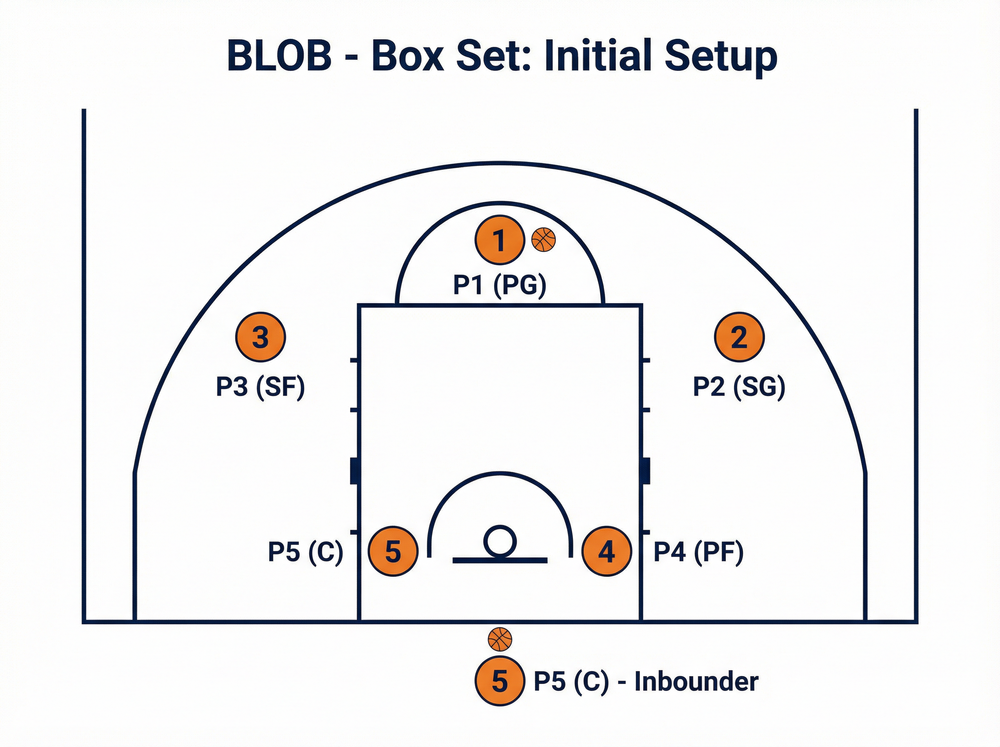
Player Positions (The Box Formation):
- Player 5 (Center): The inbounder, positioned out of bounds on the baseline, typically just outside the lane line.
- Player 4 (Power Forward): Positioned on the strong-side low block (same side as the inbounder).
- Player 2 (Shooting Guard): Positioned on the strong-side elbow (high post).
- Player 3 (Small Forward): Positioned on the weak-side elbow.
- Player 1 (Point Guard): Positioned at the top of the key, acting as the safety valve.
3. Step-by-Step Instructions
Step 1: The Initiation
The play begins when the inbounder (Player 5) slaps the basketball. This is the visual and auditory cue for all players to begin their synchronized movements.
Step 2: The Back Screen
Immediately upon the cue, Player 4 (on the strong-side block) steps up to set a hard, physical back screen on the defender guarding Player 2 (at the strong-side elbow). The angle of the screen should point directly toward the basket.
Step 3: The Primary Cut (Option A)
Player 2 reads the screen and cuts hard to the basket, looking for the lob or a direct bounce pass from Player 5. Player 2 must run their defender into Player 4's screen to create separation.
Step 4: The High Post Pop (Option B)
Simultaneously, Player 3 (at the weak-side elbow) flashes hard to the middle of the free-throw line or strong-side elbow area. If the pass to Player 2 is covered, Player 5 passes to Player 3.
Step 5: The Safety Valve & High-Low Action
Player 1 remains at the top of the key as a safety outlet. If Player 3 receives the ball, Player 4 (after setting the screen) seals their defender and looks for a high-low pass from Player 3. If nothing is open, Player 3 reverses the ball to Player 1 to set up the half-court offense.

4. Key Coaching Points

- Screening Angle: Player 4 must set the screen at the correct angle. If the screen is too flat, the defender will easily slip under it. The screener's back should be facing the baseline where they want the cutter to go.
- Patience by the Cutter: Player 2 must wait for the screen to be fully set before making their cut. Leaving too early results in an offensive foul or a blown play.
- Inbounder Vision: Player 5 must not stare down the primary option. They should look at the safety or the high post first to manipulate the defense before throwing the lob to Player 2.
- Spacing: Maintain strict spacing. If players drift out of the box formation before the play starts, the timing and angles of the screens will be compromised.
5. Common Mistakes

- Weak Screens: Player 4 slipping the screen too early instead of making solid contact, allowing the defender to recover and contest the pass to Player 2.
- Telegraphing the Pass: The inbounder (Player 5) staring directly at Player 2 the entire time, allowing the defense to anticipate and intercept the pass.
- Poor Timing: The cutter (Player 2) moving before the screen is set, or the inbounder passing the ball before the cutter has cleared the screen.
6. Variations & Progressions

- Screen the Screener: After Player 4 sets the back screen for Player 2, Player 3 can set a down screen for Player 4, who then pops out for a mid-range jump shot.
- The Elevator Doors: Instead of a single back screen, Player 4 and Player 5 (if another player is inbounding) can set double screens (elevator doors) for a shooter cutting from the baseline to the top of the key.
7. Age Adaptations

- Under 10 / Under 12: Focus heavily on the fundamentals of setting a legal screen and making a crisp, two-handed chest or bounce pass. Remove the lob option and focus on a standard pass to the block.
- Under 14 / Under 16: Introduce the "read and react" elements. Teach the cutter how to read the defender (e.g., if the defender goes under the screen, pop out for a shot; if they trail, cut hard to the rim).
- Open / Advanced: Incorporate complex counters, such as the "Screen the Screener" variation, and demand perfect timing and physical screening.
