

Cricket
The Boundary Relay & Precision Throwing Drill
Master the art of the boundary relay with this high-intensity drill designed to improve throwing accuracy, quick release, and seamless teamwork from the deep to the stumps.
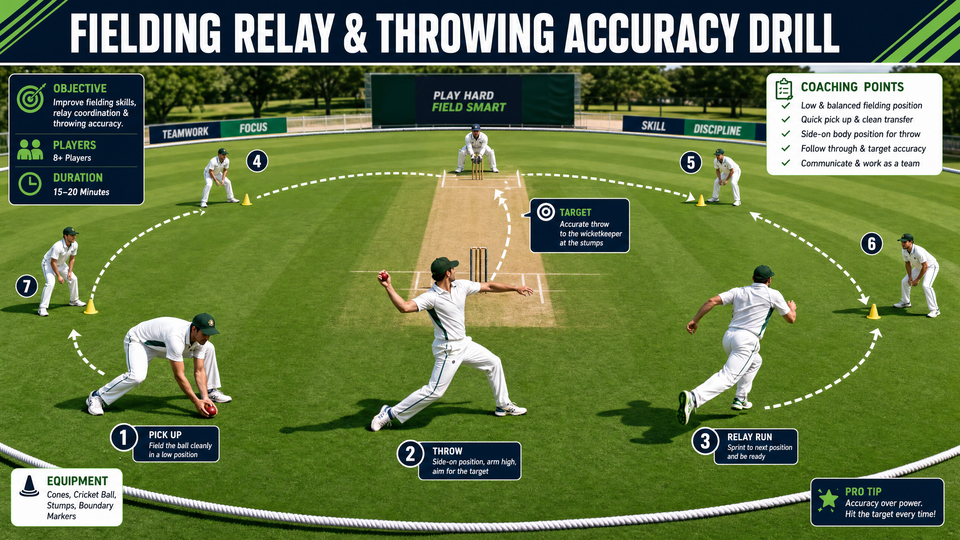
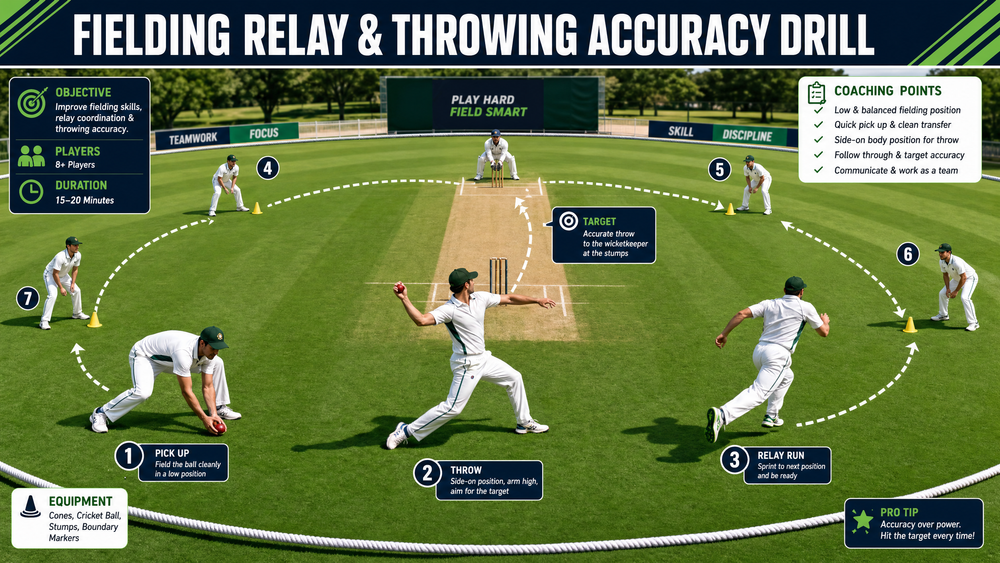
What you need
10-15 Cricket balls, 6-8 Marker cones, 2 sets of stumps, Wicketkeeping gloves
Overview
In modern cricket, saving runs on the boundary and executing run-outs from the deep are game-changing skills. The Boundary Relay & Precision Throwing Drill is designed to replicate high-pressure match scenarios where a fielder must chase a ball to the boundary, turn, and hit a relay fielder, who then fires an accurate throw to the wicketkeeper.
This drill focuses on the entire chain of events: the explosive sprint, the low pick-up, the fast and accurate transfer to the relay man, and the final precision throw to the stumps. It is an essential conditioning and skill-building exercise that fosters communication and teamwork.
Setup
Pitch & Field Dimensions: Standard cricket oval with a 22-yard pitch in the centre. The boundary rope should be set at approximately 60-70 metres from the pitch.
Equipment Needed:
- 10-15 Cricket balls (or incrediballs for younger age groups)
- 6-8 Marker cones (preferably yellow or bright orange)
- 2 sets of stumps (one at each end of the pitch)
- Wicketkeeping gloves (optional but recommended for the receiver)
Player Positions:
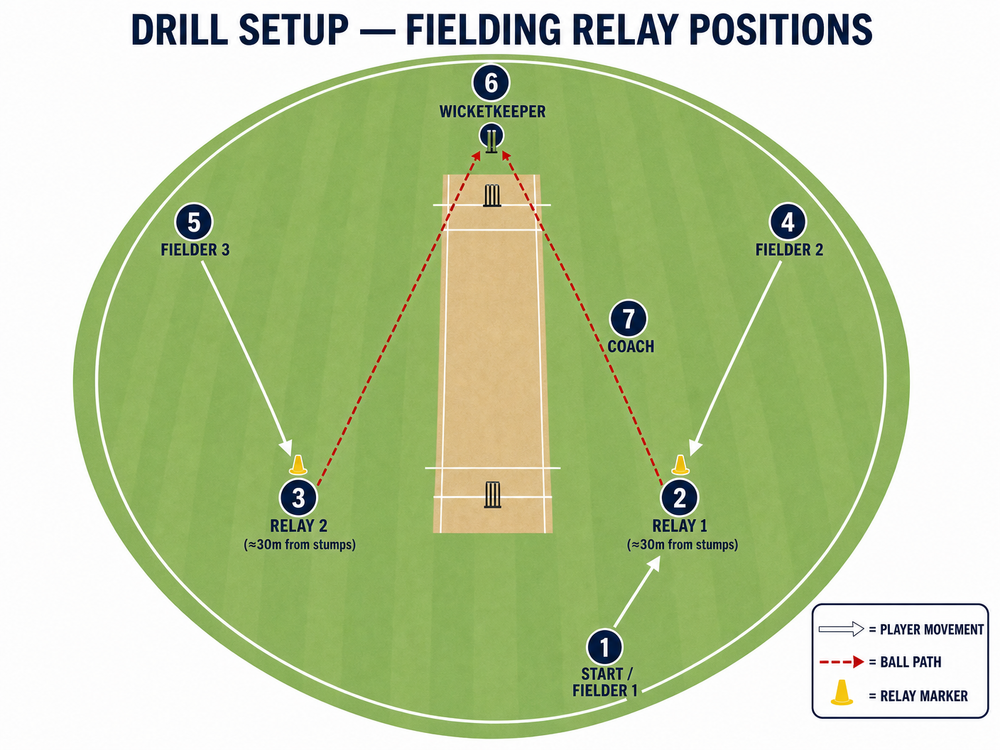
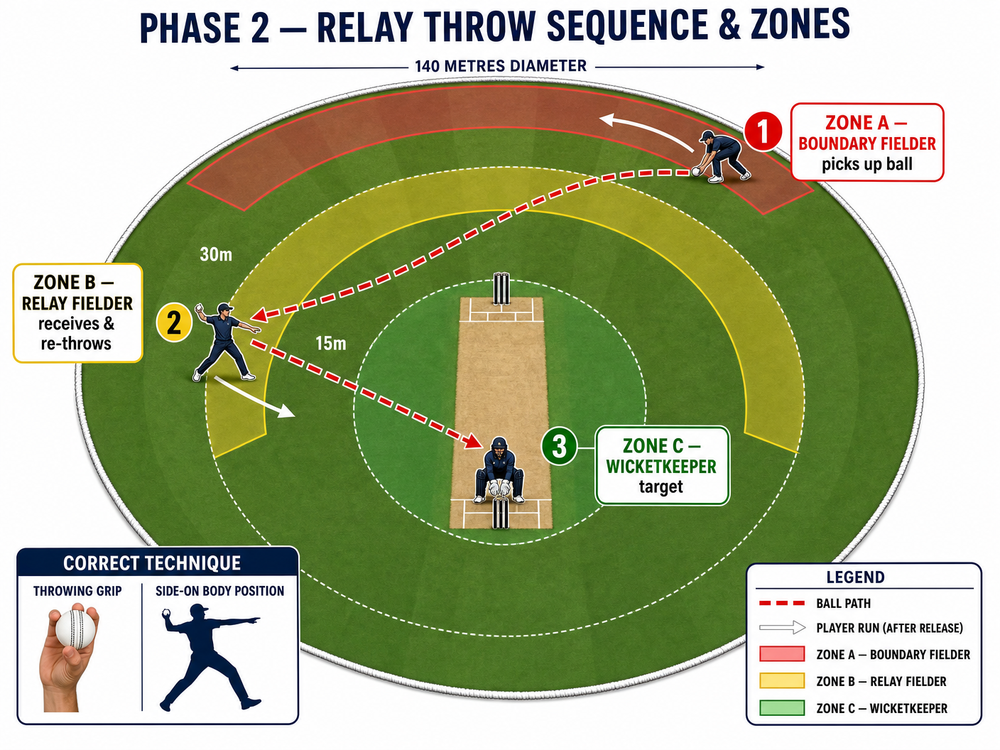
Set up the drill as shown in the diagram below.
- Start / Fielder 1: Positioned near the boundary at deep fine leg or deep square leg.
- Relay 1 & Relay 2: Positioned on the 30-metre circle at mid-on and mid-off.
- Fielder 2 & Fielder 3: Positioned on the boundary at deep cover and deep point.
- Wicketkeeper: Positioned behind the stumps at the striker's end.
- Coach: Standing near the pitch to feed the ball or observe the drill.
Step-by-Step Instructions
- The Feed: The coach hits or rolls a ball out towards the boundary (Zone A) for Fielder 1 to chase.
- The Pick-up: Fielder 1 sprints to the ball, adopting a low, balanced position to cleanly pick it up on the run.
- The First Throw: Fielder 1 immediately turns and throws the ball flat and hard to Relay 1, who has moved into position on the 30-metre circle (Zone B).
- The Relay Transfer: Relay 1 catches the ball, quickly sets their feet into a strong side-on position, and throws the ball directly to the wicketkeeper over the stumps (Zone C).
- The Rotation: After throwing, Fielder 1 sprints to take the position of Relay 1. Relay 1 sprints to join the back of the queue at the wicketkeeper position. The wicketkeeper rolls the ball back to the coach and rotates out to the boundary position.
Key Coaching Points
- Attack the Ball: The boundary fielder must sprint at full speed to attack the ball, rather than waiting for it to come to them.
- Low and Balanced Pick-up: Ensure players get low, bending at the knees rather than the waist, with their head over the ball during the pick-up.
- Quick Release: The transfer from fielding to throwing must be seamless. The boundary fielder should aim for the chest of the relay fielder.
- Side-on Throwing Stance: The relay fielder must quickly align their body side-on to the target (the stumps), pointing their non-throwing arm directly at the wicketkeeper.
- Follow Through: Both throwers must follow through towards their target after releasing the ball to generate maximum power and accuracy.
- Vocal Communication: The relay fielder must call loudly and clearly (e.g., "Keeper's end!" or "Bowler's end!") to guide the boundary fielder's throw.
Common Mistakes
- Throwing on the Turn: Boundary fielders often try to throw before fully turning their body, leading to wild, inaccurate throws.
- Relay Fielder Static: The relay fielder stands flat-footed instead of moving towards the ball to shorten the distance and build momentum for the final throw.
- Looping Throws: Players looping the ball high in the air rather than throwing it flat and hard, giving the batters time to complete the run.
- Poor Target Alignment: The relay fielder failing to align their front shoulder with the stumps, resulting in throws that miss the target wide.
Variations & Progressions
To keep the drill engaging and challenging, introduce these variations once the basic mechanics are mastered.
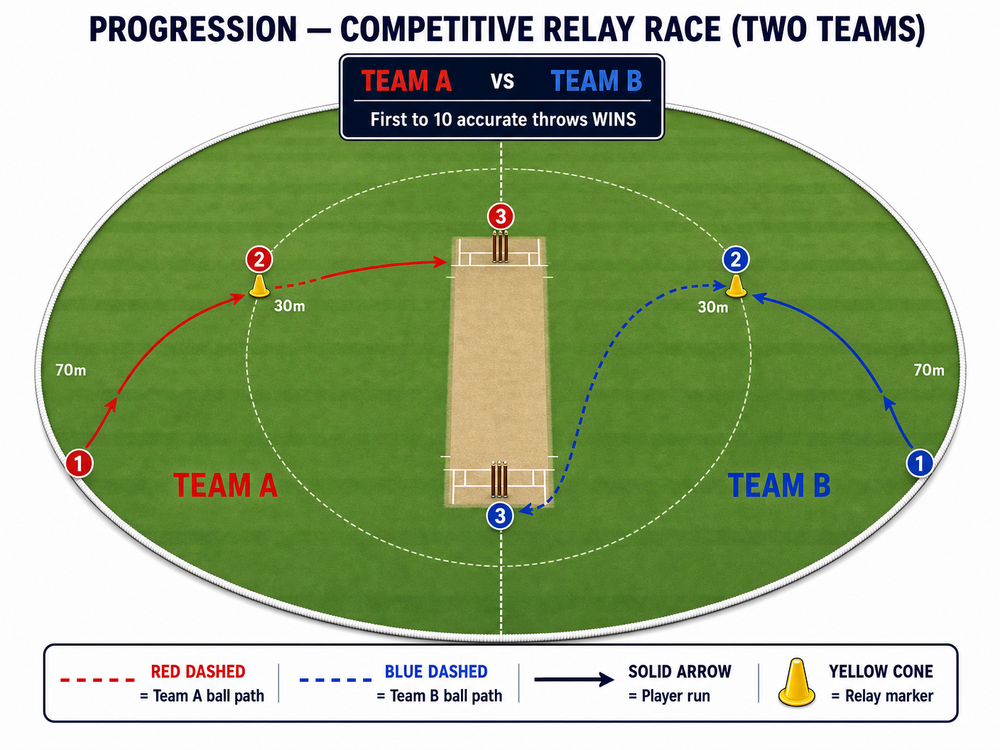
Progression 1: The Competitive Relay Race
Split the squad into two teams (Team A and Team B) and set up two identical relay stations on opposite sides of the field.
The coach feeds a ball to both boundary fielders simultaneously. The first team to successfully complete the relay and hit the stumps (or have the wicketkeeper take the ball cleanly over the stumps) wins a point. First to 10 points wins the drill.
Progression 2: The Moving Target
Instead of the wicketkeeper remaining static behind the stumps, have them move laterally to simulate a poor throw. The relay fielder must adjust their throw to hit the moving target.
Age Adaptations
- Under 8s - Under 10s: Use softer balls (incrediballs or tennis balls). Reduce the distances significantly (e.g., boundary at 30m, relay at 15m). Focus entirely on the mechanics of picking up the ball and throwing it to a teammate, rather than speed.
- Under 12s - Under 14s: Introduce the full 22-yard pitch and standard cricket balls. Emphasize the side-on throwing technique and the importance of calling. Keep the boundary distance manageable (40-50m).
- Under 16s - Open: Full match-simulation distances (60-70m boundary). Introduce high-pressure competitive elements and time limits. Expect flat, hard throws directly over the stumps.
