

Rugby
Crash Ball Play with Decoy Runners: Breaking the Gainline
Learn how to effectively deploy a crash ball set play with decoy runners to break the gainline and create quick front-foot ball.
What you need
4-6 Rugby balls, 10-12 Cones, Bibs, Tackle shields
1. Overview
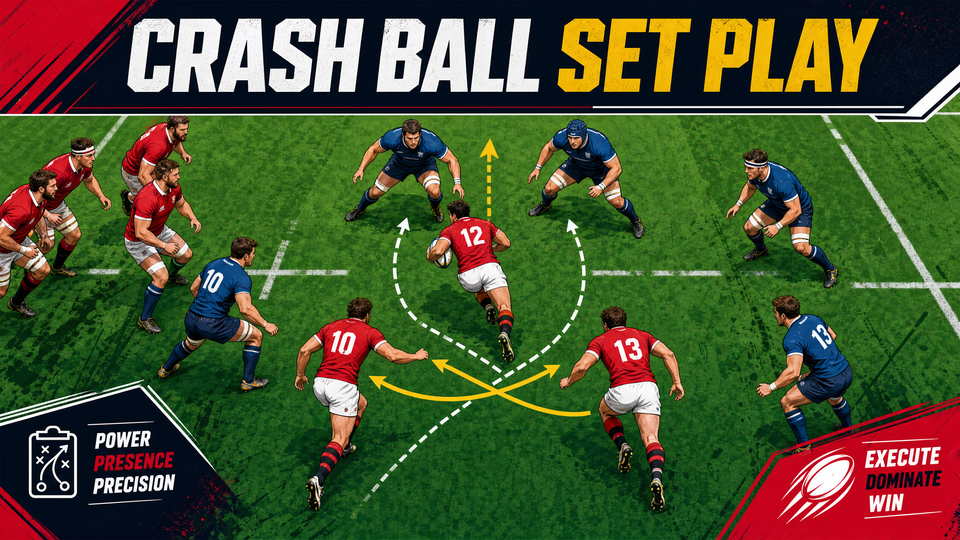
The crash ball set play is a fundamental attacking weapon in modern rugby. Its primary objective is to break the gainline, commit multiple defenders, and generate quick, front-foot ball for subsequent phases. By incorporating decoy runners, this play forces the defensive line to hesitate, creating a momentary gap or a weak shoulder for the primary ball carrier to exploit.
This set play is particularly effective when executed off stable first-phase possession, such as a scrum or lineout, or from a structured ruck in the middle of the pitch. The use of a hard-running inside centre (12) as the crash ball carrier, supported by the fly-half (10) and outside centre (13) acting as decoys, disrupts the defensive drift and isolates individual tacklers.
2. Setup
To run this play effectively in a training environment, you will need a standard pitch setup (100m x 70m) or a designated attacking zone of at least 40m x 40m.
Equipment Needed:
- 4-6 Rugby balls
- 10-12 Cones to mark the ruck, defensive line, and starting positions
- Bibs for the defensive players (optional but recommended)
- Tackle shields (for early progressions)
Player Positions:
- 9 (Scrum-half): Positioned at the base of the ruck or scrum.
- 10 (Fly-half): Positioned approximately 5m deep and slightly wider than normal to draw the defense.
- 12 (Inside Centre): Positioned 3m inside the fly-half, ready to run a hard, straight line.
- 13 (Outside Centre): Positioned wide right, preparing to run a wide decoy line.
- Support Players (e.g., 6, 8): Positioned to arrive quickly at the ensuing breakdown.
3. Step-by-Step Instructions
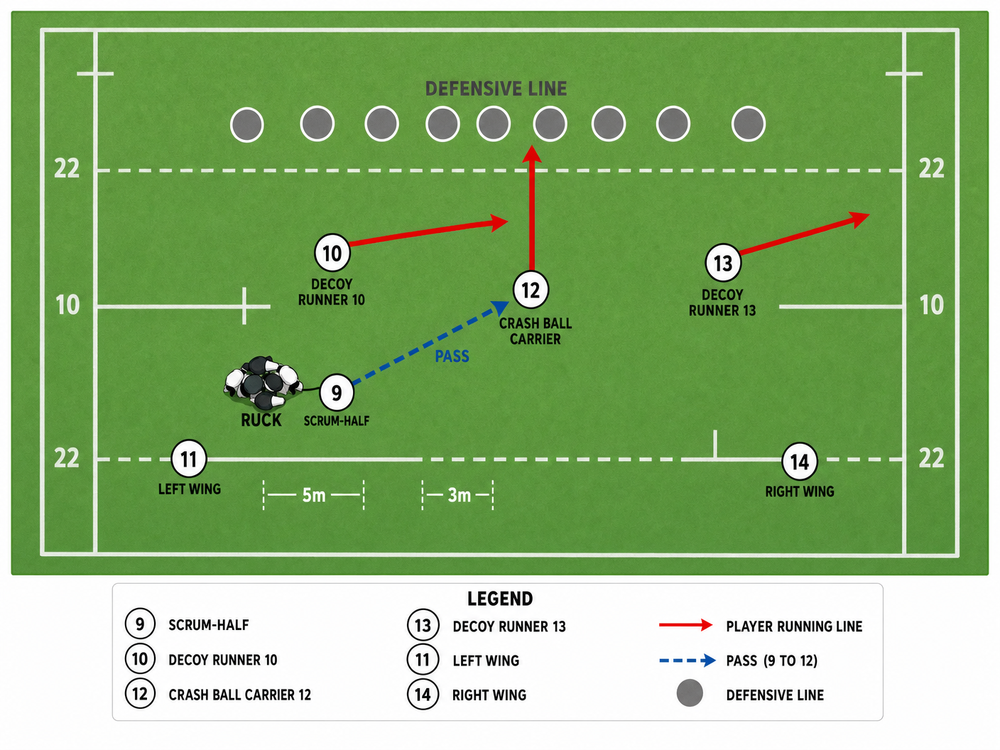
- The Setup: The 9 secures the ball at the base of the ruck. The attacking line must be deep enough to allow players to hit the line at pace.
- The Decoy Runs: As the 9 prepares to pass, the 10 and 13 initiate their runs. The 10 runs a hard, flat line towards the inside shoulder of the opposing fly-half, while the 13 runs a wide, sweeping line to hold the outside defenders.
- The Pass: The 9 delivers a crisp, flat pass directly to the 12, bypassing the 10.
- The Crash: The 12 accelerates onto the ball, aiming for the gap created between the defending 10 and 12, or targeting a weak shoulder. The 12 must maintain a strong body position, leading with the shoulder and protecting the ball.
- The Contact: Upon contact, the 12 drives the legs, fighting through the tackle to break the gainline. If tackled, the 12 presents the ball cleanly.
- The Support: The designated support players (e.g., 6 and 8) must track the 12 closely. The first arriving player clears the threat, and the second secures the ball, ensuring a lightning-fast recycle.
4. Key Coaching Points
- Timing is Everything: The decoy runners must sell their runs convincingly. If they run too early, the defense will adjust; if too late, they won't draw the defenders. The 12 must hit the ball at maximum pace.
- Depth and Alignment: Attackers must start deep enough to accelerate onto the ball. A flat alignment reduces the impact of the crash ball and increases the risk of an interception.
- Body Height in Contact: The 12 must lower their body height before contact, driving through the tackle with powerful leg drive. Upright running will result in being driven backward.
- Aggressive Support: The support players must anticipate the point of contact and arrive simultaneously with the ball carrier going to ground. Delayed support will result in a turnover.
- Communication: Clear, concise calls from the 10 or 12 are essential to initiate the play and ensure everyone is on the same page.
5. Common Mistakes
- Unconvincing Decoys: Decoy runners who jog or fail to call for the ball will not hold the defense. They must run as if they are the primary option.
- Passing Behind the Runner: The 9's pass must be out in front of the 12, allowing them to run onto it without breaking stride. A pass behind the runner kills the momentum.
- Poor Ball Presentation: If the 12 fails to fight to the ground and present the ball cleanly, the quick ball is lost, and the play's objective is defeated.
- Isolation: If the 12 runs too far ahead of the support, they risk being isolated and turned over. Support runners must work tirelessly to stay connected.
6. Variations & Progressions
Once the core play is mastered, you can introduce variations to keep the defense guessing:
- Progression 1: Live Defense. Replace tackle shields with live, full-contact defense to test the play under pressure.
- Variation A: The Pull-Back Pass. The 12 shapes to take the crash ball but instead pulls the pass back to a deeper-lying player (e.g., the 15) who attacks the wider channels.
- Variation B: The Inside Pop. The 10 receives the ball and pops it inside to a hard-running forward (e.g., a prop or lock) coming off their shoulder.
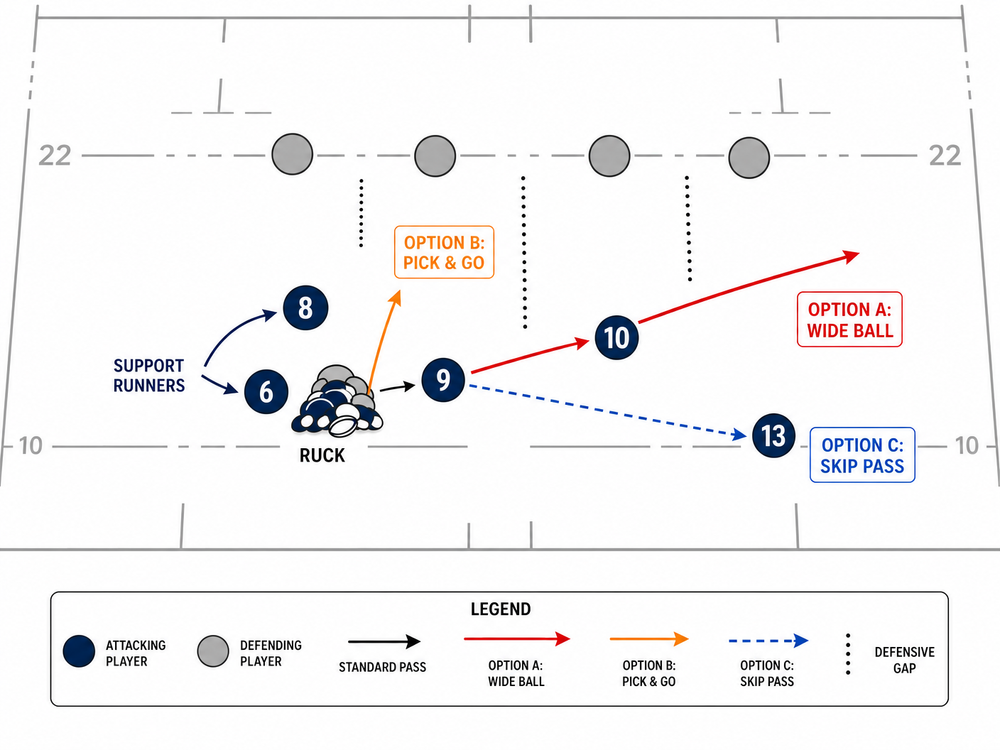
- Variation C: Second Phase Options. As shown in Diagram 2, after the initial crash, the 9 has multiple options: a wide ball to the 10 (Option A), a pick-and-go by the 8 (Option B), or a skip pass to the 13 (Option C).
7. Age Adaptations
- Under 8 - Under 10: Focus on the basic pass and catch. Introduce the concept of running straight and hard. Avoid complex decoy runs; keep it to simple support lines.
- Under 12 - Under 14: Introduce one decoy runner. Focus heavily on body height in contact and safe, effective ball presentation. Begin teaching support players their specific roles at the breakdown.
- Under 16 - Open: Implement the full play with multiple decoys and variations. Emphasize timing, reading the defense, and explosive acceleration. Demand lightning-fast ruck speed.
