

Cricket
Elite Fielding: The Boundary Relay and Throwing Accuracy Drill
Master the art of the boundary relay and pinpoint throwing accuracy to create run-out opportunities from the deep.
What you need
10-15 standard leather cricket balls, Marker cones, Set of stumps, Fielding gloves
1. Overview
The boundary relay is a critical skill in modern cricket, allowing fielding teams to return the ball from the deep with maximum speed and accuracy. This drill, the Boundary Relay and Throwing Accuracy Drill, is designed to simulate high-pressure match scenarios where a single run can alter the course of the game. It focuses on the seamless transition of the ball from the boundary fielder to the relay man, and finally to the wicket-keeper or bowler. By incorporating targeted throwing zones, this drill not only improves arm strength and release speed but also ingrains the spatial awareness required for direct hits and effective run-outs. Use this drill during the core conditioning phase of your training session to elevate your team's fielding standards.
2. Setup
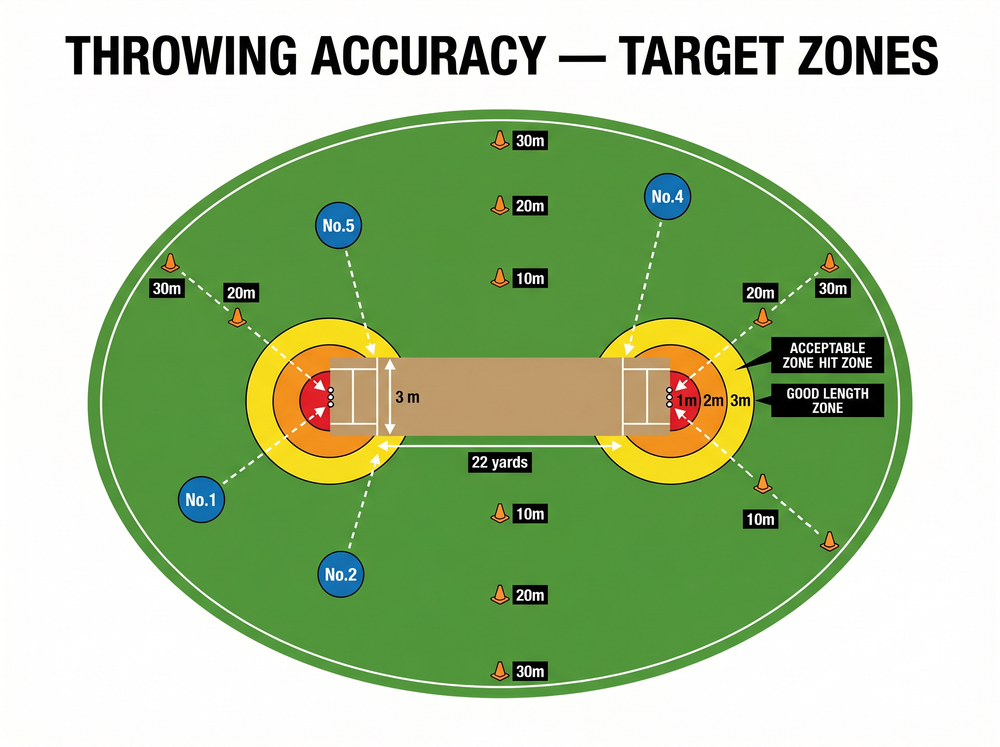
Proper setup is essential to replicate match conditions and ensure player safety. You will need a standard cricket oval with a clearly marked 22-yard pitch.
Equipment Needed:
- 10-15 standard leather cricket balls (or incrediballs for younger age groups)
- Marker cones (different colors for different zones)
- A set of stumps at both ends of the pitch
- Fielding gloves (optional for the relay fielder, mandatory for the wicket-keeper)
Pitch and Field Setup:
Set up the drill on a standard cricket oval. Place the stumps at both ends of the 22-yard pitch. Use marker cones to designate the throwing accuracy zones around the stumps: a 1-meter radius inner ring (Direct Hit Zone), a 2-meter radius middle ring (Good Length Zone), and a 3-meter radius outer ring (Acceptable Zone).
Player Positions:
Position your players to simulate a typical boundary relay scenario:
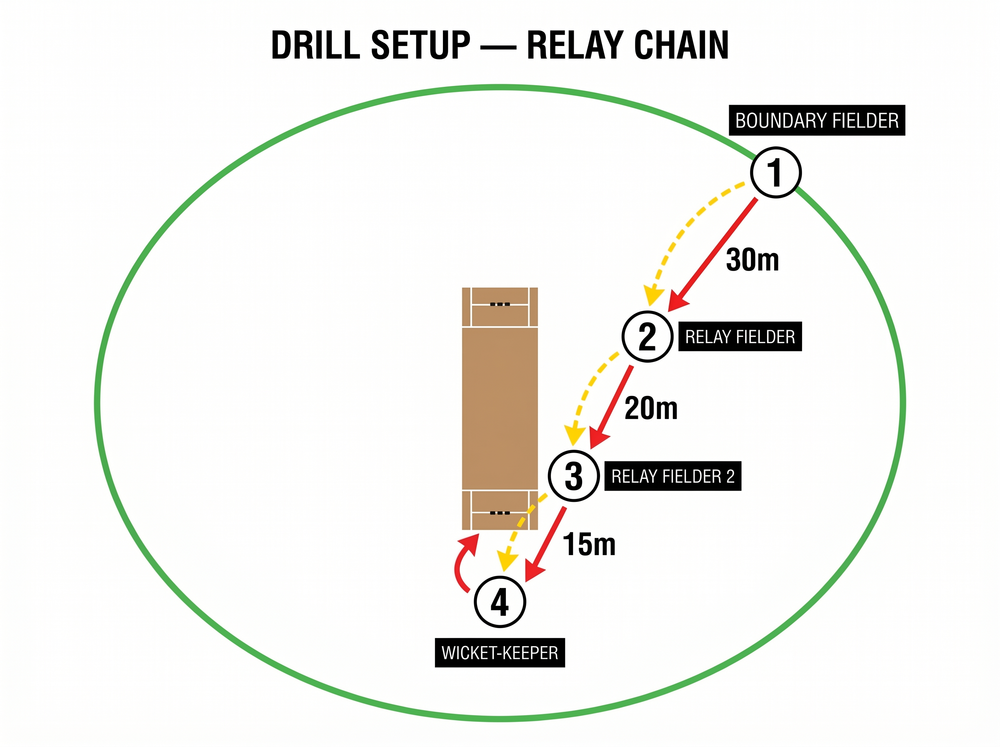
- Player 1 (Boundary Fielder): Positioned at the deep mid-wicket boundary, approximately 60-70 meters from the stumps.
- Player 2 (Relay Fielder 1): Positioned at mid-on, approximately 30 meters from the boundary fielder.
- Player 3 (Relay Fielder 2): Positioned at mid-pitch, approximately 20 meters from Relay Fielder 1.
- Player 4 (Wicket-Keeper): Positioned directly behind the stumps at the striker's end.

3. Step-by-Step Instructions
Follow these steps to execute the drill effectively. Ensure all players are warm and ready before beginning high-intensity throwing.
- Initiate the Drill: The coach hits or throws a ball firmly toward the deep mid-wicket boundary. Player 1 (Boundary Fielder) sprints to attack the ball, focusing on a clean pick-up.
- The First Throw: Upon gathering the ball, Player 1 immediately sets their base and executes a flat, hard throw to Player 2 (Relay Fielder 1). The throw should be aimed at the relay fielder's chest for a quick transition.
- The Relay Catch and Turn: Player 2 receives the ball, ideally catching it on the move. They must quickly pivot on their back foot, transferring their weight forward to align their body toward the next target.
- The Second Throw: Player 2 throws the ball to Player 3 (Relay Fielder 2). This throw must be accurate and flat, minimizing the time the ball spends in the air.
- The Final Delivery: Player 3 catches the ball and immediately fires a throw at the stumps, aiming for the 'Direct Hit Zone' (the 1-meter radius cone ring) where the Wicket-Keeper (Player 4) is positioned.
- The Take: The Wicket-Keeper receives the ball over the stumps, simulating a run-out attempt.
- Rotation: After 5-6 repetitions, rotate the players through the different positions so everyone practices boundary fielding, relaying, and keeping.
4. Key Coaching Points
To maximize the effectiveness of this drill, focus on these critical teaching points:
- Attack the Ball: Boundary fielders must sprint aggressively toward the ball to cut down the angle and reduce the distance of the throw.
- Quick Release: Relay fielders must focus on a fast transition from catch to throw. The ball should not stay in their hands for more than a fraction of a second.
- Flat and Hard Throws: Emphasize throwing the ball flat and hard, rather than looping it. A flat throw reaches the target faster and is easier for the receiver to handle.
- Body Alignment: Ensure players align their shoulders and hips toward their target before releasing the ball. Proper alignment is crucial for accuracy.
- Vocal Communication: Players must call loudly and clearly (e.g., "Keeper's end!" or "Bowler's end!") to direct the throw and avoid confusion.
5. Common Mistakes
Watch out for these frequent errors and correct them immediately:
- Looping the Throw: Players often try to throw the ball too high to ensure it reaches the target. Correct this by encouraging them to hit the relay fielder on the bounce if necessary, rather than looping it.
- Poor Body Position on the Catch: Relay fielders catching the ball flat-footed instead of moving toward the throw. They must attack the incoming ball to maintain momentum.
- Taking Eyes Off the Ball: Fielders looking at the target before they have securely gathered the ball, leading to fumbles.
- Lack of Communication: Silence in the field leads to overthrown balls and missed run-out opportunities. Demand loud, clear calling.
6. Variations & Progressions
Keep the drill challenging by introducing these variations:
- Add a Batsman: Introduce a runner between the wickets to apply time pressure to the fielding team. This forces the fielders to execute the relay at match speed.
- Multiple Angles: Move the boundary fielder to different positions (e.g., deep square leg, long-off) to practice relays from various angles and distances.
- The 'One-Bounce' Rule: Challenge the relay fielders to execute their throws so the ball bounces exactly once before reaching the next player or the stumps, simulating a skidding throw on a wet outfield.
7. Age Adaptations
Modify the drill to suit the physical capabilities of different age groups:
- Under 10s: Reduce the distances significantly (e.g., 15-20 meters total). Use softer incrediballs to build confidence. Focus purely on the mechanics of catching and throwing rather than speed.
- Under 12s - Under 14s: Gradually increase the distances. Introduce the concept of the relay, but allow the relay fielder to take an extra step to balance before throwing. Use standard leather balls if the players are comfortable.
- Under 16s and Open: Execute the drill at full match distances and intensity. Enforce strict standards on throwing accuracy and release speed. Introduce the variations mentioned above to maximize the challenge.
