

Cricket
Mastering the Middle Overs: Strategic Bowling Change to Break Partnerships
Learn how to tactically rotate your bowling attack during the crucial middle overs to disrupt set batsmen, control the run rate, and manufacture wicket-taking opportunities through intelligent field placement and bowler selection.

What you need
Cricket ball (match condition, 20-30 overs old), Stumps and bails (2 sets), Cones for marking fielding positions, Whiteboard or tablet for tactical briefing
Overview
The middle overs represent the most tactically demanding phase of any limited-overs cricket match. Whether you are playing a 50-over ODI (overs 11–40) or a T20 (overs 7–15), this is the period where matches are won and lost in the field. A well-timed bowling change during the middle overs can shatter a building partnership, shift momentum decisively, and force the batting side into risk-taking errors that produce wickets.
This set play resource guides you through the complete process of planning, executing, and adapting a strategic bowling change in the middle overs. It is applicable to all formats of the game and can be adapted for age groups from Under-12 through to senior open cricket. Use this strategy whenever a partnership has been in place for more than 5 overs, the run rate is climbing above your target, or the current bowler has been mastered by the batsmen.
Setup

Equipment Required
| Item | Quantity | Notes |
|---|---|---|
| Cricket ball | 1 | Match condition — partially worn (20–30 overs old ideal) |
| Stumps & bails | 2 sets | Both ends of the 22-yard pitch |
| Cones (training) | 6–8 | Mark bowling zones and fielding positions |
| Whiteboard/tablet | 1 | For pre-over tactical briefing |
Pitch & Field Dimensions
The full oval ground is used. The pitch is a standard 22-yard (20.12 m) strip positioned at the centre of the oval. The 30-yard (27.4 m) fielding circle is marked by a painted white semi-circle or cones. A minimum of 4 fielders must remain inside the 30-yard circle at all times during the middle overs under standard powerplay regulations.
Player Positions at Setup
Before the bowling change, the captain must communicate the new field to all 11 players. Every fielder should be walking to their new position as the incoming bowler marks their run-up — no wasted time, no confusion.
Step-by-Step Instructions
Step 1 — Read the Partnership (End of Previous Over)
As the previous over concludes, the captain and the incoming bowler must meet at the top of the pitch for a 30-second tactical briefing. Assess the following:
- How many balls has each batsman faced? Who is the dominant scorer?
- What scoring zones are they targeting? (Leg side? Through covers?)
- Is the pitch offering turn, seam movement, or pace?
- What is the required run rate, and how much pressure is the batting side under?
Step 2 — Select the Contrasting Bowler
The golden rule of the bowling change is contrast. If the previous bowler was right-arm medium pace, bring on a left-arm spinner. If a spinner has been turning it away from the right-hander, bring back a pace bowler to cramp the batsman for room. The objective is to force the batsman to completely recalibrate their timing, footwork, and shot selection.
Coaching Tip: Keep a mental note of which bowlers each batsman has struggled against in previous overs or previous matches. Use that intelligence to drive your selection.
Step 3 — Set the Spin Bowling Change Field

Diagram 1: Middle Overs Field — Spin Bowling Change. Dashed yellow arrows indicate ball trajectory; solid white arrows show fielder movement to new positions.
When introducing a spinner in the middle overs, the field must balance wicket-taking intent with run-rate control. The recommended field for an off-spinner bowling to a right-handed batsman is:
| Position | Number | Role |
|---|---|---|
| Bowler | 1 | Bowling from the top of the pitch |
| Wicket-keeper | 2 | Standing up to the stumps |
| Slip | 3 | Catching edge off the spin |
| Gully | 4 | Catching the cut shot |
| Point | 5 | Cutting off the square drive |
| Cover | 6 | Inside the 30-yard circle |
| Mid-off | 7 | Straight, protecting the V |
| Mid-on | 8 | Straight, protecting the V |
| Square leg | 9 | Protecting the sweep |
| Fine leg | 10 | Deep, protecting the top edge |
| Third man | 11 | Deep, protecting the cut |
The key instruction: Mid-off and Mid-on must be up inside the circle to prevent the easy single and force the batsman to attempt a bigger shot.
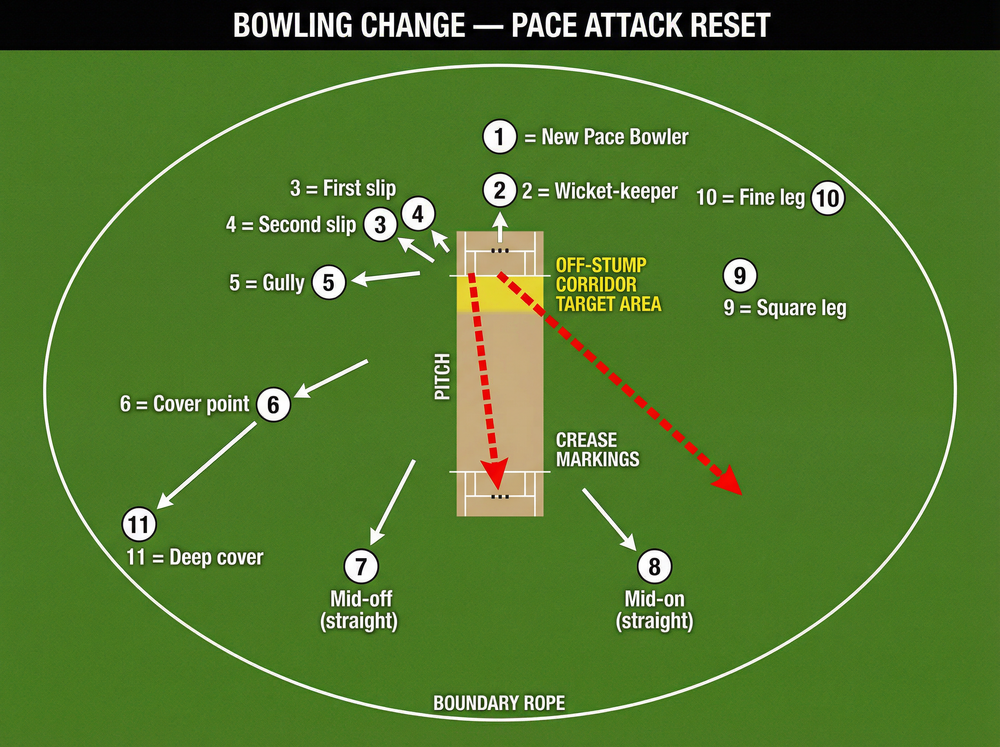
Step 4 — Set the Pace Bowling Change Field

Diagram 2: Bowling Change — Pace Attack Reset. Dashed red arrows show ball trajectory targeting the off-stump corridor (highlighted in yellow); solid white arrows show fielder movement to new positions.
When bringing back a pace bowler to break a partnership, set an attacking field targeting the off-stump corridor — the area 10–15 cm outside off-stump at a good length (approximately 6–8 metres from the batsman's crease). The recommended field is:
| Position | Number | Role |
|---|---|---|
| Pace Bowler | 1 | Bowling from the top of the pitch |
| Wicket-keeper | 2 | Standing back, 20–25 m behind stumps |
| First slip | 3 | Catching the outside edge |
| Second slip | 4 | Catching the wider edge |
| Gully | 5 | Catching the cut or slash |
| Cover point | 6 | Cutting off the drive |
| Mid-off | 7 | Straight, protecting the straight drive |
| Mid-on | 8 | Straight, protecting the on-drive |
| Square leg | 9 | Protecting the leg side |
| Fine leg | 10 | Deep, protecting the pull |
| Deep cover | 11 | Protecting the aerial drive |
Step 5 — Brief the Bowler on Their Plan
The bowler must enter the over with a 3-ball plan — not just a vague intention to bowl well. For example: "First ball — full, straight, test the drive. Second ball — back of a length, outside off, force the cut. Third ball — slower ball or variation." This prevents the bowler from reacting to the batsman and instead forces the batsman to react to the bowler.
Step 6 — Execute and Adjust
After 2–3 balls, the captain and bowler should reassess. If the batsman has defended comfortably, consider a variation. If the batsman has played and missed, maintain the line and length. The field can be adjusted mid-over if the batsman reveals a clear weakness — for example, moving square leg to short fine leg if the batsman is repeatedly glancing to that area.
Step 7 — Maintain Pressure for the Full Spell
A bowling change only works if it is sustained. A single loose over can undo three overs of pressure. Remind your bowler that dot balls are as valuable as wickets during the middle overs — every dot ball increases the pressure on the batting side to take risks.
Key Coaching Points

Contrast is king. The bowling change must present a completely different challenge — different pace, different angle, different spin direction. A like-for-like change rarely creates pressure.
Field placement must match the bowler's plan. There is no point setting two slips if the bowler is going to bowl short and wide. Every fielder must be placed with a specific purpose tied to the bowler's intended line and length.
Communicate before, not during. All field changes and tactical plans must be communicated before the over begins. Mid-over confusion signals weakness to the batting side and costs precious seconds.
Patience builds pressure. The wicket will come from pressure, not from desperation. Encourage your bowler to trust the plan and not chase wickets with loose deliveries.
Body language is a weapon. A fielding side that looks energised, loud, and confident puts additional psychological pressure on the batsmen. Encourage vocal support from every fielder on every delivery.
Monitor the batsman's footwork. If a batsman is moving across their crease to a spinner, adjust the line to target the stumps. If they are backing away to a pace bowler, follow them with the ball.
Common Mistakes

Making the change too late. Many coaches wait until a partnership is already well-established (50+ runs) before making a change. The ideal time is at the first sign of comfort — when a batsman has faced 15–20 balls and is beginning to play freely. Act early.
Setting the wrong field for the bowler's strengths. A leg-spinner with a strong wrong'un should have a fielder at mid-wicket and short fine leg, not just in the off-side catching cordon. Always set the field to the bowler's best delivery, not just the standard template.
Bowling too short to spinners. In the middle overs, spinners must flight the ball and invite the drive. Short-pitched spin in the middle overs is easy to cut and pull for boundaries. Encourage your spinner to bowl full and use the air.
Neglecting the non-striker. A bowling change is also an opportunity to assess the non-striker. If the non-striker is the more dangerous batsman, consider whether to bowl around the wicket to bring them more into play or to attack the weaker batsman at the other end.
Losing patience after one expensive over. One bad over does not invalidate the plan. Coaches should resist the urge to immediately change again — this signals panic and rewards the batting side. Give the new bowler at least 2 overs to settle into their rhythm.
Variations & Progressions
Variation 1 — The Double Bowling Change
Change both ends simultaneously. This is a high-risk, high-reward tactic that completely disorients a settled batting pair. Use it when two right-arm pace bowlers have been mastered and you have a left-arm spinner and an off-spinner available. The contrasting angles from both ends make it extremely difficult for batsmen to settle into a rhythm.
Variation 2 — The Part-Timer Gambit
Introduce a part-time bowler (e.g., a batting all-rounder who bowls occasional medium pace or gentle off-spin) to break a stubborn partnership. The unpredictability of a part-timer — irregular pace, unusual action — can produce a wicket from a delivery that a specialist bowler would never bowl. Use sparingly and only when the batsmen are in a comfort zone.
Progression — Bowling Change Under Pressure Simulation
In training, set up a scenario where the batting side needs 60 runs from 10 overs with 2 wickets in hand. The fielding captain must make two bowling changes during those 10 overs and justify each decision to the coach. This develops decision-making under match pressure and teaches bowlers to execute plans rather than just bowl to their default settings.
Age Adaptations
Under-12 (Kwik Cricket / Junior Format)
Simplify the concept to: "bowl a different type of ball." Encourage young captains to switch between a fast bowler and a slow bowler. Field settings should be basic — 4 fielders inside the circle, 2 on the boundary. Focus on the concept of change = disruption without overloading with tactical complexity.
Under-16 (Club / State Junior Cricket)
Introduce the concept of individual batsman analysis. Players at this level can begin to understand left-arm vs right-arm angles and the value of bowling to a batsman's weakness. Encourage captains to discuss field changes with the bowler and explain the reasoning. Use video review after training sessions to reinforce tactical decisions.
Open / Senior Cricket
At senior level, the bowling change strategy should be integrated with a full match plan developed before the game. Bowlers should know their roles in the middle overs before the match begins — who is the partnership breaker, who is the economy bowler, who is the attacking option. The captain's role shifts from directing to facilitating, trusting experienced bowlers to execute their own plans within the team framework.
